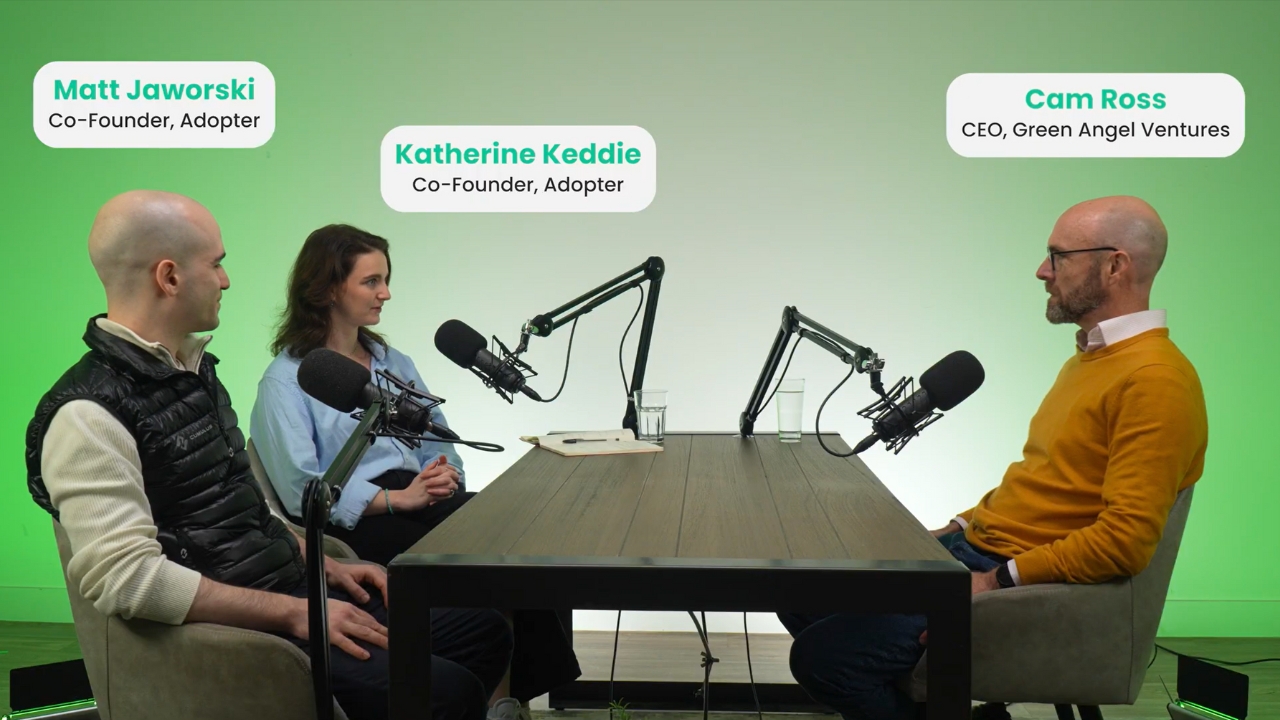
Katherine Keddie: Welcome back to Scaling Green-Tech with me Katherine Keddie and Matt Jaworski. We're here today with Cam Ross who is the CEO of Green Angel Ventures, the reference, the go-to early stage green tech fund in the UK. Thank you so much for joining us.
Cam Ross: Hi, thanks for having me.
Katherine Keddie: Our opening question as always is how would you describe Green Angel Ventures to a five-year-old?
Cam Ross: Good question to get us going, okay. All right, let's pretend Matt that you're the five-year-old.
Matt Jaworski: I'll do my best.
Cam Ross: All right, great. You know, sometimes you want something or you have a problem, like for example, you want a new playground in your park, right?
Matt Jaworski: Better than candy.
Cam Ross: Perfect, okay. But you can't build the playground. You can't get the resources together to build the playground yourself. But you and your friends really, really want a playground. So what do you do? Maybe you know someone who's really good at building playgrounds. They've built maybe one and a half playgrounds before already. What you can do is to really encourage them is to go around all of your friends and get a little bit of money together from each of your friends and employ this person to build you a playground. And that, in a sense, is what we do at Green Angel Ventures. We find people who are really good at building playgrounds, and we find people who have got a little bit of money each, and we add all that money together, and we go and build people a playground, which is essentially solving a problem that they have. And then once they've built that one playground, then we go and get some more money and help them build another playground and another playground, giving joy and happiness to five-year-olds across the world.
Katherine Keddie: I think that's one of the best we've ever had. That was a very good intro. OK, for the adults listening, give us your elevator pitch.
Cam Ross: Right. OK, well, for playground equipment, we have to substitute the climate crisis and specifically how technology is helping resolve the climate crisis. Green Angel Ventures is a specialist VC investment company and we find the best technologies that are dealing with the climate crisis and we fundraise through a number of different methods, primarily our 300 plus angel network that we run called Green Angel Syndicate. And we also run a fund as well and some other sources. And we aggregate all of that money and we invest in the very best companies that are fighting climate change with their processes, with their products, with their systems. And like in the playground analogy, once we get them to a certain scale, we hope to raise more funds to expand and deliver much greater impact as they grow.
Green Angel's portfolio and investment thesis
Matt Jaworski: Tell us a bit more about the companies you invested in so far, any specific industries that you focused on so far?
Cam Ross: Yeah, sure. So we're recording this in early 2026 and so far we've invested in more than 50 portfolio businesses. All of those companies are based in the UK and we've deployed 58 million pounds into those businesses. So roughly a million pounds average each. But of course, we start a little bit smaller and we grow bigger as those companies grow as they get into later funding rounds. So it's an average of just over a million into those companies. And there's no specific sector. What we want to do is to find companies that have the biggest carbon impact and the biggest financial returns. And importantly, a third thing, the best way for us collectively to help them to grow their businesses. So we require each of those three things, financial return, carbon, sizable carbon impact, and the ability for us and our group to help them to grow as well.
Matt Jaworski: And I think it's been working quite well for you, right? The portfolio companies overall are performing well. And as for such an early stage investor, you had a very small number of companies that didn't make it. I think when I checked, it was like just one.
Cam Ross: Yeah, so I think we've had five or six businesses that sadly aren't with us anymore, but kind of that is to be expected in a really early stage investment space. So most of these businesses, when we meet them, they have no revenue or minimal revenue. They have a beta product, but not a final product. They have some market traction, but definitely not, you know, millions a year in terms of revenue and engagement. So it's a very high-risk space, and that's why it's highly regulated as well, as it should be. But our investment strategy has always been to say, we want to put money into these early-stage companies and then engage with them to help them grow. And part of the reason that we're able to engage nicely with them and genuinely add value to these companies is because through our 300-person-plus angel network, most of the people who are in that angel syndicate work in or have worked in the sectors in which we invest. So they can bring the skills to the portfolio companies to help them through the rigors of growth. So as you guys know from supporting companies in this climate space, it's a tough area to work in and startup companies are really, really hard to get off the ground and to get to run. So the entrepreneurs and the specialists and the board members and the advisors that we have in our angel network can really add some value to helping those businesses to grow.
How angel network members add value to portfolio companies
Katherine Keddie: Can you share an example of a time when your network has really added value to a company and helped them grow?
Cam Ross: Sure, let me give you an example in the water services sector. So we invested in a company a few years ago called StormHarvester. They're based in Northern Ireland. And what StormHarvester does is they deploy a network of sensors into the drainage and water networks of really massive water utility businesses. And then they hook those sensors up to really localized weather forecasts, and they're able to see when those drainage networks might overflow or get clogged. And, you know, the water services sector is really paranoid about pollution and spilling water into waterways. So StormHarvester’s technology can avoid that by helping these companies plan, several hours in advance about where these maximum ponds or water channels are going to be and drain water away from them in a managed way rather than polluting. And when we invested into that company, we had a really experienced non-executive director from our angel network go on to the board of that business and also an observer on the board too. And both of those people having had really disparate backgrounds themselves, one of them in a massive global business where his role was to help manage the growth of that massive international services firm. has been able to help StormHarvester with their growth plans and with their forecasting plans and with just dealing with what I called earlier the rigors of growth, right? Just the sort of solid day-to-day trying to look more than half an hour into the future and looking six months down the road about what the plan is, how we can do fundraising right, how we can get new clients, how we can get regulators to see that there's a problem here that should be addressed. And so that's our standard sort of approach is to try to find the very best person from either our in-house team or our angel network to help these companies to grow.
The thousand-to-six screening and due diligence process
Katherine Keddie: And how would you describe your general thesis towards investments? You know, how are you separating the wheat from the chaff with these companies?
Cam Ross: It's a really good question and it sometimes can be difficult. So we are evaluating about just over a thousand companies every year who come to us for funding. And I think last year we made six new investments. So it's a really high bar that we are setting for these companies. The six investments were accompanied by around about 20 follow on investments into our existing portfolio companies as well. But nevertheless, you know, if you're trying to take a thousand and find the six best ones out of those opportunities, you've got to be really rigorous about it. So that has a number of different phases for us. The first phase is that our paid in-house team, our investment team, looks at the proposition. What are they trying to accomplish? Do we think, just looking at the business plan or the pitch deck, that this looks like a sensible proposition? What do we mean by sensible? Well, that's those three key things I said before. Does it look like it could have a really good financial return? Does it look like it would make a sizable climate impact? And can we find a way to help that company grow more than just giving them money? So the thousand is kind of whittled down to maybe 500 at that point at the sort of early stage. Then we start engaging our specialists in our angel network. So we've got a subset of those angels that we call our associates, and they're the people who want to look at early stage opportunities. They also tend to be the people who might invest the most in the end as well. So why are they getting involved? They want to get under the hood of how these companies work. They want to make some new relationships and some friends in doing this work and meeting interesting businesses and also meeting interesting other people in our angel network. And essentially put down a marker for, does this look interesting to me? And if it looks interesting to them, then it's likely it's going to be interesting to the rest of our angel network as well. So maybe the 500 goes down to 200 at that point. And then we have a further conversation with them inviting some of those companies to pitch to our audience. We run pitch events every two months, and those are hybrid. So we used to run all these things only in person. And then, of course, what happened to everyone? COVID kicked in, and we were forced to do everything online. And we've moved back now to a hybrid model where it's partly in person and partly online. And that's great because you can attract people who are geographically close to where we run the pitch events to come and watch these pitch events and really engage nicely directly and have a drink afterwards and meet the CEO. But you also can attract angel members from across the country who couldn't make it or who were traveling or, you know, I don't know, they had to stay at home that day, whatever. So we've got the best of both worlds. We run these things online. Our investors can ask questions through Zoom, I mean verbally to the room and be heard and see and everyone sees and hears everyone. It's excellent. But essentially that pitch is a real focus point for how we then, you know, pare down and select in the best opportunities. And from that point onwards, if we have enough financial indication of interest at that point from our investors, we'll move through to a due diligence program. And that can take several weeks whilst we really use our experts in the angel network and our in-house team to go through all the things you would want to look at in due diligence through any professional investor. And ultimately we will or won't make an investment.
Why the founder matters at the earliest investment stage
Katherine Keddie: Hmm. And I mean, a lot of investors that I know, and some of them, what we've had on the podcast say that the main, one of the main factors in investing in a really early stage company is just the founder. Like, do you think they're dogged enough? Do you think they have the right expertise? Do they have the right network? Is that personality or that kind of figurehead of the company an important part in your decision-making process?
Cam Ross: Yes, for a number of different reasons. So firstly, we want to see a person who is going to be able to sell that product or service into the marketplace. It's not all about just convincing investors to come on board. You know, they have to have a credible plan and a personality that really is going to enable them to, you know, take this company forward for the next five to 10 years and really make a sizable environmental climate impact as well as a financial return. And that doesn't have to be the founder or the CEO, as long as there is a credible plan for how to do that. But most times when we're looking at these companies early stage, they've got two, three, five people. And the figurehead main person who's going to take that to market is one of the founders. The other reason it's really important is just credibility in their market. So if they've had an idea for how to purify water, or they've had an idea for how to reduce energy consumption in buildings, When they, when they and their business go to market, is that a credible story? Is that a credible technology? Is it a credible message that people will actually pay money for? And you know, all of those things come out in a, in a due diligence process when we look at the team and we look at the IP and we look at the market and competitors and all those sorts of things. The pitch event is a really important showcase for them to be able to say, look, I do know what I'm talking about. I can answer your questions genuinely. If I don't know the answer, I say I don't know the answer, but I come back to you tomorrow with the answer.
Matt Jaworski: I guess it's also a chance to see how the founder deals with challenge, uncertainty and all those other things that they will encounter in their work more and more, the more the company grows and the more investment it gathers.
Cam Ross: Yeah, that's fair. And you have to realize that sometimes these people have not raised any funds before. So we are very frequently the first investor into the business or the first after friends and family sort of around. And so it's the first professional investment round that they've raised. And so seeing the response to that is really useful. The ones that impress us the most in terms of their fundraising will have in their minds, even if they don't verbalize that to the audience, they'll have in their minds, this is step two out of nine in terms of my fundraising journey over the course of the next few years. you know, what's the message that we're saying to this particular audience that might be different in two years time because I'll have different track record or different traction or whatever. And it's just the more mature or future sighted ones tend to be more credible because they've thought it all through as opposed to panicking that they need money today.
Matt Jaworski: Yeah, so that makes me wonder, when you have a first-time founder, obviously you might have an exited founder who's now launching a new venture, it's different then, but when you have a first-time founder who, for example, has a scientific background for whom this is a new thing, it's quite stressful, but you see big potential in what they're doing and how they think. Will you, I don't know, try to make the process a bit less stressful for them than you would for someone who is more seasoned, whom you would expect to deal with challenge, stress, or for example, such a pitching event better, or will you try to keep it you know, fully the same for everyone, knowing that some people are just not maybe ready fully for it, so they will perform worse.
Cam Ross: I think when we get into the due diligence process of looking at these companies quite closely over a number of weeks, I think that we treat people as humans and we understand their backgrounds are different. And there might be, you know, on one end of your axis, there's a person who's come out of university with an idea and no experience of commercial. And at the other end, there's people who have run four businesses before and they are trying to turn the handle on number five. And so we make allowances for that. And the great thing that we are able to do is to offer everybody the appropriate support to take them from this stage to the next stage. And so for the very mature or experienced founder, who this is company number four, you know, they might need a very different amount of support or type of support. And so within our angel network, we have people of all degrees of experience, background, sectors to allow us to really add value and help the person to the next level, no matter where they started. Our team and our investors treat people as humans and they, and everyone makes mistakes, right? My God, I make 10 mistakes every day. You know, you just got to hope that you're not making the same 10 mistakes every day. Um, so, uh, yeah, we, we really treat people like humans and, and I actually shy away from the assertion that there'll be, um, you know, uh, a whip crack at these, you know, what we really try to do is to work with these firms to help them grow. I personally have been a founder before, and I know that the biggest value that I got out of some of my early stage angel investors was when they sort of put their, metaphorical hand around my shoulder and they went, it's okay. You know, we can, we can, we understand we can take this next step. And so that's the approach that we try to take.
Okay. Makes sense.
Marketing, messaging, and pitch deck quality for early-stage startups
Katherine Keddie: Yeah. Human centric. Um, we, we spoke a little bit about, uh, framing and pitching and how you talk about, you know, the startup that you have in that context, the wider topic, and obviously something that I would love to ask about is marketing. Um, how much does marketing make an impact when you're assessing a company for further growth, for example, if you're trying to decide if that one of these six companies you're investing in out of a thousand.
Cam Ross: Yeah, so good point. I mean, it's clearly very important to the extent that we won't let a company come onto stage to do a pitch unless they have a proper deck that looks sensible, that is clear, that hasn't got a thousand bazillion dot points of six point font on them. And so we do work with these companies in advance to make sure that their messaging is clear. But generally, marketing has such an important part to play because not only is it going to be their sort of window to the world for their commercial offering when they're out there with a fully formed product and it's running in the market, but then for many of these businesses, remember, they're producing new technology that to a certain extent they're defining a new market. And so there needs to be an education piece sometimes for the market who may not be aware that such a thing exists or why it might benefit them. And marketing can play a massively clear or massively bad role in helping businesses to, you know, get their message out there. So we see that that clarity of message and understanding distilled to a deck, a set of small documents, and most times, you know, of course, a social media presence and website as well, really important in that early traction of getting the business going. Messaging changes over time, of course, because, you know, my company today running with no customers and no case studies and no market traction has got to put out a message that's fundamentally different from, let's say, two years down the track when I can say, we worked with this company, look at the benefits from that. You should be the next one. We dominate the health care market or whatever it is, right. So yeah, we see it's really important. You guys will know from your experience, and of course you represent a few of our portfolio companies, how that changes over time and how it's important for you as marketeers to latch on to some of the messages that are coming, the good news messages that are coming from portfolio companies and turn them into, you know, next quarter's messaging, right?
Matt Jaworski: There is also a big part here of what's happening in the world and how to adapt the messaging to it. So not just the company itself making progress, but obviously the changes in the world and the market on which the company is operating and what messages resonate with people in a year like 2026.
Cam Ross: That's very fair. And also when regulations change, you know, that affects a whole market. And if you can get ahead of that with your messaging, all the better, right? Exactly.
Commercial viability versus the green premium
Katherine Keddie: You mentioned earlier that two of the things that you're looking for when you're trying to assess these companies as impact on climate change, so kind of decarbonisation potential, but also returns. Do you find that when you're talking about your work, there's maybe a misconception that the two can't come hand in hand?
Cam Ross: Do you know what? That's a really, that's a really nice way of asking a question which I get on panels all the time, which is how do you compromise between, you know, climate impact on one hand and financial returns on the other? And you've done it very well.
Matt Jaworski: As if you knew something about framing and marketing.
Cam Ross: Almost, yeah.
Congratulations. I absolutely, and it's not going to surprise you to hear me say, these two things are absolutely intertwined with each other. So companies that want to make impact need to scale to the point where this is not just trivial, small-scale impact, but it's genuine global impact. And the only way that they can actually do that is to become profitable. If they don't become profitable and they don't reach that absolutely critical level where they're kind of self-funding and self-perpetuating, then they just won't grow to that massive scale. On the flip side, investors are not going to put money into companies just because it's a charitable or a philanthropic sort of donation. If they want to see real impact, they need to see a financial return because that wheel goes around together. So I just, yeah, if people ask me that different question, I say, you're kidding. That's not really a question. The real question is, how do we find the best companies to make them profitable, to make them scalable, to make them profitable? So it's all, you know, it's all one nice little hamster wheel that goes around.
Climate adaptation as an expanding investment category
Katherine Keddie: Yeah, very much hand in hand. Do you find, I mean, we recently did an episode with Federico from Net Zero Insights, talking about kind of climate tech trends in 2025. And he said that there'd been an uptick, particularly in the adaptation investment space. So people kind of maybe having a realistic view that to some extent climate change is happening and it needs to be kind of tackled and we need those solutions. Do you find that that's something that's creeping into your thesis? Is that something you're thinking about or even is it part of your framing as an organization?
Cam Ross: It certainly is. I mean, we as a planet absolutely need to adapt to the changing climate. And I think there's a lot to be said for the potential for impact in that space and also financial returns in that space as well. So we happen to be launching the next round of our climate change fund presently. And we will be investing partly into adaptation technologies and processes, as well as our sort of standard mitigation that we've been doing for years. And I think that's just a robust and mature way of looking at where we are in reality. and not digging your head in the sand and saying this thing isn't happening, because we all know that it is. And it's really important to help people, societies, agriculture, ecosystems adapt to that to that changing climate. And there's the same investment thesis in that space as there has been in mitigation.
Matt Jaworski: So how do you think this might change the challenges of the companies you're dealing with? Maybe also as some of your existing portfolio companies also pivot into this adaptation space. As originally there are many challenges involved, conservative industries, industries that are heavily regulated, slow to adapt and very capex intensive.
Cam Ross: Yeah, so we have a number of companies in our portfolio already who work in the adaptation space. So, for example, Nature Metrics is one of them. They have a fantastic technology called eDNA, which is how they measure biodiversity, essentially. And, you know, as the climate changes and as ecosystems change as a result and generally, unfortunately, reduce in terms of their biodiversity. Measuring those things and helping understand how we can all adapt our environment and our society to those things is really important. I think to pick up on the capital intensive aspect, building technologies and processes to fight climate change at scale can take substantial capital. And we are not a business that sits around here thinking that software as a service is easy peasy, invest in that and climate change will be sorted. Absolutely not. Whilst there is absolutely a role for digital services, there is a massive role for capital intensive, really hard engineering and science problems to be solved. And we see our role here as helping those businesses to unlock the first stage of their growth, where we will then work with co-investors and other entities like Innovate UK and the grant making bodies to help scale those businesses beyond where we could naturally fund. That's just a normal part of a sort of VC space and how this all works. But I think specifically for climate, We are going to need nation-scale battery systems. We are going to need nation-scale mitigation and adaptation solutions throughout all of the country and the world. And where those need extra capital we might revert to project-based finance or debt-based finance to help these companies to actually grow. We're seeing some of our early stage investee companies, where we raise two, three million in a round for them to start with, are now at the sort of 50, 60, 100 million scale. And once they get beyond that, that becomes a very different funding proposition. Entities like British Business Bank can help fund those to really greater scale as as some of the other sort of debt and project based finance businesses can. But as a country, we need to not shy away from these capital intensive things just because they're capital intensive. If we're going to get scale, we need to deploy them everywhere.
Capital-intensive climate tech and the role of grant funding
Katherine Keddie: I mean, it's interesting that you mentioned debt financing in particular, because one thing from the last year is debt financing is up for climate solutions, but grant funding is significantly down. And obviously you play in this kind of early stage space. Do you find that that's impacting the companies that you work with?
Cam Ross: I think what we would want to see from the early stage sort of grant funding is two things. One, a bit more of a longer horizon when some of these grant funding windows are open. So we see some of the grant making bodies saying, well, we've opened this program and you and your portfolio companies have got eight weeks to apply for this and then we're going to make a decision. And, you know, don't get me wrong, the fact that grant funding is out there is absolutely brilliant and is a vital part of supporting these startup businesses. But I think what we would like to see is more of a rolling program that said, well, at some point in the next two years, you know, at the right point for fundraising for these businesses, come and talk to us about grant funding to supplement or go alongside some of the equity as well. because otherwise companies scramble to race after the grant funding because it's non-dilutive funding and it might not be the right time for that business. It might be too early or too late. I think the other thing that we would like to see is Instead of the grant-making body saying, we're going to focus on domestic batteries for the next six months, and we're going to deploy some money into domestic batteries for the next six months, and then we're going to change, and we're going to move to insulation, and then we're going to move to something else. Those sorts of things also don't necessarily give time enough for the investee companies to prove that the investment into that domestic battery or into that zero-carbon insulation is actually a fantastic investment for the grant-making body. And if the timescales for proving that were longer, I think that the grant-making bodies would also see that ploughing more money into those really impactful sectors is a sensible thing, rather than saying, well, we're not quite sure whether that work will change our mind. And that may be a gross oversimplification, and I know that there's a lot of pressure behind the scenes on how this money is deployed, but practically, it's really worth talking with entities like us and our portfolio companies to understand when is the best point for grant making to come in alongside equity.
The 2025 funding slowdown and prospects for 2026
Katherine Keddie: The current funding environment's pretty tough for climate tech. I think the feedback that I get from companies that I know, from investors that I know, from people we work with is that the initial boom of climate tech that felt like it was happening in 2021, 2022 is starting to dissipate and the companies are getting through a lot more kind of, I guess, commercially mature. So for example, again, the Net Zero Insights report said that There's an 80% decrease in companies making it from Series A to Series B in the UK in 2025. Do you think that it's harder to raise this year in 2026? And what would you say to founders who are struggling to find the right capital?
Cam Ross: Yeah, interesting. So I absolutely agree that 2025 was not a great year in terms of two things. One, the amount of money that was raised and deployed into this space. And secondly, how long it took for a company to raise that funding. Both of these things are at a low or a high, depending on which way you meant. But I actually think that 2026 is going to be better for this reason. In our portfolio, we are already seeing that the amount of time that it's taking a company to raise their next round is slightly coming back and being quicker. That's really healthy. The longer it takes to raise funds, the more time the founding team is not running their business. And also the more time that they're not deploying the money into climate action. And this stuff needs to happen as fast as we possibly can. So shortening that timescale is really imperative. So I think within our own portfolio, we're seeing that come back. And we're also seeing interesting, you mentioned commercial progress, we're also seeing companies that we invested in three, four, five years ago, 2025 was the year when They hit the point of real revenue traction or profitability. Both of those things are very significant milestones for startup businesses. The revenue traction is so important to be able to then demonstrate to future investors that there's a revenue stream there. and also to show new customers in the market that other people trust us and so you should trust us as well. We've got these case studies, we can demonstrate that. And then profitability is such an important point too because it gives you the ability to not raise funds if you don't need to. Obviously, we would advocate you want to be really raising the right amount to give you the maximum impact. But I think we've just this very morning actually looked at the stats from our portfolio for the last six months of last year and we can see that. happening. So, not trying to duck the question, but come back in a year and ask me again whether I was right about 2026, but I think it's getting better.
Matt Jaworski: I see a potential for a follow-on episode in a year's time.
Katherine Keddie: We'll be in one year's time.
Matt Jaworski: Great.
Katherine Keddie: We'll see you then, Mike. Great. No, I mean, that is positive for sure. I think, would you agree that there was a boom previously in climate innovation? and that now there is a natural settling happening.
Matt Jaworski: I mean, so before you jump in, I guess, I think we talked about it on one of the other episodes, right, is this idea of the hype cycle and how some people are commenting that people who, what, four years ago were putting in their LinkedIn bios climate tech or green tech, before that had NFTs and then they quickly moved to AI and now they're moving to defense tech because they're trying to jump hype and trends. But obviously your perspective on, you know, how it changed and shifted and affected the space is what we're here to hear.
Cam Ross: Yeah, well maybe I can talk about it from just a really localized or personal experience level. All of these different stages of investment from family and friends, through angel money, through funds and VC, through Series A, Series B and beyond are all inherently linked. If you don't have a really buoyant Series D, I'm just plucking a number out of the air, market, then the Series C companies can't raise a Series D money and they stagnate. And because they stagnate, the Series B companies can't move into the Series C space with their funders as well, and everything slows down. And I think we've just seen, like in the UK economy and the global economy, with a general economic slowdown, we've seen a very similar thing with funding. And so if you look at the stats for the number of early stage companies exiting last year, it was at about a four or five year low. That would support your thesis that 2021 was, you know, or just about then was good for funding and exits. If you don't get exits, then people can't recirculate and recycle their money into an earlier stage. So the market that we're in where a lot of our money comes from high net worth individuals in our angel network who are investing into startup companies. If they haven't had an exit, they've mentally allocated or financially allocated all of the money that they're going to invest into early stage startup businesses over the course of the last few years. And if they don't get exits, then they don't have any more money to invest. And that model is exactly the same for funds. It's the same for any sort of scale. And so they're all linked. I have a suspicion that the wheels will be oiled a bit more in 2026 and things will take off a bit better.
Katherine Keddie: Do you feel like that is consistent across climate tech? Because that is a huge category, like any kind of green tech or climate change solution is a huge category. Do you see a difference between industries? Is there anything you think is particularly exciting for the coming year, for example?
Cam Ross: Well, so it is a broad sector. And I think we said earlier that Green Angel Ventures doesn't differentiate. And we don't, for example, only invest in batteries, hydrogen, water purification, whatever. We invest across the board wherever we see the best companies with the best impact. Interestingly, Kat, you were the one who raised climate mitigation, excuse me, climate adaptation earlier. And I think for us, there is a bit more movement in the adaptation space. It's partly actually a result of market maturity, and the Scottish and English governments with their backstop frameworks on biodiversity net gain and carbon credit pricing. And just having that certainty in the market has meant that over the course of the last 6, 12, 18 months, we've had some new service providers in that space, some new thinking, some new ways of commercializing some of the biodiversity improvements that can be made to wilderness and farmland in this country. And so I think that we will also in 2026 see more investment into that space, not because it's a funding or an economic thing, but because it's a market maturity thing and investors having more confidence that this is the right point for them to put money into that.
Matt Jaworski: And do you feel like there are any other sub industries, let's say, within green tech or climate tech that will become even more prominent in 2026?
Cam Ross: Yeah, it's always an interesting question. And I'm not sure. It's just like me saying that I have a favorite child, right? Actually, because we invest across all of these sectors. And we have such breadth in our deal flow and our pipeline. It's not as if we're sitting here going, do you know what? Wow, zero carbon insulation has really gone through the roof in terms of the people, you know, with getting out of university and deciding they're going to get into this space. What I think is great about the job that I do is we see such diversity and really dedicated people wanting to make impact across the board. And that hasn't fundamentally changed. The volume of it has over the past few years. In other words, the number of startup companies and the number of applications for technology into making climate impact, that's really going up nice and steadily. But the breakdown or the fragmentation of it, the segmentation of it is pretty much the same as it always has been.
Regulation as both an accelerator and a risk for climate tech companies
Katherine Keddie: I'm interested that you previously also brought up regulation as a potential view that something might do well in the coming year. Regulation is obviously a really important but also tricky point when you're, in our work, messaging or marketing a climate tech solution. Because on the one hand, it's why people might invest in your solution, it's why customers might go for your solution. You know, it might make your solution a mandatory and crucial part of a specific industry. But on the other hand, you don't want to come across as if your company lives and dies on that regulation. And if it is removed, for example, in the US, we've seen huge regime change, massive shift.
Matt Jaworski: I mean, EU is sort of softening a bit the ban on combustion engines and translated to that.
Katherine Keddie: Yeah, exactly. If you see these shifts happening, where do you find the balance as a founder when placing your solution, when pitching to investors? And do you get questions from other investors or angels in your network saying, is this solution only, you know, it's only going to work if this type of regulation stays in place?
Matt Jaworski: Is there a specific bet on this one card coming out?
Cam Ross: Yeah, I think you can look at this in a positive way and in the negative way. Let me try and tackle both of them. So in the negative way, we had a company pitched to us late last year, which has a fantastic product for a particular aspect of a market. It's a bio-grown product, or it's derived from a piece of biology, and it helps I'm just going to make something up here because I don't want to disclose the company, but it helps corrosion resistance. And it looked very promising, a very responsible and mature team, lots of data points why the market needs this solution. Subsequent to the pitch event, during the due diligence process, the EU changed its regulation on this particular sector and deemed that because it was a bio-based product, that the rules would change. And they may still be able to sell that product into that space, but they've got to just pause, understand what the new regulation means, understand what the timing for that is, where's it going to be effective, blah, blah, blah, blah, blah. Do we have to change? slightly our product offering because of this regulation, etc. So that can, you know, regulation like that can knock a startup business in its early days. On a positive level, you know, if the regulator had said you must have a solution like this, of course it accelerated and we've got a number of companies in our portfolio who benefit positively from regulation. But your point was like, you know, how do you convince an investor that the regulation if should the regulation be changed, you know, I'm still going to be in business. So that comes from a diversity of revenue streams and different possibly different products as well that you have in the market. But I think the view that I take of regulation generally is at a societal level, clear government regulation in a sector is super useful, not just for us as a society. For example, can we please have more strict regulation in home insulation and heat loss because that is a massive amount of our carbon expenditure is in heating domestic housing. But once you get that regulation in place, investors love it too, because they can have some certainty that this is going to be the market for the next X years. They can put money into it. We've seen that practically with electric vehicles, right? And although, yes, there has been a bit of vacillation about when the deadline is really going to be and some exemptions from
Katherine Keddie: Manufacturers who are finding it difficult to meet these at a societal level Actually, that is going to be super beneficial for us and the carbon intensity of the UK If I'm gonna be devil's advocate So let's say reform in the next election and they cancel their zero policies, which is generally best climate change. Yeah what what will happen to the companies you work with? How do you mitigate against that risk? Because that's obviously a situation of massive policy change, which is fundamentally very difficult to deal with. But if you're working, let's say you're working in construction, for example, a very regulated sector, and you've spent many, many years building a product within a specific regulatory framework, and all of a sudden a regime change happens, and it means that that regulation is out of the window, what happens?
Cam Ross: I think so, we're seeing this unfold in the US as well, right? Where the Trump government has axed a bunch of environmental protections and essentially, you know, artificially propping up the coal industry, these sorts of things. I think that really underscores why it is imperative that anybody who has a product or a service into this space has to not sell it with a green premium, right? It has to be a better product. Oh, it also has impact, great. But it has to be cheaper, or it has to be easier to use, or it has to have a longer life, or it has to do some functionality that nothing else can. So it needs to be commercially viable If it's governed by regulation and that helps it be more commercially viable, great. But it needs to be commercially viable and stand on its own two feet, even without that regulation. So we are actually seeing that with renewables, right? Because the coal industry in the US is still going backwards, even after the anti-renewables mantra from the Trump administration. And that's because it's cheaper. And people want it because it's cheaper. Oh, it also happens to be fantastic for the planet and not have any emissions. Great. But because it's cheaper and we've seen that with solar, as solar has really massively reduced in price, that's pushing the role out. So I think that if regulation were to change with a different government or environmental protections were to be withdrawn for some, you know, on some basis. Yes, that would hurt us as a society. But for each of these businesses, if their product, if their service stands on its own two feet and is commercially viable by itself, well, it may have a reduction in sales, but it's still going to still going to be in the market. Yeah.
Matt Jaworski: And again, it goes back to what you said at the beginning about the three pillars you're looking at. So it's the impact and it's also the viable business case. And that's the part of having a viable business case. And it's the same thing that Carbon13, where we're involved as domain experts, keep preaching that it's not about just sustainability. Green premium doesn't work. You need to have a viable business case. And if your solution is good business, then even a government that is, let's say, anti-sustainability will still see in it a good thing for the economy that makes money, employs people and pays taxes. So what's to hate about it? Exactly.
Katherine Keddie: Plus it's easier to sell.
Matt Jaworski: Exactly.
Katherine Keddie: Commercially, it's just so much easier to sell to people and something I said in previous episodes is sometimes I think When you care so much, which we all do, which is why we're here, in the solution, the bigger picture, sometimes you actually end up trying to sell the whole picture rather than just selling the specific value for the customer. Like solar, it's cheaper, it's more localized, it's just better in many ways. Fundamentally, that sells itself.
Cam Ross: Yeah, we saw a company pitch to us four or five months ago, and clearly their product has a massive amount of impact. But essentially their sales pitches to their customers were just going to allow you to save an enormous amount of water bills. Sure, that has a huge impact. Great. But your water bills are going to drop to nearly zero. And that's the sales pitch. And so fine. Why would we invest in that? Actually, because it's a great commercial model with impact. Yeah, exactly.
Katherine Keddie: Yeah. I mean, Qflow, for example, from your portfolio, also a client that we work with, is a great example because fundamentally, they're allowing you to have transparency over the materials that are on your building site in a way that you never had before, which has huge
Cam Ross: not take time for reworking your building, not have extra space allocated for a tip area on your site. The guy on the gate who's scanning the trucks in gets to do their job faster. Yeah, all these are great benefits. Oh, it has a massive impact as well? Great.
Matt Jaworski: I mean, it's also like Dekiln, previously Deakin Bio, another company from Portfolio and Aled Roberts, founder whom we actually interviewed for this podcast a few months ago. Again, tiles with extremely low carbon footprint and an alternative to ceramic tiles. That actually is a drop-in solution for the existing process and allows you to need less machinery and skip a very intensive part of the process, saving a lot of money. So you get tiles that work the same for those applications and are cheaper. And you are more resilient and you know, what's there not to love about it. And then you also don't depend so heavily on clay shipments from a specific part of the world. Uh, you can just use some local, uh, circular economy waste streams again, even better, even more resilient. Everyone is happy. Great business for everyone.
Cam Ross: I'm glad you mentioned Aled and Dekiln because that's part of what I really love about doing this job is meeting so many intelligent people who want to make a change in the world, have a great model for doing that. And then my job is, you know, make sure that we've got the funding in place to help them do that and then go out and find the next Aled and the next Aled and the next Aled. So, yeah, it's super exciting, right?
Matt Jaworski: Exactly. Yeah. And then there is a similar thing to what you mentioned where we see pitch decks of companies and they say like, Okay, we are better for the environment and go into the environmental benefits as their like main value proposition. And then that's the fifth point. And we actually significantly cheaper than anything else in existence for this. And then you look at them and you point out, Hey, you should definitely lead with this, especially in this current economic climate. And investors will love it. Just don't hide it, you know, in the asterisk at the bottom of the pitch deck. Lead with that. And then the environmental impact, it will be appreciated, but it's probably not the main value driver if you're making, I don't know, construction materials for clients. Hmm. All good.
Katherine Keddie: Yeah. This brings me on to a question that I really wanted to ask you for this episode. What makes a good pitch?
Cam Ross: Yeah, good question. I mean, I've seen a lot of pitches and a lot of what I would class as really good pitches that, you know, if I were doing that thing, I'd be super proud of what happened. So what sets the really excellent ones aside? I think firstly, there needs to be something that hooks the audience in and makes them kind of sit up in their seat and go, I never thought about that that way. So some little nugget that makes me think, oh, okay, A, you understand what you're talking about, B, you have some insight that may be some little magic sauce or something that people haven't identified. Secondly, from an impact perspective, I want to know that genuinely, if your business grows from today to, you know, five, six, seven years in the future, that I've got some confidence that it's going to make a sizable impact. So I pretty quickly have to understand How that's going to work, not just the logic of how the technology or the process works, but how do we scale it to get it to that point. And then thirdly, I think I want to have confidence that either you have the perfect team to do that today, or you understand what the gaps are. Too many pitchers, I think, come and they say, I've got the full story. Everything's great. Just give me money and everything's going to be perfect. I don't think that's ever the case. I think I am much more receptive to a team that says, hey, we've got this great team of five, but we know that we need six, seven, eight, and we're on the lookout for six, seven, eight. And part of your funding and part of your engagement is going to help us find six, seven and eight when we get to that point. So it's kind of those things mixed together. And then for me personally, and I realize that this is different for everybody, I think I want to understand how I personally can get involved, or is there part of my background, is there part of my skill set that can actually help me and maybe a team of other angel investors to make a decision sensibly or intelligently? If I feel like I'm a bystander, Maybe that's okay if I've got other people that I can trust to help me make that decision. But I much prefer working as part of a group. I think that's part of the reason why people come to Green Angel Syndicate is because angel investing actually can be quite lonely. Not only, like where do you find these companies? It's really difficult to do that. But also how do I get the confidence in this pitching and in the due diligence process that I'm, when I'm putting my money into it, that that's, a level of risk which I'm comfortable with and working together as a collective, we can really, I think, fill those gaps, have some fun as well. I mean, God, I really like this business and meeting all these companies is fantastically interesting and how they all work under the surface. So, you know, right from getting that spark at the pitch through to making an investment, I think it's a great place to be.
Matt Jaworski: One day you're seeing a pitch, the next day you're visiting the company together with Prince William and shaking hands, right?
Exactly.
Cam Ross: I mean, it's not one day and then the next. It's many years of hard work from Natasha and her team to, you know, at LCM to get to that sort of a point. But yes, that's That sort of recognition also is great, right, for businesses to have the recognition of being nominated for and then, like we're talking about low-carbon materials, being nominated for and then getting through to the finals of the Earthshot Prize and then, you know, all of the fantastic publicity that comes from that, the royal support, the site visits, the ability to then take that confidence and that validation and then show that to other customers as well. So yeah, super important for companies to get those early wins and to get that validation to be able to then recycle it.
Katherine Keddie: Flipping the original question around, what makes a bad pitch?
Cam Ross: Yeah, I think there's a number of things. If a company is not given enough time to actually go through logically its offering, and why investment is needed, and what's going to be used for, and what the next stage is, I think that's an absolute killer for any pitch. And we see in the market lots of sort of rapid fire, speed dating type things. I think that is not good for pitching. The approach we like to do is to have 20 minutes. So 10 minutes worth of presentation, 10 minutes worth of engagement with the audience. genuine unscripted questions from our intelligent audience that can be really quite tough sometimes. So I think that you've got to give it ample space for that. Other things that make pitchers go wrong is where the person just doesn't have command of the investment proposition, doesn't understand what the pre-money valuation might be, doesn't understand how they're going to use this money, I hope that when we're selecting companies, we work quite hard with them to get them to the point where they can answer all these questions correctly. But, you know, sometimes we go and see others where that is just not the case. And it's honestly a bit horrible to see someone fall apart on stage when these things go wrong. You will have seen that yourself, right? It can be demoralizing. So we're really working with these businesses to try to succeed and not have a bad pitch. But, yeah, it's not great when it happens, right?
Katherine Keddie: Yeah, and you mentioned at the start also having a size six font on a slide packed in lots of tech. Yeah, that storytelling element is also really important.
Cam Ross: Or when someone turns around and reads the slides like that. Oh, no.
Matt Jaworski: No, thanks.
Katherine Keddie: My personal pet peeve is when people just have lots of random images and they're badly cropped and they overlap and it looks like something from 20 years ago. We look at a lot of pitch decks and we've seen some frights but it's like the first iteration and then obviously people work on it and by the time you see them, hopefully they're beautiful.
Cam Ross: Yeah, yeah. And I think, I think that's for these early stage companies that haven't done this before. It's part of the learning, right? And hopefully it's part of the value add that your business can add to them and that we can add in our coaching and guiding and helping them through these first sort of tentative steps into the world of fundraising. You know, not saying we're cutting them too much slack. They do need to be professional and they do need to understand and they, they're the ones who need to make the changes. It's not, we're not going to do it for them as their business. Right. But, um, Yeah, we can be kind about it.
Katherine Keddie: Yeah, human-centric.
Matt Jaworski: Going back to what we discussed at the beginning when I was sort of asking about this topic. So no special treatment, but human approach. Yeah, exactly.
The Green Angel Climate Change Fund 2026 and how to get involved
Katherine Keddie: So you have a new fund opening, the Climate Change Fund. Tell us about that.
Cam Ross: Yeah, so we're opening the 2026 edition of our Climate Change Fund. Well, by the time this podcast goes out, it'll be live because it's going live tomorrow. So, yes, this builds on the last few years of really successful investment through our Climate Change Fund. It's a fund which uses the huge amount of expertise and background and knowledge of our angel network as part of its due diligence process. So whilst there's an investment committee and funds are allocated appropriately and decisions are made sensibly, we actually use the same processes as we're using for our member investments directly to inform the investment committee for the fund. The real reason that people invest into the Climate Change Fund is so that they can very quickly build up a diversified portfolio because the promise of the fund is to invest in around a dozen companies across the space of a year. And actually that's really hard to do if you're an individual investor wanting to make impact. Even one with a huge amount of deal flow, a person would find it very difficult to make that sort of number of investments into this space. And then also, because we balance them, and to come back to the point I made earlier, we don't just invest in one particular sector. Actually, you get diversification across different sectors as well. So yes, that's open now. And we always get a fantastic response when we go out with our publicity for that. So tomorrow, I'm looking forward to extra LinkedIn posts, more hits on our website, applications starting. It'll be great.
Katherine Keddie: Great, great.
Cam Ross: Amazing.
Katherine Keddie: And any other shout outs for us the audience should know?
Cam Ross: Well, I think it would be good for people just to know that if they want to get involved in Green Angel Syndicate, how to do that. So funnily enough, we have a website. It's greenangelsyndicate.com. And on that site, they can find the type of businesses that we invest in, the social events that we have, the processes that we have for helping people understand how to invest, how to really get involved in the due diligence process if they want to. Or people can get involved in our 4Thought Friday events, which we hold online every month. And those are where we get specialist guest speakers to talk about their area of expertise, whether it's the nuclear industry, or how power networks work, or how I helped build the world's largest offshore wind farm. Genuine story from one of our angel members. So yeah, it's great. And I encourage everyone to tune into our Full Thought Friday sessions.
Matt Jaworski: And what about if someone is an early-stage founder who is actually looking for investment and would be interested in trying to get investment from you guys? What would be next steps? What would you tell them to do?
Cam Ross: It's really easy to do to get in contact with us. Just go to our website. There's a contact or apply for funding button on there. And I think our message would be it's never too early to start that conversation. So people quite frequently come to us when they are honestly too early. They don't have a proposition that's quite ready yet or they don't have maybe the IP applications that they need to for their particular thing, whatever that is. But our team is always really happy to have those conversations, which result in a better conversation in six months. So we're always looking for those really early-stage conversations. And we are a person-centred business as well. And we treat people, I think, with respect and love to talk to these early founders.
Katherine Keddie: Great stuff. We'll have all of the links for everything that you mentioned and your LinkedIn in the show notes. We'll also have some links to some episodes that we mentioned today. So we'll have the link to Aled's episode, Federico's episode, also Simon's episode where he talked a lot about adaptation economy. So if anyone's interested in that, that is a good place to go. I think that's everything from us. Thank you so much.
Cam Ross: Thank you very much for joining us today. It's been an absolute pleasure. Thanks very much for having me.
Katherine Keddie: Thank you so much to everyone listening and catch us next time on Scaling Green-Tech.
Cam Ross: Bye-bye.
















.jpeg)

.jpeg)
.jpeg)

.avif)