Katherine Keddie: The solutions we need to save the planet from the climate and biodiversity crises are here, but they won't make a difference unless adopted at scale. We are Matt Jaworski and Katherine Keddie, and we have focused our careers on ensuring this happens in time. Back in 2021, we started Adopter, Europe's first marketing company working exclusively with scaling green innovation. Since then, we've supported organisations from pre-seed startups and Earthshot Prize finalists to international unicorns and global NGOs. We've worked with green tech solutions across fintech, construction, food systems, nature finance, and more. We also mentor on some of the world's leading venture builders, such as SOSV IndieBio, Carbon13 and ConceptionX. We are on a mission to support 100 high-integrity green innovation solutions by the end of 2025 and 1,000 by 2030. This podcast is the next step on this journey. Welcome. Thank you very much for joining us. And thank you very much for listening to us. In this episode of the Scaling Greentech podcast, we are joined by Leo and Beth, co-founders of Local Energy Systems, a company that provides renewable energy project developers with systems that reduce the time and effort needed to scope out sites for the projects and which is working to increase access to scalable, decentralized, sustainable energy across the UK and in the future globally. Thank you very much for joining us.
What feasibly does
Leo Thomson: Yeah, hello Kat, thank you for having us. Yeah, like you said, we're Local Energy Systems and we build the best data and analytics for decentralised renewable energy developers. We've spent like two years in R&D, did some really cool Innovate UK-backed projects. And what we've developed is like a, like geospatial machine learning engine that can predict and model sites viability far quicker than expert-only analysis. So we can take what was usually like a one to two month process down to a couple minutes and we achieve very, very high accuracy scores on that, like above human-only interactions.
Katherine Keddie: Beth, anything that you would like to add to this?
Beth Holloway: Oh, I don't think so. I think you nailed it.
Katherine Keddie: I think that's what you guys agreed, right? The company does. Perfect. Okay. And, you know, I think you've seen the list of questions beforehand, right? So you know what's coming next. It's a very cool thing that you're doing and it includes some really cool words like geospatial, etc. But how would you explain what you do to a five-year-old?
Explaining site assessment to a five-year-old
Beth Holloway: So I would say imagine a field next to your school and you look at the site, is it hilly? Is it shaded? Are there sheep grazing on it? All of these factors, there's actually hundreds of reasons as to you know, whether we could put solar on a field. And so instead of us having to go into that field and assess them all manually, we've created a machine that can do this for you so that it's really quick and straight away you can figure out whether a site is feasible.
Leo Thomson: Yeah and I think that goes to like the sessions we used to do at Durham City Incubator and like I feel like we've done it a few times at the pub as well with Archie Sidwell who's another like Durham like founder friend about like the Lego bricks where I feel like the explanation would be, you know, imagine you had a bunch of Lego bricks and you wanted to build something, I don't know, you wanted to build a house. How do you know where the best place to put your bricks are so that your house looks the best? And yeah, we've got a machine that can do that for you. I don't know. I feel like the Lego stuff was always a difficult thing. Explaining it in Lego blocks is always a challenging task.
Katherine Keddie: Yeah, it's something that forces you, right, to explain things in a way that is very, very simple. Yeah. But you cannot go too simple because then it loses all the meaning. Yeah, right. Yeah.
Leo Thomson: What would you guys do for yours?
Katherine Keddie: What we would do for our… That's a great question. We actually go through this question in every single episode that we record ourselves. So how would you explain, well, like in the next episode that we'll be recording, like we talked, right? We will be answering the question of how would you explain the importance or the challenges of company naming to a five-year-old. Last time when we were recording some episodes, we looked at how you would explain a need for a website to a five-year-old. So yeah, you will need to stay tuned for that.
Leo Thomson: The other episodes get released. We'll have a fantastic answer next time. I feel like I have no frame of reference for how much a five-year-old knows.
Katherine Keddie: Yeah, more than you think.
Leo Thomson: Really? Do they know what a website is?
Katherine Keddie: Yeah, I think they know what a website is. I think it's a sense that you're presenting information like a shop window, but it's online.
Leo Thomson: Oh, I see, that's good.
Katherine Keddie: That's on the telephone, that's on the computer, right? Yeah. So we don't need to actually get into what the website is. We compare it to the things that the five-year-old understands.
Leo Thomson: So it's kind of like, you know, like what you guys described, right? It's a machine. Yeah. A machine that does it for you. So it could be also said like, oh, you know, it's a robot like you've seen in Star Wars and any of your cartoons. Yeah. that does it for you or like rather than saying satellite, they might not know what that is. You say magic eye in the sky that can assess if an area is suitable for building a playground or a new school or something that will give electricity to the school or the playground. So the lights are on and children like you can enjoy it and have fun inside. I like that, I like that. Because yeah, does a five-year-old know what a solar panel is?
Beth Holloway: Yeah, hard to say.
Leo Thomson: Tough questions, man. Perfect.
Katherine Keddie: Next episode, 5 year olds. We could do an episode where we invite a 5 year old and go through all those descriptions and see if the 5 year old will understand it.
Beth Holloway: I would love to watch that. Do you guys have a 5 year old?
Katherine Keddie: I don't know any 5 year olds.
Leo Thomson: But I love the idea of having a 5 year old as a contractor or something that you just call up and you're like, is this a good enough explanation?
Katherine Keddie: Oh yeah, we like, you know, the screens in the studio, they allow having a remote guest. Oh, do they? So we could have a segment where there's a guest five year old assessing and it's kind of like, you know, X Factor or anything like this.
Leo Thomson: It's a tricky audience. I got asked to speak at a primary school recently and I was like, I just do not think I would nail that. I feel like that would not go well.
Beth Holloway: They're a tough crowd.
Katherine Keddie: They're a tough crowd. Yeah. And you have to keep the attention, but I'm sure it's the same when you are speaking, you know, to grown-ups about your work. Realistically, everyone is busy, especially if you're spending two months assessing a site potentially. So the solution that you have is basically a huge time saver, right?
Leo Thomson: Yeah, I guess that's the funny thing as well about working on a startup is like that has quite a core technical element, that the stuff that we find really interesting around particular data sets, how to model really complicated sites, inventing new machine learning techniques and so on, that's all really, really interesting to us and we know the value it can have. But when you start talking to a general audience, it's like, damn, it's so hard to know where the line is for boring and where it's interesting. And I think it's important as a startup to have a vision that works outside of the technical description. That like we can say, you know, we fundamentally want to change the way that energy infrastructure is built. How, you know, these large institutional players view their interactions with communities, with individual developers and so on. And you know, finding a description or a vision that goes beyond just we have some cool data sets and modelling that does a very niche task that's useful for some people.
Katherine Keddie: It's focusing on the benefits, right? And the impact your work has and your work can have as it scales, rather than on the features, right? The geospatial data for your customers is only a tool to achieve better energy projects.
Leo Thomson: Yeah. Yeah. No, I think I'm so bad for just talking about features.
Beth Holloway: I know we get excited.
Katherine Keddie: I mean, Leo, like, you know, I don't think you would be on this journey if you were not excited about what you do. If I remember correctly, right, you got so excited about what you guys started working on at their own venture school that you decided to do a master's in it.
Leo Thomson: Yeah, that's right, actually. Yeah. So I like we founded the company at the tail end of 2022. Then we worked in it for a year, basically just doing customer interviews, but doing kind of consulting projects in order to like bootstrap our way along. And we, after about a year of working with customers, got to the core of a problem around site assessment that we thought we could solve. And we just realised that like, literally the tech and the R&D just wasn't there. So I went back and did a postgrad degree, specifically researching machine learning approaches to ground mount solar site assessment. So very specific. And it was a fantastic kind of like, I don't want to use the word synergy. It was a fantastic crossover because I was getting to work at the forefront of the academic research and seeing how it can be used commercially and be commercially viable. So yeah, I'm very interested in this particular space, like this particular problem. And I think you maybe even more so than me.
Beth Holloway: Yeah, so for me, I was interested in climate action for a long time and for me, entrepreneurship was a route into, I guess, having a bigger impact in the climate world. Yeah, so when we started the company, we reached out to people that we felt were having a big impact and we asked them what problems they were facing. And that's when kind of the company was born. And yeah, it's really kind of grown and gotten quite exciting since then. While Leo was at university, we won some Innovate UK funding and so we brought on two extra members of the team and spent that year while Leo was researching, we were doing our own internal research in the team as well. So it was a very kind of research-intensive phase for us where we just kind of did a deep dive into site assessments and we're just kind of coming off the back of that now.
Katherine Keddie: It sounds very much like this quote attributed to Abraham Lincoln, right? American president, that if you had an hour to chop down a tree, how would you go about it? And his reply was, I would spend the first like, you know, 50, 55 minutes sharpening my axe. And that sounds like what you guys were doing. Laying a strong foundation for the growth of your business so that you can actually take it further rather than hitting a technical roadblock. Yeah. Before we get further into that, I thought it would be great to maybe hear a bit more about your journey as a whole, how it went, when and where it started, what were the different stages, because it will help put in context all those things that we talked about so far. Yeah, definitely.
Company journey: three phases
Beth Holloway: Yeah, so both of us applied to the Durham Venture School straight after we graduated from university and we applied separately and on one of the first days we were kind of given a task about how can you use technology to help with climate change, which I think for both of us was pretty on the nose of what we wanted to look into anyway. We were then assigned into the same kind of team to work on this project for a day, which was based on these kind of psychometric assessments that they get you to do. So I think Leo's skill set was kind of bringing a lot of energy, innovation, creativity, that sort of stuff. And my skill set positioned me more towards the analytical side of things. And so they kind of combined people who had different skills. And that was kind of the basis of our journey and why we started the business. From there, we started to kind of engage with potential customers, users that we were interested in. And we honestly spent about six months just speaking to people, figuring out what problems they faced around site assessment, like why can't we currently scale, decentralised energy in the UK, like what are the blockers? From there we won the Innovate UK grants and Leo went back to university and the Innovate project finished in January, so this year is kind of our year two. launch and you know actually get stuff on the ground. Have I missed anything? No that's perfect.
Leo Thomson: I mean yeah I think it is those three phases right it was like we had the like bootstrapping ourselves along doing consulting projects, then really R&D intensive when I was back at uni and Beth won two Innovate UK projects. Madness. And then, I know, right? Like while I'm just messing about, like studying, crazy. And then we have come out that we've been really lucky to get some, You know angel funding to commercialize the work We did because I know so many companies will get that R&D funding and then it you come to the end of it You've got some really cool tech, but you just can't do anything with it So we were we're lucky to be in a position now to take that forward over the next kind of 12 months Yeah, yeah, I think that's pretty spot on
Katherine Keddie: And what role did those different accelerator incubator programs that you attended play in your journey? You mentioned Durham Ventures School that sort of, you know, started you on this path. I think you were also a part of, like ourselves, right, of Durham City Incubator. And then currently you are part of Geovation.
Accelerator programmes compared
Leo Thomson: Yeah, yeah. I can talk about that if you want. I think fundamentally Durham Venture School took us from not really sure we wanted to be in startups, not sure we wanted to build a business, through to being ready to be startup founders. It's a program that's run straight after you graduate from Durham or for alumni. It's like a six-month project. I think it might have changed now, but this is what it was for us. It's a six-month program. You go on without a team, without an idea, and they give you the skills, the toolkit, and the team behind it are genuinely fantastic. I don't know anyone who really has a negative thing to say about them. So it's like Mark Dukowski, Chris Gilman, Rachel Bickerdike. you know Kirstie, Steve, Paul, like there's a really solid team there and they I think put a lot of belief in us that we could go from people who had an idea to people who could really scale that into the types of companies that have also come out of Durham, like LCM, like Ground Up, like Alora. So that was a fantastic program to be part of. Then we went on to the Durham City Incubator, which is run by like more the county council side of it. Fantastic is Leon and Pam. I don't know if they still run it, but they ran it when we were there. They were really great. And that was, I think, a tough time for us because we had done so much customer engagement and we felt that there was a million problems to work on and we really didn't know what to hone in on. So that was a really nice program because it took a wide range of businesses, so lots of different sectors, lots of different life experience, lots of different business experience. Some people have been going for days, some people have been going for years. It put us all in the room together over three or six months. And I think that's when we took all of this grand ambition and vision and started to channel it into a natural practical business that can make money. And then fast forward after the R&D projects, we recently got into a very competitive accelerator for our niche called Geovation, which is run by Ordnance Survey and the Land Registry. So it's basically the way that those government departments want to support innovation that benefits geospatial aspects of the government. I'm sure there's a more succinct way of putting it. But they find a lot of startups who help in speeding up property sales. So some really cool startups on our cohort that help people evaluate the area that they want to live in really well, like Crystal Roof, and Victoria and Vlad are killing it in that. You've also got geospatial startups that work in safety, like Safest Way, who are building…I'm not…I'm probably butchering it a little bit, but it's like Google Maps, but safety over speed or whatever. You've got these range of businesses that are working on geospatial problems. We're all in a big office together near the Barbican. It's been a really cool four months we've been working on it. It's kind of mad to look around the room and see, okay, pretty much every top UK startup that works on a geospatial problem is in this room. If they're not in this room, they used to be in this room and their name's still up on the wall and now they've spun out and they're a massive team. So that's really taken us, I think, from finishing the R&D and launching the product to thinking, okay, how do we go from this to one mil, four mil, like 10 mil ARR?
Beth Holloway: Yeah, spot on, I agree. I think the accelerators have been amazing because of the networks, both from the point of view of the people who run the accelerators, who, as you said, I think a really essential part of our The initial part of our journey was that the Durham Venture Lab made us believe that we could solve these huge problems. They almost gave us permission to believe that we could do it. And then getting a more realistic view going through the Durham City Incubator. getting contacts with councils and people who can introduce us to our customer group and then going on Geovation and it's like, we've got all these amazing startups that we can speak to who can kind of tell us about their business model and how it could actually apply in our situations. We've learned so much from all of the people that we've interacted with on the accelerators. I think it was pretty crucial to where we've kind of got to today.
Leo Thomson: Oh, definitely.
Katherine Keddie: I would love to know more about how you choose to go on these accelerators because I think it's it's a huge commitment obviously there are benefits like funding, I know you get a workspace with Geovation for example so there's obviously there's clear benefits for you but also you're potentially giving a lot of time to be, you know, accelerating and learning, but also spending time in workshops, which I think when you're at an early stage, time is so precious. It's really difficult to decide which are the right accelerator programs. And I think, you know, there are some, some brilliant ones, like the ones that you mentioned, like we've personally been on. Durham City Incubator, as you discussed, and we also were on the scale-up program with Barclays and Cambridge Judge Business School. So those were really helpful for us and our growth. But when it comes to shortlisting and deciding the right moment and the right accelerator, what are the factors that have led you to the decisions that you've made?
Choosing the right accelerator
Beth Holloway: Yeah, I think a major thing for me has been timing. So we've gone through three accelerators and I think we've gotten really different things out of all three of them. Geovation is the most recent one that we've been on. And, you know, we're going through kind of, I guess, like classic startup kind of theory around, you know, the business model canvas, the value proposition and all of this stuff that we have covered in previous accelerators, but the business changes so much. and the opportunities change. And for us, it was incredibly valuable to reflect on where we were at as a company and figure out, you know, are we actually on the right route? Is there a better way to do what we're doing? And so for me, I think the question to ask is around like, is this the best time for us to be reflecting on our business model? Or is this a time where we just need to, you know, launch, figure out like that sort of stuff? Yeah, yeah, no, I totally agree.
Leo Thomson: And I think in terms of shortlisting, I think there's only one accelerator that we've gone for and didn't get on or I don't know. I don't even know if we'd submit the application, but I think when we've wanted to go on accelerator, we've we've done it very deliberately. So for example, with Geovation, we applied three times to go on there and we're not applying to like we're not applying to like 20 accelerators and just hopping between them. We saw that, okay, we're working on geospatial tech. There's not that many geospatial startups and all of the best ones are coming out of this accelerator. Okay, we should probably look at that. And it was tough. You've got hundreds of applicants for six funded places a year. And so like it took us a while to gain enough traction and nail the narrative in order to get on. But yeah, I think it's a great question on how do you choose them because I think for us it's really just been looking at what we need in that moment, where are the stops that we want to emulate coming out of and what targets would we need to hit to get onto that accelerator.
Katherine Keddie: I think that's a great summary, particularly looking at the companies that have gone through it and going, is that the sort of direction that we wanna go? Because it sounds particularly with Geovation, they're the top startups and also you see the ones that have spun out and the impact that they've made. It's clearly a good sign for the accelerator.
Leo Thomson: Yeah, and I think we've got like, so we'll have like monthly technical meetings with one of the developers at Ordnance Survey, Jonathan, and I think it's like, You know, you get to talk directly with the people who make the datasets that you need to build your product. And these are datasets that like… you know, government departments hold a monopolistic position over. So it's not as though there's lots of options for it. You know, there's one choice. And being able to speak with the people who develop it, who can talk to you about the timeline, this is what's gonna come out. This is what all of the other startups are using it for. Or if you combine these little bits together, it creates, you know, 10X value. Those insights have been really valuable for us. And I think it's the fact that we saw startups coming out who had similar, maybe not similar products, but like, you know what I mean, similar kind of similar technical challenges they were solving was a really good indicator that it was the type of accelerator that would help us.
Katherine Keddie: I think there's also something to be said for accelerators that have a specific niche and area of expertise. So, you know, between us, we, we mentor on, on three different programs. So all of those are specific to an area. So ConceptionX is the UK's biggest PhD spin-out accelerator in the UK. And then SOSV IndieBio is obviously biotechnology. Carbon 13 is specifically early stage climate tech and similar to Durham Venture School is bringing together founders that don't have necessarily a business yet, but are kind of coming up with new ideas to save the planet on this program and then potentially getting investment at the end. So all of these are able to then crowd in mentors, people to run sessions and obviously businesses that have a specific niche. And I think that kind of niche expertise and that ecosystem allows you to grow much faster.
Leo Thomson: Yeah, no, I think that's true. And like, especially places like Carbon 13, I don't really know much about their program, but I think there's some partnerships with Geovation and Carbon 13, where they seem to always be in the space, like Carbon 13 people. And it's amazing how small the community is for the type of startups that we are, that like, It genuinely feels as though you only go to three or four events and you've met every startup that works in this space. So accelerators that can take the best of that group I think can capture something that generalist accelerators maybe can't. That being said, if we'd gone on a Carbon 13 to start with. I don't think we would have kept going as founders because it would have pushed us towards one particular…or no, I don't know why I'm speaking out of commentary, I know nothing about them. If we'd gone on a specific accelerator, a sector-specific accelerator first, I think it would have pushed us too hard in one direction and we probably wouldn't have had that time and space to figure out what we want to do. So yeah, I think for later-stage companies, sector-specific is really important, but for us we found the general nature of DCI and Durham Venture School to be crucial in developing as founders.
Katherine Keddie: I guess it brings to mind this concept of design thinking and diamond, right? So you firstly broaden your options and expand, then you narrow down and you continue this process. So here you expanded your options at Durham Venture School and DCI. And then you realised what you want to focus on, and you started narrowing it down. Then you expanded them again with research, academia, other involvement, grants, research. And after that, you're now at Geovation. You are narrowing this focus again on this specific problem, specific way to tackle it. That's a great point, actually. I've not realised that, but that's exactly what's been happening. Dummy's good. Takes one to know one. You know, guys, you mentioned a lot about all your different experiences. You mentioned a lot about the different programs you attended and different areas of your work that you explored. Something that we would be very keen to hear more about are the lessons that you learned and also the challenges that you overcame on this journey.
Beth Holloway: I think one of the biggest lessons that I've learned is to go for the long-shot opportunities. I think honestly a lot of the time the biggest barrier is just thinking that you can't get on for whatever reason or you can't take that opportunity and I think we've had a number of experiences where you know, we just went for the opportunities because, you know, we were excited by them, not thinking that they would ever happen. And I think those are the things that have really accelerated our business growth. Our first contract with a council came about because Leo and I decided to attend a public council meeting and we just sat in the back of the council room. And I think we were the only people there.
Leo Thomson: It's not a well-attended event.
Beth Holloway: And the council clerk came up to us at the end and said, you know, what do you do? Introduce yourselves. Why are you here? And we said, you know, we just wanted to kind of know what the council you know, how you make decisions, what your priorities are. We work in renewable energy. And she said, Oh, fantastic. I've been looking for people who can help us with our renewables. And that was the start of a series of meetings that led to one of our biggest contracts. So I think things like that, you know, you never think that it's gonna be a huge opportunity as you're kind of going into it. But I think the lesson for me is, like, take those chances, especially when you're early on, just do stuff like that, meet people where they're at, and really understand, like, your customers and what spaces they operate in.
Leo Thomson: Yeah, no, that's a really good point. I think also, like, around taking the long shot, like the, the kind of, yeah, that moonshot approach to things. The, like one of the big lessons for me in working, like in, in startups is especially in climate startups. And I, you know, we can maybe talk more about like climate startups in particular, but fundamentally like division isn't coming from anywhere else. Like We know we have to see large institutional stakeholders making rapid progress towards net zero. The IPCC sets a 1.5 degree temperature increase, institutional financial stakeholders have set that at an expected two degree increase and instead this morning, what we're seeing instead is huge banks like Morgan Stanley, JP Morgan and Chase disregarding that and now expecting an increase of three degrees. that's not the significant change that we need to see and significant effort we need to see. Rather than making efforts to limit global warming, they're instead going bullish on air conditioning firms, which they expect to rise by 40%. What I think a huge lesson for us being as a startup is you can't rely on these same institutions that caused a climate crisis to turn around and clean up their own mess. Fundamentally, if you can solve a small part of that problem, and we know there's loads of other great founders working on this, then fundamentally we can start to make a significant change, but we can't rely on large institutional players to do it.
Katherine Keddie: So do you think that's a key part of what motivates you guys as entrepreneurs, as individuals, and then obviously the vision of your business is really focused on decentralised energy. Do you want to maybe explain more what that actually means to you personally?
Beth Holloway: Yeah, so I think one of the reasons why we were so interested in decentralised energy was firstly the benefits that it can create for consumers. There's a lot, there's kind of a whole sector working on how to create benefit from renewables, and a lot of that is happening at the smaller scale of renewable energy. Another reason is that a large blocker in the renewable industry is grid capacity, and that will change over time. There's really positive steps that are being taken, but in the short term, when we're thinking about climate tipping points and how fast we need to integrate clean energy so that we're less reliant on fossil fuels. Decentralised energy can connect to the grid typically much faster. So you tend to look at more like one to two-year connection times. And that is a way that we can really expedite how fast we integrate clean energy with decentralised energy. So I think for those two reasons, we kind of got into the decentralised energy space.
Leo Thomson: Yeah, I think for me a huge driving point in that is it's potentially the most effective instrument we have to massively reduce fuel poverty and to achieve net zero at the same time. And if we can do both of those things I can't think of something else that's better, like devoting a lot of time and effort to nailing.
Katherine Keddie: So we talked about the lessons that you guys learned on your journey, which there were plenty, and they were important lessons. What about the challenges and ways you overcame them? Yeah.
Beth Holloway: Good question.
Leo Thomson: Start ranting. I think that the type of capital that backs startups often mistakenly conflates things that can have public good and things that are not high-scale startups. and when you look at the type of rapid type of funding that's available for startups to rapidly grow, there's often very explicit biases amongst those circles that anything with some sort of benefit is going to mean lower returns or fund performs worse and so on. And you have VCs now that are changing that and saying like, look, because you know, overlooked founders, market segments and so on, return better historically, we're going to just double down and go all in on that. And I think that's a positive change, but it's genuinely a huge barrier. When we say to people, okay, we're going to do something that's going to be incredibly positive in the pursuit of net zero. Immediately there's a bias there of, oh, so this must mean some lower return. It must mean that we're sacrificing something to our public good. And I think we believe that you can build a massive, scalable, fast-growing company that also delivers something that is not negative for humanity. We don't need to be doing something damaging to also build a successful startup.
Beth Holloway: Agreed. I would also add on the funding front that we, I think as a mixed gender co-founding team, we have had quite a specific experience, I think, in the world of kind of raising private investment. I think there's definitely experiences that I've had personally, which have been really invalidating as we're pitching to investors. For example, I've been told before that I'm not a CEO type, which is an interesting comment in the context of, I think it's 98% of CEOs are men. So it's quite a gendered comment to put out there. And I think it's just like there's a lot of I think small biases that we don't necessarily notice as to the way that people present themselves and the things that we see as being credible in a startup. founder. I think those things are quite gendered and I think that's been a real challenge for us as young founders and a mixed gender co-founding team. There's just been quite a lot of additional barriers, I would say.
Leo Thomson: Yeah, definitely. And it's not like we're just saying, oh they didn't like us and it's so unfair and that's why they didn't back us. We can tangibly put monetary value on specific checks we've not gotten, specific competitions or funding pots we've not won because of very explicit judges telling us or investors telling us we're not backing you because xyz and by the way those xyz are discriminatory reasons and it's like okay we're not coming from a particularly disadvantaged background. And if it means that we're seeing this much in terms of barriers, the fact that we see only 2% of VC funding going to all female teams, the fact that 70% of GPs are privately educated when we only have 7% of the population are privately educated, and then you start to look at the racial and gender makeup of who VCs like to employ in their front-facing roles, you start to see that it's not a mistake that the types of founders that are successful all happen to look the same, all happen to have come from the same background. It's not a barrier that's unique to us, but it's one that we can point to and say, This isn't a nice-to-have. This is something that is legitimately impacting us on a day-to-day basis. We've been really, really lucky, though. in getting support from investors and institutions who actively try to change that. So for example, our lead angel investor, Jonathan Hazan, absolutely fantastic person. We met him through like our Durham Uni connection and he decided to back us because he could see fundamentally that we're doing something in a very exciting space. and that we're not the type of people who can go and turn around and raise a friends and family round, whatever. The fact that that's a concept is bizarre, but that we're not the type of people who can turn around and raise six figures and a friends and family round and use that as the springboard for a startup. And we're incredibly lucky to have Jonathan's backing, but there's so easily a world where the exact same startup didn't succeed, just because we don't have access to that type of immediate capital, or founders that are very similar to us just don't happen to meet the right angel who backs them in that time. And I think as a challenge, it's maybe not a personal challenge to us, but as a sector, startups are horrible on the diversity front and on the representation front.
Katherine Keddie: It sounds like it's a bit of a vicious cycle. Investors don't want to invest in such companies because of preconceptions or biases. So there are very few of such companies that succeed. So investors say, okay, we very rarely see such companies succeed. So we don't want to invest in them. And so it continues and perpetuates.
Leo Thomson: I read a report on the way here by BCG, who are not even like bleeding heart liberals, they're like outlined specifically how much you can quantify how much of a better investment, for example, female-only teams are than not-female-only teams. And it's the choice of venture capital as a structure to continue to invest in particular groups despite the fact it delivers undersized returns. It's not like you're saying, okay, you should be diverse because, you know, for some altruistic reason and so on. Even if you don't care about the people, it makes financial sense to back overlooked founders. And the fact that they don't do that shows that they're willing to put biases above better returns.
Katherine Keddie: It's not a matter of ideology. It's something, you know, that's a topic for maybe another conversation, right? And personal beliefs. You're looking at it for a lens of practicalities and business returns. And here you're seeing those biases interrupt. Yeah. Yeah.
Leo Thomson: I mean, it's, it's, it's crazy for all of the talk around, you know, wanting to find the best founders and wanting to back the best companies and so on. VCs are by and large willing to overlook the data on the fact that there are particular groups that you can back that deliver outsized returns. It's right there, it's available. Deliberately choosing not to do it is a bizarre act because it delivers worse returns for your fund and it means that we end up with this vicious cycle that you spoke about.
Katherine Keddie: So many wasted opportunities as well. Think of all those brilliant founders and brilliant ideas that are just getting left behind. And I think there's also a vicious cycle, like you mentioned, of the founders that are then potentially more able to grow their businesses and then become angel investors. and get involved in venture capital, then become part of the same group. And I mean, in the UK, for example, on, you know, looking at venture capital funds across the UK, only 15% of investment committees are made up of women. But women are two times more likely to back mixed gender teams or other female founders. So I think there's also this kind of vicious cycle and there's the investor women's task force, for example, in the UK that's trying to change that. But at the same time, like 2024, so a downtick when it comes to investment in female founding teams. Yeah. So it went from 2.5% in 2023 to 2% in 2024. So we're not even moving necessarily in the right direction. I think, you know, we're, we're very lucky because we work with many incredible female founders and female CEOs. Um, so sometimes, you know, even in our kind of comfy female founder, you know, land, it's easy because we, we, kind of lose track I think of the issue but then hearing your experiences is you know it's disheartening.
Beth Holloway: Yeah and it's always quite I guess affronting when we enter pitching rooms and it's like a room of 20 men, which, you know, that is, we kind of expect that. But I mean, there have been times where we prepare for these pitches. We spend a lot of time working on them. And at the end of our pitches, I've had investors come up to me to give me feedback at the end, who have explicitly said that I should have left the pitching to Leo and that I shouldn't have been there. Which I think just, especially when it is a room full of men, it makes you feel like these aren't spaces that you belong in.
Leo Thomson: And that's not a one-off instance. It would be bizarre if that was a one-time thing, but that is a routine pattern. I'm sure that every female founder can sympathise with that. It's not even an implicit bias that's kind of working away in the shadows and so on. It's affronting to your face, you don't belong in this space. Like, frankly, I'm going to leave you off every email. I'm not going to invite you to any meeting. I'm not going to respect your opinion, voice, questions, and so on. Just a bizarre structure.
Katherine Keddie: So, you know, with those horrible experiences, right? Not being something that's a new experience, being something that's unfortunately, universal across the industry and happens to other female founders. What advice would you give to someone who is in your position or in those positions that you went through or someone who's maybe a female founder or co-founder just starting on a journey? So, you know, someone who's just at the Drum Venture School or maybe Durham City Incubator and who will be entering this kind of a world?
Beth Holloway: I would say do your research on who you're pitching to and protect your company from that because whatever the investors, if they do have biases, that will impact your company if they do come on as an investor. So I think my main bit of advice would just be research who you're pitching to and make sure that you align before you even step into the room. I think, yeah, I think that that would help. I think, yeah, that's the end.
Leo Thomson: Yeah, and I think like on the other perspective, like as a as a non-female founder or as an institutional investor like just stop talking about it and actually like if you have you know on your website that you're wanting to to have a you know a very forward-thinking approach to startup investing if you're saying that you recognize there's a problem in funding. If you, as a founder yourself, are in the position of hiring and you repeatedly hire all men, or in investing you repeatedly invest in all men, you need to take a look at that and recognise that you are the problem in that scenario. And this isn't a case of, oh, the sector just hasn't caught up yet, you are the gatekeeper to that sector. If you're hiring as a high-growth startup, you're the person who's shaping what startups look like. If you're an investor in startups, you're the person who's shaping what startups get investment. And if you're not gonna change anything about that, then you are the problem fundamentally, and you can't pass that down the road.
Beth Holloway: I agree and I think there's a lot of value in non-female founders taking those steps because there are times when people prefer to speak to Leo and you often take those opportunities to point things out to them and I think things like that go a long way and you often are the one bringing me back into the conversation. And I think there's opportunities that I look back on that I've only had, unfortunately, because you've pointed something out or you've introduced me to somebody where I wouldn't have otherwise had the opportunity. And I think having allies who are looking out for you is really, really important. And it's on non-female founders and people in the industry to do that type of work.
Katherine Keddie: We talked now quite a lot about your experience as a female founder. We touched a lot on its overlaps with raising funding and the world of investment. Would you like to tell us more about your investment journey more broadly? How did you find the process of raising investment from, for example, angel investors? Something that we keep hearing in different conversations with companies coming out of accelerators and incubators is that they want to reach angel investors, but they are struggling to find them to connect with them. So also any advice on that from you would be… I think very welcomed by the broader community and ecosystem.
Beth Holloway: Sure. Do you want to talk through the journey? I'll take the last bit.
Equity-free funding and angel investment
Leo Thomson: Okay, sure. Yeah, our journey has been, I think it goes back to those three parts we spoke about earlier. Like first part was basically just bootstrapping with consultant contracts. The second part is winning grant funding, which I can't really speak to because I've never managed to win any, but Beth is very good at that. And the third part was like angel funding. So our journey has been There's been no moment of explosive growth capital and so on. We've been very much getting targeted capital to build specific stuff in order to grow and scale as a company. I would say the best thing for us Well, the two best things, but the first best thing was like equity-free funding. It's bizarrely looked down on by the startup community. And I go to a lot of events or in a lot of rooms with other founders, and there's this kind of perception that if you're a startup, equity-free funding isn't for you or grant funding isn't for you. I don't know how this narrative has managed to be created. It's literally the same amount of money as you get from a VC or an angel, and you get to keep all your company. We raised six figures plus before we gave away a percent of the company. And I know a lot of founders who, especially in those early stages, give away 20, 30% on really low valuations just to get that initial capital to get going. And I appreciate if that's the option you have to take, it's the option you have to take. But I think I would strongly emphasise how much better equity refunding is than dealing with the traditional starb funding model. And then I think the other really good thing that happened to us is we got angel backing from someone who really respected us and our time. So it was a very good process. It wasn't quick, it probably took There was a relationship there before he decided to back us, but working with someone who respects your time, your ability to execute and so on, I think is something we really need to remember when we go into future discussions, what it looks like when someone is approaching investment in the right way and when they're not approaching in the right way.
Beth Holloway: To that point, I think, you know, we've really nourished the relationships that we have and there's been a lot of people that we've kind of been speaking to for multiple years and through that kind of relationship that we have with them where there's a lot of trust there, there's a lot of conversations about the business as it's going through different stages, and it comes to this kind of whole understanding of the business, and I think from relationships like that that are a bit more like long-term, we've, you know, they've been able to give us opportunities that are really specific to our company because they know us so well, And yeah, there's a real value in the people around you. You know, they actually know your company really well. And yeah, it's been really valuable for us to have that.
Katherine Keddie: Perfect. So to summarise it right, it's not about pretending to be nice, befriending people with a sinister idea of them getting into their pocket. It's about building relationships on your journey learning from people, receiving mentorship and advice from them, them getting to know your business. And then at some point there might be a stage of the business, right, where you guys decided to raise funding. And their interests, their funding interests, are aligned with what you are doing. And they, knowing your business, decide that you might be a potential company worth investing in. But this might come about, this might not come about. Regardless of it, you would be still having a meaningful long-term relationship together with advice and exchange of valuable perspectives and views. No, I think that's a great point.
Leo Thomson: I'd like to say this week I think I'd spoken to maybe two or three different angel investors and like fundamentally those conversations are not because we think we're going to get angel investment from them, it's because they have experience in particular areas or they might have connections to funds, maybe they're an LP of a fund that they might have a connection to and I think You know, maybe it's not the most efficient way to approach it, but we've never approached angel investors with a view of trying to get a check. It's always been with a view of learning from their experience, what connections might they have and so on. And I think in the case with Jonathan, like we were just very lucky that he was interested in investing, but had he never invested, it would have been a very positive relationship and we would have got a lot out of it.
Katherine Keddie: Yeah, absolutely. And I think his support for Durham Venture Lab was already fundamental for your journey and getting it started. Without it, the Durham Venture School program would have never taken place.
Leo Thomson: Yeah, that's so true.
Katherine Keddie: One question that I would love to ask you guys is when it comes to finding the right people to give you advice, I think that's a kind of a common problem because everyone and their dog loves to give you advice. Oh, I get added on LinkedIn, I get added by new startup advisors and mentors and NEDs daily. I can advise you if you want. I would happily take your advice. But no, I think it's very easy to find people that would give you advice, but it's difficult to find people who will give you good advice. Typically, but probably because they're the busiest. And also they're the least likely to just kind of run in with some random advice. They're more likely to need to get to know your business properly, to understand you as people, to understand your market and then be able to advise you. So I'd love to know with the advisors and the mentors that you've kind of, you know, the relationships you've developed so far, how did you decide that they were the right people to be advising your business and your journey?
Choosing the right advisors
Beth Holloway: I think we had some. I think there were opportunities that we realised were kind of in front of us. And we really went out of our way to try and take those opportunities and ask for certain mentors. For example, when we were on certain programs, we knew that they had connections to some founders. And when we know those founders, we kind of know what their expertise is in. It's really helpful for us to be able to kind of use like the accelerators that we're on, for example, who can actually who have a personal relationships with those founders and they can introduce you. I think using networks like that is really helpful. and I think being able to identify a mentor yourself who you've seen them, how they interact with other people, you've had a conversation with them before, and you notice what their style is of giving advice and how many questions they ask you, for example. Do they just go in straight away with advice or do they ask you, what's your current approach? Have you thought about X, Y, and Z rather than just giving you advice off the bat?
Leo Thomson: Yeah, definitely, and I'd say that like a very quick criteria is are they an active founder or have they you know founded a startup before that's done well. I'd say all of our like founder advisors that we rely on the most have been in a position of being a founder before, either actively or previously. And I think there's just something that comes with that experience that you just know much more. And it's people like you, right? So like I would, I would come to you guys And it's like, okay, we don't, you know, we don't have a formal like, you know, you're not on a pitch deck as an advisor or something like that. But I trust your opinions so much more than I trust a professional advisor's opinions because you actively are in the space, you're actively working, you know what's not practical and you also kind of know like what all the cool kids are doing. So I think like, I probably rely on, people that I would refer to as a friend before an advisor more than I would rely on like a formal, hey, here's X percent of the company for advisorship and so on. Yeah. Like we've never done a deal like that. I think because it just that transactional element just, yeah, I don't know. It just creates a, uh, a dynamic that might not be that productive.
Beth Holloway: Yeah, I think we're very lucky that we've become quite familiar with the feeling of knowing what it's like when an advisor or an investor has your best interests at heart as a company. And that has been such a helpful signal. um for when deals aren't right for us and i think it took us a while to kind of realize that um but i think you just know when an advisor is actually rooting for you and giving you good advice it's it's instinctive yeah it's so true yeah it's a good question though maybe we should think about more like what what criteria someone would have to pass i think instinctively we do have you do kind of get that vibe you know like i think it's like what you were saying about how
Leo Thomson: those random folk on LinkedIn and say, Hey, do you want to join like my startup mentorship program? Like, I have no idea who you are. Like, why would I trust you?
Katherine Keddie: And then it's like advisor to top startups currently advising like 1000 startups. Like, hold on, shouldn't this person be too in demand to have time to call message people, LinkedIn? Something's off. And also How can you be advising 1,000 startups at the same time and be able to do it meaningfully?
Leo Thomson: Something's wrong. I think that's why often the best advisors are not advisors, like they're founders or friends or both who aren't advising 1,000 startups.
Katherine Keddie: So I was speaking to one of our clients the other day, one of the founders, and they said they have kind of three rules for choosing the right advisor or mentor. So the first is, do they ask questions first rather than just giving advice? Have they been a founder or like an early employee in a startup at some point or are they currently? And the third one is, are they a dick? A dick, I don't wanna work with you. So I think there's a personal connection and relationship that has to also be there. So you have to understand each other and it has to be someone where, if you're a startup founder and you're calling this person at 9 p.m. at night because the next day you have a huge angel investor meeting and you need to have a little bit of last minute advice, they want to pick up the phone to you because you get on on a personal level. So I think that's also a factor.
Leo Thomson: That's a great point. I think that's maybe the instinctive, the feelings part of it we're talking about. No, it's so true. I think you do just get when someone is potentially a culture clash.
Katherine Keddie: We talked a lot about your journey. We talked a lot about the different challenges you experienced as founders, but also from the angle of raising investment. What it would be great to hear more about now is about the challenges and opportunities to scaling green tech in your specific space.
Beth Holloway: So I think AI is a challenge and an opportunity. I think at the moment there's a bit of a challenge around adoption and I think that that is kind of just based around a narrative of AI replacing your jobs. That's not how I view it. We work with AI and it's very much not trying to replace people's jobs, but instead trying to give the people in the sector the tools that they need to bring on more clients, to scale decentralised energy so that people have the tools that will get us to net zero. And I think that, I mean, that's a massive opportunity, right, is if we can automate some of the kind of tedious, repetitive parts of your job and that frees you up to, you know, manage more projects, that is a really good way to get to net zero because we know, I think the government's target is 20,000 local energy projects in their most recent regulation, in their most recent policy. And so how are we going to get there? Well, our tool and what we're creating through automation and through AI is a good way to speed up those processes. So I think it's a big opportunity.
Leo Thomson: Yeah, definitely. And if I jump in on that on the kind of… underlying tech part of it. I think there's also a narrative around AI that it's very energy-intensive and that is true at times but a lot of the top AI scale-ups you see just now are using a lot of like deep neural nets which are far far more computationally expensive than other machine learning models. So like a lot of the work we do uses a lot of, say, tree-based models which require far less compute power to achieve potentially even better results depending on the data and the problem and so on. The other point of that is the data centres you use for model training evaluation and so on can be renewable energy powered. So I'm not going to plug any like cloud compute service, but there's ones out there where a hundred percent of the power you use for training models can be renewables. And I think like, yes, A lot of big AI projects can be really bad for the environment, but they're not mutually exclusive. We can use advanced machine learning to help towards net zero goals without it being self-defeating. Yeah, it takes back, there's a quote I really like on kind of change where it's, you know, the light at the end of the tunnel is coming, it's like an oncoming train. And I think that's how a lot of people in my eyes view the climate crisis, which is like, okay, there's a light at the end of the tunnel, we're going to keep going, we just need to change little bits here and there and everything's going to be fine. Fundamentally, no. We need a rapid and fundamental change of how we develop energy infrastructure and we need to use the best tools available to us to do that. And if we don't, that light at the end of the tunnel of, okay, just tweak and we'll make some policy reform and so on, it'll be fine, is going to be an oncoming train. And instead, we need to change how we view our approach to net zero and what tools we use to achieve it.
Katherine Keddie: And it sounds like from your perspective, right, AI, if used in a good way, in a sustainable way and in a responsible way. Yeah. can catalyze and enable this kind of disruptive change that is needed. Going back to what Beth was saying earlier, there are the concerns about AI taking away jobs, and those concerns are and can be very relevant in many industries. However, it sounds like in your space, there are probably not enough people with those specialisms anyway. There is not enough just skilled capacity to deliver to enable this transition at the scale that is needed. And that's something that AI can enable.
Beth Holloway: Yeah, exactly. I think that there's definitely a role that AI can play in kind of duplicating a human so that it's enabling what a human does, but enabling it on a larger scale, essentially.
Katherine Keddie: So this way, thousands of projects could happen, be assessed, be enabled within a year rather than tens or hundreds. Exactly. Yeah.
Greenwashing and green tech integrity
Leo Thomson: I think on the challenges around scaling green tech, for me, A main challenge is that a lot of the stuff that falls under green tech is not very green and is very damaging and unproductive to efforts. And I think like I adopted this as something you guys do very well to avoid working and helping that technology that's maybe not so productive. Like we see in the spaces we work in, startups that seem to fall under similar categories to us are actually only working with oil and gas companies or are only working to serve companies that you know, serve oil and gas companies. And fundamentally, like, if we're going to continue to have the governmental support, like through capital and so on, and if we're going to continue to have public support for green initiatives, we have to, I think, get rid of these like startups, organisations, and so on, which appear externally the same as us, but are actually doing incredibly damaging stuff behind the scenes. Like in Australia this week, they've reclassified natural gas as a critical mineral, which now allows natural gas developers to access about $4 billion worth of funding that was meant to be towards the net zero transition, towards like rare earth materials and so on. A real challenge that I see is that because of all of these counterproductive measures appearing as green tech, people are very cynical that green tech can actually be productive, that you can have a startup that delivers massive change while not being incredibly damaging on the other side.
Katherine Keddie: Which you're essentially describing is a situation where a startup that is labelled as green tech does not deliver the disruptive change, sustainability benefits and economic benefits. It only delivers the economic benefits and maintains the status quo rather than, again, driving disruptive innovation and change. Yeah, I think that's spot on.
Katherine Keddie: I think also there are solutions that are really effective that can work within industries too. So there are great solutions that are kind of drop-in that work within existing industrial processes, but using new, more creative techniques or kind of better materials, for example, that can significantly decarbonise. So I think it doesn't necessarily have to be disrupting an entire industry and obviously, but I guess the point is that going net zero is a huge industrial transition that we're all trying to tackle. And having technologies that are genuinely supporting that rather than kind of exaggerating their claims, for example, is a key part of people trusting the fact that these technologies are going to be part of the puzzle to help us tackle climate change. So I think that the disruptive element comes with the transition as a whole and being kind of transparent and effective when it comes to actually creating positive impact and also having a really good understanding of the whole life of your product, for example, or your material, rather than just kind of focusing on one specific area.
Beth Holloway: Yeah, I agree. It's a fine line, isn't it? You need large industries that perhaps have caused a lot of the pollution historically. They are the exact people that you need on board to create the solution. So it's a fine line.
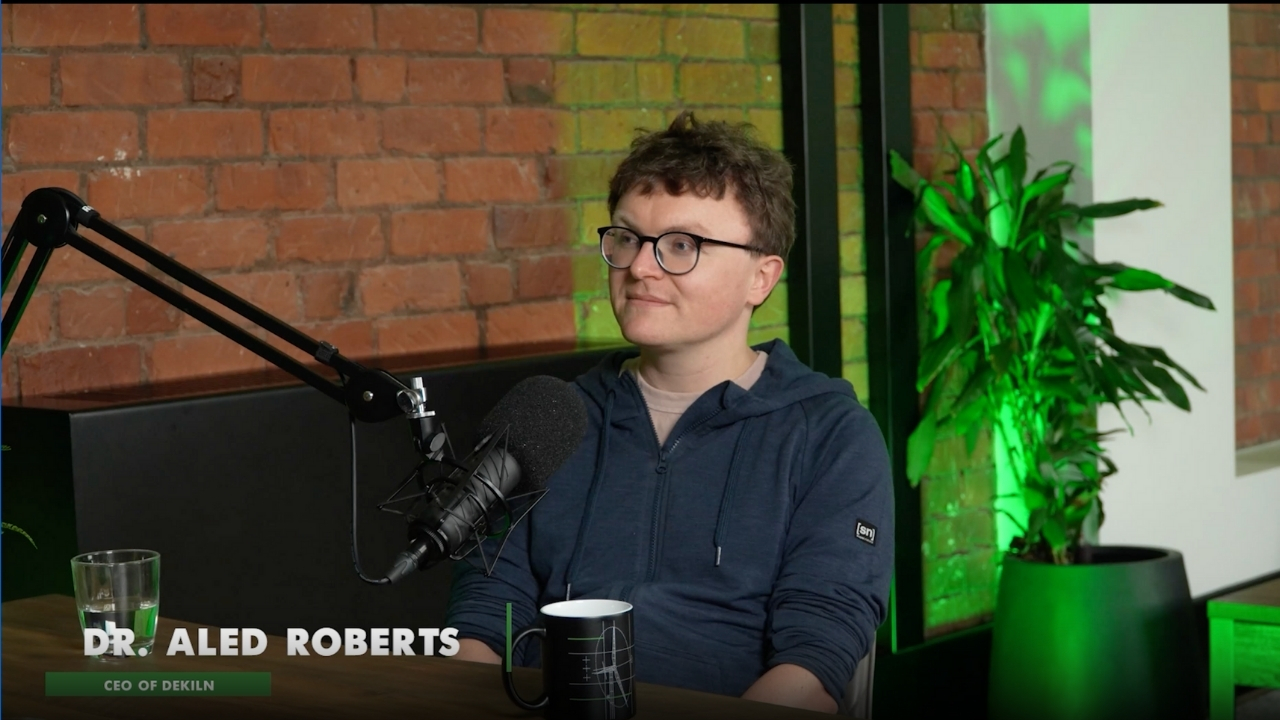
Katherine Keddie: It's something that also discussed with Dr. Alec Roberts, founder of Deccan, previously known as Deccan Bio, who I interviewed for another of the episodes. Nice. And with whom we've been working together for a while now. It's about, he shared a view that the change, the innovation, right? It has to be going together with the industry, not against the industry. Because if you approach things as a disruptive startup that enters a room and flips the table, no one else will want to sit there with you and stay there with you. You are actually joining a table. However, you are influencing what's happening at that table and in that room. Still, that disruption comes in, but as a disruptive change, as a disruptive innovation, right? That means, in his case, that when their process is scaled and widely adopted, it will be possible to make ceramics without firing them in a kiln. And it's a huge difference, right? You have lower cost of creating new facilities. You have lower energy costs, lower pollution. And you also have the significant sustainability benefit because the ceramics don't need to be fired.
Working with incumbents
Leo Thomson: Yeah, that sounds really cool. I think, like, I don't know if this is a point of disagreement, but like one point where I feel I might disagree is around having to be at the table. We've had opportunities, especially recently, to work with large industrial players who fundamentally don't have the right interests at heart. I think there's an argument to be made of, okay, we should take those opportunities, work with, and try and change things slowly. But when you look at the types of organizations I'm talking about, they've spent the better part of the last half century burying scientific evidence for anthropological climate change. are continually abandoning their own net zero promises. Like not even the ones that we want them to make, just their own ones. And I think there's a point where you have to look at particular players, even if they have a lot of money and a lot of power, look at their track record and see that every startup that they've started to absorb has all of a sudden stopped working on its impact driven mission. every institutional or rather industrial partnership they've formed has only benefited the status quo and their own financial incentives under the guise of net zero in order to claim massive government subsidies. And I think there is a point as starts where you have to decide whether or not you're going to be absorbed and shaped by the current structure which has deliberately created a climate catastrophe, not accidentally. You have to evaluate whether or not you're spending a decade of your life working towards supporting these companies to continue to exploit, or whether you're going to be willing to not take a seat at the table, instead build your own table, to use a very bad analogy, and start to build a new system, a new structure, one that works for communities, for people, and for the planet.
Katherine Keddie: I think saying no to things, particularly when you've just started and you're like in that early stage of business is extremely difficult. We had the same experience probably to a different extent, which was, you know, when we started, we had other people that wanted to work with us that were not green technology. And we obviously had to say no because the value of our business and ourselves as experts in this space is having a very niche focus on this specific area. And, you know, when we were doing that at the start, people said, you're crazy because you're saying no to work, which obviously feels totally counterintuitive. And I think especially if you're not, or if you're going for a bootstrap model or a grant funded model, I think it's really tricky to say no to those things. So when you are, you know, making the decision to say, no, I'm not going to sit at this table because I think they don't have the best interest. Yeah, definitely. I guess our mission, our vision at heart. How have you kind of reconciled that yourselves? Like, how do you make those decisions?
Leo Thomson: I feel like Beth and I and the team, to be honest, are incredibly aligned on what type of change we want to see. And so when opportunities like that come up, it usually doesn't even involve a discussion. Like we're usually very, very well like like aligned on that. I think there are some areas which are like it is grey where you think you know we we could have huge positive impact here however if this was taken and used in the wrong way could be incredibly damaging and I don't know I guess we've we've yet to be presented with a serious opportunity that has come in that grey zone. It's it's either been absolutely no or absolutely yes.
Beth Holloway: Yeah, I agree. I feel like there's always been a very clear directive as to why we set up the company and that is at the core of our decision making. And so as you said, it ends up not being a decision, like that actually guides us rather than Leo and myself having to sit down and weigh up the pros and cons. Sometimes it is just a really clear-cut decision because it doesn't align with our beliefs.
Katherine Keddie: Yeah, absolutely. And it's such a fascinating topic, isn't it? Because after all, right, you are a business, you need to make money. Someone might say that by saying no to opportunities like this, you're saying no to money, to revenue, to profit. And you are maybe prioritizing some form of ideology over it. And that's not something that investors would typically want to hear, right? At the same time, it can be also seen as a strategic decision that's prioritizing what you think is the real market opportunity, right? So rather than chasing short-term returns, short-term benefits, a contract with a big incumbent company that will derail your trajectory, you think that the real market opportunity is elsewhere and you need to say no to some of things to get to the stage where you can really reach the revenue, reach the profits of that opportunity alongside making this positive impact. And I think it goes back to what we discussed before about finding the right investors, having the right people on the journey. It's about working with investors who will also trust in the strategy that you have, that there is this opportunity. that you are going for it. And they will understand that you need to say no to short term higher returns for investors, for shareholders. Because it will enable much bigger returns later down the line because you will retain your focus. And for example, you won't end up in a situation that affects some companies, right, where you are a smaller company working with a big player, you become dependent on them. And that also affects your business or could be also used in a negative way against you to squeeze your business, maybe absorb it or acquire it at a lower valuation than is needed. At lower valuation than would be fair and appropriate.
Leo Thomson: Yeah, it's a really good point.
Katherine Keddie: Yeah, so in other words, again, it's not just not working with, for example, incumbents or not joining the table because of what some might regard as personal beliefs or ideology. It's also knowing which tables might not be just right for you, which tables are not aligned with the direction you're heading in and to which tables you might end up sort of glued without the ability to leave them and make the returns and impact you want to create.
Leo Thomson: Yeah, definitely, definitely.
Katherine Keddie: I would love to know then, what does that table look like for you? So say in 10 years time, You've built your own table with the kind of partners that you need to be able to scale your business and your solutions and generally your market in a way that's effective and sustainable and aligned with the vision that you have for the business. What does that table look like? I love this question. Yeah, it's a great question.
Beth Holloway: I think it would be a real combination of people coming from a lot of different groups. I think it would be great to have government representation on a table and we're kind of seeing that with the current government's approach to energy and they're kind of stepping forward as a stakeholder really in the energy transition which is great to see. I think it would involve, you know, renewable energy developers from the large scale, so like offshore, as well as like the community energy developers who are on the ground actually creating impact and have representatives from, you know, local households. How are they reacting to the changes in the energy market? Who else do you think?
Leo Thomson: That was the ones I was going to say. Us? Yeah, I'd like to be that, I believe.
Beth Holloway: Probably researchers to keep pushing the pace of innovation. I think a lot of the solutions that we have in the energy market today are imperfect solutions. And they're there for a reason. Things like solar panels, we know that there are problems in supply chains with solar panels. And currently solar panels are still being used because there's an overall vision that it will help us get to net zero. But there is still a very real problem in the supply chains for solar panels. And so in 10 years time, I would love for those problems to be kind of being addressed at the forefront of conversation where we kind of get to the point where we think, how can we improve on what we've got?
Katherine Keddie: Yeah, definitely. So, we've heard a lot about your journey today. Yeah. Wow, it's mind-blowing and it's also really inspiring. When you think about the place you were when it all began, you were joining Durham Venture School, you were fresh graduates, you were thinking, OK, maybe we can explore this startup space. When you think about those people, what advice would you give them? What advice you would give to, for example, recent graduates and students who are considering joining the next cohort of Durham Venture School, Durham City Incubator, or any other similar program?
Leo Thomson: I'm not sure my advice would be very useful. So when we joined the Durham Venture School, we really took an interesting path. So like we turned down top grad schemes, we paid ourselves like the equivalent of 12 grand a year and worked very hard for very little upside. And I think like it was because we genuinely cared about the problem we're solving. If I was like, you know, in that position again, I might like I might think about ways that I could get to the core of what I really care about quicker, potentially. So, you know, if you're going on the Durham Venture School program this year, if you get on, perhaps having a good think about what are the sectors that you genuinely think you could spend the next two, three years of your life turning down better paid jobs to really go all in on a particular problem. because that's the only thing that really sustained us through to the point where we started to see success.
Advice for young founders
Beth Holloway: I would say to young entrepreneurs, just go for it, try it, even if it's a three-month course, just do it and gain the skills, feel what it's like to be a startup founder, because it does kind of change your brain chemistry. You think about things in a very holistic way, I guess. And especially if you're a climate, if you're innovating in the climate space, then I would really, really advocate young people to get involved and start your own businesses or think about how you can be an innovator at work, because young people's voices are often missing from the discourse around climate change and we do see a lot of young people in activism and we hear a lot of young people having anxiety around the climate crisis and those voices and those Have a lot of power like you have a lot of power when you're really enthusiastic about something and you really care so like take Take that and be the people in the room. I would really really encourage anyone to go for that.
Katherine Keddie: Absolutely. I think what you are saying echoes one of those ideas that I heard. I think it was a video from Y Combinator, World's Top Startup Program, that if you are in your 20s, you just graduated, right? And you are thinking of getting involved with startups, starting a startup, joining a program like Durham Venture School or Durham City Incubator, go for it, like you said, Beth. And sort of what's the worst thing that can happen? If the idea that you work on flops, you will go and get a job, right? What do people do? What do people do when they get fired? A program like the Ram Venture School, it takes three months. I think there is then the second three months part. So taking three months to learn skills that will be then useful in so many other ways of your life, and at the end of which you might come out with, like you guys, a viable business idea and a very exciting new career trajectory, that seems like something that's priceless and something that can be more and more difficult to get involved in. The older you become when you have a mortgage, kids, car loan, and all those other commitments that reduce appetite for risk and make it impossible to be paying yourself on the minimum wage or even below that, right? For a prolonged period of time. Yeah, definitely. Definitely. Perfect. Thank you very much. Tell us now, what is it that you have coming up next? What are your plans for the coming year? And do you have any specific ask that you would like to share with our listeners, community, and broader ecosystem? As well as any announcements that you'd like to make, something exciting that you haven't spoken about today yet, but would be worth sharing.
Leo Thomson: Yeah, so we've spent the last two years in R&D and we're ready to launch some really interesting tech onto the market. Hopefully by the time this airs, we'll have launched our first product, which is a tool for developers and consultants of decentralized renewable energy to find and assess very high quality ground mount solar sites. And the people we've been working with on this, it's all about overcoming the pain points of a fragmented, slow, manual GIS-based approach. So if you're in that space, a DNO, consultancy, a developer, and you want to get your hands on what is the most advanced tech for your sector just now, we'd love to hear from you.
Katherine Keddie: Perfect. Thank you very much. And thank you very much for joining us today and sharing all of your insights. For everyone listening to us, thank you very much for making it to the end of this episode. And we hope you enjoyed it. Stay tuned for more. We'll be interviewing more Greentech founders and investors. We'll also share with you details of Leo and Beth and their company in the episode notes. So stay tuned and thank you very much.











.jpeg)







.jpeg)
.avif)