









The company name is one of the first decisions a founder makes, and one of the hardest to undo. It sits underneath everything that comes next - the website, the pitch deck, the press coverage, every email signature, and every conversation at a conference. Strong marketing builds on a name that works. Weak marketing struggles to compensate for one that doesn't.
Plenty of badly-named companies have built real businesses, so a weak name is rarely fatal. What it does is add friction. B2B buyers now complete around two-thirds of their buying journey before contacting a vendor1, and a name people can't find, spell, or remember quietly costs you in that phase.
Trademark disputes and rebrands are both expensive to resolve, and both are avoidable. The scale of the problem is documented: Companies House rejected 56,640 business name applications between January 2019 and April 2022, with offensiveness and similarity to existing names cited as the main reasons². The UK Intellectual Property Office handled 6,695 trade mark oppositions in 2024 alone, the most common form of trade mark dispute at the IPO³.
The checks to prevent these issues take roughly an afternoon.
This article covers the framework we use with founders before any name is finalised: what makes a name scalable, where to look for candidates, and nine checks to catch the failures before they're locked in.
Choose a name at incubator stage that isn't scalable, and immediately, nothing happens. You go about your business. You're happy with the name. You're also happy that you have naming off your plate so you can focus on what actually matters to grow your business.
Then, somewhere between seed and Series A, the bill arrives.
We recently advised a VC fund whose name was shared with two other VC funds, a consultancy, and several unrelated businesses. When our team tried finding them on Google and LinkedIn, we couldn't. They had been operating for years. The name had become a permanent obstacle in every cold outreach, every referral, every press mention. There was no clean way out short of a rebrand.
Names fail in predictable ways:
The further into the business you are, the more expensive the fix becomes. The admin is tedious but doable: email signatures, merchandise, partner notifications, client communications, contracts, web addresses, documentation, regulatory filings. The harder part is everything that's accrued around the old name - the backlinks pointing to your site, the press coverage that built your search ranking, and the associations AI tools have learned and now repeat. You can change the name in a day. The digital footprint takes far longer to rebuild.
Across the naming exercises we have run with climate tech and deep tech clients, three criteria separate names that scale from names that don't.
Easy. Easy to pronounce, easy to spell, easy to repeat, easy to remember. If a guest at a conference can't write your name down on their phone the first time they hear it, that is a structural problem with the name.
Available. Not crowded with other companies using it, not duplicated across funds or consultancies in your geography, not adjacent to a much larger company that will dominate every search. A clear .com doesn't help if four other organisations are pulling search traffic for the same term.
Linked. Connected to what you do, what you make, or the meaning of what you're building. Remy, the AI recipe app that cuts food waste with smart suggestions, ties back to the rat in Ratatouille - the chef's-hat character guiding the kitchen. Once someone explains it, you remember it.
A name only needs to do these three things. The trap is that the second and third are invisible at the desk. They look fine on day one. They start failing when the company scales beyond its first market.
The naming process splits into two stages. The first is creative - finding candidates. The second is structured - testing them. Some founders skimp on the creative stage, settling for one of the generic patterns that recur across climate tech: green-anything, everything-Co, everything-Tech, everything-AI. But it doesn't take a complex creative process to land a name that's relevant, effective, and available.
A few starting points that consistently produce stronger candidates:
Distil what the company does. If you had to explain it to a five-year-old, what would you say? If you had to compress that to one sentence, then one concept, what survives? Two of our clients are named this way. Low Carbon Materials makes… you guessed it, low carbon materials. Dekiln has developed a process that removes the kiln-firing stage from ceramic tile manufacturing, cutting the carbon footprint by 94%. We worked with the founding team to land the name, and it carries the whole thesis: remove the kiln. It also stands on its own as an independent word.
Use Latin or other foreign-language roots. Multus Biotechnology, who produce key ingredients for cultivated meat, is named for the Latin word for "many" - tying directly into a future where their technology enables abundant, animal-free food. Suyana, a parametric climate-insurance startup protecting climate-vulnerable communities across Latin America, is named for the Quechua word for "hope", reflecting its commitment to the communities it serves.
Look at mythology, fantasy, and legendary objects. Characters and items with thousands of years of cultural resonance can carry meaning into a business name that purely descriptive options can't. The trade-off is saturation: the well-known names are already heavily used, so the more recognisable your choice, the more likely it fails the availability checks. Reach for the lesser-known figures.
Test suffixes with care. "Bio", "Tech", "Materials", "Labs" all work as suffixes, but watch what people actually call you. If your company is registered as Multus Biotechnology but everyone shortens it to Multus in conversation, that tells you which name is doing the work. Decide which version is the real one and own it.
Once you have one or two candidates you like, run them through the following nine checks. The first six can be done at a laptop in an afternoon, whereas others need other people in the room. Skip any of them and the failures show up later, at a higher cost.
Start with Instant Domain Search. Drop your candidate names in and see what comes back in red (taken), blue (purchased but for sale), and green (free).
The benchmark we use: are .com and .net free? These remain the most established domain endings and carry the most credibility with buyers, investors, and partners. .ai is a strong third option for climate tech and biotech. .io and .co.uk work but suggest startup-stage. Newer extensions like .earth, .climate, or .solutions can confuse audiences who aren't sure those domains exist, which creates friction when people try to type your email or find your site. And if you're reaching for one only because the established endings are taken, that's a signal in itself: the name is probably already crowded.
If .com and .net are taken but the domains aren't actively used, you may still be unable to acquire them, or they may cost significantly more than registering from scratch.
Drop the name into Google, and look at the first two pages. Are there direct matches - other companies using this exact name? Are the results in any way related to your space? Is there anything inappropriate that would surface every time someone searches for you?
When we put Dekiln into Google during the naming process, there were no direct matches and no company using the name. The few results were related to pottery and kiln firing - vaguely connected to ceramic tile manufacturing - but none were significant or established. It meant that after rebranding, the company wouldn't be competing with related businesses for the same search term.
If the top results are inappropriate, unrelated businesses, or stronger competitors in adjacent spaces, move on to the next candidate.
Check LinkedIn first, as the primary B2B channel. Then check X and Instagram. You are looking for two things: handle availability, and any established influencer using the name in a way that would create confusion.
If the LinkedIn page name is taken by a dormant account, that could pose a problem for SEO even if you can register a variant. If a beauty influencer with 200,000 Instagram followers has your candidate name as their handle, you will be competing for that namespace forever.
The first formal check. Companies House for the UK. Most countries have a comparable register. You are looking for active companies using the name, or close variations.
If there is a match, things become difficult. If there isn't, you should be okay to proceed. If in doubt consult your legal team. With Dekiln, we put it in. There was nothing. We were good to proceed.
After Companies House, search the UK Intellectual Property Office trademark register for the name and any close variations. Then check the jurisdictions where you plan to operate or expand.
Trademark conflicts can be the most expensive naming failure to fix. If anything ambiguous comes up at this stage, take it to a trademark lawyer before going further. We can point you towards things to consider, but we are not qualified to give legal advice.
Google Trends shows you how often, and from where, people search for a term. For a name that is meant to be a new word, you are hoping for nothing - no one searching for it. That suggests the term is available.
If your candidate is a popular search term in, say, Indonesia, that is not automatically a fail, but it is a flag worth digging into. The term might have regional importance, an unintended meaning in another language, or an association with an established local business. Investigate before proceeding.
Dekiln showed almost no search volume when we checked - the result you want for a new word. It meant the space was open, and that Dekiln could rank first for its own name with some simple SEO and AI optimisation work.
The final three checks need other humans. Take the name to a busy place with background noise. Tell someone the name. Ask them to write down on their phone what they heard.
If they get it first time, that is a strong signal. If they ask you to spell it, the name is harder to use than it should be. If they write it down differently every time you try, you have a recoverable but persistent problem.
This is the check that catches names which look fine on a slide but fall apart in conversation. It is also the most uncomfortable to run, which is why most founders skip it.
Write the name down. Show it to people. Ask them to read it out loud.
Are they pronouncing it the way you intended, or in a different way? If your name has three or four plausible pronunciations that diverge significantly, you have a problem.
Names that are easy for a native English speaker but become tongue-twisters for non-native speakers also fail this check. If your company plans to work with international partners or expand internationally, the name needs to be accessible to people whose first language is not English.
The final check, and the one with the highest variance in consequences. Run your name through Google Translate's detect-language option. Ask an AI tool to check whether the name carries unintended meanings in any major language. Then, if your target markets include non-English-speaking geographies, show the name to native speakers in those geographies.
The textbook example: Osram, a successful German lighting company, means roughly "I will defecate on" in Polish. There is even a children's joke - what hangs on the ceiling and threatens you? An Osram light bulb. Despite this, Osram has succeeded internationally, including in Poland, because the company was established long before the Polish market mattered to them. A new climate tech startup expanding into Latin America or East Asia does not have the same buffer.
If you are starting in the UK but key markets include the US, India, several African countries, and parts of the Middle East - which is increasingly common for deep tech and climate adaptation startups - this check matters as much as the others combined.
Not every naming problem requires a rebrand. The decision depends on which check the name is failing and how much it is costing you now.
Rebrand if you have received a trademark letter, customers consistently cannot find you online, you have a partnership or investor conflict caused by the name, or the name carries an offensive meaning in a target market you are about to enter.
Live with it if the issues are cosmetic, the name is slightly hard to spell but recoverable, or the SEO competition is solvable through content and targeted campaigns rather than a name change. Adopter's name is sometimes misheard as "a doctor" or "adapter", which is a quick correction rather than a problem. Deliberate work on our SEO and AI visibility meant we climbed the rankings in our niche regardless.
Either way, run the nine checks on your current name to see exactly where you stand. The output tells you whether you have a marketing problem you can fix with content, or a structural problem you can only fix by renaming.
If you are at the start of a naming exercise, a practical timeline:
This week. Generate 10-15 candidate names using the inspiration sources above. Run the first three checks - domain availability, Google search, social media - on each. Most candidates will fall away here.
This fortnight. Take your shortlist of three to five through checks 4-6: Companies House, trademark search, Google Trends. Get a trademark lawyer's view on anything ambiguous before going further.
This month. Run the final three checks on the two remaining candidates: pub test, reverse pronunciation, international meaning. Test with native speakers in your expansion geographies if you have a clear international plan. Then commit.
The whole process takes roughly a week of part-time work. It is not a project that needs to look like a large corporation's naming exercise. It is a set of fast, structured checks - and skipping them costs more than the time they take.
1. How long should the naming process take?
For an early-stage startup, two to four weeks of part-time work is enough. The creative stage usually takes longer than the checks. Founders who spend months on naming typically aren't running structured checks - they are cycling through opinions. The framework above is designed to converge quickly.
2. Can I use a name if the .com is owned but not actively used?
Sometimes. The owner may sell, but usually for well above the cost of registering from scratch, and squatters price aggressively. Not owning the exact .com isn't fatal - a clean .net works fine, as our own does. It becomes a real problem only when the credible endings are all taken and you'd be reaching for something obscure.
3. What if every name I like is already taken?
You haven't generated enough candidates. The naming process should produce 10-15 options before any checks, not two or three. If you are consistently arriving at names that fail the checks, the issue is usually that your inspiration sources are too narrow. Try a different starting point - Latin roots, foreign-language meaning, mythology, function-based descriptors.
4. Are .ai, .io, .earth and similar TLDs acceptable?
.ai and .io are widely accepted in AI, biotech, and climate tech contexts, but still benefits from securing .com alongside it. .earth, .climate, .green, .solutions can create confusion - people are less used to seeing them, so they'll often type your address as .com out of habit, mistype your email, or assume your site is down. If the only endings left for your name are the obscure ones, that usually means the name is already crowded. Default to .com or .net where you can.
5. How important is the name for fundraising?
Less important than the founder team and the technology. Investors don't pass on deals because of names. But a hard-to-find or confusing name adds friction at every stage of the funnel - inbound enquiries, warm introductions, due diligence searches. A poor name doesn't prevent fundraising. It just makes everything around fundraising slower.
6. I'm expanding internationally - what's the most common naming failure mode?
Unintended meaning or pronunciation in a target-market language, especially in markets the founder hasn't lived in. The other common failure is choosing a name that is a generic word in a key market, which makes it impossible to rank for in search. Always check with native speakers in your expansion geographies before committing.
7. We're rebranding. Should we use the same process?
Yes, with two additions. First, run the nine checks on your current name as a baseline so you can see exactly what is failing. Second, factor in transition cost and time: domain redirects, customer communications, partner notifications, contract updates, brand assets. The naming framework is the same. The execution around it is different.
1 6sense (2025), The B2B Buyer Experience Report Global study of nearly 4,000 B2B buyers. Buyers initiate first contact with sellers at around 61% of their buying journey (up from 69% in 2024), 95% of winning vendors are already on the buyer's Day One shortlist, and the pre-contact favourite wins approximately 80% of deals. URL: https://6sense.com/science-of-b2b/buyer-experience-report-2025/
² Simply Business (2022), Freedom of Information request to Companies House 56,640 business name applications were rejected by Companies House between January 2019 and April 2022. 25,400 of those were rejected on grounds of containing a restricted or offensive word; the remainder largely on "same as" or "too similar" grounds under the Companies Act 2006. URL: https://www.simplybusiness.co.uk/knowledge/business-tax/business-names-rejected-by-companies-house/
³ UK Intellectual Property Office (2025), Facts and Figures: Patents, Trade Marks, Designs and Hearings 2024 6,695 trade mark oppositions were filed at the UK IPO in 2024 (including Fast Track oppositions). Oppositions are the most common form of trade mark dispute handled by the IPO. URL: https://www.gov.uk/government/statistics/facts-and-figures-patents-trade-marks-designs-and-hearings-2024/facts-and-figures-patents-trade-marks-designs-and-hearings-2024
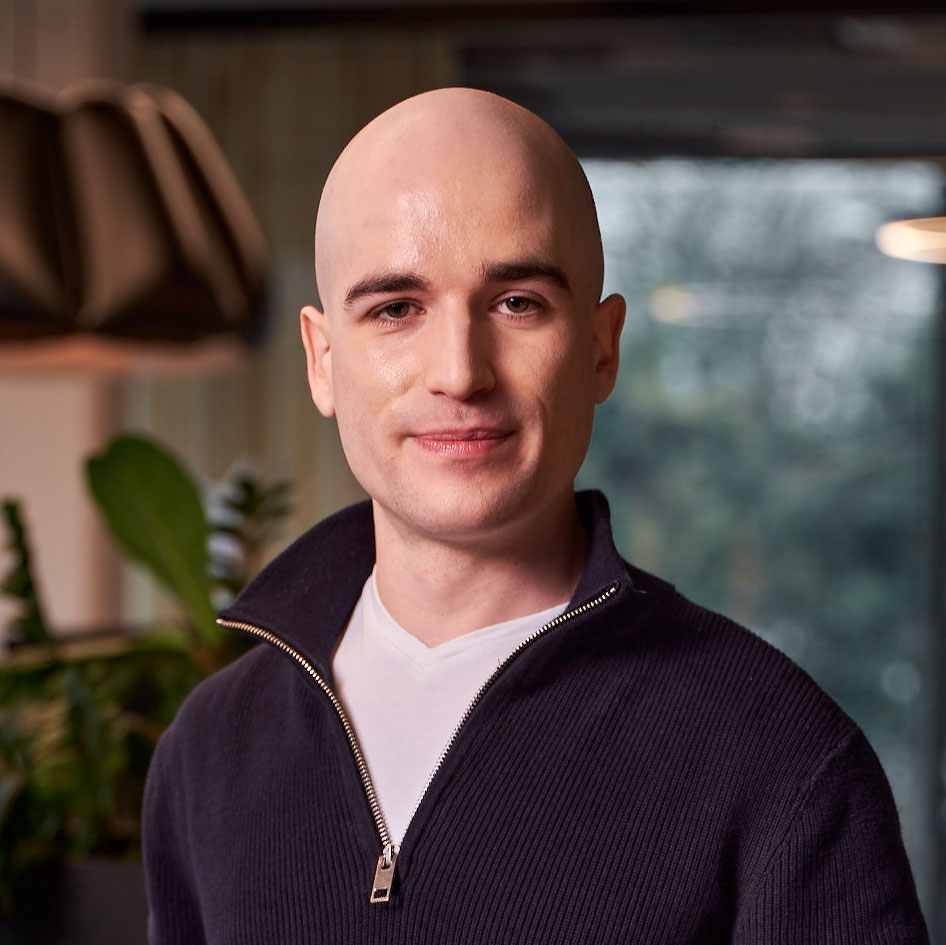
Matt Jaworski is co-founder of Adopter, Europe's first marketing agency to specialise in climate tech and adaptation. He works with clients across five continents, spanning biotech, construction, finance, and energy. His focus sits across web design and development, brand strategy and messaging, and GEO/SEO - helping climate tech companies build a credible, findable presence online. Matt also mentors at IndieBio, Conception X, and C13.
Helena is Adopter's Founder's Associate, working closely with the founders on operations, the client sales pipeline, and internal logistics. She produces the Scaling Green Tech podcast and has contributed to social media projects across construction, nature finance, and biotech. Helena holds a Master's degree in plant development from the University of Cambridge and brings a scientific background to her work at Adopter.