










When a biomaterials company posts about specific regulations, named projects, and quantified outcomes, its LinkedIn content gets 24% higher engagement than when it posts generic business updates. At a built environment scaleup, the gap is 31%. At a climate policy think tank - 160 posts tracked over 12 months - almost 40%.
Those numbers come from Adopter's portfolio data: 642 posts across eight B2B company pages, tracked over 12 months. The pattern held at five of seven testable accounts. Posts built around specific technical detail were more than twice as likely to exceed a 20% engagement rate as generic content from the same pages.
The reason is structural. LinkedIn's feed algorithm has shifted from rewarding reactions to rewarding dwell time and semantic matching - how long people spend with a post and how precisely the platform can match it to relevant professionals. For companies whose work is genuinely specialist, that shift changes everything.
This article is a practical breakdown of what's changed, what the data shows works, and how deeptech and climate adaptation companies can stay visible to the specific clients, investors, and partners they need to reach.
The most valuable audience for a climate adaptation company or a biotech scaleup tends to be the quietest on LinkedIn. The fund manager evaluating nature-based solutions, the programme director sourcing construction technology, the chief sustainability officer tracking regulatory changes - these people read carefully but rarely react. Under LinkedIn's old ranking system, they were invisible. A post could reach exactly the right readers and the algorithm would treat it as a failure.
That's changed. LinkedIn now measures dwell time as its primary feed signal - how long someone actually spends with a post, not whether they reacted to it. A detailed breakdown of compliance and audit requirements will hold a building safety manager's attention for 40 seconds. A post walking through transparent performance data from pilot-scale bioreactors will keep a biotech investor reading. The algorithm registers that attention and distributes the post further, even if neither person ever hits like.
LinkedIn has also changed how it decides who sees what. The platform now uses language models to match posts to people based on actual subject matter - a shift that's made hashtags largely irrelevant as a distribution mechanism. A post about biodiversity credit verification methodology reaches people working in green finance. A post about "driving sustainability impact" gives the system almost nothing to match on. These aren't hypothetical users. A 2025 study of 300 senior B2B decision-makers found 41% use LinkedIn as one of their main research channels - second only to AI tools at 45%. When your audience is a few hundred decision-makers across a specialist field, this precision is what makes LinkedIn viable - and it depends on your content containing specific enough language for the algorithm to find them.
We tested this across 642 posts and eight accounts over 12 months. The gap between specific and generic content was consistent - and larger than we expected.
.png)
Across the data, event recaps - posts with specific takeaways, named speakers, concrete observations from sessions - had more than twice the median engagement of promotional posts for the same events. Same companies, same followers, same conferences. A recap gives the algorithm specific language to match and gives the audience something worth spending time with. A promo drives awareness and attendance, but gives the algorithm far less to work with.
The pattern held well beyond events. Across five of seven testable accounts spanning deep tech and climate adaptation, posts with specific technical detail outperformed generic business posts from the same pages. At a climate policy think tank - with 150 posts over 12 months - the gap was almost 40%. At a construction technology company, 23%. At a biotech scaleup, almost 30%. The variable that separated the posts that performed from the ones that didn't wasn't format or timing. It was whether the post contained named regulations, quantified outcomes, concrete project detail - or broad claims and general language.
The gap widened at the top end. Across the data, 22% of high-specificity posts exceeded 20% engagement rate. For generic content posts - excluding functional content like hiring announcements and team updates, which run on a different engagement mechanism - 11%. Specific content doubled the probability of a post that significantly outperformed baseline.
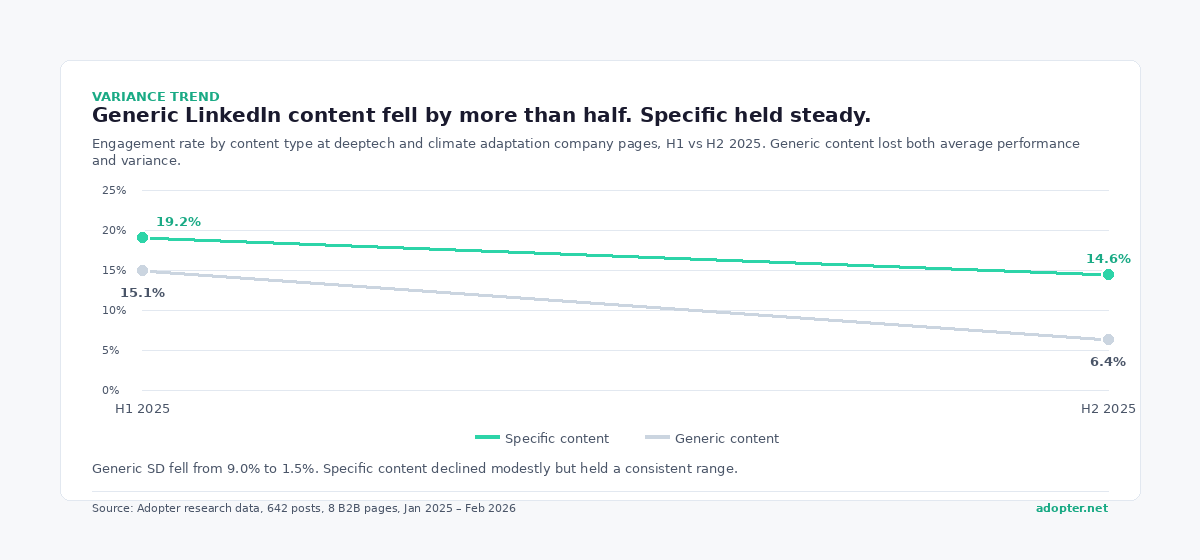
In the first half of 2025, generic posts at one environmental intelligence firm had a wide spread - some performed reasonably, some didn't. By the second half, that spread had collapsed into a narrow band of consistently low engagement. The occasional strong result that had kept the average respectable disappeared. Specific content held steady throughout the same period.
The numbers are consistent across sectors and accounts. But scroll through most technical companies' LinkedIn pages and you'll see the same thing: posts that could have been written by any company in the industry. Something in the content production process is stripping the specificity out between what these companies know and what they publish.
The gap between what technical companies know and what they publish on LinkedIn is where the specificity advantage dies. A biotech company running pilot-scale bioreactor trials at posts "Excited to share our latest breakthrough in sustainable protein innovation." A construction tech company supporting contractors with compliance documentation posts "Navigating the evolving regulatory landscape requires innovative solutions." The specific knowledge exists inside the company. The content production process - AI rewriting tools, templated approval cycles, the instinct to sound "professional" - strips it out and replaces it with language that could describe any company in any sector. LinkedIn's CEO publicly noted that professionals resist AI-polishing tools because they want to sound like themselves. The algorithm now adds another layer: polished-generic content gets less distribution than the specific draft it replaced.
Compare what these companies could post instead. "Our platform monitored biodiversity net gain across 14 development sites in the Thames Basin over 18 months. Nine hit their Defra 4.0 targets - here's what the data showed about the other five." That reaches ecologists and BNG assessors working on planning compliance - the people this company needs in its pipeline. The construction tech company: "New building safety regulations now require structured digital documentation for higher-risk assets. Here’s how several contractors we work with are approaching the requirement." That reaches building safety managers dealing with this exact problem. Same companies, same knowledge, same platform. The difference is whether the specific detail survived the content process.
The mechanism is consistent across every example in the data. AI tools and approval processes strip out nouns - named regulations, quantified outcomes, project details - and replace them with adjectives. For a company selling to a broad consumer market, that's a minor cost. For a company whose target audience is a few hundred specialists in building safety or bioprocess engineering or sustainable finance, the nouns are the distribution mechanism. They're what the algorithm matches on, and what the audience spends time reading.
Which means there's a simple editorial check you can do before anything goes live: does this post contain at least one specific detail - a number, a perspective on a named regulation, a project outcome - that only this company could credibly include? If it doesn't, the specificity hasn't survived the content process. Well-written generic content still performs like generic content.
That's the content side. The next question is format - and the data here didn't line up with most of the popular LinkedIn advice.

Across 642 posts and seven accounts, the gap between video and non-video social engagement was less than a percentage point at five of them. The primary variable in every analysis we ran - specificity, events, breakout rate - was content, not format. For companies that have spent energy worrying about whether to post more video or invest in carousels, this is the clearest finding in the data.
Where format does matter, it follows from the dwell time shift described earlier. Longer, substantive posts are advantaged, provided the substance justifies the length. The algorithm measures time spent, not word count. A 200-word post making one specific, well-evidenced point outperforms a 50-word post that says nothing. Padding to reach a length target has the opposite effect.
The video finding was more nuanced. Video had a 41% median view rate across the portfolio - nearly half the reached audience actively started playback, and the platform is clearly surfacing B2B video to relevant audiences. Where video outperformed non-video on engagement, the pattern was consistent: a person explaining something complex. Research walkthroughs, methodology explanations, field updates. Non-video posts, meanwhile, generated 2.2x more clicks - better suited for driving traffic to reports, tools, or detailed analysis. The practical distinction is clear: video holds attention in the feed, text moves people to external resources. Which one you use depends on what a given post is trying to achieve.
Getting the content right and matching the format is the straightforward part. Publishing consistently when the people who hold the expertise are busy doing the work - that's where most technical B2B companies get stuck.

Researchers, engineers, and project leads have the most interesting material inside a deeptech or climate adaptation company. They're also the people with the least time to write LinkedIn posts. The gap between what these companies know and what they actually publish is rarely about ideas - it's about getting expertise out of busy people's heads and onto the page.
In practice, it takes a 15-20 minute conversation. A subject expert talks through a recent trial result, a regulatory submission they're navigating, a problem they solved on site. Someone else turns that into a drafted post. The expert reviews for accuracy, not prose style. This is how you get a post about advanced biomanufacturing processes or construction safety regulation without asking a researcher or engineer to sit down and write. The best-performing posts in our dataset came out of exactly this kind of conversation.
Those conversations produce enough material for two to three posts per week - the range where accounts in our dataset consistently performed well. Below one, presence becomes patchy. Not every post needs to be deeply technical. A mix works: one post built around a project outcome with real numbers, another around a regulatory development and its practical implications, a third that's a hiring update or an event recap that reaches a broader audience. The technical posts build credibility with your target market. The broader posts keep your page active and visible to people at the edges.
Company pages carry this content well, but for early-stage deeptech and climate adaptation companies, the founder or a senior technical leader's personal profile is what actually drives visibility - personal content reaches further and builds trust faster. The company page works best as the evidence base behind a visible founder. It carries the technical posts from the content conversations. The founder's profile carries sector commentary and perspective that gets decision-makers paying attention. When they look closer, the company page is where they decide whether the substance is real.
Edelman and LinkedIn's 2024 B2B Thought Leadership Impact Report found that 73% of decision-makers trust thought leadership more than marketing materials and product sheets - and a majority say consistently high-quality thought leadership makes them willing to pay a premium to work with that organisation.(2) For companies selling specialist expertise to a small number of high-value buyers, that premium effect matters more than reach.
This rhythm builds credibility with the decision-makers who actually matter to your pipeline - the sustainability directors, CTOs, fund managers, and procurement leads you already know by name. Keeping technical and broader content on separate tracks, with separate benchmarks, is what stops the mix from becoming noise. Substantive posts lose specificity the moment they start chasing reach, and broader posts collapse under technical detail a general audience doesn't need.
Every recent shift in LinkedIn's algorithm - dwell time weighting, semantic matching, resistance to AI-polished content - advantages companies whose work is specialist. Most deeptech and climate adaptation companies know exactly what decision-makers they need to reach. What's changed is that LinkedIn has become dramatically better at putting specialist content in front of those specific people. The expertise is already inside your company. Now put it in front of the people who need to see it.
Publish one post built around a specific finding, methodology, or outcome from your work - with enough detail that only your team could have written it.
Then audit your last ten company page posts. For each one: is there a specific number, a named regulation, a concrete example that only your company could credibly include? If fewer than half pass that test, that's the pattern to break first.
Identify two or three subject experts and book a recurring 15-20 minute conversation with each. Someone else drafts, the expert reviews for accuracy. Two to three posts per week in total - substantive technical content alongside team updates, event promotions, and sector commentary. The substantive posts build credibility with your target market. The broader posts keep reach growing beyond it.
Run this for four weeks. After each post, look at who engaged, not just how many. Are the people commenting and reacting the kind of decision-makers you need to reach? If a post about your pilot results gets three reactions from sustainability directors at contractors you'd want as clients, that tells you more than a hiring post with fifty likes from recruiters. The names and job titles in your notifications are a better signal than the engagement count above them.
By now you know which experts produce the best material and which topics your audience responds to. Document what's working. Set substantive posts as the baseline and plan broader-appeal content on a separate track, measured on reach rather than engagement depth.
Then develop your strongest-performing LinkedIn topic into a website article - a published methodology, a sector analysis, a detailed guide. LinkedIn posts scroll away within days. A well-structured article compounds through search and AI referrals, and gives every future post on that topic somewhere to point. One substantial article per month is where that compounding starts.
Use both - the LinkedIn posts and the articles behind them - to build an email list. LinkedIn followers are on LinkedIn's land; the algorithm decides whether they see your next post. An email subscriber is yours. Even a simple newsletter collecting your best monthly content moves your most engaged audience onto a channel you control.
Before a first meeting, your potential clients and investors will look at your LinkedIn. What they find shapes whether outreach gets a reply, whether a warm introduction leads to a conversation, and whether you make the shortlist when a procurement round opens or a fund starts deploying.
We help deeptech and climate companies make sure their LinkedIn presence is doing that job.
Yes. LinkedIn's semantic matching now finds specific audiences based on post content, not follower count or network size. A post about biodiversity net gain methodology or novel protein scaffolding reaches the people who work on those problems - even from a page with 200 followers. The smaller and more specialist your audience, the more specificity matters in every post.
Because LinkedIn's algorithm now rewards exactly what these companies produce: detailed, specialist content that holds attention. The feed prioritises dwell time and semantic matching - it rewards content people spend time with and matches posts to people based on subject matter. Companies producing detailed content about carbon removal mechanisms, biosynthetic processes, or adaptation engineering are favoured by this shift. The companies at a disadvantage are those posting broad, generic content that gives the algorithm nothing specific to match against.
Use the language your audience uses. If your buyers talk about Scope 3 reporting frameworks, actuarial climate models, or cell culture scale-up - use those terms. The algorithm needs specific language to find the right people, and the right people want those terms because that's how they talk about their work. Being too general is the bigger risk: if neither the algorithm nor your audience can tell what you do, the post disappears.
For most early-stage technical companies, the founder's profile is the biggest visibility driver - personal content builds trust faster and reaches further than a company page. But founder commentary without substantive company page content behind it is visibility without depth. The company page carries the evidence: research findings, project outcomes, technical detail. The founder's profile carries the voice and perspective that gets people paying attention in the first place. Build both, but if you're starting from scratch, the founder's presence usually builds momentum first.
Format matters less than content quality. Across our portfolio, engagement rates were virtually identical between video and non-video at most accounts. Video performed better when the content was a person explaining something complex. Non-video drove 2.2x more clicks - better for linking to external resources. Match format to content goal, not to what you've heard performs best.
Two to three company page posts per week. Below one, presence becomes patchy. The bottleneck for most deeptech and climate companies is getting expertise out of busy people's heads. The process that works: a regular 15-20 minute content conversation with a subject expert, turned into a post by someone else, reviewed for accuracy by the expert.
Barely. LinkedIn is phasing out hashtag-based distribution and inferring relevance from post content instead. Use zero to three as labels for specific events or topics. The real targeting language belongs in the body copy - regulation names, methodology references, sector-specific problem language that your buyers actually search for.
This is the highest-value use case for most deeptech and climate companies. LinkedIn content works as pre-outbound warming. When you publish substantive posts about adaptation infrastructure, carbon methodology, or bioprocess scale-up, decision-makers at the organisations you want to reach see that content before you ever reach out. By the time you request a meeting or get a warm introduction, they've already seen evidence that you understand their space. We see this across our deeptech and climate portfolio - prospects and investors reference LinkedIn posts in first meetings. The effect is practical: outreach gets more replies, and first conversations start further along because credibility is already established.
Green Claims Without Greenwashing: How to Communicate Your Message Responsibly
LinkedIn & social media for deep tech and climate adaptation
Leveraging Dwell Time to Improve Member Experiences on the LinkedIn Feed (LinkedIn Engineering Blog, 2024)
Large Scale Retrieval for the LinkedIn Feed using Causal Language Models (arXiv preprint, 2025)
LinkedIn Stops Resurfacing Old Posts, Shares Updates on Hashtags and AI Functions (Social Media Today, LLC, 2025)
How AI is shaping the B2B buyer journey (Magenta Associates, 2025)
2024 B2B Thought Leadership Impact Report (Edelman-LinkedIn, 2024)