Katherine Keddie: So welcome back to Scaling Green-Tech. Today we have a special episode with Simon Zadek. Simon is the co-founder and managing partner of Morphosis, which is an integrated adaptation solutions business. He is a globally recognised leader in sustainability economics and has spent four decades at the intersection between sustainability and markets as an expert. Simon is also currently a member of the Club of Rome, a Senior Fellow of the Paulson Institute, a Senior Advisor to organisations like the Task Force on Nature-Related Financial Disclosures and NatureFinance, and most recently, he is the first Distinguished Fellow of the Hoffman Centre for Global Sustainability at the Geneva Graduate Institute. Simon is widely published as a thought leader, including the award-winning book ‘The Civil Corporation’ and most recently and poignantly for this episode, ‘Time to Plan for a World Beyond 1.5 Degrees’. Today we’ll be exploring the adaptation economy as an opportunity for investment policy innovation and solutions, and the launch of their landmark report, Morphosis, ‘The Rise of the Adaptation Economy: Investing in Adaptation and Resilience in a World Beyond 1.5C’. We will be exploring ideas around investment, but this episode is not intended as financial advice, so please enjoy. Thank you so much for joining, Simon.
Simon Zadek: My pleasure.
Katherine Keddie: So, as always, our first question is, how would you describe Morphosis to a five-year-old?
Simon Zadek: Yes, indeed. So, five-year-olds don't know that much about climate change, but I guess I would start with a story about if there's a big storm outside your home, I guess you'd go inside and you'd probably shut the door and you'd probably close the windows. And if the storm got really big and your roof blew off, so all the rain came in, probably you'd want to tell your parents or somebody that they should really build a better roof so that it doesn't come off. And when you go to school, of course, going to school on your bike is all very well, but if there's lots of water in the street because there's a flood, you probably need a bit of a boat in order to get to school, which might be quite fun, kind of rowing along to school along with other friends. And so Morphosis is about helping to make those changes. To make sure that when there's a storm coming you know, so that you can go indoors and shut the door and shut the window. That hopefully you can make the roof okay before it blows off, so that the rain doesn't come in. And that we've got to find a boat that works and stop you getting on a bike if there's going to be a flood of water. So it's something to do with coping with those sorts of changes in your work, going to school, in your home, with your parents, in your house, in the many ways that a five-year-old will live life.
Katherine Keddie: Very nice introduction for our adult listeners. Give us an elevator pitch about Morphosis.
Simon Zadek: Sure. Well, if there's a storm, you should go into your house and you should shut the door and shut the window and make sure the roof isn't going to fly off and buy a decent boat in order to get to work. Sorry. No. So I think it is clear that we are moving into uncharted climate change territory. And that brings with it a lot of unknowns as to how to be safe, how to eat well, how to ensure one has water, how to deal with refugees. There are all kinds of very large-scale changes that will come to our world. So what would I say to an adult? What kind of adult? I think I'd say things are not going to be the same in the future. Not just because there are storms afoot or wildfires or floods or other physical effects of climate change, but because the structure of our societies and the way our economies work and how we secure food and water and health and education and civil security on our streets is not going to be the same. in a world of two degrees or two and a half degrees. Now if you happen to be an adult living in Pakistan or living in the Sahel, you already know that. I don't have to tell you anything at all. You're facing drought, you're facing floods, you're facing civil insecurity, you're facing escalating food costs, and unavailability of potable water. But if you're living in Geneva, you might see that from afar. But my guess is, your assumption is that that story is not going to come to your home. And you're wrong. And it's important that the person living in Geneva understands that as the glaciers melt, as the mountains crack, as water flows into the Rhône and the Rhine become unstable, there will be many, many changes. As Valais becomes too hot, as wine no longer grows properly on the shores of Lake Geneva, as food security issues make it harder to import food, that wherever you are, your life is going to change dramatically. That's, I think, the story I'd want to tell adults wherever they are.
Katherine Keddie: I mean, my next question, I think you may have already answered, which is you have spent your career working in various forms in sustainability and finance. And you've now chosen to start Morphosis to focus on the adaptation economy as a whole. what triggered that decision to focus on adaptation?
The case for planning beyond 1.5 degrees of warming
Simon Zadek: The facts and denialism is what drove me into the space. The facts are, and of course, these are today's facts as well as tomorrow's facts, which haven't actually happened yet, that there's going to be a billion refugees. The facts are that there's going to be huge food insecurity, particularly across the tropics. The facts are we already have water stresses across many societies, and those will worsen. And the denialism of those with power and influence, but also of many folks within the climate community that should know better, is that we can stop that happening before it happens. And I would love to agree and hope that they're right and I'm proven wrong. But frankly, I doubt it. I think most likely is that some variation of what I'm describing is what we face, and that what we need to do is not run along a spectrum of optimism and pessimism, but see the logic of planning for a future that we can reasonably predict. And today, whether you look at the climate community or any variation of progressive actors that are working around climate change and social justice, there are far too few of us that are willing to overcome inertia, to overcome pressure, not to talk about adaptation because it feels like a giving up or a pessimism. There are far too few of us that are willing to go, actually, this is kind of where we're heading, but the catastrophic, we're all gonna die narrative, if anything, prevents us from acting. You know, so that we need to understand that adaptation is not an incremental activity, but is a transformative activity in the context of the kind of changes that are before us. And that actually people are quite good at making large-scale change if one faces the right kind of crisis with the right kind of story at the right moment. So how does one create the conditions that can unlock the more positive, extraordinary side of humans as individuals and collectives to begin planning for a world that we're moving into with great certainty?
Katherine Keddie: It's an interesting way of telling the story. It's going from the reality of climate change, which is pretty terrifying, to the optimism of human ingenuity. When you said it takes the right kind of crisis, my mind went to the story of the frog who's slowly boiling in the pot and then eventually it gets too hot. The frog boils, which everyone who works in climate is very familiar with, I think. How do we create this environment in which it's possible for us to focus human innovation and ingenuity and the optimistic side of what we can do on the reality that we're currently facing?
Quantitative easing and pandemic spending as precedents for rapid policy change
Simon Zadek: Well, let's start with a couple of different examples, just so we know what successful innovative responses at scale actually look like, irrespective of whether we thought what they did was a good idea or a bad idea. In the run-up to the global financial crisis, the nature of the devil in economics was the overproduction of money, which would create inflation and economic chaos. But within six months of the crisis arising, a small group of central bankers and ministers of finance came together and decided that something called quantitative easing was the only way in which to save the world. What is quantitative easing? Well, it's just a massive production of cash pumping it into the economy through the sale of bonds. No, through the purchase of bonds, excuse me. And so we saw a conventional wisdom that had existed for decades within months being turned on its head. Example two, the pandemic. At the climate negotiations in Denmark, famous for its disaster, as we know, Hillary Clinton and others came together and foolishly or slightly randomly committed to $100 billion a year by some slightly undefined date, which, as we also know, was a number only reached of money moving from the north to the south. by 2020 and with a certain amount of, shall we say, creative accounting. So that's $100 billion a year. So when the pandemic broke out, seven countries raised and spent $15 trillion in 36 months. $15 trillion. So that's 150 years worth of the $100 billion a year raised like that and spent like that. Now, I'm not here to debate whether it was a good or a bad idea, whether the money was well spent or not well spent, whether quantitative easing is a good or a bad idea, but we're able to overturn conventional wisdoms on a sixpence and do something completely different. Now, to your point, what are the conditions that make that possible in the adaptation space? Because we've seen in the carbon aspect of climate change, we have notably failed to create those catalytic conditions, which is why we are where we are today in passing through the 1.5-degree goal and heading north of two degrees. Maybe the adaptation space presents crisis in a much more visceral way for large numbers of people as compared to carbon, which is an invisible not hypothetical, but an invisible, unimaginable source of catastrophe for most people in the world. Maybe wildfires and cities being flooded and tragic, tragic outcomes for many, many people around the world won't just create numbness, but will create demands for action. So that's one part of the story. Terrible thing to say, but we're often not driven by optimism and insight, but we're driven by fear. There's nothing terrible about fear. We shouldn't downgrade its importance in catalysing social change. And maybe pushing back many of the innovations that are actually purely incremental and advancing more structural, systemic, catalytic changes can begin to accustomize policymakers, businesses, and other leaders that quantum innovation that isn't just technology is possible. So to give an example, today we have about 150 million refugees, more or less by count, up from about 80 million back in 2015, kind of more or less depending on how you count. But we still think about dealing with the refugee problem as a humanitarian model where you help people once they're displaced, you keep them protected, you either get them home or you give them a Swedish passport. Yeah, that's kind of been the humanitarian model really for decades. Imagine a billion people on the move without any prospects of ever getting a Swedish or any other passport from a sovereign state ever again. And then one begins to think, okay, so the current model is not a way to think about this problem. We have to think about it in a completely different way. So can one imagine, thinking of some of the work I've done over recent years, a different understanding of what a sovereign nation is? where refugees from all over the world are part of some kind of migrant nation that confers responsibilities and rights in the same way that you or I can cross borders because we're part of the global elite. We can open bank accounts. We can borrow money. We can start businesses, whether we're in China or Chile or Timbuktu. Well, why can't one create those conditions for people who are displaced, not only for the global elite? So my view, long explanation to an end, is that not accepting defeat, but reframing the nature of the challenge to be more realistic and the scale of the change needed, doesn't just numb us into fear, it can open up many new kinds of innovations that can be advanced. And I think historically we've seen that to be possible.
Katherine Keddie: So part of what we're discussing today is the new report and analysis and policy framework that you've just launched, which is introducing this concept of the adaptation economy which I think is far broader, as you just illustrated, than the typical adaptation financing that people may think of. So before we go any further, I'd love to hear your definition of what you mean when you say adaptation economy.
Defining the adaptation economy
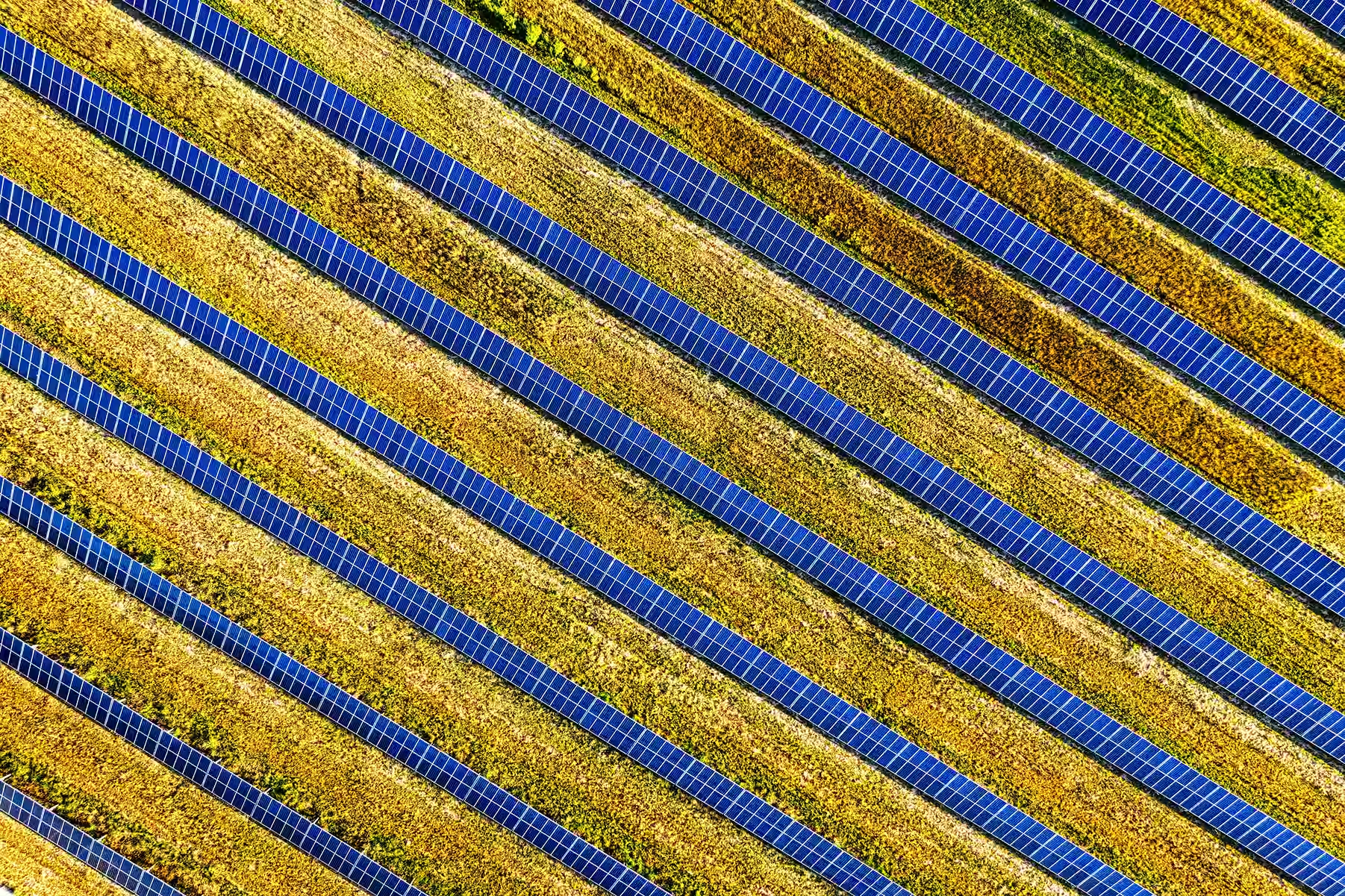
Simon Zadek: So why is it that when we buy a Coca-Cola can full of whatever it is, we don't expect it to be subsidised by the government? But when we buy the equivalent amount of water, we can't imagine it not being subsidised by the government. So why can't we make a market for water that doesn't require subsidies from government that are not sustainable at scale, given the state of public finances, not just in the Global South, but increasingly all over the world? Now translate that into water plus technology, which is desalination. Today, desalination technology is obviously in the market and desalination equipment is purchased by industrial operations, data centres, hotels in dry areas and many others. If you look at where the real potable water constraints are, i.e. low and middle-income households in climate-distressed areas, desalination technology is absolutely unaffordable at that level. And yet, they can't access water either at all, sufficiently, or at an affordable price. So, what would we need to do to create a market for desalinated water that was affordable by low and middle-income households? Well, it turns out that that's exactly what we've done for solar. Fifteen years ago, there was barely a person on the planet who thought that last year Pakistan would invest in 7 gigawatts of energy. A huge uplift compared to Europe. Only a small amount compared to China, but that's really not a comparison that is entirely relevant. What happened? And what happened in Nigeria? An oil state that is absolutely booming in the solar mini-grids area. And the answer is, they got cheap because there was huge scale. Governments couldn't provide electricity infrastructure that was affordable. New financing innovations created lease arrangements and all sorts of other ways in which low and middle-income households and small communities could afford to build infrastructure. And technologically, off-grid opportunities became available and so not dependent on large-scale national or regional electricity grid infrastructure. And hey presto, we have low and middle-income households buying solar panels in order to keep going. And that's also for a herder in Mongolia in a tent. Yeah, and so that to me illustrates not uniquely, even though solar costs have fallen so far, illustrates exactly what we need to do across multiple energy spaces, across food, across water, across health delivery, and other aspects of what particularly vulnerable households and communities are going to need to acquire in a world that is entering uncharted territory. and that governments, even those with the best will in the world, are really going to struggle to provide.
Katherine Keddie: I think, particularly with the solar and renewables example, it's a great illustration of how different actors can come in at the beginning, and then eventually it just becomes so much better, so much more affordable, and the scale just allows you to be able to expand it. Therefore, it's a massive opportunity for private markets to get involved. As opposed to thinking of it as a model where public financing governments, for example, have to step in to help people. It's at a scale where everyone wants to get involved because it's just a great opportunity.
Solar energy as a model for policy-driven market creation
Simon Zadek: So yes and but, as always. So if you go back to the earlier days, what really triggered the change? Now today, You know, what everybody talks about is the extraordinary fall in kilowatt-hour costs of solar, and to a lesser extent, but wind as well, as compared to dot, dot, dot, fill in the gaps for any fossil fuel you want, right? But it wasn't originally like that. You know, solar costs were really high. Wind costs were really high. We were high up the so-called technology cost curve. And who stepped in? Well, to begin with, it was Germany. So Germany was the feed-in tariff friend to the world, deployed what effectively was tens of billions of euros of tax dollars, and increased consumer electricity costs, and created a highly concentrated scale demand. Who was the other? It was China. So China took the advantage and started producing at scale, which allowed them to drive costs down. So actually, yes, technology costs have fallen over the past 10 years in the most extraordinary manner, but renewables markets were driven by innovative policies. that were ambitious enough to trigger the way in which not just a certain amount of renewables will be deployed, but an entire market and industry globally would be shaped. And so we need to think about how policies are needed to drive a much wider array of adaptation markets that over time, to your point, become self-sustaining because of scale and falling technology costs and standardisation that allows those products to become affordable to the audiences and the stakeholders and the consumers that need them. Yeah, and it's those upfront policy dynamics that are significantly what Morphosis on the insights side of our work. So the analytic research policy engagement work has focused on. And of course, it's the businesses that are going to deliver those adaptation solutions is what we focus on, on the investment side of Morphosis as business.
Katherine Keddie: So when we're thinking about those ambitious policy decisions at the start that, like you say, kind of kick-started the eventual curve that brought down the cost of solar, what do you think we can learn from that experience when applying to this new challenge slash opportunity of the adaptation economy?
Financial regulation, climate risk pricing, and the role of central banks
Simon Zadek: Yeah. So let's just for a moment stick with renewables, but realise that they're not just part of mitigation, but they're part of adaptation. So it turns out that some type of renewables are going to fall apart at two degrees, and other types of renewables are not going to fall apart at two degrees. Some parts of renewables are going to require large-scale grid infrastructure to be sustained by governments or large business sectors, and others are going to be distributed into mini-grids and therefore aren't dependent on governments sustaining that infrastructure or large businesses continuing to invest large amounts of money. So even within that, I'll say narrow example, but very important example of renewables, there's one type of investment that might have much higher resilience and adaptive capabilities and characteristics, and another type of renewables that has far less adaptation and adaptive and resilience characteristics. So it's important for us to recognise that adaptation and mitigation, yeah, are not different. We need all aspects of mitigation, particularly when it involves infrastructure development, to go through the lens of an adaptation resilience test to ensure that those mitigation solutions are also going to deliver the long-term energy supply solutions that we really need. And if we stick on basic needs, which is a potentially wide spectrum, but let's say food, water, shelter, health, security. I mean, we can debate what's in and what's out. Actually, in almost all of those markets, actually all of those markets, there are significant policy engagements that shape the basis on which innovation happens, so investment in research and development, that shape the basis on which markets price goods. Think of pharmaceutical products as a case in point. Think of food products in many parts of the world. Think of water in many parts of the world. There are many rules and regulations set by policy makers, standards makers and regulators that influence the basis on which technologies and which types of businesses can function and deliver those products and services effectively. And now think about the role of central banks and financial regulators in the way in which they understand risk and the way in which they encourage the investment community to price risk. Obviously, underpricing climate risk, not just carbon, but physical effects, will lead to the wrong types of investment in the wrong types of technology because climate risk is being underpriced. The wrong kinds of weightings through Basel III and other aspects of financial regulation will lead adaptive assets to have too much capital retained, which will make them less profitable. Whereas the right kind of risk weightings will benefit adaptation investments because a bank or an asset manager or an insurance company doesn't have to hold so much capital because the adaptive capabilities are delivering a lower risk profile to the asset. And so from innovation, to skill development, to regulated pricing, to standards of businesses, to financial regulation, all of these and other types of, I'll call them broadly policy interventions, although some of them are regulatory and standards and so on, are all things we know shape the way markets function. This is not a new story. This is an old story. Policy has always created markets. Some good, some bad, some efficient, some not efficient, many illegal, some not illegal. They're all over the place. And so our challenge is not to imagine something exotic that has never been thought about before, but to go, If what we need are markets that are capable of delivering adaptation solutions, so products and services, particularly to low and middle income households in vulnerable regions. Vulnerable is not an algorithm for the global south. Vulnerable means the global north too, just while we're focusing on that point. and that we need policies that drive those markets forward, that incentivise them to begin with, potentially even subsidise them to begin with, but with an aim of creating self-sustained, commercially viable markets that in turn can attract private capital without blending, without subsidies, without guarantees from government, which are simply limited in their availability. Then we're beginning to create adaptation markets that, in aggregation and in the way they fit together, begin to create economies, entire economies, that can function more effectively in delivering products and services that people are going to need in that world that we're talking about. It's actually really straightforward when one thinks about it. It's just the work is not being done.
Katherine Keddie: I think you outlined it in two parts earlier, which I think was really useful. One part, which is a solution. So desalination, for example, could be a very important adaptation solution. Flood defences could be an adaptation solution. And then on the other hand, it's when making financial decisions when investing, does that come with an understanding of climate risk, which often it does not? Do you think that's a fair assessment of the two parts?
Simon Zadek: Yes. So today, you might find that adaptation solution businesses like delivering small-scale water desalination are relatively unprofitable because water is not priced as it should be, say, as a result, they are undervalued by investors, those businesses, as a result, They are undercapitalised by the investment community. As a result, they can't scale and bring down the costs of production in order to make them more accessible and affordable to all, but particularly lower and middle-income households. So that's the vicious circle. So what do you really need? Well, you need to create a virtuous circle. So what does the virtuous circle look like? It means, how do we price that business, given where we think climate risk and demand is going? and where we think policy action is going to be taken that supports that category of business to become more successful in the future. Then, as an investor I'm going, well today they're not so profitable, but I know these policy measures are coming into play. Climate risk is increasingly going to be priced in as a result of financial regulation or other effects. Consumers are going to rely less on centralised grid delivery of water and are going to increasingly look for decentralised solutions. Hey, we've just been there with mini-grids, that's the conversation we just had. And so, actually, the likely future value of this business over a reasonable period of time is quite a lot higher than the market is currently valuing them at. Oh, so that means this is an undervalued business. Well, as an investor, what do I spend my whole time doing? I spend my time looking for undervalued businesses where there is the possibility of a liquidity event down the road. If I'm a private equity investor, obviously if I'm into publicly traded equities, that's totally different. And so suddenly I'm going, that's a business worth investing in as long as They have a strategy that allows them to get over this valley of death where markets are backward looking and are not effectively rewarding the adaptation solution that with scale and over time and as climate risk and impact becomes more significant will become a more and more desired product in the market. And so if I know that in Kenya, government policy is going to move in a way that is going to make a particular type of adaptation solution more viable going forward, I'm going to be more interested in investing in a business that's operating in that economy. On the other hand, if I'm looking at the UK, and they're not going to advance those policy measures, so that adaptation business is unlikely to be profitable in the foreseeable future in that market, I'm less likely to invest in that business. So as an investor, I'm interested in the asset, I'm interested in the market that they're in, but what I really want to understand in order to get an edge. over other investors is where do I think this market is heading? How are policy influencers going to change the way that market functions and either make this business more or less profitable over time? And frankly, can I steal an edge on my competitor investors by spotting the businesses that are undervalued, undercapitalised, and could actually become much more important in a world that is severely climate-impacted?
Katherine Keddie: What do you think the barriers are for investors currently in spotting those undervalued businesses?
Why private adaptation investment is undercounted
Simon Zadek: Yes. So when you look at the adaptation financing data that researchers publish, then what we know from that data is that there's not much being invested in adaptation, and the private sector hasn't turned up to the party as yet. So firstly, is that really true? Actually, maybe not so much. When you talk to Brazilian agribusinesses, we, as part of our work in developing this policy framework, have done with FGV in Brazil, a detailed Brazilian case study of adaptation economy and finance. Agribusinesses will tell you in Brazil that they're not investing in adaptation. And then you get below the surface and you're, well, so tell me what you're investing in your supply chain and new products and new this and new that. Hey, presto, of course, they are taking climate change into account. in all sorts of different ways, but they don't call it adaptation investment. So actually, firstly, the numbers terribly underestimate how much the private sector is engaged in adaptation finncing, it's just that it's not a labeled way of thinking about the category in the same way that sort of low-carbon investment has become a sort of labelled way of thinking about investment. Because low carbon investment is a much narrower set of investment opportunities. It's in the energy sector, it's in the property sector, it's in the mobility sector. One can classify those those market segments and asset classes in a much more effective way. Adaptation is much more integrated into broader investment patterns in how businesses evolve over time. But there are exceptions and growing numbers. So if a chocolate company, a Nestle, or one of the many that are buying cocoa from West Africa, are on the one hand making investments possibly in solar regeneration, in trying to improve the resilience of cocoa production in West Africa. And on the other hand, they're seeing the writing on the wall, and are quietly also investing in synthetic cocoa, or figuring out how to plant cocoa somewhere north of Siberia. where climate change dynamics will be quite different. And so, will they tell you that they're planning on exiting West Africa in a few years because they think climate change is going to be so destructive? Well, frankly, they probably won't. you know, their reputational team will mention that that's not a terribly good idea. Yeah, but actually one can see that they're investing in synthetic cocoa startups, because they can see that they need that to play through, yeah, as it becomes more and more difficult to use traditional soiled production techniques to grow the quality of cocoa at the cost that they need and stability of supply in order to produce chocolate for wonderful people with lots of money to eat. And so I think the first part of the answer is there's a lot more of it about than we actually think. And I think that's a positive thing, but it sort of militates against us trying to count it in this way that we've counted sort of clean tech investment and low carbon investment. I think the second part of the story is that the narrative that adaptation is a public good remains in place. Oh, it's flood defences. I mean, everybody does flood defences, right? Because that's the easy one. Oh, yeah, the Dutch pay for that through taxes, and so on and so forth. We kind of know the story. And although we shouldn't shrug that off, whether it's a concrete wall, or whether it's an investment in nature's infrastructure, so mangroves, say, in order to reduce flood risk, these are real investments that often aren't easily attached to a market-driven business model. Although, we know from drawing capital markets into toll roads that we can turn a public good, which is a road that cars drive along, into a private good. by generating a private revenue flow, in this case from toll cars. So we know also increasingly that we can turn a public good like mangroves into a semi-private good by creating revenue streams that draw private capital into investment in mangroves. So the second part is that adaptation is a public good, not our business, actually is something that's already shifting significantly as we speak. The third part of the story is actually people from the industry, by which I mean the financial community, beginning to increasingly publish projections of market opportunities in the adaptation space. The Boston Consulting Group recently produced a really fascinating piece about the prospects for private equity investments in adaptation sectors across many of the basic needs areas that I've just described, sanitation and a whole bunch of others that I hadn't mentioned. GIC, one of the two major Singapore sovereign wealth funds, recently produced a piece called The Inevitable Investment, i.e. in Adaptation Financing, mapping out what they thought was the growth effectively, although they didn't call it that, of the adaptation economy. moving from 1 trillion to 4 trillion between now and 2030. They didn't frame it as the adaptation economy, but that's actually exactly what they were talking about. So we begin to see insiders, i.e. people within the financial community and the business community, talking about how this market is gonna develop and looking quite concretely at what the sorts of returns are. And then the fourth part, is to do with policy frameworks. So let me just touch on this briefly. So when the renewables hockey stick begun, there was a lot of policy experimentation. What kind of policy levers will reduce the cost of capital, de-risk the technology risk, de-risk the policy risk, all of the stuff in order to make it as cheap as possible to pour money into renewables? Feed-in tariffs and all these different things were sort of up for grabs. And for 10 years, there was a lot of experimentation in different types of policy models for incentivising private investment in renewables. Today, if you ask, what's the policy framework for incentivising private investment in renewables, you will get almost the same turnkey model, whether you're in the Sudan or Switzerland. a small exaggeration, but trust me, not a lot. It's an entirely standardised policy framework. So it turns out in the adaptation space, there is no playbook. There's no policy playbook. There's a bit here, there's a bit there. Somebody does a bit on water, somebody does a bit on sanitation, invest a little bit in different types of crop seeds. It's a scattergun approach. And so investors, when asked, is this government moving systematically, to incentivise private investment into dot dot dot dot their answer is don't really know because there's no systematic framework to work from. Now the argument is is that adaptation is so heterogeneous and therefore different from renewables that there can't be a standardised framework and at Morphosis our view is just that that's plain wrong. And so our take is not that we've got. you know, the silver bullet answer today, but our offering is a first version of what a standardised policy framework could look like that allows governments to begin to plan more systematically, not just at a vertical sector level, but at a transversal economic development level that allows investors to understand the difference between what one country is doing vis-a-vis what another country is doing, and to enable adaptation solution providers to go, that market looks more interesting and that market looks like crap. And we think that market is going to get more interesting because we can see, benchmarked against a standardised policy framework, that this government is now moving forward on that agenda in this measurable way. So creating a policy framework for catalysing the adaptation economy is not just a conceptually interesting act of contribution or kindness. We think it's essential to begin to standardise that policy framework to enable governments, investors, and solution providers to begin to understand where they should be channelling resources and focusing their energy. and to help policy makers get their heads around where this fits into industrial strategy, where it fits into financial regulation, where it fits into trade negotiations, and so on, right across the board.
Katherine Keddie: So I think you have really nicely laid out what the adaptation economy is as a whole and some of the challenges that you're facing and the policy levers that can make a big difference, the innovation, the understanding of value that can be improved, particularly for investors. As an investment group yourself, when you're thinking about adaptation solutions to invest in, What is the criteria that you're considering for investment?
Morphosis's investment criteria
Simon Zadek: Right, so we have a number of layers to our investment framework. One I've mentioned already, which is we're interested in a basic needs agenda, so we're less interested in high quality handbags that might be sold on the streets of Geneva, and we're more interested in food, water, health and security. So that's level one. So that puts out of scope for us, not necessarily for others, a lot of different sectors. Secondly, we're particularly interested in low and middle-income households. But I need to just explain briefly what I mean by that and why. It's partly a values view, which is, I'm not sure that Morphosis wants to spend too much time figuring out how ultra-rich people are going to survive climate change. It just doesn't really interest us very much. But it's also a financial and economic view, which is that actually the largest markets for adaptation solutions are going to be the billions of people that fit into low and middle-income household ranges. So looking for businesses that are delivering solutions to those market segments, which is not the Nike shoes, but is the premium shoes, sorry, the value shoes, to us is more interesting from a values perspective and from a market growth perspective. But in order to look at adaptation solutions that could be affordable to low and middle-income households, we're only interested in scalable businesses. Because they need to reach scale to bring down the cost of their products and services. that tends to edge one towards technology-intensive products and services. And so looking at desalination, looking at other tech products, infratech products particularly, we tend to get drawn towards one of the companies we're working with at the moment is indeed in the desalination area. and we're interested in what happens to that technology when production is far more scaled and how far down the technology cost curve that technology can fall and will it become affordable on a cost per square per cubic meter of water to low and middle income households. So that's another criteria. Now that doesn't mean only looking at scale through tech. So one of the businesses that we're working with at the moment is actually in the ecological infrastructure investment space. And their scaling is more complicated as a result. and has to do with methodological application, creating large data infrastructure, so to some extent tech, in order to bring down the costs of being able to draw investment into ecological landscapes. So there's tech-intensive, tends to lend itself to scale more effectively, but also one can look at less tech-intensive under certain conditions. And then to add another criteria, in the world of adaptation, the distinction is made between adaptation and resilience. And often one will see sort of as normal discourse, people go adaptation and resilience without really distinguishing what it means. So from an investment point of view, we look at adaptation as the product and service innovation. and we look at resilience as whether the business will be resilient in a world that is more severely climate-impacted. So that's looking at the entire value chain of the business itself and understanding resilience through that perspective. So adaptation is the product and service, resilience is the business in a climate-impacted world. So we make that distinction. So there may be a brilliant product and service, but the business model may not, in our view, be able to cope with high levels of climate change itself, given where they're getting raw materials from, and so on and so forth. And then, finally, and specific to Morphosis, we're principally looking at series A investments. So we're less interested in the sort of strictly VC end. We're more interested where there is a rounded business, a well-defined product, some sales in play, but the real growth period hasn't started yet. So it's in that sort of point in the development chain that we're principally looking at businesses to invest in. I think what we're seeing is, I don't know whether you would call it a gaggle or a swarm or an avalanche, but what we're seeing is a huge number of growth businesses that are effectively in the adaptation solution space. And so the dilemma is not trying to attract pipeline, but trying to figure out, as is often the case, which ones are most interesting to invest in. And beyond that, we find a lot of what we think in principle should be investable businesses to be businesses, as I said before, that could be profitable in the future, but they don't necessarily have what we would call a transition market strategy. How to deal with that period of time, not just where they haven't reached scale, that would be a normal growth business challenge, but where markets are not pricing climate risk properly, where policies are not in play correctly, and where you need a short to medium term tactical strategy in order to navigate that period before markets become more responsive to the adaptation solution that you're actually providing. And so in our work so far, we found that we want to and need to work closely with those businesses that we're considering investments in, in helping them to develop that transition market strategy, which could be a three-year period, a five-year period, a seven-year period, but also could mean which jurisdictions are likely to provide most interesting returns at this point in time, as opposed to the many markets that might be relevant to their adaptation solution in the future.
Katherine Keddie: So you're not following a path of build it and they will come. You have an understanding of the difficulties within your market and a plan to see yourself through.
Adaptation versus resilience as distinct investment lenses
Simon Zadek: That's right. And I guess the challenge for us, if I can put it that way, is that although we talk about basic needs as the sort of content spectrum, most investment funds would have a much narrower approach. They would go, we're a water fund, or we're a sewage fund, or we're a baked bean fund. In other words, the common practice is a vertical focus. For good reason, not for bad reason. Our view is that there is a need to specialise in particular areas, but that the adaptation space requires transversal capabilities and criteria being applied and support being brought to bear that is often not unique to the particular vertical that one company fits into.
Katherine Keddie: Yeah, it's a really interesting approach to investment and expertise that I think you're bringing to the table. I mean, we've already explored all of the different aspects of what it would take to scale an adaptation solution. And it's definitely a different approach to what is typical in the market. Coming now, I think, to the end of our session, I wanted to ask you a few broad questions, which hopefully you will find fun. My first is, in a perfect world in the future, if your kind of vision for what you want to see come to pass happens, what does that world look like?
Simon Zadek: The world or Morphosis?
Katherine Keddie: The world.
Simon Zadek: the world. So as many people have said far better than I can, there are limits to adaptive capabilities. And so I am not Pollyannish. about the challenge, particularly of vulnerable communities in the tropics, for example, of adapting to climate change that is already baked in to the world we understand. And so, hence, we will see large-scale migration because adaptation is so hard in those contexts, if not impossible. Number one. So I don't want to describe a world to you where we're all having fun adapting, irrespective of the degree of climate change. That would be just idiotic and irresponsible on my part. But I do think we have extraordinary adaptive capabilities, you know, as a sort of hopelessly deluded but reasonably intelligent species. And as a species, let's be honest, that is a technological species in many of the aspects of its adaptive performance over millennia. And so I think we need to not neglect the importance of preserving and restoring nature, for example, but we need to understand that as a technological species, a lot of our adaptive performance and practice will depend on how we develop and deploy a range of different technologies. I think that we will see, not everywhere, because nothing is everywhere, more and more decentralised infrastructure, and communities and households increasingly relying on the one hand, on globally produced technology, and on the other hand, locally deployed technology. So if you think of back to your mini grids in Nigeria, Yes, that's decentralised, except that all the solar panels come from China. So you're combining both a very highly centralised and global technology play with a very localised, decentralised deployment model. And I think we will see increasingly that strange mixture playing out in practice. I also think, just to add one more characteristic, I'm sure you don't want too many, that on the financing side, we will see some fairly radical changes, partly because of the limits to public finance, and increasingly so, or the redeployment of public finance to other priorities, such as defence. Partly because we will see the withdrawal of modern financial institutions from severely climate-impacted areas. That already is the case in some parts of the world, like the Sahel, major parts of the Sahel. but will increasingly be the case that actually our grand model of modern financial system is simply not interested in engaging in growing parts of the world where climate risks are simply too high and the returns are too uncertain. And on the other hand, the third part of the finance story is that we will see more and more citizen-led innovation in the financing space. So last year, the level of citizen remittances to low and middle-income countries, so that's migrant labour working in one place, sending money to other places, was $700 billion. So you add up all of ODA, Overseas Development Assistance, you add to that all of foreign direct investment, the whole lot, and remittances was twice that amount. to low and middle-income countries. So actually, the biggest investors in low and middle-income countries today are individuals. They're not financial institutions at all. It's a complete myth. And so I think we're not seeing the way in which these different innovations that we've always considered to be on the margin could very well become really major parts of the way, for example, we finance adaptation, solution innovations at the business level and at the household level going forward.
Katherine Keddie: So I think you know what I'm going to ask next, which is long-term vision for Morphosis, let's say in 10 years, what does that look like?
Morphosis's ecosystem growth model and the Rise of the Adaptation Economy report
Simon Zadek: Good question. So I don't imagine Morphosis as having an ever-expanding balance sheet, which is the way many investment firms would talk about success. What I do imagine, though, is Morphosis expanding as an ecosystem of different actors and achieving scale through those partnerships and social relationships and leveraging between each other. Now, what does that mean in practice? Can we imagine a private equity firm in South Africa or Peru or Vietnam going, we actually want to build the equivalent here to what Morphosis has built somewhere at an international level. And we want to tap into the IP that Morphosis has. We want to tap into the knowledge frameworks and infrastructure that Morphosis has built, but actually we want to run our own private equity firm. We don't want to become part of Morphosis Inc. We want to become part of Morphosis Eco. Yeah. And so that to us is a very interesting vision of scale. It's not anti-commercial in any sense of the word, but it's thinking about a distributed growth structure in the same way that we talk about distributed infrastructure for delivery of basic needs. We see no reason why one needs to build a monolithic large-scale institution in order to achieve scale delivering commercial success or and broader impact on the adaptation side. So in 10 years time I would like Morphosis to be an ecosystem of different actors including Morphosis Inc. but including many other actors that are working in concert and sharing knowledge and infrastructure and IP, co-investing, sharing the development of pipeline of research and of policy engagement. And I think that we could, in that vision, make a useful contribution in a commercially effective way.
Katherine Keddie: So many of the ideas that you shared today, which I think are the first iteration of that vision for Morphosis, are available in this report that you've just published. Can you tell us a bit about the report, give us an introduction, and it will be linked in the description of this episode.
Simon Zadek: I fear even using the word report as this world is overflowing with reports. And so I'd like to describe what it is and what it's for, rather than what its form is, which to some extent is neither here nor there. We have joined forces with an unusual coalition of partners. In Brazil, FGV, which is certainly one of Brazil's most prestigious business schools and research institutes with networks across the world, has been, if you like, our anchor partner and Itaúsa, which is Brazil's largest asset manager, that has both engaged on content and through its institute provided some financial resources to help the work take place. And then we have joined with the Paulson Institute, which is the non-profit vehicle that Hank Paulson established in order to advance a green finance and nature and now also an adaptation agenda at scale, particularly in China and the US. And the communications and public affairs company, Basilinna, which is interesting both because of their contribution to some of the research, particularly the China case study, and also because of their network of engagements with businesses and policy makers, which allows us to clarify how best to develop and communicate the underlying knowledge that we've developed during the period of this work. So a very interesting set of actors have come together for this first piece of work. What is it? Well, it's wrapped up in a piece of writing, a report, called ‘The Rise of the Adaptation Economy’, with a subtitle, ‘Investing in adaptation and resilience in a world beyond 1.5 degrees’. And in that sense, from a personal point of view, it follows on from a piece published through NatureFinance in advance of COP28 called ‘Time to Plan for a World Beyond 1.5 Degrees’. So it takes it logically to the next step, now as part of a different vehicle and set of activities. And sitting underneath the core paper are a whole lot of technical analytic papers on what do we mean by the adaptation economy and what's the landscape of adaptation finance. And then these two primary case studies, one on Brazil and one on China. What's the value added of this piece of work? So hopefully the value added is a reframing of the adaptation agenda, not to exclude adaptation finance, but to focus on the adaptation economy of which finance is one part. How do we develop these markets through policy intervention that can harness technology and other factors in order to make adaptation solutions profitable and therefore attract the private capital that's needed to scale and drive down the cost of those solutions to make them affordable for low and middle-income households, what we've been talking about before. We are proposing a policy framework that we think forms the basis for a standardised playbook for policymakers to pursue. It's not the last word, it's the first word, and we're sure that it will improve over time, but we think this is a step beyond ad hockery into what is really needed in advancing these adaptation markets at scale going forward. We think that at this stage, it is useful, and that's why we've done it, to put forward a qualitative framework. So it describes seven domains, policy domains, It identifies leading policy levers and then provides use cases against most, if not all of those policy levers. This is a good first step for a conversation. But we also think that this framework needs to deliver a measurable model. that enables us to go, so how is the UK doing compared to France? How is Canada doing compared to Australia? How is Peru doing compared to Sierra Leone? And so we've built the framework on a qualitative basis, but with already work in progress to translate that into a measured model at a sovereign level. of how each country is advancing according to the policy playbook that we think makes sense in implementing policy measures that will encourage the development of adaptation markets. Now measures are always very contested and we're not trying to that everything is precisely correct, but we're sure that some level of measurability and comparability will be useful both for policy makers and for the market that is trying to distinguish between different countries and different market opportunities. We're starting at the sovereign level and we'll bring out an alpha version of it early in 2026. But we already see how the framework and its measurability can be brought down. to a sub-sovereign level, potentially a city level, and ultimately to an asset level, to enable investors to understand how far a particular company has advanced in implementing the right actions at the innovation level, so that's adaptation, and at the resilience level. Ironically, such measures so far are largely unavailable.
Katherine Keddie: Thank you very much, Simon, for giving us an introduction into the adaptation economy, the opportunity that it presents, and the new resource, I won't say report, resource, which is available now. For anyone listening, you can find more about Morphosis on LinkedIn, about Simon on LinkedIn, and Morphosis on their website as well as accessing the report that will be linked in the show description. So for now, thank you so much, Simon, for joining us. And everyone else can join us for the next episode of Scaling Green-Tech.
Simon Zadek: Fantastic, and thanks to you very much indeed. Great session.











.jpeg)