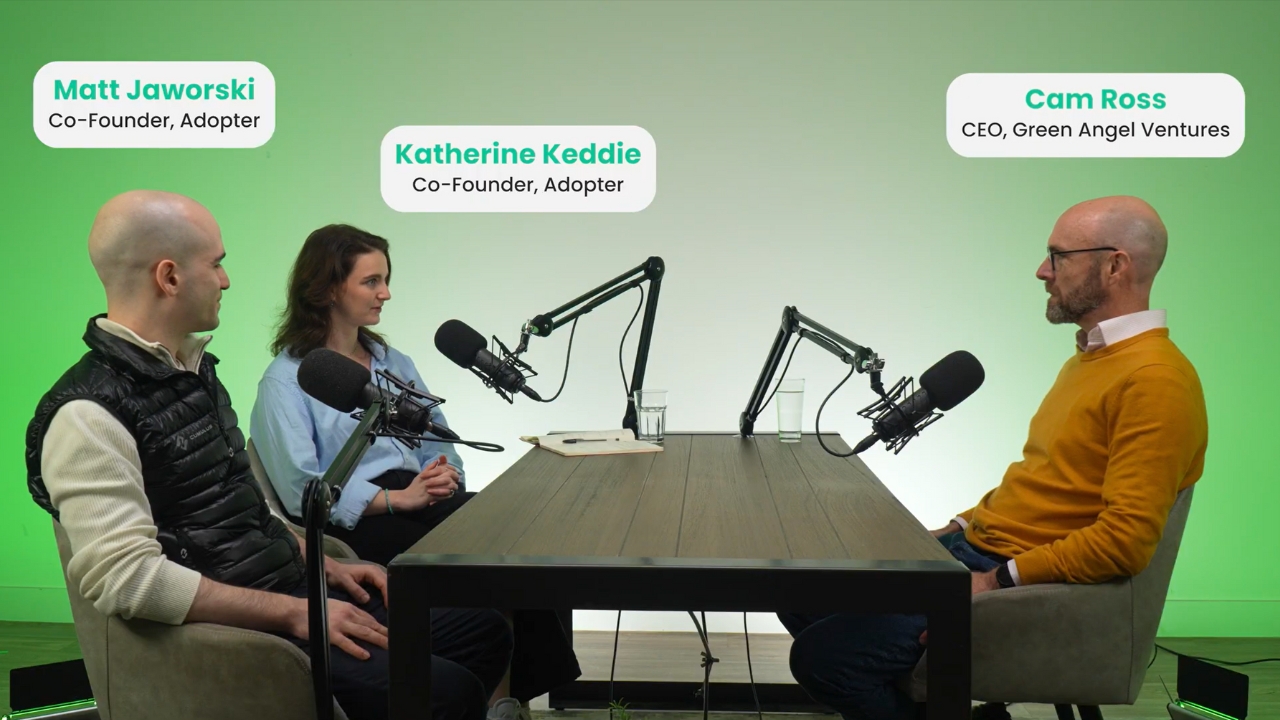
Katherine Keddie: Hello and welcome to Scaling Green-Tech. We are Katherine Keddie and Matt Jaworski, co-founders of Adopter. Adopter was Europe's first marketing agency to specialise in climate tech and adaptation. In this podcast, we take you behind the scenes of climate tech's most inspiring journeys from breakthrough scaling wins to game-changing innovations.
Join us for practical lessons, proven strategies and actionable insights from founders, investors, and change makers making climate solutions and adaptations a reality.
Hello and welcome to Scaling Green-Tech with me, Katherine Keddie. I'm here with a really exciting guest. We have Helin Cox, who is the CTO of Climeworks. Thank you so much for joining us. Hello.
Helin Cox: Thank you for having me.
Katherine Keddie: So our first question, as usual, is: how would you describe Climeworks to a five-year-old?
Explaining direct air capture with a vacuum cleaner analogy
Helin Cox: I have a two-year-old at home and I was thinking about this actually: how would I explain this to him? And he has this book called Inventions that have, throughout history all kinds of machines and how they were invented. And one of those pages is a vacuum cleaner. And I've thought about using that as the example to explain to him what direct air capture is, but it's the least-used page of the entire book.
So I haven't been able to get him interested, but once he is there, I'll use that as an example of explaining direct air capture. But fundamentally, direct air capture is quite simple to understand. It's a bit harder on the technology side, but it's basically like a vacuum cleaner.
So what a vacuum cleaner does is it takes dirty air it puts it through a filter. That filter basically retains all the particulate matter, all of the dust, the dirt and the clean air kind of exits out. And once that filter is full, you unload that filter, you store away the dirt and the dust into the trash can, and you put a fresh filter in to, to redo that process all over again.
And that's similar to what we do in direct air capture. We take air from the atmosphere. We have filter materials in our machines that collect CO2, just like a vacuum cleaner collects dust and dirt. So we collect the CO2, and once our filter is full, we shut down our machine. We take out the CO2 and store it underground permanently and release the clean air into the atmosphere.
So it's very much like a vacuum cleaner. And hopefully that will work at some point with my 2-year-old.
Katherine Keddie: Okay. Maybe that is enough to get him to stay on that page this time.
Helin Cox: I, we would have to put tyres on the vacuum cleaner to make it look like a car for him to currently be interested.
Katherine Keddie: Yeah. Okay. Maybe wait a couple of years and it will come back around,
Helin Cox: Yeah, exactly. Exactly.
Katherine Keddie: Once the car phase is done. Okay. And Climeworks is well known as a leader in direct air capture.
What is unique about Climeworks as a company?
Where Climeworks sits in the carbon removal market
Helin Cox: So maybe if we take it really high-level view and then just focus on how Climeworks fits in this space. So Climeworks really focuses on the entire carbon removal market, and direct air capture, DAC, as we call it, is part of that carbon removal solution portfolio.
But if you take an even bigger view, there's all of the CO2 emissions across the board from fossil fuels. And a lot of those fossil fuels are actually dealt with through emission reductions, right? So the majority of the CO2 management within the climate, if you wanna get to net zero, will be with emission reductions.
And the last bit of those emissions will be dealt with carbon removal solutions if you wanna reach net zero. And within those carbon removal solutions, there are engineered durable solutions, direct air capture, which is the technology that Climeworks offers. So that's how it fits in that overall industry as a portfolio and as a company.
What I think makes us really unique, actually, is that we have to develop a new market that doesn't currently exist. We have to develop a technology that is the lowest cost of its kind for a very difficult process engineering problem. And we have to develop projects, build plants, and operate them because in order to be able to deploy the technology, somebody also needs to develop the projects and operate them.
So what makes Climeworks really unique than a lot of the other companies is that we have the market piece, we have the project development piece, we have the operating plant piece, and we have the technology piece. And I think bringing all of that together is really the unique offering that Climeworks brings to the table.
Katherine Keddie: There's so much that I would love to get into, but just before we kind of dive further into Climeworks and how it stands out in the market, tell us a little bit about your personal background, your journey before Climeworks.
Helin Cox: So I'm actually Turkish, I was born in, in, raised in Turkey in Ankara, which is the Washington DC of Turkey.
So that's where I grew up. And as a young teenager, I moved to the US. And I went to Purdue University, which is in the Midwest, for chemical engineering. And then I started working for Honeywell UOP, which is nearby, by the Purdue campus. And I lucked out into the job because I have always loved technology; I've loved R&D and I didn't realise the company I was starting to work for was one of the best technology licensing firms in the world.
So I started at the company and realised it was a dream job. And I started there as an R&D development engineer and absolutely loved it. I spent a number of years in the field. Starting up industrial first of a kind, plants, troubleshooting, demonstrating around, what, more importantly, learning what doesn't work in the field versus what works in the lab.
And then I went back and spent a number of years in the business trying to commercialise new technologies, first of a kind, plants, developing new product lines. And then my final job there was actually my dream job at the company, where I ran the entire new product portfolio for the company for renewables sustainable technology solutions portfolio.
So green hydrogen, blue hydrogen, long-duration energy storage, as well as all of the traditional areas. So refining, petrochemicals, gas everything from new materials to new product development to new process design. And so that, that was that was an incredible experience. And then I actually just happened upon Climeworks and met the team and fell in love with it.
And that's how I landed there.
Katherine Keddie: And what made you go, I have to be involved with Climeworks?
Helin Cox: So I had been really, I had been coming to a place in my career where I more and more wanted to focus on sustainable technology solutions. So UOP actually had a very large portfolio, but I just really wanted to live and breathe it.
That's what I wanted my focus to be. So I've been itching to make that my main area. And in parallel, when I met the team. So there's two things that just made me go, this is a no-brainer. I met the team, so both the executive team and the technology team, I would say is one of world class.
So in terms of people who really wanna solve tough problems in the market, in plants and in technology, I, it's just, it's quite amazing. And I saw the facilities, so from my previous life, I was used to seeing cutting-edge analytical equipment, testing equipment. And so when I saw the facilities we have in Zurich, it's really quite impressive.
And I firmly believe you need to have the capabilities to be able to solve technical challenges. And when I realised the capabilities and the technical powers, that was to me a no-brainer.
Inside the Climeworks innovation centre in Zurich
Katherine Keddie: Because Climeworks has really invested in R&D capability and scale-up, right? I know that you have an innovation centre; for example, I think it's the biggest innovation centre for DAC in the world.
Is that right?
Helin Cox: Yep. I don't think there's anything like it in the world. In fact, anybody who wants to come visit, we'd love to have you. It really is quite incredible. It's actually a space that used to be used by a space agency. So you can imagine kind of the size of the area and how tall it is and how big it is.
And it's two levels where we have both wet chemical labs where we make materials rapid testing for performance of those materials and maker shop downstairs where we can prototype mechanical equipment really quickly and mid-scale testing where we really look at how these processes and materials kind of fare in a, at a commercial scale relevant condition.
So it's a really unique cutting-edge innovation centre in and of itself. And it's, I think, the only one of its kind for direct air capture.
Katherine Keddie: When you are coming to the company, I would imagine thinking about being a, coming into the CTO role, there's clearly a, a big investment in the company into R&D, but there are also many challenges remaining when it comes to scaling up.
And there's been a lot of, pressure on direct air capture, particularly for scaling, bringing down the cost, bringing down the energy demand, et cetera.
What are the main challenges? Help us understand what those look like.
The direct air capture cost stack
Helin Cox: So for direct air capture cost, it's actually a little bit distributed.
So if you look at the cost stack of DAC, a large cost factor comes from actually site selection. So it's technology-agnostic to a certain extent in that you need to find a site where sequestration is available. So you need to be able to find a site where there's an offtake for the CO2. Transport is expensive, so you can't really be too far away from sequestration.
So you need to be able to find a site where there's cheap and available sequestration. You also need to be able to find a site where you have cheap energy and preferably for us renewable power. So that's what we are really looking for, and that can actually substantially impact our cost in terms of just the carbon removal cost we can deliver to customers.
In addition to that, there's the cost of operating and maintenance, right? So direct air capture is just like any other process plant where you really need to be able to operate and maintain equipment reliably. And being able to do that autonomously, with as little inventory as possible, as few failures as possible, as reliably as possible, actually has a big impact on cost.
And finally, there's the technology piece, the fundamental cost of the technology that we bring. And as the, the as the chief technology officer, that's really where I focus on, is bringing the costs down in the technology space. But there are really contributors from each of those. And one really needs to look at it holistically to optimise the site, the operating and maintenance costs of that site and the technology contribution.
Katherine Keddie: So what you're saying is the cost is obviously multifaceted. Your focus specifically is on the technology side. What are the cost drivers within that technology atmosphere?
Helin Cox: So within technology, basically, what really governs the cost from just a fundamental perspective is how much throughput can you get per year?
So how much CO2 can you capture and store within a year for an investment size and the energy demand it takes to do that. That's really fundamentally those two factors. And the throughput really is a function of your filter material. So filter material makes a substantial difference in how much you can capture.
So imagine, say a sponge, you have a sponge, how much water that sponge sucks really depends on sort of the, the volume that sponge has that's empty, that can go into. That material is similar for us. Our sorbent material needs to be able to capture a lot of CO2, do it very energy efficiently and release it energy efficiently.
So we focus a lot of our energy on fundamental research and breakthroughs on that sorbent effectiveness, how effectively it captures. In addition to that, one of the high costs of direct air capture, once you deploy commercial plants, you find that is that sorbent life. So if that sorbent loses its effectiveness every six months, every year you have to shut down the entire plant.
You have to take out the filter material, and you have to install a new batch. And that really, one, it's the cost of that filter, new filter material, but also that you have to shut down production. So because of the really significant impact of that, we have made a lot of investment in being able to develop materials that can do all of this to really substantially drive the cost down.
So we have a very big chemistry lab. We have a 30-person team that focuses on synthesis, modification and breakthrough innovation of these materials. And that's a very big focus area for us, and that also affects energy consumption. So we really focus on how much energy it takes to release the CO2 and process the air.
The other area we really focus on is actually the machine design. From operational experience, one thing that makes DAC very unique compared to other process technologies is that we are exposed to air, right? And we're exposed to the weather. So if there's a hail or ice storm, it's coming into the unit, right?
You can't really stop it. And that's not really the case. In other process technologies, you're very much a closed system. And so the reliability of that equipment is super important because if you have to shut down, you lose production. So we really focus our energy on building mechanical designs that can cycle thousands of times no matter what the weather is outside or the conditions, reliably expectedly.
So we have a huge programme in making sure that our mechanical design is appropriate.
Katherine Keddie: So I know that you started building plants in Iceland, and that was the initial kind of base zero to begin your work.
And now you've also expanded into much hotter, much drier, more arid countries.
So clearly there is a lot of variety in terms of the sorts of conditions in which you can work.
From a technology perspective, obviously you are seeing results from different conditions in a lab setting. How does that differ, and what are the challenges when it comes to scaling that up into the reality of what actually happens on the ground?
Mid-scale rigs and the mobile testing unit
Helin Cox: So it's actually quite nuanced and difficult and has to be done with a lot of rigour. And I'll explain why that is in a minute, for us coming back to our innovation centre. We have invested a lot to be able to capture very different conditions within Zurich.
So we have made a lot of investment to build what we call mid-scale testing, which is a representative unit, one unit of a filter material where we treat the air with an air conditioning unit to very different conditions. So we can go up to 40 degrees Celsius at 15% humidity, all the way down to negative 25 degrees Celsius and 20% humidity.
Wow. So the range is up to 90% humidity. So the range is very large, and the reason why we made that investment is that we know how important it is to be able to forecast production through day and night, week to week, month to month, season to season. It becomes really immensely difficult to do that unless you have simulated all of that within an environment.
So that's one piece of machinery. We have to be able to close the gap between a lab environment where the air is just what you get versus conditioning it to the conditions that are relevant to the site. You're gonna build the plant. The second investment we've made, and this is completely unique to Climeworks, is that we have a mobile testing unit.
So this is a replica of the mid-scale testing unit. So it has a representative filter material from a representative site, and we can ship it around the world. And all it needs is an electricity source and a water source. That's really it. And we plug it in, and it intakes the air from the local site conditions.
So we really de-risk the local site conditions. And the reason we do that is that we want to be able to connect our lab measurements where we condition the air to really match site conditions. And if there's a condition we can't meet in the lab. So for example, in it's really quite incredible in Riyadh, it gets to 45 degrees Celsius and less than 10% humidity.
So making sure that our test results around that region match the local environments is super important. So we've sent our, actually, a mobile testing unit to the Kingdom of Saudi Arabia to really connect the dots there. In addition to that, there are sometimes local environments you can't catch in the lab, right?
So for example, in Iceland, if you go around the Mammoth Plant, you will smell something strange, and what you're smelling is sulphur. So it's because of all of the geothermal activity that's around. And we really hadn't tested if sulphur would make a difference in our filter material, right? Does it poison it?
Does it affect the performance? We found out it does not, but it's also really important to capture those local environments. So, in fact, then we went to the Kingdom of Saudi Arabia. It was super important to really understand: does sand dust make a difference? Because we don't have the capability to spray our midscale testing unit with sand, right?
So I think having that capability is quite unique and actually super important to be able to go to FID of a project for a local site, particularly in direct air capture, because you are so prone to the local site conditions, the temperature, the humidity of that place.
Katherine Keddie: But even though you have obviously these innovations that allow you to test more on a mid-size scale, surely there's still a part of you that's crossing your fingers to try at this scale-up stage to ensure that it works,
Helin Cox: Yeah. I try really hard not to leave anything to chance. Yeah. So my I, as I've mentioned before, I spent time in the field doing startups and what really helped there was that there was an incredible amount of thought and rigour that went into those startups. And as a startup engineer, you could really trust that people had thought through the design.
There were always surprises with first-of-a-kind plants. But, I have the, yes, I hope it works, but in the back of my mind, I've probably worked through a hundred failure modes and tried to figure out if it will or will not happen. But there's of course, always an, I hope this works.
Katherine Keddie: Yeah, no, of course. And because you have been such pioneers, I think, is it 18 years that Climeworks has been since it was founded?
Helin Cox: I think it was founded in 2009.
Katherine Keddie: Yeah, that's right. Wow. It shows that you guys have been groundbreaking in the industry. You've been pioneers and representatives of direct air capture, and in some ways that is a lot of pressure because every single win is a win for the industry, and every single failure is seen as a failure for the industry.
And obviously direct air capture as a method has come under a lot of criticism, particularly from the climate community. One of those areas is obviously price. And we've talked about how you are really focused on the reduction in prices as a key factor. Another, and I think you touched on it at the beginning in your explanation, is: where does direct air capture fit in comparison to other efforts to mitigate climate change?
Mitigation solutions in all different aspects, also adaptation solutions. Yep. What is the role of direct air capture within that kind of wider picture?
Where DAC fits against emission reductions
Helin Cox: I think maybe. If you think about the global emissions, right? The place that direct air capture plays is dealing with hard-to-abate sectors.
So when you look at the emissions portfolio, there are very good technical solutions today available for emission reductions: point source, carbon capture, renewable power, fuel replacement, and I think those all come those all have to be done to get to net zero. DAC will not play a role in displacing those solutions.
They're mutually complementary. So if you think about fossil fuel-generated emissions per year, it's about 40 gigatons per year, and 80 to 90% of that needs to be addressed with emission reduction solutions, right? But the last bit for hard-to-abate sectors that are fossil fuel-driven can't be practically or economically abated.
We still need to get to net zero, and we need to be able to do that with carbon removal solutions. And that means fossil fuels for that portion need to continue to be used because we don't have a good alternative. And we use carbon removal solutions to deal with that last bit. And within carbon removal solutions, there is a portfolio, right?
In fact, Climeworks has a portfolio of solutions where we offer nature-based, biochar and so on, so forth. And direct air capture is part of that solution, and that's how we see ourselves fitting in the general market of CO2 emission reduction.
Katherine Keddie: Yeah, sure. And then in that respect, also, the people that you work with have a nice differentiated portfolio of different investments in the space rather than one specific bet when it comes to carbon removal.
Helin Cox: Exactly. And they can think about the timeline of their portfolios, right?
So if you would like to make a direct impact today at a, a nice price point, nature-based solutions are a really good way to do that. Direct air captures more if you're really interested in durability and additionality; engineered solutions that's where you focus on- but having that portfolio really gives the handle to our customers and the world to grow this market, right?
So the CDR market needs to grow, and for that to happen, we need to offer a portfolio of solutions at an attractive pricing point so that the market can start absorbing these products.
Katherine Keddie: Interesting. Going back to the hard-to-abate for a moment. What I understand from what you said is that there are a lot of different aspects that can come into tackling climate change as a whole and specifically where something like direct air capture would fit in is within this hard-to-abate sector where there are really no other options.
Obviously what a common criticism of direct air capture is that it's enabling the oil and gas industry or continuing that cycle or, worst case, also giving the idea that we can just continue as we are because technology has solved the problem and we don't need to worry about it anymore.
What is your response to that? How does that align with your views and your mission as a company?
Helin Cox: I wish technology had solved the problem. We could continue. I wish that was true, but it just simply isn't. To be honest, I don't quite resonate with the criticism.
And the reason for that is because, as I mentioned, there are 40 gigatons of CO2 emissions in the atmosphere, and direct air capture cannot scale to that amount. So direct air capture can't displace 40 gigatons of CO2 in the atmosphere. So we can't enable fossil fuels to continue; fossil fuel use needs to come down to get to net zero.
But the way we enable fossil fuels is that there are hard-to-abate sectors that use fossil fuels and will likely need to continue using fossil fuels because there's no alternative. And for those areas, we need a solution.
And that solution is carbon removals, whether that be, that's nature-based, that's BECCS, that's direct air capture, but it's really enabling those hard-to-abate sectors to continue, but not necessarily continue to emit into the atmosphere such that we can't get to net zero.
So that's why I don't resonate with the criticism, because direct air capture won't displace 40 gigatons of fossil fuels, and we believe we need to get to net zero, and that needs to come from emission reductions. But there is a portion of hard-to-abate sectors where we will need solutions.
And one of those solutions is carbon removals and direct air capture within that.
Katherine Keddie: Let's skip for a moment to talk more about your customers and the people that are betting on your solution and work with you. Obviously, reading about your company, one thing I learned is that a large portion or the vast majority, of your customers are actually voluntary people who are investing in a voluntary capacity.
What do you think motivates people to do this? Because again, another common criticism of this type of work is that people are moving away from net zero; companies are moving away from net zero. Policy makers are moving away from net zero. So there's no demand in a voluntary market, but I think you prove that is not the case.
Voluntary buyers and risk-adjusted returns
Helin Cox: So there is demand in the voluntary market for sure. And I'll talk about that in a second. I think maybe where we. Where we need the focus is: how do we grow the market to gigaton scale? And I think that's where there will be a need for regulated markets. But if you wanna talk about today, how we commercialise technology, how we operate plants, how we scale this, there's actually a really big supportive cohort of customers and investors.
And so in terms of customers, those are the folks who buy carbon removal credits. And they are in, they have net zero goals themselves, right? It's not necessarily always put on them by regulation. And so they have themselves decided that they have car net zero emission ambitions. And in addition to that, they are excited by catalysing a new industry that they know will be needed.
And so they're willing to be part of this pioneer group that is building and catalysing this market. In terms of our investor group. What they really need is risk-adjusted returns that are good, right? So that's what investors look for, and that's what we as Climeworks develop, right?
So we have a CDR buyer base that's willing to buy CDR at a pricing point that is more than a regulated market would support today. And we have project development that allows us to find really cost-effective sites. We have plants, we have technology and plants that we can deploy such that when you bring all of that together, the cost and the price combination gets you a good risk-adjusted return.
So at the end of the day, that's what investors look for. And that's what we really focus on bringing at Climeworks. That combination of a pioneer customer base with a technology plus project solution that can deploy plants to deliver amounts of CDR that the market can con, can absorb today.
Now the question is. Does that setup work for Gigaton? Probably no. So maybe that's where people see the disconnect. How does this get into a gigaton scale and what do the governments and regulations play there? And I think that's when we will need governments and regulation to come in and make sure that we can meet our net zero targets.
I think that will be difficult to get to with only the volunteer market.
Katherine Keddie: Interesting. When you were building out your commercial foundation, how did you go about building that trust and market demand while still proving and scaling your technology? It's a journey that you're still on.
Helin Cox: It's hard. I think what we focus on is so the the base of investors and customers we have is a mix of course, but we have champions who have the patience for the long term as well. So it's really important to build an investor portfolio and a buyer portfolio that's mission-aligned with sort of what you're trying to accomplish.
So that's why we have that, and we're really proud of it, and that really helps enable us to do this in terms of just scaling the technology. Again, I, what we really need to do is give a positive risk-adjusted return to our investors. And that's really what we are focusing on today as we're scaling up.
So first of a kind plants are hard to do for a positive investment story, but we have the pricing point with our order book that allows us to be able to build these plants at reasonable returns. My role as a chief technology officer in this entire story is to make sure we deliver the technology we deliver, it meets its performance targets so that we meet our cost targets, so it produces the amount of CO2 we say it will, with the energy demand.
We estimated that it will, and it's de-risked for an investment of a plant when we reach an investment decision so that we can promise to our investors and say, okay, here's what it's gonna cost, here's what it's gonna produce, here's how it's gonna work, and we're confident that the technology will deliver.
And that's what the technology group focuses on delivering to an FID decision for these projects.
Katherine Keddie: Interesting. What do you find are the main pushbacks against the business case that you're trying to build, from customers, from investors? Like what are the kinds of pushbacks against that?
Offtake agreements and pushback on the business case
Helin Cox: So the business case usually the, the most difficult part is getting the contracted off offtake for long term.
So in general, if you don't have a firm offtake that covers at least 70% of the loan period, it'll be very difficult to justify because now you're building a plant where you might make a product that you can't sell.
So the biggest pushback we would get if you were to FID the plant too soon would be that you need to build an order book that is guaranteed. So that's actually quite difficult to do. The other big pushback we have is if we depend on sort of government funding and subsidy, there are always questions about stability of regulation, stability of government support.
So if we, if you try to construct a project where you have heavy dependence on regulation or subsidy, you might get a lot of pushback, even though the math makes sense, because given the global environment currently, people might question how stable those support systems are. So those are the two things we tend to see most often is that, dependence on regulation and or offtake periods for long-term pricing.
Katherine Keddie: Yeah. I think dependence on regulation is particularly an interesting topic that I'm sure will be relatable to lots of people listening. When I first started Adopter six years ago, it was very common that a kind of way of explaining the value that a climate tech business provided was through the lens of regulation.
So you would say the regulation says we need to reach net zero. Here is the carbon target; here is how the specific part of the carbon target relates to our work. It is inevitable that will happen. And therefore there's a business case for our work. And now, only over the course of six years, that argument has been undermined quite substantially by changes in regulation.
And particularly lots of investors that we've also had on this podcast have said I wouldn't invest in a business case that was focused that way anymore. It has to have very clear, like commercial benefit; it has to be faster, cheaper, whatever.
Helin Cox: Yep.
Katherine Keddie: What is the value driver for you if governments are saying we're rolling back on our net zero commitments and companies are also doing the same thing and pulling more out of the voluntary market?
Helin Cox: No, I think that's a really good question. And it is difficult for the market right now. So if you look at the Cleantech landscape, it's very apparent that the funding is coming down.
The regulations, regulatory support is coming down. And we feel that as well. We are a bit lucky in that because we helped build the CDR markets, we have firm offtakes at our, that are at pricing points that allow us to build profitable plants without regulat regulatory support necessarily.
So we are a bit lucky in that because we were a pioneer in building the market and building a DAC portfolio of buyers that we have firm offtake that are long at certain price ranges. In addition to that, what you really need to have is a site that, that allows you to have access to cheap energy and cheap storage.
And again, the team has spent a number of years scanning the globe trying to figure out where plants can be built economically. And so we have those pieces. There's never a perfect unicorn, but we can put these pieces together, combined with the technology innovations we've made between generation one and generation two, to now generation three.
If you put those three things together, we do truly bring a positive IRR project to the table without subsidies. If you can find those pieces. Now, as I mentioned, in order to scale this to gigaton, it really does need regulatory support and government because the market is small for what I just described, right?
So where we are today in our journey, we bring value by deploying risk-adjusted returns that are convincing to investors. But that's a small market and a small number of projects. And so, in order to build large projects in gigatons, many of these regulatory environments do need to change.
And we need to move towards a, people can call it stick or carrot probably we need both, but we need some practical form of regulation to enable these projects to move forward. And the jury’s still out on that. So we are, we got lucky, I think, in some senses in that we work on project development, we have plants and we have technology, and we helped build the market.
But I think other firms who are earlier in their journeys are probably feeling this is quite broadly at the moment.
Katherine Keddie: Interesting. Yeah. I guess in some ways you have a first mover advantage here, right? Because you've become synonymous with the category. You've built trust over time.
You have a reputation for being experts in this area. You mentioned that there are obviously many things that may make up an ideal project, in particular one that helps to bring the price down, like the logistics of the project itself as well as the technology are really important. What are the, what would be, like, the dream scenario for the most effective project?
What does that look like?
Helin Cox: So a dream scenario would be very close coupling of a sequestration site that is quite cheap. So cheap meaning either the service fee you have or the building costs would've been cheaper. Those sites exist around the globe, but there are not very many at the moment.
As those projects come up, those will increase. So that would be a dream come true and for us, actually, if we could access cheap renewable power for electricity, that would be amazing. Without having to go through connections, grids and things that build up costs or very intermittent sources.
In addition to that, for our desorption part of the process where we release the CO2, our process has this advantage of being able to use low-quality, low-temperature steam. And so if you look at waste steam coming from industrial plants, it's actually quite perfect. So if there was an industrial site where there was waste heat available, we can likely intake that quite cheaply and also without a sort of carbon emission effect because it's considered waste.
So that would be a perfect site if we had all of that together. And actually, if I'm having a wish, I'll make one more. If the project was located in the UK or Switzerland where the, the temperatures didn't swing so drastically as say, negative 25 to plus 40,
Katherine Keddie: Yeah,
Helin Cox: I think that would be absolutely perfect.
But unfortunately I don't think that site exists.
Katherine Keddie: Yeah. Speaking of negative 25 to plus 40, am I right in thinking that you've recently opened a new office in Calgary and you have some work in Canada happening?
Helin Cox: We have opened the office in Calgary, and we have a project development team there that's really working with industrial partners to investigate opportunities for projects in Canada.
Canada has a very favourable regulatory and government platform for these types of technologies. So we're investigating quite heavily if you wanna develop a project there. And I think it's actually the industrial area in Alberta, particularly, has quite good sites available for these types of projects.
Katherine Keddie: Interesting. And obviously the regulatory environment of a specific country is a substantial factor, right? In how ideal the site is specifically for this type of work. Broad strokes, what kind of regulatory environment is helpful to you? Are we thinking about like specific incentives that focus on direct air capture, or are there other factors that make an impact here?
Helin Cox: There's so from a regulatory perspective for technology, what really helps is governments that are trying to catalyse first-of-a-kind plants.
So if there is a specific subsidy scheme for innovation, for example, we can benefit from that because what we deploy tends to be cutting-edge on materials or equipment or process design.
So it's quite likely that we can qualify for those from a technology perspective, and we can work with local universities or partners to be able to bring that knowledge into the local government or federal governments. From a project development perspective, if the CO2 storage and site exists and is functional, that's great.
Many of those sites don't have those permits yet, or the site is not built. So having the regulatory framework for permitting of CO2 storage in place and supported by the government is also quite important to make sure that these projects can move forward. Because otherwise, if you build a DAC plant and there's no CO2 storage, it's, it doesn't really quite work.
So those timelines have to match together. And if you're really behind on permitting of CO2 storage, it will delay everything around that point. From a, just a subsidy scheme perspective, so for example, the US has 45Q, where there's a credit for operating the plant.
So it's $185 per tonne. That you get as a credit that's deducted from your operating expenses. I think that's really quite useful. For, as a subsidy scheme, Canada has what's called ITC where they give you a, as a percentage, a subsidy on the CapEx investment you make on the plant. All of these are very helpful.
So anything that helps us reduce the cost down fundamentally and structurally is quite helpful. And permitting to move the project alone is also really helpful.
Katherine Keddie: Do you see a future where we could have a kind of gigaton scale of direct air capture that was not supported directly by subsidies?
Is there a scale point where that is reached without government intervention?
Helin Cox: So the way I think about this is lift-off price. As the cost of direct air capture, really any, any new type of process comes down. This happened in solar, actually, as the price of solar came down, and it was coming down because we were building bigger projects, but the majority of the cost was coming down in solar because there was technology innovations.
So in the early years of solar, 60% or so of the cost reduction came from actually R&D innovation. People don't quite know that because we all, we have recency bias where we see a lot of solar panels coming through on a volume basis. And we think it's just manufacturing scale-up. And it is true for today, but the initial stages were done by technology cost reduction.
And when you hit a point where it's low enough such that the plants can get bigger, then economies of scale take over for cost reduction. So I think for gig, for us to get the gigaton, the cost needs to be reduced to the low hundreds. And then I think scale will take it from rest of that point, but we need to bring the cost down such that we can now start scaling up to these big plants.
And I think that will be the journey for DAC, but for many other green technologies from first of a kind to nth of a kind.
Katherine Keddie: Yeah. Yeah. So does the classic example, right? Because you had really positive regulation coming from the German government, for example, and the Chinese government too.
So it's like that kind of scale-up capacity was enabled very aggressively. And then this, the technology sort of took over, and now it's just the cheapest. So therefore people buy it. There's no net zero argument there. It's just the better solution. It just is the cheapest
Helin Cox: solution.
Exactly. That's, and that's where we need to get there, right? If you wanna be climate relevant, we have to get to gigatons. And for that, first we need to reduce the cost such that economies of scale can start coming in bigger and bigger plants.
Katherine Keddie: Something really interesting that I'd love to get into with you more is that, as we've discussed, you have your pioneering company; you are breaking doors down.
You are working in new markets; you are doing things that have never been done before. You're reaching commercial scale; this technology is globally known and you are like the leaders in the space. You are still, in some ways a, a small company like 300 people or so. How do you create and stimulate that innovation that allows you to punch so far above your weight?
Fail-fast culture
Helin Cox: So it's actually quite an interesting question that I spend a lot of time thinking about because to me, what's really important is enablement of those people. And once you do that, I think you have very little to worry about. So within technology, actually, we have about over a hundred people who work in technology in various departments.
We have our materials department; we have our equipment process design and testing department that allows us to test all of this. And what we've implemented is a fail-fast culture. And, coming from the US, that's quite well accepted in the US, where you don't really mind breaking things and you go fast, and you figure it out as you go along and you have to be careful.
You can't do that too much, obviously. But it allows you to innovate much faster, right? So it's a lot better to find out if something isn't working at 80/20 that takes you two months to get to, versus waiting five years to get to 99% and finding out, oh, shoot, it didn't work, right? So that culture has been quite important to me in my career, and I really wanted to establish at Climeworks. And we have a fail-fast culture where every time we feel we're doing too many calculations on the computer or at our desks, we say we have to go build it. So we have actually a maker space where everybody's encouraged to go make what they're thinking and test it right there.
And in fact, for our latest generation, our latest innovation. We went from having the concept, which was a couple of months after I arrived, actually. We had a workshop where we locked ourselves in a room, 12 people and decided, okay, we're gonna come up with a couple of new concepts. And from that day to testing that concept at a very large scale at our Basel plant was about a month and a half.
And that, to me, is an incredible speed, because what that took is getting material to site at the hundreds and hundreds of kilograms scale, making a structured sorbent that's a mechanical device that's two metres by two metres. And being able to put it into a testing facility and getting first results was just incredible.
So we've established this; let's not worry too much about getting to 99%. Let's go test. And so that's been super important to us. In addition to that, we have established what I call the stagegate process, where we now make room for exploratory research. So if people have ideas of really great breakthroughs, they can bring it up as projects that we fund based on sort of the quality of the idea, but also how innovative it is.
So we actually have a platform of next-generation technologies that are coming through the pipeline where people can test it at a small scale, get early indications very quickly to see if it makes sense. And if it does, they come to what we call the project approval committee to get further funding to explore their ideas.
And finally, I think this is actually quite important. We put everybody in the same space. Within technology, we encourage people to sit at the innovation centre, get their hands dirty and sit together. So I believe a lot in being in the same space, talking, going, making stuff, working on things together.
So we have an amazing space where people can go sit together and work together and actually make stuff.
Katherine Keddie: So much more of like a, a fluid environment where you're not just sitting like working on a structured project with timelines that are set, three rungs above you on the hierarchy.
It's much more like being individually empowered to be able to move forward and try and test stuff.
Helin Cox: Exactly. And it's a very much get your hands dirty, the environment. If you wanna make stuff, if you wanna break stuff, if you wanna test stuff, it's the place to be where you're really empowered to go make things happen.
So if you have an idea, don't ask for permission. Go make it happen. Take a look at the results, let us know if it's a, if it's exciting, we obviously need to align on the goals and everybody can't go do everything, but we really try to encourage people to come up with their ideas, take ownership, and go make things happen.
And don't really wait for a couple years if you have a great idea.
Katherine Keddie: I like that. It's also, it's nice to hear leaders say stuff like that. It's very low ego. I think, like, you're able to say everyone here is capable of having the next groundbreaking idea. Let's just get people to try and test things out as much as possible.
And it also means that I would imagine if you're someone in the company who's tested something and it's slightly outside of your traditional scope of work, let's say, and then you're able to get those positive results really early. It actually helps them to build a case internally and to come up with ideas.
So it's less of a potentially hierarchical approach, is that right?
Helin Cox: Exactly. We really try to eliminate as much hierarchy as, as we can. So if you have a great idea, we empower you to go try it out. The other thing we really empower that's, that we try to take advantage of at Climeworks is that we have operating experience.
So for example, at Mammoth, we know how things operate in general, right? And we have the facility there. So if you wanna test something, you send it over to Mammoth, and the team there tests it in an operating environment, in a real environment, not a test environment. And we have peer reviews where we discuss very difficult technical topics in an open form and we invite people from different backgrounds.
So we have people from the operating plant coming looking at lab data saying, Hey, that looks a lot like what I see on the plant. Are those things related? Or saying, oh, hey, I know I've seen this before at the plant. Let me show you that data. I know what might happen here. And then you can adjust very quickly what's happening.
So that connection to the field and ability to send things to the field for testing actually really enables innovation cycles fast. In fact, I think Climeworks has done a great job. So if you look at what they've done, they deployed the first plant in Switzerland. Capricorn, it was selling CO2 as a commercial product.
It wasn't storing it, but it was the first-of-its-kind plant in 2017. So that was generation one. Those learnings fed into innovation and development of generation two. And all of those now are going into generation three. So when you really think about the innovation cycles, inherently what we try to do is take all that knowledge from the operating plants and feed it into the next cycle of breakthroughs.
And that to me, is a quite unique part of Climeworks actually in the DAC landscape currently, of how far along we are on the technology journey, although nowhere near the end, somehow at the same time.
Katherine Keddie: Yeah. Just 18 years in, yeah, exactly. You want to go? What does this generation three look like for you?
Helin Cox: So it's different from our generation two technology. We use structured sorbents, which are a way to use the filter material differently. So we use similar filter materials, but they're geometrically aligned such that you can get faster absorption, more absorption with less energy usage.
And so that's our generation three technology. It's been in the works actually for a number of years, but what we've been doing is we've been injecting in breakthroughs into that generation. And actually it's really cool. This is the first time I've mentioned it, but I'll mention it.
We actually deployed some of our generation three technology at Mammoth earlier in the year. And we have really promising results, and we will actually deploy the first generation three integrated product to Mammoth for testing by the end of this year or Q1 next year to get field data results of the full integrated products.
And it should be substantially better than generation two. And as you say, fingers crossed,
Katherine Keddie: Exciting. Yeah.
Helin Cox: Very exciting. But we are very excited about that, and everybody is working very hard towards making that happen.
Katherine Keddie: Exciting. And I think it shows the pace of innovation happening at Climeworks, right?
It's announcement after announcement. Yeah. Yeah, which is amazing. And it shows your culture of innovation work there, you go. Final question for you before we get to the end. I'm sure there are people listening who are on a scaling journey when it comes to climate tech. Who are technical founders, for example, who are trying to scale first-of-a-kind technologies.
What would your advice be to people trying to scale in this environment today?
Advice for founders scaling first-of-a-kind technology
Helin Cox: I would say actually do a lot of your iteration at small scale. So when you scale up a technology, the amount of innovation you can make at the cost that you can afford is very different as a function of scale. So if you can iterate a lot and learn a lot at small scale.
And really improve the product at the smallest function, it will cost a lot less. So you will spend a lot less money; the majority of the innovation scaling up should really be for de-risking the deployment. So you should really be doing that scale-up to make sure that your estimates of the performance, your estimates of the consumption of utilities, production, all of that is completely de-risked and eliminated for a project.
And that should be the scale-up journey. But the innovation journey of really getting a good product out, the many iterations you wanna do, the breakthroughs you wanna do should all be at small scale so that you can iterate a lot faster. 'Cause as you get bigger, you have to manufacture big things, you have to buy big things, you have to move big things, right?
And it takes money, time, costs. So if you want a big scale, it might take six months to a year to get the first data point, while you could have done five iterations at a smaller scale. So my advice would be to really focus on iterating at the smaller scale and switching to larger scale when you wanna de-risk the deployment plan so that you've allocated your money towards innovation upfront.
Katherine Keddie: Okay. So just de-risking by starting small and then tweaking from there.
Helin Cox: Exactly.
Katherine Keddie: Okay, amazing. What should people look out for from Climeworks coming up?
Helin Cox: I'm gonna just do a pitch for technology, so if my colleagues are watching, but I really am so excited that Gen 3 is going to be tested at Mammoth, and so the team is working day and night to make sure that happens.
And we do it fast, and we do it to the best of our ability, right? So we're really gonna try to do that by the end of this year, beginning of Q1, depending on some timelines together, but really be on the lookout for our generation three at Mammoth. And hopefully it goes really well.
Katherine Keddie: Okay, perfect. We'll watch this space, and people can find out. We will obviously include your LinkedIn, the company's LinkedIn, the websites, everything else that they might want to know in the show notes so people can find you there. For everyone listening, thank you so much for listening and join us next time for Scaling Green-Tech.
Thank you so much. Thank you, Helin. Thanks a lot.











.png)





.jpeg)