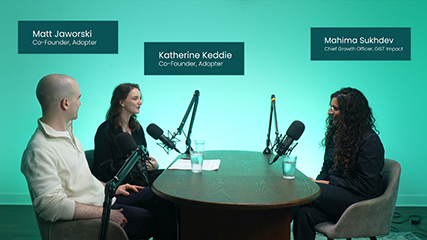
Katherine Keddie: Hello and welcome back to Scaling Green Tech with Katherine Keddie and Matt Jaworski.
Matt Jaworski: Hello. Hello.
Katherine Keddie: We are here with a very exciting guest, Mahima Sukhdev, who is the Chief Growth Officer at GIST Impact. Thank you so much for joining us.
Mahima Sukhdev: It's my pleasure. Thank you for having me here.
Katherine Keddie: So the first question we ask every guest to keep things simple is, how would you describe GIST impact to a five-year-old?
Mahima Sukhdev: You say, keep things simple. I saw that question on my way over here and I was like, oh gosh. Okay. Because I was thinking about all the five-year-olds I know, and the problem with five-year-olds is that they don't yet know what a company is.
And of course, just as all about we start, with the company as a unit of changing performance. Going back to the question, how would you describe it to a 5-year-old. I was thinking along the lines of, you care about your toys and your snacks and your clothes, but do you also care about your mommy and daddy and your friends and your schoolteachers and the birds outside your window and you know the trees that are in your garden. And the five-year-old would say, yes, I care about all those things as much, hopefully, as my toys and my snacks. And then I would go on to just explain that what we do at GIST is to remind grownups that those other things matter too and that we need to take them into account and to protect them when we are making decisions and making choices on a day-to-day basis.
So that's how I would take it to a five-year-old who would take it slightly differently to an 8-year-old or a 10-year-old.
Katherine Keddie: Okay. My next question is how would you take it to an adult? So give us your kind of elevator pitch where you don't have to think about how to describe this without saying what a company is?
ESG 1.0 versus ESG 2.0
Mahima Sukhdev: Yeah, of course. So GIST Impact, we are a data and analytics company and we help corporates and investors make better decisions that incorporate. Climate, nature and social dimensions into those decisions. And the way in which we're differentiated, really, most of our clients know, ESG ratings and no ESG measurement, but the way in which we're differentiated is we're building the next evolution of ESG.
ESG 1.0 was shaped by actually thinking about the intention behind ESG 1.0. It was to put some glossy numbers into a glossy report and it was to upsell and charge higher fees for ESG products. The intention around ESG 1.0 was not to make a change in the world. And what ESG 2.0 is about, is actually shifting the way in which data is used for decision making and not just reporting or product development.
And we build traceable, transparent, methodologically rigorous data that is reflective of what a corporate's actually doing on the ground. What's the, on the ground reality, what's the risk there, what's the impact on society, on the environment, and feeding that data into the places where this decision becomes useful.
So whether that's investor workflows like portfolio construction and stewardship and engagement and so on, or it's corporate decision making around capital allocation and so on and so forth. So really what we're doing is building that ESG 2.0 and the way in which we built it is fundamentally different and because our intention is different for ESG 1.0.
Katherine Keddie: And you've been around as a company for a little while. You've scaled your really well known presence when it comes to this area. How have you seen this change from 1.0 to 2.0 in terms of your own work and your product?
Mahima Sukhdev: Yeah, I think so. We started life as a research lab very many years ago.
And so we've seen the whole evolution from, and I think it was 18 years ago, when we started and for the vast majority of those 18 years, we stayed as a little research lab. But it was really only in the last, let's call it seven or eight years, where we started to see a shift in the landscape where suddenly standards beyond GRI were emerging to start to encourage companies to disclose more systematically on climate and nature and social factors.
Around the same time, there was the pushback against ESG 1.0, which was a pushback for some poor reasons, but also for some really good ones that I had just hopefully highlighted. And so we have been from the get-go saying that the way in which we do ESG is not right and we need to move into a different way of doing it.
And what we've noticed then, going to your question really in the last, let's call it seven or eight years, has been that sort of gradual evolution in the space where you're starting to see businesses really. Engage with this information differently and start to ask tougher questions of the data and to start to interrogate it and study it in a way that they just weren't doing before.
So I think that's maybe the biggest difference.
Katherine Keddie: So a kind of attention to detail.
Mahima Sukhdev: Yeah.
Katherine Keddie: With what this actually like the rigorousness of the data, and then also the use of it for actual tangible benefits for a business.
Mahima Sukhdev: Exactly. And then, it's also in the context of, look at the world around us where we're seeing wildfires and floods and we're seeing climate risk play out and nature risk.
Arguably, we're just. Not as good at measuring it. But we're seeing real live examples of how, what we would otherwise look at, on paper as like a climate risk score play out in the real world. So I think there's been this sort of collective awareness that's driving the interrogation of that data.
It's not just, the folks have become more savvy with the data. It's also an awareness of why they need to pay attention to it.
How companies come to recognise the need for this data
Matt Jaworski: How do companies realise in the first place that this kind of data is what they need?
Mahima Sukhdev: It's a really good question. I think there are a few different drivers, right?
So the easy one is actually regulation where the regulator in some way tells them like, actually you need to pay attention to these factors because they're material to you as a business, or you need to disclose information on these factors. So there is that sort of top down imposition, but unfortunately as we very well know, and I won't dwell upon too much the initial push towards standardisation and regulation has slowed and has been pulled back even a little bit in the last year or two, sadly.
So then really the drive has bottom up. And where does that sort of, realisation emerge? We've seen it in different ways when it's bottom up. The first is there's a real business risk that has been seen as a supply chain risk or a, a sort of a resilience issue.
And you're starting to bridge closer and closer to issues of nature and climate without calling them that. And so then you, if you recognise that there's, especially after COVID an awareness around supply chain risks and operational resilience, and you're also aware that climate in nature has a role to play in that.
Then there's that sort of let's call it event-based or or operational based awareness. But there's also a values-based awareness growing in some of these firms. You're seeing business leaders either growing through the firms or entering into the world of business from.
Not-for-profits from academia and other spaces like fighting the good fight, going in and saying, actually we're going to, we're going to change how we do things here. And you see a lot of that too. So you have the sort of business based awareness and realisation, but then you also have the people based awareness and realisation and embracing of those values.
Like we work with companies like, Ørsted for example, and you we've, we see how visibly they live their values day to day when they're making decisions to, to incorporate dimensions of climate and no nature and social factors when they're when they're going about their operations. I think it's those three things, but they interplay with each other.
There's that regulation, there's the sort of operational oh, there's maybe something happening here. And we become much more aware of the risks to our business. Or there's just the values based, like we must be doing, we should be doing the right thing to keep that, to keep our business running in the long term.
Katherine Keddie: I think that's really interesting that you still have that kind of people-centric one. In fact, that's, it's nice to hear.I think but I think often in our work we've found that pragmatic piece about a new awareness of risk, a new awareness for the impact of climate change on that, say supply chains are more powerful in supporting business growth.
Is that something that you've found in your work, or is it genuinely a mixture of those three in kind of equal proportion?
Mahima Sukhdev: Yeah, it's a good question. Because we actually started life as an impact focused firm we have historically been working with a lot of those impact led leaders, who, whether it's good for the business or threat to the business or not, will want to do the la the right thing because they recognise that long term.
Every impact is also a risk, right? Like we say it, just today's externalities are tomorrow's risks and day after tomorrow's losses. And that's really the way in which these business leaders think about it as well. But of course, for the majority, you're right in that the majority are looking at it as more of an operational risk.
To give you an example, we work with a big bank in India, one of the biggest banks in India on integrating climate and nature risk into their loan book assessments and loan books across millions and millions of loans, right? Small scale agricultural loans. And they already see the increase in default rates in their agricultural loan portfolio.
And the delta cannot be explained by anything apart from climate risk, right? And nature risk. So that there is that very real world, this is happening to us. But then, we still have that contingent of leaders who've always known that this is going to happen. And so they're focused on the impact bit because they want to avoid those future risks.
Matt Jaworski: Have you seen any difference between companies who got interested in this earlier than those who are catching up when they are starting to see those negative impacts?
Mahima Sukhdev: Any difference in performance you mean?
Matt Jaworski: Yes. Yeah. And the results that they're getting.
Mahima Sukhdev: Yeah. In a way you could argue, and this is, it's a really interesting sort of design question, right?
In a way you could argue that companies that have preempted transition risks, let's call them regulation or consumer behaviour change and so on are better equipped for the future. You may not say that they're doing better in market cap and so on, but they've definitely built business resilience and unfortunately that business resilience doesn't show up systematically and can't be traced as easily to.
The decisions that they've made about climate, nature, and social dimensions. But the licence to operate is a really, clear one where if you have a company operating in areas where, when we have clients, for example I worked with a utility company that had a utility out in an area in Brazil that had very high water stress.
And because they were managing the water in their, the use of water in that area much more carefully, they were one of the few firms that were not picketed against by the local communities when the drought hit that area because they were recognised as a leader in water management.
And they were also engaging constantly with the local community on water management. So you can say that if you preempt those sorts of transition risks early, you're more likely to, then to trace it back to, okay, they had fewer shutdown days because they were not picketed and stuff.
I don't think anyone's done that research. I hope that it shows up more materially going forward.
Matt Jaworski: Yeah. That's you have less negative publicity, let's say. Exactly. Marketing terms, right?
Mahima Sukhdev: Yeah, exactly.
Matt Jaworski: That's a clear outcome that will have impact on some like commercial results.
Mahima Sukhdev: Definitely.
Matt Jaworski: Even though obviously the company makes thousands of decisions over a year. So it's difficult to attribute specific outcomes to any single one of them.
Mahima Sukhdev: Exactly. Exactly. You're just, you're bang on.
Katherine Keddie: In some ways it's common sense, if you are, let's say you're an insurer, and you're looking at ensuring small businesses, let's say, take your example, you're insuring farms. In a certain area that is likely to be subject to climate risk.
Mahima Sukhdev: Yeah.
Katherine Keddie: If you don't have a great understanding of what that looks like, what the nature impacts are, maybe. Let's say one farm has a specific type of vegetation or approach to protecting nature, that means that they're less likely to be flooded.
Mahima Sukhdev: Yeah. Yeah.
Katherine Keddie: And surely that has a very clear material benefit to them because they're looking at how many claims they're going to get. It's about having an actual understanding of the risk of your portfolio.
Mahima Sukhdev: Exactly. Exactly. And we, with the Strait of Hormuz of shipping closing recently, and fertiliser supplies being affected.
All of those, again, exactly to your earlier point, all of the agricultural companies who have been investing in natural farming practices that rely less on fertiliser. Again, I don't know if anyone's done that research yet, but it would be a really interesting piece of research to see if they were able to showcase that resilience in some financial metrics and where those financial metrics sit.
That's the key question.
Matt Jaworski: Yeah. So it goes down to the fact that you build this resilience. And then when there is some moment of stress, you are less likely to enter this cold red mode if we have an emergency, what do we do now? You just have more buffer when this hits.
Mahima Sukhdev: Exactly.
Katherine Keddie: So you've mentioned climate-nature risk as part of what you look at, but give us an idea of what is the range of different data that you consider risk impact, et cetera.
Mahima Sukhdev: Yeah. Oh where should I start? So we started life, as I mentioned, as a research lab, and we were looking at natural human and social capital alongside financial capital.
We recognised as a starting point that our entire economy, global economy depends on these different types of capital. It is just that we're only accounting for that one financial capital piece and ignoring the rest. Because they're harder to measure and quantify, but they have real, truly real economic value.
So we actually started life. Looking across all of those different dimensions. So we therefore have data on climate. We have data on nature, we have data on social factors. We're always looking at the performance of companies across these different dimensions. Also, recognising that they're deeply interconnected, right?
There's no easy way to separate out climate and nature. We've done it with our, like different cops every year into different UN agreements and so on. But I also think vendors funnily, like still organise themselves a little bit. I'm a carbon accounting firm, I'm a nature data provider.
I'm in a social impact analysis firm. But the real world doesn't operate like that. And so we've always seen those interconnections and we've always recognised that if you're an investor or a corporate and you're making a decision across one of those factors, it's probably good for you to also see the intended or unintended consequences on the others. Because there's that interplay is really strong between them. So we've always had that sort of holistic view. So we have impact, risks, opportunities. I think some of the framing that's really mainstreamed in the last five or six years has been really helpful.
So now I can say things like, impacts, risks and opportunities and you guys will fully understand what I'm talking about. But, so we do impacts, risks and opportunities, data across climate, nature and social. And also, often provide more than one at the same time because that's what our clients have in mind.
Impacts, risks, and opportunities explained
Matt Jaworski: Okay. And for those of the listeners who don't fully know the difference between the impacts, risk and opportunities, especially in this context.
How would you summarise it?
Mahima Sukhdev: Yeah. Sorry. Good catch. I feel like a lot of people in our space assume that everybody else in the world cares about these things and knows about these things. Basically what the way in which I explain it and look at it is impacts are your inside out effects. So as a business, you do things, you conduct activities that have an impact on society and the environment, and that's what I call inside out.
It's coming from your business to the outside world. And usually it's negative, but sometimes it's po. If it's an environmental issue, it's almost always negative. But if it's a social or human dimension, companies add a lot of value, right? They create human capital. They invest in communities.
They provide infrastructure. There's that sort of positive bit as well. So those are impacts. Now, risks are that more of that outside in dimension, considering the same factors, climate, nature, social dimension, all of the things that the companies do to the world then create problems usually unintended problems that then create.
Go back to the company in the form of risks. So for example, when we say climate risk, physical risk, and so on, that's not just happening because it's happening because companies are creating that impact in the first place, but then it's going around and coming back to the company in the form of physical risk or in the form of transition risk or reputational risk within that and so on.
So that is your risk dimension. So impacts inside out, risks outside in, still connected. And an opportunity is really, if you're a company who's ahead of the curve, which you've asked about and are already thinking about this interplay, an opportunity is where you get ahead of that dynamic and start to say, actually, maybe we can build business resilience.
Maybe we can create new products that actually service these challenges and help us not just avoid them, but actually make more money out of them in some way by providing a solution to the problems that businesses are creating and or providing a better quote unquote greener option that consumers and so on are more likely to want to buy.
So that's impacts, risks and opportunities in a nutshell. And then, to bring it back to what just does and what we're here to talk about if you're an investor. Then you want to understand how the companies in your portfolio, your investments in your portfolio are doing across all three of those dimensions, right?
You want to know, are they creating a lot of impact because that will potentially create reputational risk and so on in the future. Are they managing their risks? because that's actually the nearest pain point, right? If you have a plan operating in an area where it is flood prone, you're very likely to see some sort of impact, financial impact in the near term.
And then are they thinking about the opportunities which allow them to get ahead of these challenges and even capitalise on them in some way.
Nature value at risk
Katherine Keddie: You recently launched nature value at risk, a new measure that kind of adds onto your board of work. Obviously that fits into the risk category.
Mahima Sukhdev: Yes.
Katherine Keddie: But can you tell us a bit more about what exactly that looks like and the developing offering that you have for your customers?
Mahima Sukhdev: Yeah. Yeah. No. I'll maybe even start off by saying why we developed nature value risk. Our research was already focused on financial quantification of externalities, right?
We always said that these factors, climate, nature, social, are financially relevant to our firm and are financially relevant to society. And externality is a cost that society bears or benefits, that society benefits from, that's not ca that's not captured in an, in a company's balance sheet, but is a real economic cost.
There's a financial value there. And then of course, and that's our origin story. So we're really valuation experts, if I may say and have been widely awarded for our pioneering research in that space. And now when you come to risks, obviously. The way in which risks manifest are immediately, I shouldn't say easily, but they are financially quantifiable, right?
Because it's like production loss, lost days, productivity, et cetera, et cetera. And so the reason we developed a nature value risk methodology was because some of our leading financial institution clients, these are major sovereign wealth funds and huge asset managers and insurance firms were saying, you have great nature data.
This is really important and valuable. We need to now use it to really build a business case around taking action on nature and start to engage with these companies in a quite serious way. And there, the ECB, the European Central Bank had come out in December with their guidance on how to think about nature, value at risk, at an economy level. And so between December and this month our teams have been really hard at work, bringing, we'd already started vere before, but bringing that thinking from the ECB into our own nature value at risk dataset. So first of all, why does the European Central Bank care about nature risk?
It's shocking if you think about it, 75%, and this is not my stat. This is coming from one of the people on the supervisory board of the European Central Bank himself saying in a public forum, nature matters to the European Central Bank. Because 75% of the European companies in Europe are heavily dependent on ecosystem services.
And what happens if we lose those ecosystem services? These are being provided for free right now. These companies are heavily dependent on them and therefore, the impact of the loss of those ecosystem services could be very severe. And the European Central Bank's job is to control inflation and to organise our monetary policy.
And they therefore see this nature risk as a real threat that could become a runaway problem that they can't control. No amount of monetary policy could fix if there's huge shocks to the system caused by nature risk. So that's the sort of background on nature, value at risk, and why we got there.
And our clients were really pushing us saying, there's nothing good out there. You guys are really smart when you do these things. So please take on this challenge and develop a nature value at risk approach. So we went about it in a nutshell, the first, and this is version 1.0, and we're very clear that this is we don't have the sort of fully baked end-to-end product.
Right now we're focused only on physical risks and the way in which it manifests and focused on 25 of critical ecosystem services and what we look at to explain nature value at risk. In a nutshell, if you haven't heard of climate value at risk, so I'm assuming that we're not starting with some prior knowledge, but nature value at risk basically says if you have a company, call it Unilever just as an example, and that company has certain is involved in certain business activities, and we know the, where their assets are and what those assets are doing in that area. So maybe there's a manufacturing plant and a wholesaler and a retailer, and that you've got a, you've got an understanding of where their assets are and what they're doing in those areas.
Then you have an understanding of obviously, the location, the business activities. Then you have an understanding of what's happening in the ecosystem around those assets. Now if you have a business activity that happens to be very heavily dependent on that ecosystem, that's where the nature value risk sort of equation starts to play in, right?
So you start to understand, okay, heavily an activity that's dependent on that ecosystem in the area where that ecosystem service. Occurs, and then you need to start to understand what's happening to that ecosystem. Is it under pressure? Is it highly vulnerable? Is it degraded? For example, we use data from the Natural History Museum, the Biodiversity Intactness Index, which is a great measure of ecosystem integrity too.
Give a picture of the vulnerability of that ecosystem. So if a nature related shock then occurs in that area, what's the likelihood that company, because it's got that asset in that location and that has that ecosystem is fragile, what's the likelihood that company's production is then at risk?
And that's 1.0. So you can imagine how Complex 2.0 is. It's a very com it, it's a, it's a very detailed calculation that follows for those of you who then are familiar with climate value at risk, the same sort of damage functions, hazard vulnerability exposure, et cetera as climate value at risk, and the ECB guidance.
But just brings that down to a geo sector level, really understanding like which business activities in what areas, under what ecosystem conditions, and therefore what is the production at risk, right? And that's where risk calling and nature value at risk, but in essence it is, this is the production that is at risk and the revenue at risk as a result.
Yeah. Long enough explanation on that.
Katherine Keddie: That was great. I think it shows you are just creating a tangible case behind looking after the nature on which your business relies.
Mahima Sukhdev: Yeah.
Katherine Keddie: Or look after the nature of the businesses that say, if you were the European Central Bank that you have jurisdiction over ensuring the continuation of survival.
Mahima Sukhdev: Exactly.
Katherine Keddie: There's no monetary policy that supports soil quality going completely out the window and flooding and droughts and, the, some real substantial potential risks here.
Mahima Sukhdev: Exactly.
Katherine Keddie: In fact, I think maybe to give it some flavour, could you give us some examples from maybe from your customers or from your experience around what this kind of risk actually looks like tangibly for businesses?
Mahima Sukhdev: Yeah, definitely. I'll continue with the Unilever example since I started on it and didn't get very far with it. But, so say Unilever has operations preparing perfumes and toilet related products in India, which I know they do.
Their operations in India are in a flood basin. And they, that it's an area which is heavy in manufacturing in general. A lot of different companies actually manufacture in that region, in the Western cots. And that area is also. because it's in a flood basin and prone to flooding. And so there's that.
If you have, if you're an investor for example you're looking at Unilever, you're saying, okay, actually of all of the the places where you're doing business, this is an area where you're particularly exposed to flood risk then that's a factor to start to ask them questions about.
Right? And then what's interesting if you're an investor is you might see like on the surface a very diversified portfolio, right? You might be okay, I've got Unilever and Nestle and name 10 companies here. But actually you may be overexposed to that one flood basin if you think about it.
And yet you're not, that's not showing up anywhere in the other. Data that you have on your portfolio but nature valued risk will surface that information saying, oh, all 10 of those companies actually manufacturing in that little manufacturing park that's actually exposed to flood risk.
Now, flood risk is one of those things, which is like a bit of climate and a bit of nature. So maybe I can give you another example. Genetic material, if you're a pharmaceutical company and the dependency of that pharmaceutical company on ecosystems to provide novel compounds that they use in manufacturing, right?
That's another. Ecosystem service that if degraded and if, the Amazon rainforest continues to die back at the rate that it is dying back today is at severe risk. And again, that's a nature value, at risk example of how a pharmaceutical company may be exposed to an ecosystem related risk that is just not being surfaced right now.
So it can play out in very many ways. Like soil you talked about soil retention, soil erosion, all sorts of ecosystem services can interplay with business activities in all sorts of ways. But that information is almost never exposed to an investor or indeed to a corporation right now.
And they're all starting to grapple with that topic. Now. I understand like. Where exactly are they exposed? Not just in their operations, by the way, but also in their supply chain, which is a whole different kettle of fish.
Matt Jaworski: You might think that you're sourcing whatever you need from different places, but then it turns out that it all passes through straight of orus and you a lot of expensive problems.
Mahima Sukhdev: Yeah, totally. Totally.
GIST's approach to growth
Katherine Keddie: Yeah. Yeah, exactly. I would love to talk about growth. You work all over the world. You have some extremely prominent clients and customers.
Some extremely prominent partners. What has been your approach to growth?
Mahima Sukhdev: Ooh, how long do you have? So look, we are, we operate in a space like climate, nature, social data that is not new to the world in any way.
It's always been around. But in very many ways. It's as we actually talked about in the beginning, it's being used in a new way by relevant people who are relatively still new to it. And so our approach to growth is very, I would say, quite different from how a mature, B2B SaaS sort of consumer tech company would approach growth, right?
There's a big dimension of growth that requires market shaping, market education, building trust. To give you some concrete examples we do a lot of work on educating the market. We have a very brilliant team, 120 people of which I think about two thirds have advanced degrees in environmental science, ecology, climate risk, et cetera, et cetera.
I'm one of the least educated people at the company by the way. But so we do a lot to provide education and upskilling and training because there's no point selling an organisation some data or some analytics if they don't know how to use it. So it is and it is a like incumbent on us because we're a mission-driven company that they do use it.
Because that's our whole mantra, right? ESG 2.0. Let's actually go and use this data in a different way. So we do a lot on education, a lot on training, and then also on that sort of market shaping piece. We've gone through a period in the last. Five, seven years where a lot of these standards have been created and developed and refined.
And so we've been involved in each and every one of them, from TNFD to the Social Value International. There's all sorts of ways in which we're feeding back into the ecosystem shaping. Because we have been fortunate to have such a long history of data and analytics capabilities, we give our data to academic institutions, to standard bodies and so on for free because we want them to have it at hand when they start to think about what's possible.
We don't want this to become a lowest common denominator exercise, right? Where everyone is is boggled by the challenge at hand and don't realise that this sort of data, this sort of. Analytical capability already exists. So when I talk about growth, it actually feels quite different at a firm, like just compared to say a standard startup because you're shaping the market as you sell into it, and it's almost incumbent on you to shape the market as you sell into it in order for the whole effort to succeed.
You want to be able to grow the pie of users who are actually using this data systematically and using it in the right way, systematically.
Matt Jaworski: The kind of the rising tide rises all the boats.
Mahima Sukhdev: Exactly. Exactly. Yeah. It's a collaborative space, interestingly, and it has to be because.
Bigger than any one firm. Capturing market share is the massive existential challenge that's faced before us, climate breakdown and nature loss. That's something, that's what keeps me up at night. Not necessarily the growth of GIST Impact in particular.
The nature data ladder and Nature Metrics
Matt Jaworski: You mentioned, for example in the chat before the episode started recording, that you collaborate with Nature Metrics.
Mahima Sukhdev: Yeah. We do. We do. So Nature Metrics is a fantastic firm. You may know their history. They started out with pioneering eDNA technology and we and Nature Metrics talk a lot about what we call the nature…
Matt Jaworski: Sorry, before we go further, what is eDNA for those who are not aware of it?
Mahima Sukhdev: Oh, environmental DNA, where you can sample now with Nature Metrics technology the specific species and the biodiversity present in a given area. It becomes very important for companies like mining and agriculture and so on to understand the state of nature in the areas that they own.
Often these are owned pieces of land and coastline and water as well. And eDNA is a fantastic technology just historically. It takes a long time and it's expensive and so on. And Nature Metrics basically democratised access to eDNA and just in fact and Nature Metrics. As I mentioned, we talk about the nature data ladder which basically is okay.
If you're a company, you have a site and you have eDNA in a way is a really good starting point. You want to know exactly which species are at that site. You need to be able to send someone to take the sample and send that sample into a lab and so on. So that's and, but that gives you the most granular, focused picture of.
What's happening on the ground when it comes to nature, and then you go up a level and then you can start to use geospatial data and by acoustic monitoring and all these other types of data sets. But then there's like this, I shouldn't say loss of resolution, but in a, yeah, it is a loss of resolution if you lose resolution.
But what you gain is breadth. And the ability to scale that data because unfortunately most companies are not sampling on ground and assessing their biodiversity and nature impacts on ground. So you can then go up a level and up a level and use geospatial data, use satellite data use modelled data where you need to, when you're starting to talk about investors and their portfolios where you, and then, so I've painted the picture of, let's call it an agricultural company, taking a DNA sample here.
But then if you go up to I'm a big asset manager and I've got thousands of companies in my portfolio and no ability to send anyone on the ground to take a sample, that's where GIST Impact comes in, right? You then have a big picture understanding and ability to start to build a portfolio-level picture of where you should be focusing in terms of priority areas with nature risk, with climate risk, with biodiversity impacts, et cetera.
Where you don't have access to that on ground data. And eventually we want the two parts of that equation to come together. Hopefully more and more companies start to report on ground specific data right now, they barely do except for a few leaders who work with firms like Nature Metrics.
And then you want the data that investors use to become more and more specific. So we, for example, at GIST Impact, we collect data on forward-looking metrics now because we recognise that there's enough of a critical mass of companies that are disclosing climate targets, water targets, and deforestation related targets that we can now crawl all of that information and start.
Pull it together in some meaningful format for an investor use case. So the data that they publish will hopefully become more and more granular and the data that we therefore can collect on these companies becomes more and more granular. So that's the collaboration in a framework basically.
Katherine Keddie: I think it's a great example of how you all work with other pioneers to shape the market, like you say.
Mahima Sukhdev: Yeah. Yeah. Totally.
Katherine Keddie: And I think, coming back to the wider piece about education, there has to be a market for you to grow into, right?
Mahima Sukhdev: Yeah.
Katherine Keddie: And fundamentally, before, let's say, seven, eight years ago, you started to commercialise your research and grow the market.
It was a very different perception and I think even the shift between the impact focus of the work. So it being seen as this kind of selling point ESG 1.0 as you said, or this kind of feel good extra thing to now being considered a serious risk for your business or a material factor in how your business will develop over time.
Even that shift on its own, I think is pretty substantial. What exactly does education look like for you in terms of that shift?
Mahima Sukhdev: Yeah. It's a really good question. Maybe I start off with saying what we put out into the market but then I'll also take it slightly differently on education.
So we do for example, right now we're running a series of webinars called Ask the Expert, where our head of nature and biodiversity products almost does like a really mini presentation on what, to answer your earlier question, what is an impact when it comes to nature? What's a risk when it comes to nature?
What's an opportunity when it comes to nature? And then hosting the rest of the session as an open forum. And we have hundreds of participants from financial institutions joining these sessions because you can just see their hunger to learn from somebody who knows what he's talking about and has built a 25 year career in the space. There's just a lot of ability to give.
Matt Jaworski: This is amazing. And it shows one of those sides of marketing growth work where what you can get out of it in a way depends on what you put in. Yeah. We meet companies sometimes, say for example, oh, we trade webinars and they don't work.
But then there's always a question of whether the webinars focus on a tangible problem that an audience has. Like in your case.
Mahima Sukhdev: Yeah.
Matt Jaworski: Where they stay at something more surface level in general. That doesn't actually reach that deep into organisations and doesn't attract such a big audience.
The Nordics 100 report with StoreBrand
Mahima Sukhdev: Exactly. Exactly. You hit the nail on the head. If you offer something meaningful folks will join. Like what they're not going to join is very clearly like a marketing oriented session. because they get marketed to enough, but we have knowledge in-house, a huge amount of it.
And so we're really happy to share it. And then again, going back to that, hopefully that builds a bigger base of individuals at these companies and financial institutions who say, actually I think we're ready to use nature data now. because I know what a dependency is. I know what an impact is and I know roughly how I might use it.
And then that brings me to my other point about how we do education. So we publish thought leadership on what use cases should look like, because that is one of the biggest questions we get, which is like, what is the final decision that you're trying to drive and then working backwards from that decision, what data do you need?
How do you consolidate it? How do you aggregate it? How do you derive insight from it? We just published with StoreBrand, which is one of the Nordic's leading asset managers. A report called the Nordics 100 because the Head of Climate and Environment at StoreBrand, she's brilliant.
She's a brilliant woman and she's really been advocating for a long time the need to use data in stewardship and engagement and portfolio construction and screening and so on. And she was almost a bit agitated by this narrative that still dominates some airwaves here and there, that there's not enough data.
There's plenty of data. We just need to show folks that. It exists and show that it can be used. So we developed this report together called the Nordics 100, which looked at a hundred of Nordic's largest companies filtered by the sort of high priority sectors that TNFD or those of you who don't know, that's the nature standards body, TNFD recommends the high priority nature sectors and compared it to the Nature Action 100 list, which is a global list of companies that, again, investors have identified as high priority for nature. So basically it's close to apples to apples. I do a hundred companies in the Nordics that are nature important and a hundred companies globally that are nature important.
And we use the nature action 100 as a benchmark and then show this is how you look at the impacts compared to the benchmark. This is how you look at dependencies compared to the benchmark. This is how you start to surface risks and look at the risks within this Nordics 100 portfolio. And then finally, these are the opportunities for StoreBrand to start to, get ahead of this.
And I, it's been, I'm I don't want to take. As much credit for it. It was very much driven by the brilliant folks at StoreBrand, but we've gotten so much positive feedback from across the market on this report because folks were hungry for something really concrete, really tangible and a bit unafraid.
There can be a little bit of fear in some of these spaces if we're putting too much information out there. But really the purpose of this exercise with StoreBrand was to show everything that can be done even today with the data that we have today and how robust and rigorous it is.
And we've just have had huge amounts of interest and attention in this report because in a way it's been the most sort of comprehensive end-to-end, like nature analysis that has been published by a financial institution.
Matt Jaworski: Sounds amazing.
Katherine Keddie: Yeah. Yeah. It sounds like it was a success, but how would you be measuring success going into an initiative like this?
Because there's many areas in which this could cause benefits like your SEO, your GEO, your, content, your position as a thought leader, your relationship with the firm
As well. But when you go into this initiative, what are your metrics that you are considering?
Mahima Sukhdev: Yeah, it's a good question. So we track our SEO and GEO and so on.
And of course like it had a lot of activity around the publication of this report. But in the space that we operate in, actually what really matters is are the right people paying attention to this? And by the right people, it sounds snobby. I don't mean it in that way. Folks who are in positions to influence and to guide decision making.
For example, it caught the attention of policy makers, right? May not be as close to the day-to-day of how financial institutions are really tackling what they see as Target 15 of the global biodiversity framework. They're looking top down on this thing, knowing the global policy landscape, trying to understand like, what are companies and investors doing about their little bit amongst all of the bits.
And so to have policymakers come to us and say, oh, wow, that report was really illuminating for us because we finally understood everything that's possible and can then shape further our requirements of companies and investors going forward. That's in my mind, like though it's less quantitative, which is ironic for someone who works at a data firm.
I think that type of impact is really what we look for. Because we want to be able to continue to grow that space. And of course, the positive impacts on SEO and so on, that happens by the buy sort of thing.
Katherine Keddie: Yeah, I think that makes a lot of sense. We actually had a very similar experience.
We worked with one of our long-term clients, QFlow. They're a materials waste data company.
So they allow construction companies to actually consider their materials and waste data at scale, which is currently hugely under-reported in quite an alarming way.
Mahima Sukhdev: Yeah.
Katherine Keddie: And we worked with them to develop a white paper that explores this subject using some of their original data.
And there were many benefits including being repurposed onto LinkedIn. It's really beneficial as content, using it for personal profiles, and getting it on the website. It's obviously great for engagement in many ways that we can measure.
But some of the most valuable benefits came from similar policy makers and people referencing it and other studies, people referencing it in parliamentary debates.
People referencing it, most importantly within the industry. And I think that ability to be able to create original research has these hugely wide ranging benefits. And maybe you wouldn't even be measuring the other ones.
Matt Jaworski: Yeah. But like new doors opening for you. It's not something you'll measure on Google Analytics, but it is a very tangible and valuable business benefit.
Mahima Sukhdev: Yeah. Totally. Totally.
And it is that when a company sees what's possible, and you're putting in front of them the use case, their reaction is very different than if you're just pitching them like a snazzy platform. You're just pitching them a very detailed scientific methodology. If you're saying, this is exactly how you can use this data, and this is exactly how a peer of yours, or, if someone a leader in your space that you admire is looking at this I say imitation is the best form of flattery.
Like we've seen that some of these things should be pre-competitive. There are best practise ways to depict how nature data should look, or the best practise ways to apply scientific methodology and established peer reviewed research to raw data. And we're happy to, and we were quite open source with all of our methodologies and approaches because we recognise that a lot of this is important, again, to build trust in the data ecosystem.
Long-term thinking in content and business
Matt Jaworski: It also feels like a much better approach than what many companies haven't fallen into, which is educating customers about the problem. Obviously about the solution. So companies say that, okay, there is a problem, there is no data. They provide this data, but then very quickly everyone says yeah, we know there is no data.
Mahima Sukhdev: Yeah.
Matt Jaworski: But they don't see this tangible use case Exactly like you're describing
Mahima Sukhdev: Exactly.
Matt Jaworski: That would make them actually interested in the solution.
Mahima Sukhdev: Exactly. Exactly. Yeah, for sure. And there's also that sort on the other bit about education. So I've just remembered, we also get educated, by the way, by our clients.
Like our clients are leading thinkers in this space and they are. Really pushing the envelope when it comes to how they're incorporating climate and nature and social factors into their broader strategies, into their capital allocation investment processes, stewardship processes. And we don't know all of the answers to that because we're not portfolio managers.
We're not responsible investment analysts. We're not those things. And so having that collaborative working dynamic with our clients as well has been really valuable. We've learned a lot from them. We work with Allianz. They've really shaped our thinking on how we should approach that, and aggregate our data in certain ways.
I'm so grateful for them, for their brilliance in starting to think through this and then sharing that with us openly. So it is really a two-way street. And so while we're a data firm, like we have actually a big team of about 20 people who. Day-to-day working with our clients in that way to make sure that data is embedded. And we're also learning in return. So I think that's a really critical part of all of it.
Katherine Keddie: And it sounds like really fundamental to your growth as a market leader
Mahima Sukhdev: Exactly.
Katherine Keddie: Fundamentally your approach. To say back to you, what I've heard is based on the partnerships that you've built, the way that you've been a leader in establishing and shaping and educating this market, your approach to thought leadership when it comes to sharing your methodology or data, your use cases and doing these extra reports that speak to specific problems in the market.
I can't tell you how many times I've heard someone say, there's no nature data. That's the problem. Yeah,
Matt Jaworski: Exactly.
Katherine Keddie: Exactly. I completely understand why that would be an interesting piece. So it sounds like those things are key to how you've managed to reach the stage that you are, which is being an established, genuine thought leader in the space.
Mahima Sukhdev: Yeah. We like to think that we've done our little bit to also shape the direction the market needs to go inward from that ESG 1.0 to now. You have some of the more established firms being like, oh yeah, actually we're also going to do that 2.0.
Which is good. We've achieved our end goal.
Katherine Keddie: Yeah.
Mahima Sukhdev: Yeah.
Katherine Keddie: I love the use cases as well. I think anyone who's listening, who is a marketing or commercial lead in a scaling company, such a valuable way to show how your solution actually works. So it's like it has all the benefits of the case study that brings credibility and then the education piece that comes along with it.
So maybe, going back to your point about the problem, obviously, that's maybe early doors in your customer's journey. Yeah. But then once they understand that they generally have a problem you are giving them the resources that allow them to actually tangibly consider you as a solution.
Matt Jaworski: The thing is that the customers typically know that they have a problem. They're just not aware what solutions there are to this problem. So it's connecting your solution to those problems and issues that they are already aware of, like total resilience and supply chain longevity, let's say.
But then there's, I guess, another very interesting point, which is that, the approach you are taking with like marketing and the whole growth strategy seems to reflect the approach that you seem to focus on and encourage in companies that you work with as GIST Impact, which is reducing the risk, thinking about the impacts and building something that is resilient in the long term.
Mahima Sukhdev: Yeah.
Matt Jaworski: I saw your brow change a bit now, so I'll try to explain it a bit more, which is that you are creating those resources, right? That brings the attention to now, but they also build long-term positions and things like search engines and AI engines.
We reviewed data across like 20 green tech websites across last year. And there's a clear pattern that organisations that have reported original research get so much more traffic and that this type of content drives most, AI originated traffic to their websites. And if you're in a niche like you are, then people who search for those very specific niche topics, they are your target audience.
So then this target audience finds you through all those channels and you don't have to rely on any marketing gimmicks. Okay, how do we now wheel our way into AI rankings? Because you are already there from the beginning as an authoritative source because you've been publishing those reports for years and years, so they probably became a part of the AI training data sets.
So you are already at the core while everyone else is trying to find a quick fix.
Mahima Sukhdev: Yeah.
Matt Jaworski: Like a company could be trying to find a quick fix to either let's say insurance models are not working well, but if they accounted for climate nature risks in them long term, they would be already in a good position and they wouldn't have this kind of code red.
How do we catch up? They wouldn't even realise that this problem is happening because they would be resilient to it.
Mahima Sukhdev: Yeah. Yeah. I think my facial expression changed when you said that. Not because I was confused, but because you had articulated brilliantly Exactly. This sort of approach and really value set that we've been born with and therefore continue to embody, which is that long-term thinking.
And there's an interesting and quite inherent tension as a startup to still be focused on the long-term, to keep your eye on the horizon, because often you're like, racing to do the startup thing and get ahead. But we've always had that sort of long-termism built in, as you say, and it reflects in our SEO it reflects in the way, in the type of content we generate.
We see a lot of companies these days publishing so much AI slop, right? Oh gosh. And we'd rather go with fewer and better, thought out, like I saw some, one of our peers published, no names mentioned, publish something where the AI prompt was still written in the script and it was like, oh my, I was like, God, this is really bad.
So you do have to take that long-term view, and I think you captured it beautifully to say, like it also shows results in your marketing and your growth outcomes in exactly the same way as it shows results in the business. As for our clients. If they start to invest and think about their capital allocation and the way in which they approach decision making with that same long-termism, it does boil down to that. Your bang on.
Katherine Keddie: Inconsistent quality.
And quality and sounds like a rigour and a standard to everything that you put out that's fundamentally. The USP that you have in the market is that you're based on this really high standard for research.
Mahima Sukhdev: Yeah.
Katherine Keddie: It is then bolstered by the partnerships and relationships that you've built along the way and, Allianz for example, changing your perspective and allowing you to be a market leader by working directly with them.
Mahima Sukhdev: Yeah, totally. And I think that there's a lot of sort of benefit to be gained. If you take that sort of approach where you're collaborative by nature, you hold yourself to a high standard before putting something out in the market. We've got some really interesting questions, for example, from investors being like ooh, those competitors are putting out that product.
Don't you want to rush out with something? And we'll often say, no, we don't want to rush out with that because when we put it out, we want to get it right. And our clients recognise that in us, right? We were not first out the door necessarily, but when we put something out, we have to stand behind it.
And part of it is so much built into our DNA because as a business. Again, as I mentioned, we're two thirds like scientists. Like they want that 99.5% sort of confidence level before they put their own name behind anything. And I think that long-term, especially in the world where everything's moving fast and content can be generated quickly and so on.
My long-term bet, especially from a growth head of growth perspective, is like the content that will win out in the end is like truly the content that has been invested in. And I can recognise AI writing so easily, and I know a lot of us can, but even in and it's fascinating to see the places where it's landing up, right?
I'm seeing it lin ike major news publications. There's an article in the FT recently, which I was like, oh, that's an AI framed section. And so visible. I do therefore believe that is going to be increasing in value. And not to say that we're really AI savvy as a company. Like we have embedded it in a lot of our processes and all of that, we do especially data collection and quality check and stuff. We still keep humans in the loop. We have a team whose entire job it is to do data quality and verification. because there's a lot that AI cannot do. But so we are embracing AI to its full capabilities as of today as a business.
But when it comes to content I think there are good ways to use it. But writing. Putting out material that's AI generated is not one of them.
Matt Jaworski: Thinking that's as simple as saying AI, write me a report and then hitting publish.It's not as simple, but yeah. What I'm hearing from you and your overall approach to sound a bit like AI, we've adopted an ‘it's not x but y’ pattern.
It doesn't sound like it's just a marketing or growth strategy. It sounds like a business strategy. A core part of your business strategy.
Mahima Sukhdev: Yeah.
Matt Jaworski: And something that deeply comes out of the values that your business has and then those values cascade into marketing and a very sustainable and very effective approach.
Mahima Sukhdev: Totally. Totally. Again, you summarised it beautifully. That is where we started, like for a long time we were a diamond in the rough, right? Like we had until 2023, which was only three years ago, we didn't have any marketing team. We didn't do anything on the market. We were already a business. We attended our first events in the year 2023. Like we were not out there in the market in the same way, but we were busy building the product. And I see startups that do it the other way around. And there's credibility in that as well, where you start with a big marketing splash and then you get some customers and you quickly build the product, which is also fine.
But we, for us as a business, are wired that way. So that was the only way we could go about it. Now I'm happy to say now our sort of reputation has an awareness in the market, has caught up with the quality of our product. But for a long time we were like, basically not many people knew who we were unless they were very serious scientists or researchers.
What the next three years look like
Katherine Keddie: How have you found the last three years as you start to go into the market? What do the next three years look like for you in terms of your growth and putting yourself out there?
Mahima Sukhdev: Yeah, the last three years it's been delightful. Can I just say from when I started in 2022, I think it's the end of 21.
Everywhere I went people were like, what's GIST? And now everywhere I go people are like, oh, you're with GIST. And it's a really nice change, at least in the circles that I end up having to be in. Obviously the wider world doesn't necessarily know us, but that's been really good and we've started to think about what's next for us as far as a growth team.
And also now speaking back to that world of AI, like we're going through some really fundamental changes in our thinking about what matters in a world where there is a lot of AI slop. I think that educational content becomes increasingly important, like face-to-face, person to person interaction becomes important. What we're not doing is lots of LinkedIn, sales navigator, autogenerated outreach, and I get loads of inbound.
Katherine Keddie: Me too. Yeah.
Mahima Sukhdev: And it's fascinating because people are using AI for that too, right? They're saying they've found the last thing I've posted on LinkedIn and made that the title of the email and then they're trying to sell their product to me.
But I'm not buying that and I want another person and maybe call me old fashioned. I want another person at the end of the line to build that trust for me. So I think going forward what we're trying to do is make sure that we're. It matters. We put our people forward, we put our credibility forward, we put our knowledge forward in that sort of high touch way.
But then at the same time, we're really aware that SEO is not what it used to be. And actually most people are. Asking, Claude or chat GPT, like who are the best climate and nature data companies out there? Yeah. And making sure that we show up on that list as well. And then it speaks to your earlier point, which is that if over time we have built enough really high quality content and we have enough out there in the market, it's already being called up on searches, basically those LLM searches.
Katherine Keddie: Yeah, you're well positioned. Is there something specific you would like to shout out?
Mahima Sukhdev: Yeah, there's a few things that come to mind. First of all we are, and I hope it's become clear through this conversation. We are very collaborative by nature as a company.
And if you are out there, if you're a startup, if you're looking for data, if you're an academic researcher, you need some analytics or you want to understand something like you need a sample of something to get started on your work please get in touch because we're really happy to hear from you. We partner with the likes of the British Natural History Museum.
I mentioned Global Canopy, Hub Ocean and lots of not-for-profits. We bring on board their science and their data as well. So really pleased to hear from anybody who either wants to partner because they've got something really. Good and good research and data that they think we should onboard or the other way around, if you, we also go to market a lot through our partners.
Like we've partnered with Integrate ESG, who's also like a ESG 2.0 type company who, where their selected nature and biodiversity data provider. And we also partner with the Toronto Stock Exchange and so on. So we also go to the market in partnership. So we welcome those types of interests as well.
And really again, speaking to what I mentioned earlier, this is an honest offer that if you just want to learn more about climate and nature and social impact and all those good things like reach out, there's no obligation to buy anything from us. It really suits us that we have this conversation.
We want enough people to feel like they're equipped with the right data, the right tools, the right methodologies. We're happy to feed in to answer any questions that you have. Yeah, really just a plea to get in touch because we're really happy to keep chatting.
Matt Jaworski: Thank you very much for joining us and sharing all those insights and the journey and for everyone else all the different resources.
Some reports from GIST Impact will be in the show notes and if you'd like to also read through the additional research that we do on our site, head to our website and the resources page. We recently published, for example, an analysis of the patterns in AI originated traffic to over 17 Deep tech and climate tech websites that show what kind of resources bring those visitors and perform well in this kind of AI search, including reports and original studies.
And then if you would like any help with turning your knowledge, your know-how into such resources and content do get in touch with us. We are also always happy to chat and have an initial free half an hour conversation. And then if you'd like to work with us on a project of this type, that's also one of our specialties.
And then you'll hear from us in two weeks time on the next episode of Scaling Green Tech.
















.jpeg)

.jpeg)

.avif)