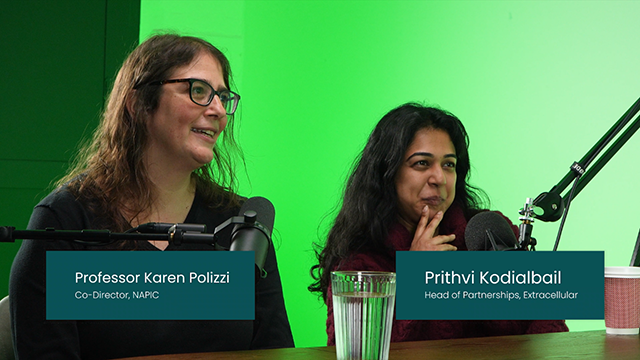
Katherine Keddie: Welcome back to Scaling Green Tech with me, Katherine Keddie. I'm here with two very exciting guests, Karen and Prithvi. Karen is a Co-Director of NAPIC, the National Alternative Protein Innovation Centre. And Prithvi is the head of partnerships at Extracellular. As is tradition on scaling Green Tech, I want to come in with our classic first question.
I'll come to you, Karen. First, how would you describe NAPIC to a five-year-old?
Karen Polizzi: Thanks very much, and thanks for having me. I'm really excited to be here, even though I've never done this before. I think the way I would start to describe NAPIC is that we need to find new foods for a growing population and also ones that maybe don't damage the climate and the earth as much as they do now.
And as people invent these, they're going to try to manufacture them on a large scale, but that's a really difficult process, taking something brand new and making a lot of it and getting it on supermarket shelves. So NAPIC's role is really to help businesses who are making these new products really grow and be able to reach the consumers and the people who will buy the new products.
Katherine Keddie: Amazing, amazing.
Prithvi Kodialbil: Great question. So from my side, Extracellular the way we like to perhaps think of ourselves with respect to how we want to communicate that to a 5-year-old really is probably that in terms of day-to-day products. So things that you have access to at home, things that you see around it could be in your fridge, it could be on a cosmetic stand, it could be somewhere, tucked away somewhere else.
We approach the science behind it. So we do a lot of cool techy stuff. I don't even know if this is 5-year-old language, very honestly. But we do a lot of cool techy stuff to make sure that there's always going to be access to these products today, tomorrow, in the future, five years from now.
That's essentially what we do. We de-risk their future.
Katherine Keddie: Nice. Nice. I love that. That was both very good explanations for a five-year-old. I think that also shows a good trust in what a five-year-old can understand, I think, which often people under pitch. So I, most five-year-olds I know are very smart.
Prithvi Kodialbil: They do. Yeah. They are smart and, times are changing.
Katherine Keddie: Yeah, exactly.
Prithvi Kodialbil: They might know more about this than perhaps they do.
Katherine Keddie: I'll come back to both of you for adult listeners. Maybe put it first. Give us your elevator pitch. What does extracellular do?
Prithvi Kodialbil: So essentially we are a company who helps a lot of startups or even large corporates in the space, de-risk that journey.
So they can be, at a point where they have a concept or an idea or even have a small scale sort of lab demonstration experiment that they're like, oh, this is what we want to take forward. We help bridge that gap to commercialisation, which means that we take on all of the engineering, the wide process engineering, or even the r and d to help them get to a point where it's a commercially viable product.
Katherine Keddie: And what kind of stage are you as a business.
Prithvi Kodialbil: So we are fairly a small company. We are, we were founded in 2022, which means that, we have spent a lot of time very much focused on the tech and the engineering side of it. We do have our own r and d facilities and our manufacturing plant as well.
So yeah, that's where we are and we are based in Bristol by the way. Dunno if that's relevant, but yeah. Nice.
Katherine Keddie: I'm Karen, coming to you. Tell us the kind of elevator pitch for NAPIC.
Karen Polizzi: Yeah, so NAPIC is a UK government funded innovation knowledge centre. There are a few different innovation knowledge centres that have been funded in areas of emerging technology and ours is really around what's called alternative proteins, which are proteins that aren't derived from animal agriculture basically.
And the idea behind the innovation knowledge centres is that they help translate the scientific discoveries into companies and help businesses in the area to grow so that they can actually, manufacture and get products on the market.
Katherine Keddie: And what kind of businesses do you like support and work with?
Karen Polizzi: So we've got a large number of partners across different areas. So some of them are large food companies who are looking at alternative protein products as a supplement or augmentation of their current product line. Others are startups, small companies in the area that have come from an academic research lab who's made a discovery and want to get that onto the market and pretty much everything in between.
Katherine Keddie: So you are greasing the wheels of those, that scaling journey.
Karen Polizzi: Yeah, exactly. Exactly. The idea is that we can help as much as possible to actually take this really good science and make sure that it's turned into products that people can eat.
Katherine Keddie: And you are only at the beginning of your journey, right?
There's a lot to come from NAPIC, it's quite a new organisation.
Karen Polizzi: Yes. We started August of 2024 funded initially for a five year phase with possibility of extension.
Katherine Keddie: Okay. Exciting. So watch this space for those in this area.
Karen Polizzi: Exactly. And I would encourage anyone who's interested in learning more about it, we have a website and also if there, there are people working in the space who want to become members, it's free to join.
Katherine Keddie: Okay. Amazing. We'll have all of the links for both of you as well in the show notes. So for anyone who's curious, you'll be able to find out more there. Big question to set some context for the audience, those who might not be familiar I'll come to you Prithvi. What is Cultivated Meat?
What is cultivated meat?
Prithvi Kodialbil: So Cultivated Meat as an Industry.
It first came up because people wanted and they wanted a solution for food security really. They wanted an option that they can explore to support sustainability as well. And also just accessibility to food. That was another reason why there was a lot of interest from the biotech community, from the scientific world to identify ways to look into an alternative source of food.
So cultivating meat essentially involves taking a small amount of cells. And then propagating that cell’s material to a form where you can actually scale that up using something called bioreactors, which are very similar to fermenters that are used in other industries like the brewing industry, for example.
And then at the end of it, using that material to actually generate food products. And that kind of takes away the need to go back to an animal or use material like, it bypasses the requirement to actually have meat coming from conventional sources. And this is a good alternative to provide to consumers.
Katherine Keddie: And what kind of stage is cultivated meat at in terms of scale and reach?
Where cultivated meat sits today
Prithvi Kodialbil: I've been in this space for, what, six years maybe now. And it's definitely had its journey, where initially it was a very novel concept. It would've taken a lot more explaining for, even for me, I guess at this point to convey what that is to people.
But I think now we're at a point where a lot of people are aware of, or even have heard of this term somewhere. There are a lot of countries in the world now who have approved the sale of cultivated meat as well. There are countries where cultivated meats are available in submarkets in restaurants.
So it's more accessible to the public at this point. So yeah, it's gone from an early idea to an actual point where people are like, oh, it's there, people can see it, they can buy it, they can taste it. And then, yeah, as part of that, of course there are other countries who are very much looking into this space as well.
The UK being an example with the cell cultivated sandbox that has come up. So definitely, yeah, a lot more progress has happened.
Katherine Keddie: And what would you say, maybe Karen, you can answer this. What would you say are the technical barriers to cultivating meat and what's still ahead of us in terms of us all being able to eat a cultivated meat burger on a regular basis?
The cost barrier to scaling
Karen Polizzi: Yeah, I think from my perspective, I think that the biggest challenge has been the cost of manufacturing. Because taking those few cells and actually getting enough to feed a person if you think about a lot of the similar techniques are used to make medicines, but you only take a small amount of medicine, maybe a tablet, but if you think about eating a meal, you're eating a few hundred grammes at a time.
And the initial sort of production procedures that people were using were, adding a lot of very costly ingredients to the medium. And so I think. If I'm not mistaken, the first ever burger that was made cost something like 27,000. Yeah. Dollars. So obviously that's not something that you could bring to supermarket shelves.
But I think a lot of strides have been made over the past, say, three or four years, where people have looked at ways of reducing the cost of making the cells grow better so that you get more out of each production run and things like that.
And then in parallel, I think the product formulation or, what else do you mix into the product is something that people are working on.
So it will taste a lot like meat because it comes from animals, for example, if you have a sausage, there are other things in a sausage. So thinking about what else you might put in with it.
Katherine Keddie: Is it a general issue right, with alternative proteins, or maybe not an issue, but a challenge that they're trying to solve, which is how do you create something that is like enough that people feel like it's the same kind of thing?
Or do you create something that just feels completely different?
Karen Polizzi: Yeah, I think there are a variety of alternative proteins and some of those are based on plant proteins like pea or soya. And to make those taste like meat requires quite a lot of work. Whereas, if you're taking cells from a cow, it should taste very similar to material from a cow or product that comes from a cow to begin with.
But there are still some things that are slightly different. And so trying to make sure that it's something people actually want to eat and that the cost is a cost that they're willing to pay as well.
Katherine Keddie: Yeah. And I was going to ask about commercial challenges, but I guess just the cost of the meat itself is the key one.
Are there any other kind of commercial scale up challenges like to do with partnerships or to do with the market that either of you have encountered in your work so far?
Karen Polizzi: Yeah, I think scaling up is challenging and I think Prithvi could talk about that much more knowledgeably than me.
So even without the cost factor, just having large enough factories and facilities to make this for the general population is a bit of a challenge.
Katherine Keddie: So how is extracellular helping to solve some of these technical scale up challenges?
Prithvi Kodialbil: Yeah. So from our side, we have invested into setting up infrastructure that companies can have access to.
We also help to facilitate a lot of the requirements to even support, not just the final commercial production, but also a few steps early on. So challenges with scale up intensifying processes so we can drive down the production costs as well. And then longer term, making sure that our production scales are in line with what a company would want to be able to scale up to, to be able to actually sell products.
So that's where we come in to make sure that we support the industry the best we can. It also means that we work quite closely with regulatory bodies as well, just to make sure that everything we do is in line with what's expected or has been put into place from a safety point of view and even of course the regulatory framework as it is.
Which also means that it might not just be the UK it might be Singapore, it might be the US many different geographies where companies also want to be at a point where they can sell this material at. So it does just mean a bit more of a deep dive from our side to be able to set this up.
Katherine Keddie: Yeah.
To be experts in how to navigate Absolutely. The regulation.
Prithvi Kodialbil: Yeah.
Katherine Keddie: Yeah, absolutely. because it varies substantially between countries at the moment, right?
Prithvi Kodialbil: It varies based on the level of progress as well. So for example, a few countries have started, they started approving Cultivate to meet fairly earlier on Singapore being an example.
And then the US as well have their own framework that they had established. And now countries like the UK and then of course around EU or even New Zealand, Australia, they have their own frameworks that they've either developed or are developing. So there's a lot more you always need to know or be up to date with what is happening, what are the requirements out there and how does that align?
Katherine Keddie: So it must be so challenging, right? It's part of the problem you're solving for these companies.
Prithvi Kodialbil: Absolutely.
Katherine Keddie: It's so challenging to keep up. And I think when you are, when you're selling into a new market
Fundamentally, you are limited by all of these differences in regulation and it does slow you down substantially.
Are there any particular geographies that you think are doing really well in terms of regulations? So really well balancing the safety aspect with the capacity for innovation?
Prithvi Kodialbil: I think it's a, that's an interesting question because I think, to be honest, like a lot of the countries that have established frameworks or are establishing frameworks, they're all taking input from the key players in the industry.
So they're all opening up conversations, dialogues with people in the space, bringing in experts as well, academic, non-academic experts to really talk through what they think, might be feasible or even de-risk, the sort of framework that they're looking to set up. Very honestly, I think the approach across is aligned.
I think it's just, it's a novel field. It's a novel technology. I think it's a natural progress of how companies are, or countries rather are approaching it.
Katherine Keddie: It sounds in some ways the building in of the different partners sounds very similar to NAPIC, right? I remember reading about your work. I think you have over 120 different partners which is amazing considering, how early stage you are in some ways as an organisation.
In terms of your work to support, I know alternative proteins generally, but specifically for cultivated meat, what does that support look like?
NAPIC's input to the FSA sandbox
Karen Polizzi: So I think on a few different levels. So coming back to the regulation a little bit the Food Standards Agency has had this dialogue open through a cell cultivated product sandbox, and there were a few academic hubs that were invited to input into this NAPIC being one of them.
That's been really interesting because I think where we contribute to the conversation is to say, here's the kind of research that's being done in universities that would eventually be coming through. And then the manufacturers are talking about their current processes and what they do.
So we've been inputting into that. And I think for us it's also been really interesting to, to hear, the differences between what would be considered more traditional food production or, agricultural based production. And and some of the things that are being done. We're also doing a lot of small research grants between companies and academics.
So if a company has a specific problem that's preventing them from being able to commercialise, they can look around to find someone at a university that knows a specific technique or has some experience with a particular type of cell. And we can fund a small amount of work there to help get them over the hump or the hurdle that's preventing them from moving forward.
And then we're also very interested in infrastructure mapping. So trying to identify companies in various places that have facilities like extracellular does. Also in other areas of cultivated meat. So if it's something plant-based or based on microbial fermentation, if a company's looking for someone near them that has extrusion, for example, trying to help them make a partnership or identify a piece of equipment that they can rent access to.
Because often they won't want to invest in it until they're sure that they need it. So they want to do a demo run or a trial to make sure that it's, what they actually need for a technology before spending the money.
Katherine Keddie: So it's that early stage or testing process. In some ways both of you are filling that gap right?
In different ways. So fundamentally the cost, the CapEx of investing into a facility to do cultivated meat is really substantial. It's a really tough funding market. This is solving that problem in some ways because you're allowing the testing. To happen in more of a, I guess like a fractional sense, like a temporary sense which allows for breakthroughs.
And you said the matching between different individuals in the ecosystem, I imagine is really key. Cultivated meat is still quite a, feels like quite a small ecosystem in the UK currently, but I would imagine across alternative proteins or, precision fermentation similar technologies, there are very many, useful connections that can be made that aren't because people are focused on that lane that you are, you're filling that gap and bringing those people together.
Karen Polizzi: Yeah, exactly. And it's really hard to find people even, Googling, you'll get many things and you're not sure which ones are relevant. So having someone who has knowledge of who has what equipment, who has which expertise is useful. And then there are also, not just the cell culture or the bioreactor kinds of things, but also analytical capabilities.
So being able to measure what you're making and look for different contaminants or make sure that things are behaving the way that you expect them to be. So even though an individual researcher in a university may not have worked with Cultivated meat specifically, they may have a particular type of analytical technology that's useful.
And we can help make that connection also.
Katherine Keddie: Yeah, one of my our long term clients at Adopter is called Multus. I'm sure you're both familiar with their work. Yeah. And they're what, probably one of the people on your map, right? Because they helping to develop media far faster and better than other people currently do for call to meet as well application, but also for biopharma and other things.
So it's a good example of something that can be applied to multiple markets for mutual benefit because of the technology innovation they've managed to create.
Prithvi Kodialbil: I'm going to be cheeky and say that we also do media development very well, just as FYI and we also address key challenges in the industry.
Katherine Keddie: Yeah,
Karen Polizzi: go tell us more.
Tell us more. Tell us more.
Prithvi Kodialbil: No I feel like I'm really on a parade,
Karen Polizzi: so
Prithvi Kodialbil: I'm like, okay, maybe not, but yes, definitely we know them very well as well. But you know what, like honestly, it's an ecosystem where everybody needs to work together. And the more the merrier. because we can have one or two people saying, yes, we do it great, but unless everyone works together on it and it's a common issue that has been addressed by people in the space, technology is key over here.
And the faster we can move in terms of innovation, getting the tech to a point where you're like, okay, is it ha does it have an impact, a real world impact? I think that's what's needed to drive this industry forward. So as I said, the more the merrier. I just wanted to throw out spanner right into the wheel.
Katherine Keddie: No, I love it. I love it. I love it. No, this exactly. Sorry, IM being
Prithvi Kodialbil: cheeky.
Katherine Keddie: Please be cheeky. I love it when people do that. Okay. So it sounds like the cultivating me as a whole is quite a small ecosystem currently to the point where people have to help each other and move each other forward.
Yeah. And fundamentally you're all driving towards the same goal. Absolutely. And regulation, as we touched on is definitely a difficult barrier. Can you give us, maybe for the listeners who are not so familiar with cultivated meat, a broad breakdown of where different regions sit in terms of regulation?
I know there's been some pushback in Europe, for example, around cultivated meat recently
Regulatory landscape by geography
Prithvi Kodialbil: in terms of regulations. A key area, and I think, I'm happy to share my thoughts on this, is that there is a need for harmonisation across. So I do think, yes, some countries around the world, let's say the US or even Europe, they have a perhaps a different approach where some of the states or even member states have essentially voiced opinions that, maybe might not be favourable for C meat.
But I think in the longer run, everyone's working towards the same thing. And I do think that still, irrespective of that, it's very easy to have a conversation with any one of these regulatory bodies around the world. And your, the opinion coming from the scientific part of the industry remains well received, is my thoughts on it, but I dunno.
Karen Polizzi: Yeah, I would agree. I think also the regulations can seem like a barrier, but they're also necessary for consumers to be confident in buying something. Of course. To know that it'll be safe. And so it's a necessary process. And I think what's been interesting about it is just that, that these are very different food production technologies than existing ones.
And so thinking about which parts of existing food certification processes apply and don't apply and, how will this be different and where might it need a little bit more thinking about, what are going to be the hazards or what, what things don't necessarily apply. A potential example is that there won't be any abattoir involved in this process.
So anything that was designed to prevent contamination in the abattoir is obviously not going to be relevant.
Katherine Keddie: Yeah. Also it's important to understand why cultivated meat is something that people are exploring, right? You take a small sample from the cow grows off and lives a long and happy life, and then you then are able to create cultivated meat from that process.
It's also a much more some ways palatable process in my opinion.
Karen Polizzi: Yeah. From an animal welfare standpoint. Yeah. Yeah, definitely. And not all, but I do know some vegans who are open to eating it, because there's no sort of animal cruelty involved in it.
Katherine Keddie: Yeah, interesting. One thing I wanted to ask both of you is there's been obviously pushback, I think from following a hype cycle and generally amongst consumers around alternative proteins.
And I'm curious to hear what you both think is the value, like the way you talk about alternative proteins now to maybe a more sceptical audience. What do you lead with when you describe the benefits of alternative proteins and speaking to consumers?
Food security as the core value driver
Prithvi Kodialbil: This might be more of a personal preference, but I have always leaned more towards food security.
Because, for me, growing up, I grew up in Asia, middle East, et cetera, so that has always been something that has been personal to me, and the ability to now have options or alternative food sources that are available around the world, I think that is it's important for me as a person. And I think when I do have to talk about alternative proteins or alternative food sources, I think that's where that comes in.
But I'm not sure if Karen has…
Karen Polizzi: Yeah. Yeah, I agree with that, definitely. And I think the UK imports a lot of food, so that's something that we have to think about. I think there's also sort of general climate and sustainability angles, which for some consumers are important for others don't mind as much. And for some people it's all about the taste. And so I think, innovative recipes that use these products can go a long way to catching people who are foodies and catching their attention and getting them to try things. And then if they taste good, they'll continue to buy them.
Katherine Keddie: Yeah, I'm definitely that consumer personally, like happily will try cultivated meat, will try anything cricket based or like bugs and very common as an alternative. It's not alternative protein, it's just a protein. But as a maybe different to a diet that you might be used to in the uk I'm definitely that consumer, I think I'm always ready to try new things.
So that would definitely work on me. And I think about the food security point. A lot of our work at the moment at Adopter is focused on building a kind of national resilience through green technologies and also on, on an adaptation to climate change. In the context of farming being limited or weather conditions, meaning that the soil quality is poor, that it's not possible to farm in the same way before alternative proteins offer a lifeline really for feeding, as you say, a growing population.
Karen Polizzi: Yeah. One of our co-directors, Derek Stewart, who's at James Hutton Institute often makes the point that probably in 20 or 30 years you won't be able to grow things in East Anglia anymore. Part of it will be underwater, part of it will be a desert. So there's going to have to be some thinking about how to make sure that there's enough food for everyone, even in places that are relatively food secure at the moment.
Katherine Keddie: Yeah, exactly. Food security is not this established thing that we are used to. It's very much changeable. No, I think that there's a really strong value drivers as a whole as well as the welfare, the environmental benefits, et cetera that we've discussed already.
Prithvi Kodialbil: I think it also comes down to the fact that, as a consumer, you walk into a supermarket, you're like, okay, what do I fancy today?
And you look at options around, you're like, oh, I could try this, I can try that. And then there's a story behind that option where, there was a certain impact that food product brought in as part of its development, as part of its commercial journey. And I think conveying that message to the consumer then becomes important as well, because they might just pick it up and be like, oh, that's great.
But then really understanding the fact that, oh, it has an impact that's associated. I think this is the interesting part about coming up with any sort of novel food technology really.
Katherine Keddie: Karen, as an academic who's working at the really early stage of some of these technologies, how important do you think the role of science communication is when speaking to the wider public to then affect the positive scaling journey of these types of technologies?
Karen Polizzi: I think it's so important. I think the general public are really the end user as the consumer. So for them to be willing to try it for them to be happy that research is going on in this area, NAPIC is publicly funded. So for them to be happy that taxpayer money is going into this it's very important.
And I think we've tried to tackle that on multiple levels. So we do a lot of outreach to schools and school children. That's also about, trying to get people into the fields. There's a nice science museum exhibit, which some colleagues of mine from Imperial College we're involved in helping put together on the future of food, which I
Katherine Keddie: went to.
It was amazing.
Karen Polizzi: Yeah
Katherine Keddie: hi. It was honestly unbelievable. I
loved
Karen Polizzi: it. So eye catching, isn't
Katherine Keddie: it?
Karen Polizzi: Yeah. And then also within NAPIC we also have a, a. A pillar around consumer attitudes, behaviours, and adoption. So my colleague Louise Dye, who's a professor at university of Sheffield, leads that and we're running surveys through Ipsos to try to understand what people's attitudes are, what they find interesting, what the potential barriers are and what we need to be thinking about.
And repeating those over time as things become available and seeing if consumer attitudes are changing and if there are particular things that are, more favourable or less favourable and whether we need to be changing what we're researching depending on what those answers are.
Katherine Keddie: It's really interesting because I think some of your work is really around trying to break down barriers between different different groups of people that typically are very siloed. So specifically ac academics for example, tend to speak to other academics in one space. And then there's all this amazing innovation and brilliant thinking that's being focused in one area.
How do you find, like I said before, 120 plus partners, maybe more now. How do you find that works in practice? What's the partnership mechanism that you've used to bring those people together effectively?
Karen Polizzi: I think a lot of it is about one-on-one conversations, understanding what people need and what their way of thinking is.
So yeah, I think the prototype of the academic is the absent-minded professor droning on while no one's really listening to them, we try not to be like that. But also I think depending on which stage a company is at, whether they're small, they've just spun out whether they're larger.
There are different challenges there. If you think about a big food company moving into the space, they have a lot of infrastructure and ways of working that are geared towards one thing and for them to invest the time and money and effort into pivoting, they have, different kinds of questions than someone who's developed the technology and is then thinking about growing it.
There's no one size fits all approach. I think it has to be a lot of tailored one-on-one support. That said, I think there are a lot of challenges that cross cuts all types of alternative proteins, not just cultivated meat. Things around access to infrastructure, scaling things around having the potential of nature being unlocked.
So there are different food sources that could be the starting point for any production process. And I think, if you're working on cultivated meat, it will be a type of animal cell, but there are many different types. There are different breeds of even the same kind of animals. There's a lot of diversity out there in biology that can be harnessed for different production.
Katherine Keddie: Interesting. It's why NAPIC is so crucial, right? Or helping to connect those dots.
Karen Polizzi: Yeah. And it does take time and effort, but I think it's a labour of love for us. Yeah. And we're all super passionate about making sure that this works.
Katherine Keddie: And then you are obviously head of partnerships.
Prithvi Kodialbil: I'm,
Katherine Keddie: What has your approach been to partnerships at Extracellular?
Partnerships and commercial strategy
Prithvi Kodialbil: I think, as I said before, like one of the main things that we really need to do as an industry is try and facilitate those discussions, those sort of collaborations that unlock a lot of the key challenges that are faced. This also does branch out into other areas. For example, if we are looking at per se, we do strongly believe in investing, in training young talent for the future.
So really one of our things that we do, we have established a partnership with the University of Bristol, for example. And we are running a bootcamp with them over the next month or so to really train graduates coming out of STEM degrees in terms of high process engineering, getting them up and running, really to get them to understand what it means to be in a cell cultivated product project really, or what that looks like.
What is the technology, what does it mean, what's the impact behind it? Where does that lie in terms of the ecosystem as a whole? And it's one of the strong things that we want to focus on and which is great. And having a collaborator like the University of Bristol is great to be able to do that as well.
And then we also do have partnerships with some large corporates as well, really to help drive that food requirement, because safety of course is a big area of focus for a product going to market. But also access to raw materials, supply chains associated. It's very important for us to be able to do that.
So this is where such sort of partnerships come into play. We also do have other partnerships in place with technical experts in the area where we can then tap into resources as needed as well. And it could be a equipment supplier, it could be, certain parts that are acquired or even like specific technologies that are relevant to cell cultivated products.
But also, I've been on the phone occasionally with Karen where I've been like, this is a very novel idea. What do you think? So I think having that opportunity just to pick up a phone call, like just to pick up a phone and be like, Hey I need help. Maybe can you tell me how to approach this?
Yeah. So I think that is the position that we are at. And as part of that, we also do work very closely with the government in the uk. So Will, who's our CEO, he works quite closely with the engineering biology steering committee. He's part of that actually. And as well we do work closely with the FSA, for example just to make sure that, we are also contributing the best we can to this novel space.
And we also are part of BBIA community as well. And we also work with other associations around the country. But. Also internationally. We do work quite closely with a lot of those associations as well, who drive that conversation around cellular agriculture or even circular bioeconomy or even sustainability as a whole.
So that's where we come in from. And one of the other areas that I personally support strongly is really women in STEM as well.
And, look at this coincidence, I guess we're all women here today. But definitely it's an area that I think, is again, it's a personal endeavour that I have taken on because I remember when I was young and I had no idea what to do in life, which does, I'm sure brings back memories.
Everyone's been there. Yeah. Yeah. I really at that point would've appreciated having access or exposure to certain conversations, dialogues, talks where somebody had I wouldn't say, like I had a clear path when I was younger about what I wanted to do, but at least somebody who had tried different things and, they were like, okay, this is what I want to do.
This is not what I want to do. And just had exposure to novel tech. And had taken an unorthodox approach perhaps to, what they should be doing. So yeah. So I think that's a few areas that we focus on.
Katherine Keddie: Yeah, I think those networks all sound extremely valuable. I was going to ask you, how they've provided you business value, but I guess it's, inordinate really is it?
Oh
Prithvi Kodialbil: yeah. I think, if business value is tied very strongly to the progress of the industry okay, it could be cell cultivated products as a whole, everything under it. So there's food, cosmetics, biomaterials, even, nutraceuticals, et cetera. So it brings everything together and the more that these partnerships are in play, are in action, it unlocks a lot of key challenges.
The only way for a business to grow being part of an industry is to help facilitate that journey for other companies or the industry as a whole. Very honestly.
Katherine Keddie: Would you say that partnership building is really central to your commercial strategy or extracellular?
Prithvi Kodialbil: Yeah. And I think it's also something that if you've met Will as well.
Who's our CEO? I know I've said this a few times, but Yes. I remind myself too. C-O-C-E-O will Yes. Him and as well as me, I guess personality wise we're both very people. People oriented.
Karen Polizzi: Yeah.
Prithvi Kodialbil: That's what we are. And I think we have significant connections in this space. We know a lot of people we're naturally, those people who want to know more about what they're doing what challenges are they facing, what are they thinking of, where do they want to be in this year, next year?
Where are those sort of people? So very honestly, it just, it aligns quite well to how that kind of ties in, into the commercial strategy as well. And as I said it's a key area of focus for us, and it's probably similar to what NAPIC also do. So I think it's the, yeah. Baseline.
Karen Polizzi: I think ecosystem building benefits everyone.
Katherine Keddie: Yeah, absolutely. Yeah. As you say, like the, when the market is small, fundamentally everyone's activities benefit each other, so you might as well support and grow. And that's the stage of the industry as a whole, particularly for cultivated meat, which is earlier I would say, than a lot of other alternative proteins.
Prithvi Kodialbil: Yeah. And, dialogues are key here because at the end of the day, like everybody needs to know where this industry is going to get to. They need to have a common aligned vision
Katherine Keddie: Yeah.
Prithvi Kodialbil: For them to all work towards it. So I think it just makes sense.
Katherine Keddie: What do you think the industry needs to do as a group to allow for more collaboration to move it forward?
Karen Polizzi: I guess one interesting thing is that because things are so early I think there's a lot of baseline science that still needs to be understood. And I think that benefits everyone. And there are examples from other areas of research where companies have come together and worked together on that baseline science because they know it's a crucial gap that needs to be filled.
And then therefore they can then go off and do what they want. So an example from medicines manufacturing is, there used to be an industry club called BRIC Research Industry Club, and I think it was born of the idea that there were a lot of similar challenges around medium development, bioreactor design, and things like that, that everybody needed to solve.
And so there was this idea that, even though it would be a joint resource, it was something pre-competitive and therefore something that people needed access to. And I think given the fact that cultivated meat is a small community and very open, I think there's probably a scope for something similar.
Katherine Keddie: Yeah, one challenge that you must have is accessing talent, right? Because fundamentally it's a small group to the point where people work together on things to move the industry forward. How do you access the right people in your work?
Prithvi Kodialbil: I think this goes back to what I was mentioning earlier about things like, a bootcamp with the University of Bristol or even like a training, internship, et cetera.
From our side, we want people to be at a point where they know what this technology looks like, what they can contribute to it. And the only way for them to be able to do that and for us to be able to develop that talent is by being able to share what we do and then being able to give them tools to build those skills.
And, everybody loves innovation. Everybody wants to learn really. And especially the generation that we're now working with, it's amazing because the amount of like curiosity, the interest coming through, just like the motivation, the enthusiasm is incredible. And, it's it's absolutely lovely to see and be part of that.
Katherine Keddie: That must be refreshing to see.
Prithvi Kodialbil: Yeah, I absolutely love it. It's great. because you're like, wow. And they ask questions, which honestly are so refreshing because you are like, that's great. I'll get back to you in three working days.
Katherine Keddie: What do they give? Give us an example.
Prithvi Kodialbil: Sometimes it's questions that go deeper than just, like a, like tech itself. Sometimes it's questions around impact or oh, why did a concept come about? Which is great because at some point you've got to remind yourself about that being part of a tech technology field.
because you're like, oh, this is an industry that we've all been part of for so long. And that it just, it's just so refreshing and you're like, I love this.
Katherine Keddie: Yeah. It must be amazing as well to see to be part of an industry where everything is a new discovery.
Prithvi Kodialbil: Yeah.
Katherine Keddie: Like it's moving forward.
Prithvi Kodialbil: There's so much potential. And there is so much need. That's what we've discussed. And the pace of innovation, right? It's great because you're like, okay, great. This industry needs to move. And let's do it.
Katherine Keddie: It's hard to raise money for cultivated meat at the moment. There was a big hype and then there was some delay because old technology takes time and there was a few high profile failures in the industry.
How are new cultivated meat companies or companies that are trying to scale supposed to raise funding in this environment?
Fundraising challenges and revenue diversification
Karen Polizzi: I think that's a really interesting question. I think this happens quite a lot with new technologies, that there's that early investment phase, and then investors may not be that patient.
I think with a lot of these deep tech kinds of ventures, investors need to be willing to leave their money in for a very long period of time. And oftentimes, if there's someone coming from investment, say in software, they're not used to the timescales of development of some of these products. But I think this happens quite a lot.
And usually what happens is a phase of consolidation and then new technologies are invented, and then there's another upswing. So I'm confident that there will be another upswing. I think geopolitical events probably not helpful in this period of time. Yeah. But I do think that it's something that will rebound.
But I think what a lot of the more innovative companies are doing is really diversifying what they're doing, so they know it'll be a longer timescale to get approval for human consumption. So they're looking at other products that they can make in the meantime. So for example, there's a company called Meatly who's in the pet food market where the regulations are slightly different.
They're able to get approval and sell and pet foods while they're working on getting approval for for human consumption. There are other things that can be made in similar kinds of cell culture which could be a revenue stream for companies while they're working on developments and getting regulatory approval of other products.
Prithvi Kodialbil: It's also a constantly evolving space as well, right? So all the information, or, knowledge that comes through that is kind constantly fed in so that people know, they're like, oh, okay, this is, there's now a regulatory framework that you work towards, or there's a different approach that's perhaps better.
So I think it's a constantly evolving space.
And yeah, as people go through that journey, it's only natural to see that curve that Karen was talking about, which is really the journey of novel tech.
Katherine Keddie: And I like the idea about finding other ways to get revenue into the business rather than doing this kind of huge moonshot for the big cultivating meat prize.
because it's, it is an easier bet for an investor, right? Because there's a, definitely a market that exists. It's growing neatly, doing really well. And it doesn't, you're not trying to sell, believe in me, believe in this market, believe in the regulation. There's a lot of unknowns in that pitch.
You're going for something that is more tangible and focused on revenue in a shorter time period.
Karen Polizzi: Yeah. Yeah, I think exactly right. And I think actually the Food Standards Agency has recognised the regulation as a potential bottleneck. And they're trying to cut the approval times for dossiers down through this cell cultivated product, sandbox work.
And I think they're really committed to ensuring that things are definitely safe, but that the guidance that they're giving to companies is very clear. So they know exactly what they need to submit in the dossier and are able to do that relatively swiftly without having to add additional data, because there are things that they've missed.
And they've actually recently released guidance on tasting. because one of the things that needs to be done in this process is get input from consumers on, how does it feel in your mouth? How does it taste? Do you like it? And that sort of thing. They've developed a whole set of guidance around that, which I think will help companies a lot in their product development.
Katherine Keddie: Absolutely. So you're finding these more specific to the market steps that are now being catered for by the regulation.
Karen Polizzi: Yes.
Katherine Keddie: Interesting. Are you optimistic that it's going to move faster than it has in the past?
Karen Polizzi: Yes, definitely
Katherine Keddie: It’s good that you are optimistic. If you could change one thing about the current ecosystem, what would it be?
What the industry needs to change
Prithvi Kodialbil: I think maybe I might jump in quickly
Katherine Keddie: Yeah, please.
Prithvi Kodialbil: So I think, definitely there is, there's the IP associated with a lot of these technologies that, you know, it's very much dependent on company strategy, depending on what they want to do and depending on what the product is. But I think, of course it makes sense for a company to hold on to that IP and it just makes sense for them to not want to disclose certain aspects of what they're doing.
But I think there is a scenario where that learning or that set of data that understanding that has come about a certain product or challenges faced, can then be dissipated into the public forum. That I think will definitely benefit not just the current set of companies in that space, but also the future.
There are so many startups coming in as an entrepreneur who wants to come up with a company someday that addresses one of those challenges. It's a great area to be able to be like, oh, okay, that this is what has worked, this is perhaps what has not worked. So I think that would definitely be beneficial as part of this evolving ecosystem.
But, as I said, it's something that would be nice to have, but at the same time, everyone's trying to fix certain challenges or make sure that the product is at a point where it can get to market. So it's something as more of an afterthought for now.
Katherine Keddie: Yeah. So be more open.
Prithvi Kodialbil: Yeah, in some ways.
Katherine Keddie: Yeah.
Prithvi Kodialbil: But that's, I think, with any technology, right? Like it's a fine balance between having IP security and then what you can actually share and help to promote that sort of ecosystem in the future.
Katherine Keddie: Yeah. Yeah. I think it's a common innovation ecosystem problem. Exactly. Yeah.
Absolutely. Any thoughts, Karen?
Karen Polizzi: Yeah, I agree and I think also the more data that's able to be shared, the more AI tools can be brought into the equation because they do require a reasonably large set of high quality data and and so pooling data from different manufacturers would be very useful.
And I'm definitely not an AI expert by any means, but I understand that there are some algorithms that can keep data anonymised so that it's the IP security is still maintained with that. So I think that's something definitely worth exploring.
Katherine Keddie: That's exciting. It’s going to unlock a lot of things, I think.
Question for both of you, but I'll come to you, Karen. First, what advice would you give to someone who is currently trying to scale a cultivated meat solution?
Karen Polizzi: I would say call Extracellular.
Prithvi Kodialbil: And anything else that requires deeper innovation or support from the network, call Karen.
Katherine Keddie: Nice. Okay. Good. Mutually helpful.
Prithvi Kodialbil: Yeah, I think we are saying the same thing here, which means that, they talk about it, if they talk about it, if they find the right people in this space to ask questions too. Find resources. There are a lot of people in the space now who are quite visible, accessible out there on social networks or even otherwise and talk about it.
And yeah, people will help with whatever challenge they have, be it a technical nature of technical nature or commercial nature, or just a general concept, it might just be something that they're like, oh, I want to try this, like, how do I do it? And then, yeah, I'm sure between the few of us in the space, we can all figure out how to do.
Yeah.
Katherine Keddie: Come in the world, it's warm, it's fine.
Prithvi Kodialbil: Yeah. Come on, have coffee with this. Yeah. So let's chat.
Katherine Keddie: Okay. Nice. So we are coming to the end, sadly, of the episode. Do you have anything that you would like to leave the audience with? Maybe Karen, if you want to go first?
Karen Polizzi: Yeah, I would say if you're in this area at all, if you're an investor, if you're a startup, if you're an academic and you want to be involved, go to our websites.
You can join, it's free to join. And we do have collaborative funding programmes available. There's a round, which is just closing, but there'll be future calls, so keep an eye out for that. And feel free to come to our conference, which is in Glasgow in October and see what's been going on in the community.
Katherine Keddie: Amazing. Amazing. And like I said, all the information will be in the show notes, so we'll make sure that's all in there.
Prithvi Kodialbil: I think from our side as I said, we love. We'd love to hear from whoever you know is out there listening to us right now,
Katherine Keddie: Say it to the camera.
Prithvi Kodialbil: Yeah. Yes. So if you have questions, if you have thoughts, if you have feedback or just want to know what we do on a day-to-day basis or even generally, just follow us on LinkedIn reach out to us there or on the website, either way we're happy to chat
Katherine Keddie: okay. Perfect. All right. Thank you so much both for your time and for everyone else who's listening, you can catch us on the next episode of Scaling Green Tech. Goodbye.
















.jpeg)