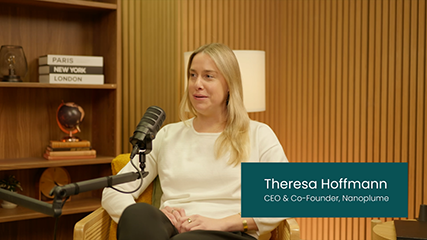
Katherine Keddie: Hello and welcome back to Scaling Green Tech with Katherine Keddie. I am here today with Theresa Hoffmann, who is the CEO and Co-founder of Nanoplume. We will be talking today about the experience as an early-stage founder with a deep tech solution and what she's learned along the way and where the company is going in the future.
Thank you so much for joining us.
Theresa Hoffmann: Happy to be here.
Katherine Keddie: Our opening question that we always ask. How would you describe Nanoplume to a five-year-old?
Theresa Hoffmann: So we develop a wall that stops both heat and cold to go from one side to the other.
Katherine Keddie: I love it. I wish everyone explained their terminologies that way.
Although it might put me out of a job, so maybe not. Tell us about your career today. How did you get into Nanoplume? Give us the backstory.
Theresa Hoffmann: Sure. So as you said, I'm the CEO. I also have a technical background, but I'm not the technical person. I have two brilliant co-founders both chemical engineering PhDs.
My background is I started studying material and process engineering and business back then. I first I grew up in Germany in an area with a lot of steel production. And, I always felt there must be better ways to develop materials. Circularity was definitely not part of my vocabulary back then, but I felt there must be something innovative, something space-age, actually that was always my dream.
I was always also really interested in space. And yeah, then I would just want to understand what materials are and then I got into that field. I did that for a while. Then I wanted to understand better how can we now build something with materials? So I switched over to mechanical engineering, which was more yeah, more, more tangible.
And during that time started becoming interested in human centred design. So design thinking and how can we actually. Develop products that actually fulfil human needs, especially in the hardware and like mechatronic space. Because I think, especially Germans, are really proud of their engineering and their processes, and that's what's being followed in the whole social, you're developing products for people, right?
So the whole social science is often ignored. So then I found a professor at Stanford University in the US who was one of the pioneers of this in this space. Combined mechanical engineering with social sciences. And did research in that space which is very interesting.
And yeah, during that time, as many people in Stanford who spent some time at Stanford realised that I wanted to become an entrepreneur, build something myself, contribute somehow to the world. And then it actually took me some time to get there, though. So I knew I wanted to do hardware, something with lasting impact.
I wanted to do something impactful, could be for the environment, could be for humans. But that meant I needed the right co-founders, of course. And yeah, I didn't really know how to get there. So I started in strategy consulting and worked at at BCG for some time, always at the intersection of business and hardware.
Then I moved over to the startup, our investment space, and worked at a family office as a venture developer. So in a really operational role where we only invested in deep tech companies, so I mostly worked with drones and laser tech and helped data technologies, and helped the CEOs scale their businesses.
So basically what I'm doing now, without the responsibility, it’s almost the same.
Katherine Keddie: What a great job.
Theresa Hoffmann: Yeah. And then during that time met my two co-founders and we started working on Nanoplume.
Katherine Keddie: And why did you decide that Nanoplume was the company that you wanted to jump into? Feet first.
Theresa Hoffmann: So it actually grew organically. So in this case it was, I was, we joined, we met through Carbon 13, the venture builder programme in Cambridge. And for me it was really about, so I wanted hardware, I needed a hardware co-founder, but it was really about a pain point or a problem space that excited me at that point.
I didn't know which one that was. And the right people. So I think, like for me, I'm an extroverted person. The co-founders are the most essential part. Generally, I don't know the exact number. I think 80% of startups fail because of co-founder issues. Yeah, that was really what I was looking for.
And then I got together with Tara, and we came back to speaking to each other. We really energised each other. We just realised we have the same interest and, then luckily also we're very compatible in terms of backgrounds, and we developed the idea together. So the whole idea about developing high performing insulation that started after we met.
Katherine Keddie: So for you, it was. The founder, like co-founder matching first, that gave you the energy and then from there you then developed together obviously through the Carbon 13 programme.
Theresa Hoffmann: Yes, exactly. Okay. So of course you always like limited, it sounds so negative, but by the skillset of your co-founders, the technical co-founders in this case.
Tara, our CTO, she had the idea of developing, absorbing materials for nappies or female hygiene products. So that's how we started. And then we looked into that space and looked into recycling nappies and cellulose in this case.
And then at some point came across the idea of developing those high nano porous materials, which you also need for the absorbent products with bio-based materials. And then understood that the thermal insulation space definitely is in need of an upgrade.
Katherine Keddie: Yeah. So let's get into that.
Yeah. Because I think that would be really interesting to hear your perspective on. Tell us about your product and how is it different from what's on the market right now?
The problem with conventional insulation
Theresa Hoffmann: Sure. So we develop a nano porous material and then it's super insulating biomaterial. The problems in the market we are solving are exterior issues across industries with outdated thermal insulation materials.
The first issue we see is a lack of energy efficiency, especially in the built environment. The second is a lack of space efficiency. Usually, for example, mineable insulation materials are quite heavy, quite bulky. Waste space, waste fuel during transport. And then third, a lack of circularity.
Currently 80% of insulation materials are still based on petrochemicals. And now we're solving these problems by developing what's called a bio-based nano-porous material material that is three times as insulating 60% lighter and thinner and a hundred percent biocompatible compared to conventional insulation.
Katherine Keddie: So not only is it. Substantially more sustainable, more importantly, as it's just more efficient. It works better.
What aerogels are and why bio-based changes the case
Theresa Hoffmann: Exactly. Exactly. Exactly. Actually, aerogels have been around for almost 80 years. And they sound quite space age and they are, they have been used by NASA, so they have really been successful for niche applications.
They have been on Mars. They have been protecting the Mars Rover, so they're really proven to be highly effective materials. However, they are very expensive, difficult to scale and usually quite brittle. So they have a porosity, like the best Aerogels have a 99.9% porosity. That means only 0.1% solids, which is like nothing.
It's also called like smoke, frozen smoke, because it's really just like air and yeah, different companies have tried to make these air results more cheaper and in the end commercialise them. But it's been difficult because it requires a different, certain process. So now actually in our case, we realise that by making Aerogels bio-based, we can solve those issues that prevent the classical silica based aerogels to be commercialised.
The sustainability is enabling us to commercialise it and bring it to high volume industries. Super interesting. So by thinking that way, it helps you get outside the box and then actually solve this wider industry challenge that's been going on for eight years. Exactly. So it's like a double layer problem we are solving.
So the bottom problem is the thermal insulation materials that are outdated. And then the other problem is that aerogels are amazing insulators, but too expensive.
Katherine Keddie: What does the competitor landscape look like for you?
Theresa Hoffmann: For the bio, like for the bio, so generally there's different categories.
So we have the super insulating segment with other players in the original space, so both silica, also biobased and other super insulators like vacuum insulated panels, which is more a component. And then of course we have the conventional insulation, and here also bio product, biobased product and the petrochemical based products.
And we, in terms of so you have to look at it in terms of cost per insulation value. There we are, like very competitive in the super insulating space. So around 75% cheaper than competitors. Then yeah, and then in the conventional space also cheaper compared to other biomaterials.
Then for the traditional products, for the petrochemical-based products, not always cheaper, that you have to look at like the total cost of ownership and how much value can we add overall for the specific application.
Katherine Keddie: Okay. But then in those two first applications it's much cheaper.
Theresa Hoffmann: Yes.
Katherine Keddie: Yeah. Interesting.
Theresa Hoffmann: Yeah. That's the goal.
Katherine Keddie: And when it comes to how you frame your work I'm always really curious about what you've emphasised in the way that you've described your work. You emphasised, from what I understand, adaptability for efficiency of use, sustainability, and then affordability.
Do you think that is the order in which you frame the value drivers currently? And if so, why have you decided to frame it in that way?
Theresa Hoffmann: Yes, so that's a very, yeah, especially the whole sustainability world and discussions. That's a very important thing. One of our customers said we like green if it makes green, and I think that's also what investors agree with.
And that is actually what we are building. So we want to have a material product that is high performing and also meets the economic or provides the economic value. And then on top of that, it's sustainable. And that's how we are framing it. And that's also how it is. And of course, in some, currently in the US, sustainability is.
That's not even part of my pitch. And other customers depend on the customer also, it depends on the investors. Some would only invest if it's sustainable, but then they're still looking for something, of course, where we have the economic value, right?
Katherine Keddie: Yeah. So from, for some segments in industry that are less interested in sustainability, it doesn't need to be part of the pitch.
It actually doesn't matter why it's better. It just is better. And then you've got another segment where it's still a sort of win-win.
Theresa Hoffmann: Exactly.
Katherine Keddie: Yeah. Okay. Interesting. And then in terms of markets, you are obviously early-stage as a company. How did you, firstly, what is your beachhead market and secondly, how did you identify and prioritise that market?
Beachhead market selection - pharmaceutical cold chain
Theresa Hoffmann: Yes, the, so beachhead market or generally? So we are developing a platform technology. The overall thermal insulation industry is. Growing to a hundred billion dollar market by 2030. So it's a curse and a blessing and it's definitely one of the challenges as an early startup to identify the right market, especially to reach that market.
And then where do we go from there? So of course you want to market ideally where that cannot exist without your product, but then at the same time, you need to align it with where your product is at. And I think for us, that's why we have now chosen the cold chain, the cold chain pharmaceutical logistics market.
There's of course a lot of segments in that market. And here we're focusing on single use, smaller volume shippers. Pharmaceutical segment because it's less price sensitive and then the smaller shippers because of the volume requirements. And then we have, so in terms of product development we want to develop a product that can be used in the built environment long term.
And for that we need a certain mechanical strength, but currently we're not there yet. So now we need a beachhead market that doesn't require this. So because of that, we're looking for anything where we have rigid walls to support our product. So that's, yeah, what we're currently looking at. And then the idea is to scale from that.
So start in pharmaceutical logistics. Once we have higher mechanical strength, we can. Maybe even do multi-use shippers and then scale up so you can go from small shippers to pallet shippers. Then at some point to the truck insulation. There we can add a lot of value with better performing installation and also less weight for the trucks, which.
Reduces the fuel used for powering the cooling unit and also less fuel because it's just lighter. And then from there towards warehouse insulation, the cold chain. And then this would be in theory a smooth transition to the built environment.
Katherine Keddie: Yeah.
Theresa Hoffmann: Yeah.
Katherine Keddie: Okay. So you're able to use this as an initial market to prove commercial viability, and then once you've got that kind of strength aspect that's needed for the built environment, then you'll move into that as a next step.
Theresa Hoffmann: Exactly. Yeah.
Katherine Keddie: Yeah. Okay. Interesting. When choosing that use case in that market to be your beachhead, how have you gone about validating the product market fit? Ensuring that your assumptions about the market actually makes sense and that it is a good beachhead market for you in practise.
Validating total cost of ownership with customers
Theresa Hoffmann: Really make sure to work closely with customers and with the market and make sure that there's a need and there's economic value for the customers and to do that. So we do first of course we do conversations. We listen to their requirements. Then as a next step, we do case studies. And the goal here is to prove, the net cost effect in the end because we all, the, most of those customers are using not super insulating materials, but conventional materials.
So in the end, you need to show them other, our material will be a bit more expensive in terms of upfront cost, so you need to show them that overall they still have a positive net cost effect. And we calculate, give you an example in the pharmaceutical logistics space. So we look at a shipper, like a pallet shipper.
Currently they're using polyurethane. And then we calculate what's the volume of the polyurethane, how much does it cost, what is the shipping cost because of the weight and the volume of the whole shipper. And then of course the end of life. So what does it cost to get rid of it in the end?
And then we do the same calculation with our material. And because it's higher performing, we can reduce the volume, we can reduce the weight. You don't have any end of life disposal costs. But again, we are a bit more expensive in terms of upfront cost. So anywhere in the end, so this example we're currently calculating with the customer is like around 200, over 200 pounds net cost effect per shipper.
So if they have a thousand shippers, that's already like a six figure profit or cost reduction they can see. And yeah, and this really differs though in terms of, and then of course the next step would be to do the pilot and we're currently preparing for that to kick off the first pilots.
And it, but it really differs. Also, the value add really differs depending on the use case. Give your second example from the built environment. Yeah, we are currently calculating also with an actual, yeah actual real data customer. They are developing, so it's like a real estate investor.
They're doing conversion projects where they're buying commercial space that's empty and then converting it into hotels. So the one important thing for them is separation walls. To build the rooms. And here, because it's a hotel, the sound insulation is essential. So now we are calculating again with a case study, how much of our material do you need to reach those sound values?
because it's also, the porosity also makes it sound absorbing. And then how does it compare to the. Two layers of mineral that they're currently using to get through those same values. And then, yeah, what are the cost savings overall? And here the biggest driver would be the space. So how much living space can they, in the end, win by making the walls thinner?
And that's the space that they can sell, right?
Katherine Keddie: Exactly. So using those early customers to help you calculate ROI, so then when you go to the more sceptical ones, you have data to back it up.
Theresa Hoffmann: Exactly. And we need to focus on all those use cases where we can have an instant ROI, otherwise it's a difficult sale and there are enough of those use cases.
Katherine Keddie: Yeah. Interesting. And how did you get those early conversations? What tactics did you use to get those early pilots or even case study conversations going?
Theresa Hoffmann: So from the built environment, it's really like inbound interest a lot. I think a lot through events where we're pitching investors who are connecting us.
So we've been in touch with a lot of the big real estate developing companies. In the cold chain we did more out like cold, even cold outreach in the cold chain on LinkedIn, which actually also worked surprisingly well and attended some conferences where we talked to those potential customers directly.
Katherine Keddie: Nice. Okay, so all through found outreach. Very much your own blood, sweat and tears conferences. Cold Outreach on LinkedIn, that kind of stuff. Okay. Interesting. And just for the listeners to get a reference of at what point you are, some pilots coming what stage are you in terms of funding right now?
Theresa Hoffmann: So we are actually currently about to close our pre-seed round. I've been saying that for a while, but this time I really think now, so we've so far raised around 1.5 million US dollars. And now we want to raise a couple hundred more. This is all part of our pre-seed. And then technologically we're at around TL four approaching TL five.
So between, prototyping on our way to demonstration. So the goal is to reach TL six, actually by the end of the year, early next year, and have some successful customer pilots. Until then.
Katherine Keddie: What is your number one priority right now? Today?
Theresa Hoffmann: The customer? Yeah. To kick off those pilots.
Katherine Keddie: Yeah.
Theresa Hoffmann: Yeah.
Katherine Keddie: Okay. Let's talk for a moment about sustainability. How have you approached circularity and lifecycle with your products?
Theresa Hoffmann: So I think for us it's really again, a multi-layered approach throughout the product's lifecycle. So we have the sourcing. For sourcing, we are only using, so we're using polysaccharides, all renewable feedstock.
We are only using abundant feedstock. Going forward, we want to focus on using local feedstocks and ideally even from waste. So it's on the sourcing side. Then this next step would be manufacturing. Here, our process is built on green energy principles. That means that we only use water as a solvent that we then also reuse.
And we are integrating this with our proprietary technologies or secret sauce, which is technology that significantly increases or actually decreases the manufacturing time. And our biggest cost driver is energy. So in the end, if this brings down the time, then that brings down the energy intake and down the cost in the end.
But of course, also the carbon. Or leads to significant carbon savings. Then the next one would be distribution supply supply chain. So here we are. This is also going forward not yet, but our vision is to develop close to the manufacturer with partners and then close to the customer side.
So globally to have a network where we can use local waste manufacture close to the customer side. So we are not dependent on supply chains and we also don't have any additional emissions because of those supply chains. And then the last one is oh no, end of life is another one. Here, as I said before, it's degradable so you can just compost it.
And I think then the biggest impact in terms of carbon savings is through the product use. So in the built environment as an example, insulation can significantly increase energy efficiency, and of course, also bring down cost. But this would be the biggest over the next, yeah, 20, 30 years the biggest carbon effect out of all of these.
Katherine Keddie: Have you done a lifecycle assessment yet?
Theresa Hoffmann: Yes, we are working on it. So we have done a preliminary one, but we're currently doing a, yeah, more in depth one. Yeah, it's quite a lot of, quite a lot of work.
Katherine Keddie: Yeah. So there's a really long term benefit and kind of case for this work from a sustainability perspective.
How is policy driving demand driving behaviour in your space and how could we do that better?
Theresa Hoffmann: So it really, I think, depends. On the geography, first of all. So this is also, again, a challenge especially in the built environment. We are UK based. We have been spending some time in the US.
We also have potential customers there. I'm German, we also have some people we're speaking to in Germany and then across Europe. We recently went to Abu Dhabi where we had interests from big building companies. We had an accelerator in Japan. There's also a lot of interest. So of course across all these countries regulation is very diifferent sometimes more existing, sometimes less existing. One thing that could help, I think, is currently it's still different silos when it comes to climate policies and regulation where you have the circularity on the one side, then you have another one where it's really about building codes.
And then there's, I dunno, energy efficiency somewhere else. And they're not really working together. And then I think especially specifically for materials, there's not really one instance pushing to focus on high performance, sustainable materials. I think that would be very helpful.
And then also the education around, there's another one we are not like, struggling with and I think other companies as well to convince customers and also investors of the overall value. So the total cost of ownership instead of just looking at the upfront cost. because most people are like, oh, this is more expensive than mineable.
Yeah, but you first of all need less material. Again, you have an instant return on investment because you can have more space you can sell or it's like quite easy usually. But still. Because also in the built environment, the parties along the value chain don't work together. You have the contractors and you have the building company.
They have the tenants later on that want to have the energy savings, but they don't, they're all focused on their own benefit. And then, yeah, that's where I think these solutions can fail because there's not enough support in that space. And education as well.
Katherine Keddie: I did some really interesting work this year with one of our clients called Qualis flow. They are looking specifically at materials and waste data in construction sites. And they released a report last year which was focused on the quality of data in construction and one of the broad problems was also just that people don't know what materials are actually even in buildings.
So I think it makes it very challenging because you're con, convincing people at each level to buy into this process and to understand the return on investment. To not compare directly like for like with something that, for example, you need a lot more of for it to work.
And the return on investment isn't as good. Then you get to the actual build and even at that point, the wrong material might be put in a building.
Theresa Hoffmann: Yeah, exactly. So everyone who has actually built there, I have some friends who are like, I recently put in some insulation in my space and it was horrible.
There must be better solutions, like everyone who's gone through it really feels sad. Yeah. But then usually landlords, they don't. They don't care, for them it's just an additional cost and they don't see the benefit.
Embodied carbon regulation and policy gaps
Katherine Keddie: Yeah. And one thing I'd love to get your perspective on is the UK government in particular, their approach to embodied carbon which I would imagine is one of the key areas that would focus on solutions like yours.
As you say, sustainability is not the top line message that you're leading with. It's not the main benefit. It's a benefit alongside others. That kind of delay or lack of clarity around embodied carbon regulation, do you think that's affecting the scale up of solutions like yours?
Theresa Hoffmann: Yes, I do think so.
And I know there's some people that are asking for this. Again, both from the customer and the investor side. And yeah, we have those, the, this data prepared. And we also. Very competitive compared to other materials or superior when you look at this data. So yes, I think everyone who's aware of it likes our product even better.
Katherine Keddie: Yeah. Yeah, and when you're speaking to these like early adopter customers. Do you find that there's a greater chance that they would be passionate about the lower embodied carbon or the fact that it's biodegradable, for example, than maybe your later stage, even your early majority stage customers that are maybe more motivated by price, scale efficiency, these other value drivers that we discussed.
Theresa Hoffmann: I think you need both. I think the ones we are currently talking to, they want sustainable solutions. So yes, it probably helps as a beach market, beachhead market. But they, the focus is on, on those performance cost. Cost values. Yeah.
Katherine Keddie: Is there anything that you have taken from these early conversations with customers that has significantly changed your perspective?
Like anything that you thought was going to be really important to them? It turns out it's not, or you didn't consider and it turns out that it is.
Theresa Hoffmann: That's a good question. I think the example I just gave with the sound absorption, like this is something so we've really been learning that we need to look at the material and also to.
To sell it, right? To look at it from different with different metrics. So you can, we started with this is the cost per cubic metre. And then of course if you compare it to other materials, it's not that we are not a winner. So then we changed it to, okay, this is a cost per r value, right? Or per installation value.
And now this would be another one. What's our cost? Per decibel or per sound absorption. So I think there's something that, in the end, you really, you need to frame it the right way, depending on the use case and depending on the value that you're adding in the end.
Katherine Keddie: Yeah, and I guess it, it goes back to the common understanding that the more you talk to your customers, the more you can frame your work and the more tailored each pitch becomes.
Theresa Hoffmann: Yeah.
Katherine Keddie: That kind of thing comes through and you go, okay, perfect. There's this whole value driver that I didn't consider that I can now lead with.
And it makes you very adaptable to be able to pitch and win clients in different areas.
So overall, what role would you say insulation plays in the energy transition?
Insulation's role in the energy transition
Theresa Hoffmann: So I think I've called it the unsexy and silent hero in the energy transition. because it's like a really overlooked topic, right?
And everyone, like when we talk about energy transition climate, everyone is thinking about energy generation, so wind, solar, hydrogen, or heat pumps, and all those more like sexy topics. But in the end from our point of view, it's really about energy efficiency and not like even just getting to a point where you don't even have to generate the energy at all.
So the most carbon friendly way to reduce carbon is to not produce energy at all in the first place. And that's where then insulation comes in, right? So insulation in the end determines in buildings how much energy is used, determines in the end how much power the grid needs, determines how much dry ice we need in the cold chain, how much fuel is being used in the cold chain.
So all of this. We at Nanoplume believe that, not energy generation, but energy efficiency is the silver bullet to reach the 2030 climate goals. So scaling climate tech is really not about building more, but in the end about wasting less and insulation is driving the shift or is one of the drivers.
Katherine Keddie: Yeah.
It's foundational to all of this other activity that goes on. Why do you think it's unsexy? What's unsexy about it?
Theresa Hoffmann: I've had this discussion before I wanted to pitch, this is not a sexy topic, and then I got the feedback saying, this has not been a sexy topic. Now it becomes sexy.I think if you think about insulation for me it was always memorable, something dusty, like people wearing masks.
Do you get stung? Everything is itchy afterwards. It's, again, not really healthy. And yeah, now of course the material we are building, it's I think you could call that sexy. It's like very, yeah, very lightweight, very like the fine pores white colour.
Katherine Keddie: I think what is sexy about your framing in particular, and that I've seen when I've seen your co-founders pitch on your website as well. Is this idea of a space technology being applied in an affordable way to commercial applications like the built environment, the cool chain, for example.
That's the kind of early-stage messaging that I think works very well for helping to bring in those early adopter customers that are really excited by the technology, by the innovation and to show your vision for how the technology can develop over time for investors. And yeah, those excited early customers.
And then it will change as you grow and it will be more focused on return and investment. You have gone through several accelerators. In particular, the ones that we've discussed before are IndieBio and Carbon 13. How has each shaped your experience and for those founders listening who might be considering going on an accelerator programme, what would you recommend for which type of founder?
Carbon 13 and IndieBio
Theresa Hoffmann: Sure. So yeah, we started with Carbon 13. Without Carbon 13, we would not have met. So that was, yeah. Essential. I think the reason I decided to join Carbon 13 back then was to really have because we really focused on teaming, so there's other venture builders for early-stage or for even individual founders who are looking for co-founders or end.
Or an idea. And they usually have a very short period to meet people. So at Carbon 13, it is really 10 weeks that is just focused on teaming. And you have three groups, one technical group, one commercial, and one everything else. And then, yeah, you can support you, but you can also structure it yourself and you can decide on how much time you spend with whom, what topics you discuss.
So that was incredibly helpful. We got along great. So I think the goal at the end is really to make it as, or become as authentic or as, make it also somehow as uncomfortable as possible in the short amount of time, to really German would say let down your pants. Just really be yourself.
Show your true self. So then if it doesn't work out, you have enough time to maybe even find someone else, right? You just want to find out early and quickly. And so we got some tools there as well that helped us. I think for every co for every founder, people who are looking or meeting with co-founders it's useful to go.
There's 50 questions for founders to go through that they really talk about: what are your values, or, where do you see this company going in the long-term, what kind of exit do you want? But really just get to know each other. Yeah. And then the carbon 13. So the next phase that really helped us within and the end, it was like four to five months to get from an idea to an investible company.
So until UNC Incorporation, yeah, it was I think a six month period. And we really got they help us also, the whole carbon. Perspective, ESG perspective. How do you do proper monitoring and what does all of this mean? What do you need for a data room? What do you need to get investment ready? What are the legal contracts you need?
So all of this really, yeah, really accelerated us. And then afterwards, we instantly afterwards got investment from IndieBio. This was a really exciting period. We had just pitched at Carbon 13. I was still living in Berlin getting ready to move to London.
We were all still fully employed at that point. And then we got investment from IndieBio in New York and they invited us to join their accelerator. And that started two weeks later after the, basically first conversation between first conversation to Let's All Move to New York. It was like two, three weeks.
Which was very exciting and we decided to do it. So we all moved in together as well. So we lived together without even really knowing each other. For three months in New York. And yeah, then in the bio again it's called an accelerator and that's what it does. So we were really, from day one, we had a laboratory there.
They helped us to get something ready. So it's one of the learnings of how important's to have a physical prototype as early as possible. I think the rule is usually for MVPs, but even like for that, if you're not embarrassed about it, like it's too late, so you should feel embarrassed about it.
Katherine Keddie: Yeah.
Theresa Hoffmann: But yeah, you should yeah, find something. So really be scrappy. Get a physical product fast. Find a way to produce it. We had so many issues there with finding the right. The right equipment. So we, in the end, like started working with some university. Like we messaged different companies, we messaged other accelerator programmes, we messaged universities in order to get support and somehow worked out.
So I think that was yeah, big learning. And then through our thanks to Carbon 13 yeah, first concept three. And then in the bio we got really momentum. And really started yeah, building relationships in New York in the big climate tech scene there. Joined another accelerator, the founder fellowship and so on, and just built a really, yeah, really amazing climate.
A startup investor network there.
Katherine Keddie: As someone coming into these programmes, having done venture building for a family office and I'm sure had a good foundational understanding of what it takes to scale a startup. The nitty looks like. What do you think these accelerators brought to you?
Theresa Hoffmann: Again, for me, the main focus was the co-founders. Okay. The relationship. Yeah, that's, yeah. I think the building in the end, it was still very useful to have the so I was not that educated on the, like the whole carbon side of things. Carbon savings and the, yeah, the legal things, for example.
So there's definitely things that can be helpful. Already with Carbon 13, even now, later on, they're supporting us with their network. Investors, they give us visibility. So that's all still really ongoing support. But yeah, I think the, by far the most important thing for me is the teaming.
And then at IndieBio, I think the, yeah the mindset I think is also us thing, right? To really be scrappy, to move fast is especially difficult for Germans who learned to be, it's all like rules, perfectionism. So that was really useful for me to just be in that environment and for that was also really useful to be in the US.
And then of course to be so close with my co-founders and really be co-located during that important first time was essential. And then the other thing is storytelling really, without really having a product or having a scrappy product. Just having an idea to to really solve a vision and yeah, to do it well.
So we got a lot of coaching there in terms of, we got support with like product, video, like really whole whole filming crew who helped us develop a product video. And we didn't have much right. But so that was very useful. We had a coach to help me or to teach me how to pitch. And how to communicate.
Yeah, and this was all within those three to four months. Yeah. And then of course the network. So the network in the end is essential.
Katherine Keddie: Yeah. Yeah. And does the network have more investors or are you getting early customers through that network too?
Theresa Hoffmann: Both. Yes.
Katherine Keddie: Yeah.
Theresa Hoffmann: Yeah.
Katherine Keddie: I think the skill of storytelling can never come too early.
Matt, my Co-Founder and I are both domain experts on Carbon 13, and I know that they also teach storytelling really early doors in the programme. And it's such a valuable investment because every single touch point that you have with customers, investors, everyone else, is through the lens of how well can you sell this idea at an early-stage , you have to get people excited.
Every employee description you have to sell exactly what they’re doing and get them on board. And I think having a full team that is able to go out and pitch and communicate your vision really well, early, early-stage, when everyone is a spokesperson for the business, I think is very underlooked because often the more technical founders step away from that role.
But actually you are a really critical spokesperson for the business. Yeah. If you are representing the technology you're speaking to customers, you're speaking to investors, you are communicating with your fellow co-founders. You are hopefully doing some stuff with your personal brand.
They play a crucial role too, so it's refreshing to see that.
Theresa Hoffmann: It's interesting that you say that. Because at IndieBio we had those like pitch training once a week or we had to come in and They specifically asked for each co-founder to come in. So only one, and it was every Friday to deliver an elevator pitch.
And exactly that was the reasoning that Yeah. Whoever is on the, if it's a co-founder, as an employee as well. So we currently only have one employee, but also with him going forward, like we want to also do this kind of pitch training. With employees, especially the early ones.
Katherine Keddie: Yeah, I, I have been on accelerators with my business.
I now teach on accelerators, support them with workshops, and mentor. But I think one of the biggest lessons that I had is right when we started Adopter, we went on an accelerator programme, and they just made us come in and pitch every single day. And that was one of the best lessons because I'd just lost all fear of doing it.
And every day you come in, there would be a different speaker, someone important, you want to impress an investor or, potential customer, whoever. And we would have to pitch, and it would have to be, myself or Matt, either way. And I think that. That trial by fire is really key.
Theresa Hoffmann: Yeah.
Katherine Keddie: Yeah.
Theresa Hoffmann: It's uncomfortable in the beginning, but then yeah, you get used to it quite quickly. Yeah. I remember, especially on stage.
Katherine Keddie: Yeah. Yes. No, exactly. And it becomes so critical. because you are selling an idea at the end of the day. You have to get people to believe in your vision.
Living with your co-founders. How was that?
Theresa Hoffmann: It was good actually. Yeah, I think we had
Katherine Keddie: Oh, okay. Great.
Theresa Hoffmann: Yeah, I think in the end we had some horrible apartments. Of course we were trying to save money and it was like our first investment that came in. And then New York is very expensive, but we did want to live together, so it was the first thing we all had that was different, so we are very different people.
We are all different characters. We come from different cultures. And that also showed itself when it, when we like talked about, okay what's important for you with a, with an apartment even, right? So I wanted to be very like, central and my co-founder, I don't know, wanted a proper kitchen or whatever.
I think that was a good early experience for us to get to know each other and learn how to, yeah, how to communicate with each other and. Yeah. So in the end the tough phase, or again we moved into one apartment, it was like very bad. And now we're laughing about it right now.
It's now one of the stories that something that unites us somehow.
Katherine Keddie: Yeah. Have you got any tips for people listening about building positive co-founder relationships? As you said at the beginning. Huge issue error for startups. So what would be your tips for the audience?
Co-founder dynamics and self-development tools
Theresa Hoffmann: Yes. I've been thinking about this a lot.
So I think the, so I think you, one thing is you have a certain skillset depending on the role, right? So what I now learn for, I think for commercial co-founder what is really, so you, I always have to look at what skills someone can develop, especially now with AI. How does the fundraising work?
You can figure it out. You have investors who support you or someone and what are the things you cannot just learn quickly? So then of course, focus on the things you cannot learn quickly. I think for commercial co-founders, it's really a network I think that really helps from, yeah, myself.
I've worked in consulting before, I've worked in the startup investor world before, so I think that was definitely helpful too. To spread the word, to get warm intros. And then the second thing I think for commercial components is really communication. So to be good at communication or be open, be.
Good to, like with communicating internally, but then also externally. Then I think for the technical co-founders what I can see with my technical co-founders, which is what is very helpful. And also I think a bit rare is to be able to iterate quickly as a technical person and not get lost into too much detail.
So I have a good balance of, being focused of course on the details of the technology, but also being able to move quickly. Being able to, I learned the phrase to, ‘to kill your darlings’. To be able to pivot, to not like, yeah, really fall in love with your solution, but be able to move away from it.
I think also during, especially during those accelerated programmes, carbon 13 you meet people that come in with ideas, especially on the technical end. And some are postdocs and they have developed something years ago. And yeah, you need to be open as a technical co-founder too. Kill your darling and maybe move into a different direction and listen to what other people say.
And then of course, the other way around. So I think that's in terms of skill sets. And then the other really important thing is character, right? And here I think you need to be able to have difficult conversations. I think that's a really important one. because you will have a lot of difficult, uncomfortable conversations.
So you need to be able to do that. And I would recommend everyone to just. Test that and do that early on. So you need co-founders who are able to do that willing at least. And you can always learn like we are constantly learning. And the other thing that comes with it is the growth mindset, right?
To be willing to really change yourself, to accept that maybe what you thought was right is not right. And to really work on yourself and not just like this trendy, oh, we all, but you can see in Instagram growth mindset, but really come in every day and it might take months or years and do the thing that feels, doesn't feel right, and that is uncomfortable.
And again, every day, again, it's uncomfortable. To give you an example, for me, I really now learning, I think I had a different idea of what a CEO role entails. So I thought, okay, A CEO, it's a leader or generally co-founders as a founder and you need to show the direction and you can be, maybe you should be assertive and.
A bit more like controlling and now quickly learned that it's really not that, and that I think a lot of founders that also have been, had like careers before and have had quite like a success, successful track record are, have learned to, to win and to be focused on winning. And in the end it's really more about, it's not more about, it's about making your team win, helping others to win.
And that just means to, I think, shut up a lot. Like to often just, not be defensive, not react. Just say thank you. Just maybe someone has an idea and you already knew this. Instead of being like, yeah, I knew this. Thank you. Just say say thanks. Or like this urge of adding value constantly and making it your idea.
So some, someone comes in with an idea and you're like, oh yeah, but maybe add this. And then in the end you make it your idea. You steal their motivation. But you might make the idea 5% better and it's not really worth it to, in these moments, to really pause and say, okay, great idea. Go. Go on. Good luck. Yeah, and that's what I'm not describing actually have found from a book I'm currently reading, which is what got you here won't get you there. It's really about stopping habits that might have helped you to get where you are, but won't really help you to get anywhere in a leadership role. So I can definitely recommend that for everyone who's founding a business.
Yeah. Interesting. And that also brings me to this, my coach recommended this. So coaching is another thing we have been doing as a team for a while, so we've been doing individual coaching and we've been doing group coaching and it's been life changing. So I can also recommend that to everyone.
I think it often feels it's bit stigmatised or changing now, right? But it often feels like maybe failing or being too weak, like not being able to handle it yourself. But yeah, I think it's of course not true and. That I think is essential for every successful co-founder relationship.
Katherine Keddie: I think it's tough because you need to find people that have confidence and conviction enough that they can look at a huge industry or a huge problem like insulation being deeply inefficient and very non-sustainable and go, I can solve that problem.
Theresa Hoffmann: Yeah.
Katherine Keddie: I know what the answer is and I'm going to convince industry and I'm going to scale this idea. And it's going to change the industry. It's got, it's got legs. It's going to change the world. But then also humble enough to go. I've been going down this road with this specific MVP for a year and it's actually not working.
It's not fit for you. So I'm going to pivot and go in a different direction or I'm willing to hear another's perspective or I'm going to speak to a coach or speak to an expert and get a new, fresh perspective that's going to help to fuel the idea of the company going forward. That combination, I think, is quite a rare find.
Because I think people perceive being humble as being a weakness.
Theresa Hoffmann: Yes. Yeah.
Katherine Keddie: But actually you need both to be able to move effectively. Yeah.
Theresa Hoffmann: Or naivety also to some degree. Yeah. Lack of knowledge. You know that Dunning-Kruger curve where you have the mountains.
Mount Stupid first. And you are in a really high level of euphoria because you don't know anything and then you go into the valley of despair. So I was riding them on stupid for quite a while. It was great.
Katherine Keddie: Okay. And then you look at the challenge ahead of you and you're like, oh my God.
Yeah.
Theresa Hoffmann: But then you're at a point already, you're like, okay, I guess we can also figure this out. And yeah, it's,
Katherine Keddie: Yeah. Yeah, absolutely. I think all the investors that I've spoken to on the podcast and also generally in our work, the ones we work with and partner with the most common reply to what makes a good founder.
They just all say resilience.
Theresa Hoffmann: Yeah.
Katherine Keddie: By far resilience, you have to believe that someone's going to be told no at every corner. Has to pivot and chop and change what they're doing. Has really difficult conversations with co-founders, important people in their life and will still keep tracking with this idea.
And I think to be resilient you have to be humble as well. Because you have to understand where you're going wrong and you have to be able to move and change your direction.
Theresa Hoffmann: Yeah. Yeah,
Katherine Keddie: I agree. Yeah I would say that is a good description of all the really great founders I know, they are that combination.
Any other books that you would recommend? For the listeners, anything else that you're reading that you love?
Theresa Hoffmann: So another personality test we did early on which was useful is positive from Positive Intelligence. The saboteur test. Which is for free online takes maybe 15 minutes and it gives you a good indication of your saboteur.
So it's the, like childhood mechanisms you build up to protect yourself. And we did that very early on in the first month, I think. And it really helped us to understand yourself better and your behaviour. Like mine, one of the top ones was controlling. So then I know, oh, the controller is kicking in.
This is why I feel the need now to tell everyone to do it my way or, so it's easier for you to distance yourself from that behaviour and as well for your co-founders. because they're like, ah, Theresa's control again. And there it is. Here we go again. It, yeah, removes the like on a personal, level. And makes it much easier to handle. Yeah, I think another framework we're currently using that our coach taught us is the above and below the line. It's on YouTube also like a three minute video, but really helpful just to communicate. Where you're at emotionally. So am I ready to have a difficult conversation or not?
And it's just a good, again, a good like external layer to, to use in communication to not make it personal.
Katherine Keddie: Yeah. And I think that's actually a really smart thing to do because I think there's this misconception that if you think or. If you're thinking about your emotions or your feelings, that has to be separate from your Yes.
Your behaviour as a founder or your even, as a professional. And I, my perspective is that. If you don't consider your own emotions or how you're feeling or the context of why you are saying something or making a certain decision, you're actually making it you're making it in quite an ignorant way.
You're making off the basis of something that you haven't considered, you don't understand. And that's how people grow into these weird directions. And I think particularly when you are a founder who is in a very stressful environment, it will push you. To make decisions based on emotion.
And sometimes you need to acknowledge that in order to make a decision with a clear head.
Theresa Hoffmann: Yeah.
Katherine Keddie: We did this really interesting test, similar to what you're saying. 36 trades, rank some in order. And for the first kind of top 10, it gives you a sense of how these are strengths, but also how.
These could potentially go too far. It's called Clifton Strength Finder. So for example, you might have activator as number one, which means that you are really someone who can like, pick up and run with something. If you're motivated, you're just going to like power right through now, as an option.
Like you just keep going. But obviously the negative side to that is that you could then, go through people's boundaries, move things too fast. You can try and get stuff done when they actually don't need to be done, and you could probably leave at 80% and stop. So I think that's kind of a nice one, because it gives you how something is a strength but also a weakness at the same time.
Theresa Hoffmann: Yeah.
Katherine Keddie: Yeah. And in my team, everyone's done this test and we use it as a frame of reference, like a common language to discuss something now, like he said, they’re being controlling today. That's a good way to describe a common language in the end.
Theresa Hoffmann: Yeah.
Katherine Keddie: Yeah, exactly. And it's not I think it takes the offence or the emotion of it a little bit. You can discuss how you feel like this test reflects you. And if someone says, you are being too activated. It's, we just need to pause for a second and work out how are, we're going to do this and do it as a team.
I'm aware of that. And it just pulls out the miscommunication.
Theresa Hoffmann: Yeah. And you don't, yeah, it's not as hurtful, you don't take it as an insult because it's just tied to this framework that you're all using.
Katherine Keddie: Yeah.
Theresa Hoffmann: Yeah.
Katherine Keddie: Yeah. Absolutely. I think they have flaws as well.
They're not a hundred percent accurate, but we found that using them as a jumping off point for discussion is really helpful. Yeah. But I wouldn't be making, I dunno, hiring, firing decisions based on that because I think it's not. Yeah, it's not accurate enough to base that, but it does give you that common language.
Theresa Hoffmann: The culture code is another one I read. If you were thinking about what is the company culture, how you want to build it. I think we, one of the central themes is vulnerability and what does that mean? So I can recommend that as well. Because all again, vulnerability seems for its leader.
Yeah. The first instinct is to think, okay, this is weak, this is wrong. I can't be vulnerable. But in the end, it's the opposite. Of course it also differs, depends on the people, the character, and how you want to build your culture. But this has been working well.
Katherine Keddie: I think my favourite book of all time is Never Split the Difference.
Have you read that?
Theresa Hoffmann: I have it and I haven't read it yet.
Katherine Keddie: You need to read it. That's all. It's your homework,
My co-founder recommended it to me. We recommended it to everyone, me all the time. It's so useful. But at its base, it is teaching you how to have conversations with people where you put yourself in their shoes. You empathise with their position and then you come out with it's a negotiating book, but you come out with outcomes that actually mutually benefit everyone in the situation.
That leaves you with a positive relationship. And I think, reading it for the first time, I actually thought a lot of this to me is just empathy.
But it gives you a framework with which to do that, which again, is helpful and is something that has, again, provided a common language in our team because of the way that specific phrases are used in the book, for example, you know what someone's trying to ask you when they ask those questions.
Theresa Hoffmann: That’s very interesting because I bought it years ago and I always just saw it in the context of. Buying a car, like negotiating, getting the best deal for myself. Yeah. Like really more like selfish, how can I win this? What's the psychology behind any negotiation? So that's interesting that to use it.
Katherine Keddie: I honestly think I use it every day.
Theresa Hoffmann: Yeah. Okay.
Katherine Keddie: Genuinely, I use it when I have conversations with my partner and I'm trying to understand where she's coming from. I use it when I have conversations with clients. Me and Matt talk, use the language with each other, because it gives you a sense of what someone's trying to ask you when they ask you question, and
Theresa Hoffmann: Then everything is a negotiation.
Katherine Keddie: Right? I think it's more that everything is two people with different perspectives coming together who have their own motivations. Yeah. And the book is about finding a solution that fits, but is not necessarily the middle ground.
So it starts with this analogy of if you have one black shoe or one. Brown shoe and a pair. That's not an ideal middle ground . It's actually a bad pair of shoes, so yeah, that's my recommendation and my recommendation to you to read.
So looking back at your journey so far, what is the number one lesson you've learned along the way?
Theresa Hoffmann: So I always had this idea of what CEO and a founder should be. And that can be quite frustrating, right? Because you, yeah, you always try to become something that you're not. So I think the big learning was, and also with the help of coaching, to really rather focus on how I can structure the role around who I am.
And of course, being a founder, being CEO still comes with certain skills and expectations. But yeah, and you still need to continuously learn. So I think that's the other thing that to really, we really to accept that you have to stop doing the things you have been doing so far. You have to also maybe learn to do new things again, it should all be authentic.
It should all be part of who you are, but it's in the end, it's really continuous. Continuous learning process. Yeah. And to be open for feedback, to be open, to listen really to your co-founders. Listen to your team and be comfortable with it. Yeah.
Katherine Keddie: I think that's something we can all learn.
Theresa Hoffmann: Yeah, you can not only use it during the job, like it's really been helping me in my life.
Katherine Keddie: Looking forward, what does Nanoplume look like in five years’ time?
Five-year vision for Nanoplume
Theresa Hoffmann: So it would be great if we could get there in five years. But, so generally the overall vision would be to build the company, have Nanoplume everywhere, of course, across industries globally to be not sure how we get there.
If we want to build it up ourselves, work with partners, contract manufacturing or licensing partners, but scale up quickly, insulate the world. And then ideally have. Really again, local production, local manufacturing, no supply chain carbon reductions because of that and incorporating waste. So I have used waste sources as feedstock even maybe with modular manufacturing setups.
We recently spoke to customer from Alaska, and they're looking for a remote setup, a modular setup where they can in their village use their waste and then manufacture building materials from it. So of course if we can make that happen, let's see if we can make an addition to it. Get there in five years. But that would be the vision.
Katherine Keddie: Interesting. Watch the space.
Theresa Hoffmann: Yeah. And then go to space at some point.
Katherine Keddie: Yeah. Oh yeah. No, of course.
And then do you have any other shoutouts for the audience? Where can people find you? What do you have coming up? What should people look out for?
Theresa Hoffmann: Yeah I think the easiest to follow me or connect with me on LinkedIn.
Also I'm happy if people like, have anything they want to talk to about me one-on-one. They can message me on LinkedIn. So I'm open. And then on LinkedIn we're also sharing so we attend quite a few pitch events currently this week in London, the material research exchange. That might be too late when this airs, but we're posting everything on LinkedIn.
So yeah, I'm always happy to develop my network there. Speak to other founders, investors, or even potential customers.
Katherine Keddie: Amazing. Thank you so much. This was such an interesting conversation. That's where you can find Theresa, also on the website. I know you have a great newsletter too.
Theresa Hoffmann: Thank you.
Katherine Keddie: So I'll give a shout out to that. That's all from us this week, so catch us next time on Scaling Green Tech. Goodbye.

















.jpeg)
.jpeg)

.jpg)
.avif)