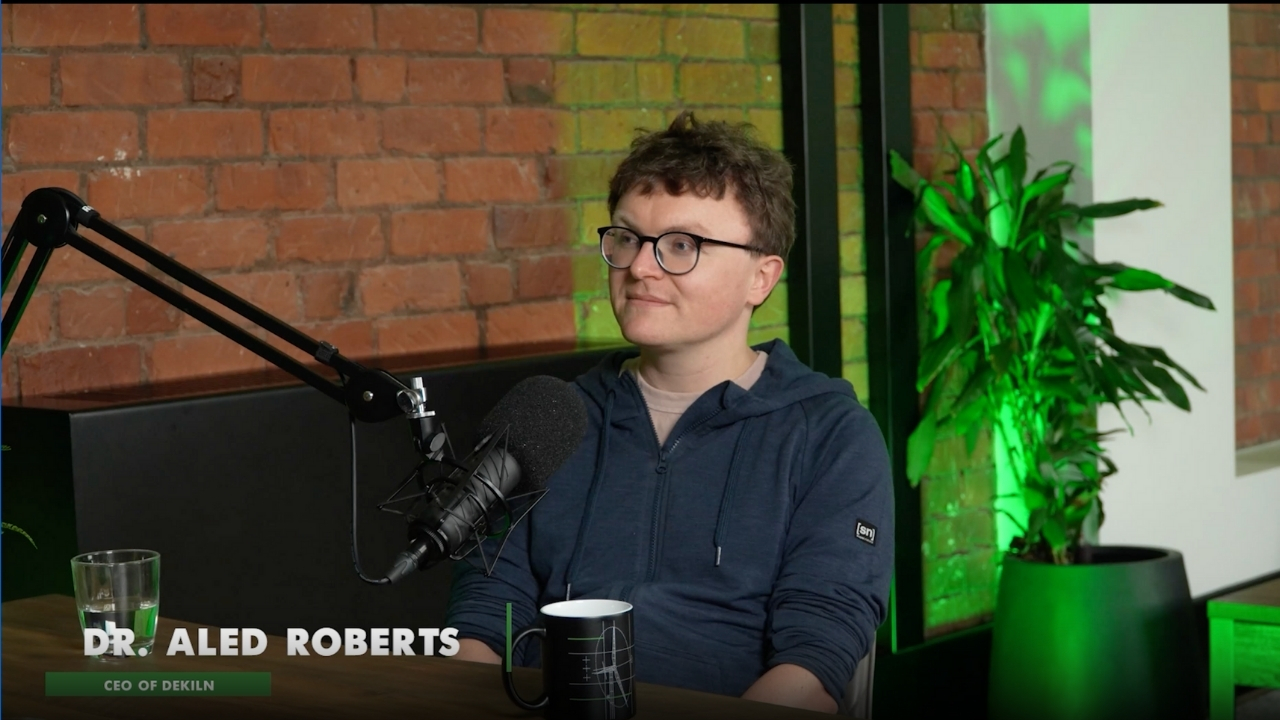
Matt: Welcome to the next episode of the Scaling Green Tech podcast. Today, sadly, my co-host Katherine, is not able to join us. However, I would like to introduce you to Dr. Aled Roberts, the founder of Dekiln, formerly known as Deakin Bio, a startup that has invented a way to reduce the carbon footprint of ceramic tiles by 94% by removing the requirement to fire the tiles in the kiln. This technology has a potential to revolutionize the ceramic sector and well, when it gets adopted at scale, I would hope it can be present in every home, including my own.
Dr. Aled: Thank you very much for having me.
Matt: Aled so what would you like to add to this introduction? And then we'll get started with the opening question. How would you explain what you do to a 10-year-old?
Dr. Aled: Yeah, I think you've basically covered everything. We're still fairly early stage. We're quite small, but with ambitions to grow, hopefully fairly rapidly. But yeah, happy to crack on with it.
Matt: Perfect. So do you want to be the first one to take a stab at the 10-year-old question?
Dr. Aled: Yeah, sure. Happy to give it a go. So essentially what we're doing is we're trying to produce a sustainable alternative to ceramic materials. So ceramic is something like a brick or a tile or a ceramic mug. And essentially it starts with clay and you have to heat it up to very high temperatures to fuse the clay into a solid material. And this takes quite a lot of energy. And because it takes a lot of energy, it typically takes a lot of fossil fuel resources. So you have to burn a lot of gas in a kiln to produce your ceramic materials. And this is bad because it releases a lot of carbon dioxide emissions. It's not sustainable, it's not good for the environment. So we have tried to develop an alternative that avoids this kiln firing step, and we take inspiration from nature.
So natural materials like sea shells or tooth enamel or pearl are all ceramic like materials, so if you imagine a seashell or a pearl, it's a very hard, strong, robust material, but nature produces these materials without having to fire them. So we looked at these materials, we investigated them, and we thought, how can we emulate what nature does, but combine it with human engineering and human processing? Because although nature makes these materials and they're very strong and robust and tough, nature is also quite slow. So to grow a shell, it takes many weeks and months, whereas if we want to produce tiles, for example, we want to produce them hopefully over the course of a few minutes. So that's what we've tried to do. We try and learn from nature to produce materials that look and feel like ceramics, focusing on ceramic tiles and do this in a cost effective and scalable manner.
Matt: Perfect, yeah, it's a great thing you are building. You are on a mission to create the world's most sustainable tiles and so far you are succeeding, but obviously market is also working on the same challenges as you are. So your goal is to stay a step ahead of the market and make sure that you are at the forefront of this ceramics innovation.
Dr. Aled: Precisely yes.
Explaining ceramic tile production
Matt: When I'm thinking about this idea of explaining something to a 10-year-old, I think you touched on many, many things that a 10-year-old would be familiar with. So like breaks, references to breaks, references to seashells, and other such objects. What I was thinking was that I was also obviously doing a bit of prep ahead of it. I was thinking that the way to approach it could be also to focus on the kiln side of things, like you mentioned, which is that when you make ceramic styles, bricks, anything like this, you need to burn, you need to fire them in a kiln, which is essentially like a big oven, similar to an oven in which your mom, your parents would be making cookies. This big oven for making ceramics, it takes a lot of energy and it creates a lot of pollution that is bad for the environment and poisons the air. Your technology makes it so that the oven is not needed. So the process is better for the environment and also cheaper to implement. So it's easier to make and quicker to make.
Dr. Aled: Precisely. Yes. So by cutting off this kiln firing steps of the oven firing step, it saves a lot of gas, which is 30% of the cost of the ceramic tile, but a huge chunk of the carbon dioxide emissions, so the pollution essentially. So by cutting out this energy intensive step, we get a material that's a lot more sustainable, much lower carbon footprint, and much better for the environment.
Matt: If I remember correctly, you're also able to unlock some new properties of the materials. So I think we touched on new shapes, colors, including red, which is one of those premium colors in the world of tile manufacturing. And you have less, I think it was warping and shape distortions.
Dr. Aled: Yeah, that's right. So because our materials aren't fired it's called centering this process of firing clay to make a ceramic material. Because our materials aren't centered, typically they don't have as good material properties as ordinary ceramics. So they're not as hard, they're not as strong. So one of the big challenges we have is getting our material so they meet those performance requirements that are needed. However, as you mentioned, because our materials aren't fired, we also have certain advantages. So yeah, like you said, one of the advantages is we can incorporate various pigments, including lots of natural pigments to get colors, which are difficult to achieve with normal tiles, because with normal tiles, because it has to survive very high temperature firing, they're limited with what they can use to achieve the colors. And historically this has often been quite toxic materials like cadmium or lead to get specific colors, which now you're not allowed to use for environmental reasons.
But we don't have that limitation so we can add natural pigments to get natural colors. We can even incorporate natural materials that we can press flowers, for example, into our tiles. Obviously if that went through a kiln, like normal ceramic tiles, that would get destroyed, whereas we don't have that limitation. And as you mentioned with the shrinkage and the warpage, one of the problems that normal ceramic tiles have is when you fire them, they usually shrink by a few percent. And this can cause the tiles to crack, to change in their shape and warp. And this results in a not insignificant amount of just kind of rejects and failure rate, which will typically just be like crushed up and then put back into the process and it would have to be re-fired again, which adds to the carbon footprint, because ours aren't fired, they basically don't change in size or shape at all after they're formed. And this is, yeah, advantageous in terms of like less waste because there's less rejects. But also by having very consistently sized tiles they basically look better and you can get away with using less grout because the grout between the tiles is often used to kind of correct for the slight differences in size and shapes. So essentially, yeah, the tiles can look better when they're all kind of cemented together on a wall.
Matt: Perfect. Yeah, it's a lot of things that you're unlocking. And yesterday I was visiting your lab, your workshop, and it was really amazing to see those tiles with the flowers pressed on them. You're essentially unlocking a new level of creativity, of design opportunities for the designers, for anyone who will be using the tiles. And also each of them can be fully unique depending on what's pressed into it, I think. You mentioned an idea that you use fishing nets in them, obviously, if that was relevant to someone for their purposes.
Dr. Aled: Yeah, we can incorporate lots of different things. So the flowers were just an example. It was spring, we saw there was flowers outside. I think St David's Day was coming up and Welsh shows, well, let's make it a Welsh themed tile so we pressed like some daffodils into the tiles. But yeah, we can incorporate all sorts of different things. So we're really keen on keeping the recycled content as high as possible. So anything that is difficult to recycle ordinarily. And these include fishnets, where we got this idea from. We could press and incorporate into the tiles as an option. But yeah, there are all sorts of other potential applications we can unlock just because our tiles aren't fired. Another possibility, which we think is quite interesting is 3D printing our material to get complex shapes and structures.
So you can do this with ordinary clay, but the problem is when you put that into a kiln, because of the shrinkage and the warpage, if you 3D printed it, it will very often crack and break just because it will change shape slightly differently depending on the thickness and the temperature fluctuations in the kiln. But because again, our material doesn't shrink in the same way as normal ceramics because we don't fire it, we don't have that problem. So we have started to look into 3D printing our material to get complex shapes. It does work. We've only done a few kind of scooping experiments and we've confirmed the proof of principle, but we've got a lot on our plate. So we've just kind of paused that for now. But it's one avenue we could potentially go down in the future if there's a good application for that.
Matt: Wow this is amazing. This is news to me because I haven't seen any example of it yesterday. I'm hoping that maybe you'll show me later today when I'm popping in for a visit.
Dr. Aled: Yeah, yeah. We should still have those samples buried away somewhere. We worked on a project with a university down in London where a student worked on it. So most of the development was done by them actually. But yeah, it looked quite promising. We passed those initial kind of like milestones we wanted to reach. And at the moment it's just paused just because we have a lot on our plate. But yeah, I'll certainly show you the samples later today.
Matt: Perfect. Amazing. And you wouldn't happen to have any samples with you right now that you could show for the camera?
Dr. Aled: I have some tile samples.
Matt: Perfect.
Dr. Aled: But none of the 3D printed ones. Should I go grab them?
Matt: Yeah, go grab them. Oh, amazing. For those watching the video, it'll be very interesting for those on the audio, make sure you describe what you are showing to the camera.
Dr. Aled: Yeah. So this one, essentially it failed QC. So all our tiles that failed QC, we relegate to being coffee coasters or we just give them away as like coffee mats or something. So that's why it's got this cork backing. But yeah, so we have an order for kitchen splashbacks, which we're working on and they want to do a very specific shade of blue with a speckled effect. So this is one of the test samples. Didn't pass QC, but we thought it still looked quite nice so we've just converted it into a coffee coaster. And then this other sample, here you go. And this other sample I just keep with me everywhere I go. So I keep it in this little cardboard thing, but this is our kind of plain default color, so it's almost like enamel or ivory colored yellow with a nice finish. So that's quite a nice one I like just take around and if anyone ever asks me, I just whip it out.
Matt: Amazing. Wow. And it feels like normal ceramics, makes sound that's just right. So great job.
Dr. Aled: Yeah, yeah. That's what we're going for because it's not just the material properties, it's also the look and the feel we're trying to emulate and even the sound. You pass it to a designer, they often tap it or they note on how how much it weighs, it weighs less than normal ceramic tile would weigh. So we're trying to basically make them functionally equivalent. So they are as similar as ceramic tiles as we can make them, including the finish, like a glazed effect when we can and where it's desirable. So it's as easy a sell as possible to the end users. It's just a drop in replacement that has a much lower carbon footprint and a much higher recycle content.
Matt: Perfect. And as we spoke before, designers are currently on the lookout for new sustainable materials that can help them and their clients show leadership in the sustainability and sustainable space. And nobody is doing sustainable tiles with properties like yours. There are some companies that combine recycled content and through it, they're able to reduce the carbon footprint, but the process still differs from what you've been able to achieve.
Dr. Aled: Yes, yes. So the industry has been looking to cut their carbon footprint and their cost for decades really. But we jumped a step and managed to cut out the firing step altogether. So yeah, there are companies out there, they're doing some really good work at reducing the carbon footprint, still producing genuine ceramic materials with a lower carbon footprint and a high recycled content. But we have taken it a step further, so our materials technically aren't ceramics because they haven't been fired, but we're trying to tick those boxes in terms of performance as a ceramic material. And there are all sorts of other biomaterials out there as well as wall paneling and other applications as well. Ours differ yet again because we're aiming to get materials that look and feel functionally equivalent to ceramic materials, whereas often these other biomaterials, they have a totally different aesthetic. So maybe like a mycelium based panel or a sound insulation covering made of hemp fibers or something like that. We are going for, yeah, ceramic tiles and trying to make the materials look and feel and behave as much like a ceramic as possible.
Matt: You touched on the performance slightly earlier on as something that you're currently working to optimize. However, maybe you could elaborate a bit more on what results in terms of performance you've been able to achieve, because I think we discussed earlier one of those Ian performance standards. So if you could share a bit more on that.
Material performance and B3 classification
Dr. Aled: Yeah. So ceramic tiles have all sorts of different classifications depending on their intended applications. So a ceramic tile that's outdoors on the ground for like heavy footfall environments needs to have a certain set of performance criteria. They have to be very robust and resistant to people dropping things on and the hard-wearing, whereas tiles that are just going to be indoors on a wall, away from kind of rough applications or heavy kind of like splashes or cleaning products like kitchens and bathrooms, they have much less stringent set of performance requirements to meet. And there's a classification system for this. It's all quite heavily regulated like any other building product. And at the moment we are going for the lowest hanging fruit, it's called B3 classification. We don't necessarily have to meet these performance criteria.
There are a few examples of other sustainable alternatives to tiles out there that don't meet these performance requirements, but they still are able to commercialize. But it would make life a lot easier if we can go to builders and say, Hey, this ticks B3 classification, so they know how it's going to perform. They know where it can be used etcetera. So that's our target. We have ticked most of those boxes. We still have a couple of things that we're still working on, but in terms of, for example, the strength of the tile. So if you try and snap a tile, we meet that performance requirement so that's important here for transportation or when the builder's installing it and they're tapping the tiles in with the hammer, it needs to have a certain minimum strength. Otherwise they're going to potentially break in installational or transportation. We tick almost all of the boxes, the final couple of things we're working on are just the surface properties. So the hardness, the abrasion, resistance and the way we are looking to overcome that is by applying bio-based coatings to protect and seal the tile, just to kind of, yeah, give them the nice kind of ceramic like glazed finish that people would expect from a normal tile.
Matt: If I remember correctly. That's also where you were experimenting and doing some innovation recently. So how can you make coatings that are using what was it, renewable materials that are bio-based, perhaps also using some recycled materials from other industries. So would you like to share a bit more on that process in the recent discoveries, obviously without getting too much into the details that are not ready to be shared publicly just yet.
Bio-based coatings and Henry Royce Institute
Dr. Aled: Yeah, yeah, certainly. So coatings aren't my area of expertise, so it's somewhere where we looked elsewhere and we are really grateful that there's quite a lot of support we were able to utilize to help us develop these bio-based coatings and finishes for our tiles. So the first thing we worked on was with the Henry Royce Institute, which is based in Manchester, but they have spokes all over the UK through a program called the Industrial Collaboration Program, ICP. And we had, I think it was a 6-month project with them. And it was mostly screening, a range of existing coating materials, almost all bio-based, but we didn't necessarily limit ourselves to bio-based and sustainably source casings. We wanted to cast the net quite wide and see what we could use.
And then we flagged a few, which looked particularly promising, and then we developed and optimized them. And then there was another program, again, via the Henry Royce Institute it's called CEAMS, the Center of Expertise in Advanced Materials and Sustainability. So we have an ongoing project with them, where they are, again, using their expertise and capabilities and analytical equipment, which we don't have ourselves because we're a startup. We can't afford expensive flashy equipment we have to make do with, what we can. But they have access to that. So they've been working with us again to take what we knew already and what we've developed in-house and through the previous program with the Henry Roy Institute to work and develop, optimize, and also do lifecycle assessments just to ensure that the coatings that we are developing and optimizing and ultimately plan to use and scale up, they do have a good sustainability profile. And we're not accidentally using something that is destroying rainforests or otherwise causing environmental harm.
Matt: Absolutely. I mean, if you are working to make the world's most sustainable tile, you want to make sure that it's sustainable across the board and make it as sustainable in all those different ways.
Dr. Aled: Precisely, precisely. Like we have, it's important to consider the entire value chain, the entire pathway, cradle to grave of the material. Because yeah, we don't want to greenwash at all for our own integrity, but also, there's no point bringing a product out to market claiming it's green when it's really not, that just defeats the object in my view. So we really want to have visibility on the entire ecosystem where we're getting our materials from, the impact of those materials on where they're being produced and how they're being processed. Because we, unfortunately, there are materials out there where they just turn a blind eye to a certain part of their processing chain, which isn't sustainable, and then they just kind of shine a light on a part that is sustainable. And I really don't want us to go down that path. I believe that's greenwashing. And although, you could feasibly at some point replace that part of the production chain, we want to have full transparency and do things as good and as green as possible right from the outset.
Matt: That's perfect. And that makes what you are working on a truly meaningful green innovation rather than something that seems like green tech innovation, but it's actually a greenwashed, well not a solution because it's not solving climate change if it's greenwashed so that's one of the reasons we like working with you and your team.
Greenwashing and transparency
Dr. Aled: Thank you. Yeah. Yeah. Precisely. Personally, I think integrity is like super important. I can understand why other sustainability, green-focused startups, do you go down that path because it is very tough? And especially in the early days, you don't have all the answers to anything. Sometimes you do need to take a shortcut or an easier, or use something with the idea of, okay, it's not perfect, but it's still better and we're working on the rest. So as an example, I think with recycled plastic in bottles, often it's only up to a certain percentage, like, oh, 30% recycled, 70% recycled, and we're working on the rest. That's still better than a fully virgin material. So, although I try and keep us to very high standards, I don't want to insist that everything has to be perfect and 100% good right from the start.
It's not always feasible or realistic. And the pursuit of perfection, especially right from the start, can kind of hinder you in a way. But I personally believe in transparency and doing as much as we can as early as possible, because if you start to use like a process or a technique or source like materials that aren't sustainable with the idea that, okay, one day we'll move away from this, I feel like you can potentially get bogged down and it can be a slippery slope to, if you start to kind of like ignore like a certain part of your valley chain because it is problematic and maybe present, very kind of roast into goggles version of what you're trying to do. You could potentially accidentally find yourself going down a path of greenwashing. That's something we really want to avoid with the kiln.
Matt: You know what you just described, I feel like it's spot on. It reminds me of a problem that software as a service startup of my friends faced as a challenge. They built their software and they were working to deliver it quickly, to iterate, to get it to the market. However, they also built technology adapt. And as a result, at one point they realized that their system is not scalable and they essentially need to rework their web app and their entire, again, system from ground up so that it can scale well with the number of users they're getting. So what you're describing is that it could be tempting for a company in this space to do some creative accountancy in terms of carbon at the beginning, turn a blind eye on the part of their value chain.
However, such things will come to light, especially when there is more and more scrutiny. And if they leave it to something again to fix later, well, it might be the case that in a year, in two years, they will have other challenges and it'll be really difficult and really expensive, perhaps not even possible for them to fix something that's a foundation of their business and technology that's putting them in a very tough spot of not being able to actually evolve the business in the way they intended and being stuck in the loop of greenwashing. And then with the green claims regulation coming in and everyone becoming more and more sensitive about this because, well, the claims of materials manufacturers, affect the claims of the materials users. So there's an incentive for them to scrutinize the materials manufacturers that becomes even more of an expensive problem.
So doing things right from the beginning, doing things in a transparent way. It definitely seems like not just ethical, but also pragmatic way to go to approach things to run a business. And as you said, it's not necessarily about trying to do everything perfectly from the beginning, but it's about being transparent and about doing claims that are accurate. So it would be better to say that, let's say your tiles have 94% carbon footprint reduction and that you're working now to get them to 96% reduction than to say something like, our technology has a potential to create tiles with 96% lower carbon footprint, and then in like, fine print. But we're actually up 94% right now, which would be greenwashing and impact washing.
Dr. Aled: Yeah, yeah. Totally agree. That's exactly our alignment. That's what we are going down. I think the regulation on greenwashing is going to just help everyone because at the moment, if a few people are greenwashing, it makes it very difficult. If you are trying to play an honest game, it's like going to play poker with a load of people. And some people are blatantly cheating and they're not getting checked, they're not being called out about it, or they do well, they get the funding and they win the grants. Whereas the people who are trying to play like an honest game, they look by comparison not so good. So if someone's greenwashing saying, oh, our materials are like, amazing, it's like super carbon negative hasn't got any problems at all. When they're greenwashing, it means that someone who maybe genuinely has a good green innovation but isn't as good, by comparison, but it's more honest, they can lose out because it's not a zero sum game. But often, it is very competitive, like grants and funding. There's only certain pots of money that go around. So I think with regulation coming out to limit the greenwashing, it's going to help everyone because it means no one can cheat. So it's a fair playing field, and we should hopefully see a lot more genuinely good green tech startups rising up because they're no longer at a competitive disadvantage for the people who are gaming the system.
Matt: Absolutely. And it becomes a system that again, promotes meaningful innovation, rather than, let's say, market incumbents who add the green leaf to their packaging, pour some more money into marketing, and thus stifle innovation because it seems like what they're doing is sufficient. Well, it actually isn't.
Dr. Aled: Precisely.
Matt: We're actually finalizing a resource on messaging for green tech startups and how to avoid greenwashing and it help to check your messaging for greenwashing.
Thank you. Wow. We talked quite a lot about your product, about your solution, about your space. One thing that we haven't touched on yet is your process. It consists of four distinct steps represented in the [inaudible Dekilslago] however, maybe you would like to give an overview of it to the audience.
The Dekiln process: four steps
Dr. Aled: Yeah. So our core material, we call it Eralith, it starts its life as waste plastic. So that's gypsum plastic, not plastic as it can sometimes be misheard as, so things like waste plasterboard or plaster casts. It's a very difficult material to recycle. If you ever tried to take plasterboard to a skip, it's always like a nightmare you have to go through to specific skips and go through specific waste disposal routes. And if you're disposing of larger quantities of it, like trade quantities of it, you often have to pay for it to be taken off your hands and processed. So that is over 98% of the material. We currently get it as a waste product from the ceramics industry. So slip casting, if you have a teapot or some kind of complex-shaped ceramic, it's typically a clay that's been cast in a plaster mold.
And these plaster molds can only be used a certain number of times, about 40 times or so before they have to be thrown away, and they have to start with a fresh one. So they generate large quantities of this plaster waste, which they have to pay to get it disposed of. So we take this, at the moment, we're taking it for free, and they're very happy for us to take off their hands. And it's very nice for us to have a free resource. Over 98% of the material is zero cost for us at the moment, with the potential for it to have a negative cost. So people, feasibly could pay us to take it off their hands, but at the moment we're just happy to take it off their hands for free. So that's the first step, then we grind it and mill it down into a powder, then that is the main raw material.
We combine it with a binder. So this is a plant derived secret ingredient. Essentially we're keeping it secret as we're getting it patented. That is the magic ingredient, which essentially sticks it all together and forms the ceramic. After we combine those, we press it into this specific shape we want it. So for tiles, which is our initial application, we press into a tile shape, then we dry it. And ordinary ceramic tiles, they also go through a very similar process. So they start with a clay powder, it's pressed into a shape, then it's dried. So we follow the same steps, but a normal ceramic tile would then go through the firing process. And that's where a huge amount of CO2 emissions are produced, just because you need to burn so much fossil fuels to get the kilns to the high temperatures to fire and into the materials, we skip that step. So once our tile are dried, they're hardened. So that is the main forming step. And then finally we apply our bio-based coating to provide a finishing seal on the material.
Matt: Perfect. And the results speak for themselves, right? So compared to the traditional process, you're not only looking at huge carbon footprint reduction and energy savings, but you're also looking at lower water use and water pollution because you are using dry milling rather than wet milling. You're also looking at much lower, I think it's 99%, 99.9% lower particular emissions and air pollution.
Dr. Aled: Yeah, that's right. So across the board, our materials are quite a lot more sustainable. Again, because we skip out the kiln firing step, we avoid a lot of the other associated problems, including particular air pollution. So basically [inaudible] when you burn fossil fuels, much lower water usages, as you mentioned, another energy intensive step for ordinary ceramic tiles is a spray drying step. So when you get your raw ingredients to make normal ceramic tiles, you first add a load of water, you rotate it in a big drum with a load of rocks essentially, and this mills it down into a consistent slurry or soup, essentially. Then you need to remove all that water that you just added. So they do this through a process called spray drying, which is basically spraying the solution into a heated chamber, which you're burning more fossil fuels to keep very hot.
This evaporates that water off, and then you get your precursor power to which then goes on to pressing. Our process doesn't have this energy intensive spray drying or wet milling step, which is lots of water, which you have to evaporate off. We use, as you mentioned, a dry milling step, which is much lower intensity in terms of energy and fossil fuel use in particular. So yeah, there are a few different areas where we have like a greater sustainability profile, but the standout figures are the much lower carbon footprint and the very high recycle content. So yeah, as I mentioned, over 98% of the material is this recycled gypsum plaster, which is a very big waste source, particularly from the building industry. So plasterboard from buildings being renovated or demolished is generated on, I can't remember the exact figure, but basically millions of tons generated every year where there's no good recycling route. So we're trying to generate that recycling route. So yeah, high recycle content and much lower carbon footprint of the main green credentials, but there are other benefits as well.
Matt: Amazing. And that's a big part of the very high potential of your innovation. I remember the story you told me of when investors were visiting your workshop and you did a little demonstration for them. You show the powder, you put it into a press, you pressed it, you took it out, you show them the tile, and that was it. They looked at it and they were, what, is that it? That's easy. That's so easy?
Dr. Aled: Yeah. Yeah. I think they were all surprised and there was like a delegation of maybe like six or seven investors from this investor syndicate that came to visit. And each one of them ended up investing personally into the company. So we must have impressed them, but yeah, I just remember their faces, they were like, is that it? I think they were expecting the process to be a lot more complex or to involve like a time intensive step. I go and after seven days we grow the material or we incubate it and then it's ready. So the fact that it was just pressing, drying in a low temperature drying oven and then once it's dry, you have your solid ceramic light material. So faster than making an ordinary tile considerably and much faster than a lot of other bio-based materials, which do evolve, like a growing step of often many days.
Matt: Wow. This story is very much impressive. And maybe moving slightly away from your solution right into the broader context of your journey as a Green Tech founder and journey on scanning your solution and getting it adopted, how have you found the process of raising investment and what advice you would share for other companies that are going through this process or considering this step, especially when their founders are scientists and maybe don't have experience with the world of business and investment?
Advice for scientist-founders
Dr. Aled: Yeah, so I also had no experience when I was getting going. I've learned things the hard way. So I wouldn't recommend doing things the way I did it. I would definitely try and get yourself on an accelerator, which was a high intensity training course. It's something I never did, and it's something I always kind of wish I had done because I've learned things the hard way. It's taken much longer than it should have done. I was very lucky that I had a set of circumstances, which meant I could take things slow. But looking back, you can kind of see that time is a very important resource. And taking things slow can mean you miss out on certain things or maybe a competitor overtakes you. So time is of the essence, but I would also say don't rush into it if you're not ready, if your idea, if your technology isn't quite ready but once it is, once you decide to take the plunge, just go for it a hundred percent. I was in a situation where I could basically keep doing it on the side. So I had like a cellar in my house, a laboratory in my house that I use mostly over COVID.
So over COVID, obviously under lockdown, there was not much to do so I had the opportunity to develop the technology on the side. And even after COVID, I kept it up on evenings and weekends type deal. Not everyone has that luxury of having like a laboratory in their basement to do those experiments, but there are resources out there. So for example, one of them is called Quick Labs Based in Leads. It's like a startup, but they offer an accelerator and reduce price lab facilities that you can do these kind of early experiments and scoping experiments to get the first data points you need to go to investors. So I found the process of engaging with investors because I didn't know what I was doing quite long and convoluted. I remember the first time someone asked me to send me my pitch, I asked them, sorry, what do you mean? They were like, oh, you know your investor presentation. I was like, oh, presentation. Yeah, yeah, sure. And then I sent them basically an academic presentation and they were very kind whereas a lot of investors probably would've just not replied to me, they were like yeah, no, this isn't like what we have in mind.
You need to have this, that, and the other, like, present your business case in technology and all that. And I was like, oh, right, okay. I didn't know about that. And then that was just the first step and then over years really of just slow iterative improvement, I eventually got there. I took the option to partner with much more experienced company, which specializes in turning early stage spin outs and startups, basically people who have like an idea, a technology that has potential into a business. So that's the way I got around my personal knowledge gap of not knowing really what I'm doing in terms of turning a technology into a company. So I would say that is a very good route if you're in a similar situation. But if you have a co-founder who has that background knowledge, or I think probably more important is the commitment and willingness to dive into the business side of things, that would be probably the best, the best option.
But that option, I struggled to find a co-founder with those skills probably because I just didn't know what I was looking for. I knew so little about it that I just didn't know how to screen for a good business orientated co-founder. So that's the path I took and it worked out for me. What other advice do I have? Try and do as much as possible in terms of developing your technology and your business case before you seek external funding because as soon as you bring investors on board, it's like a ticking clock. They want you to spend their money usually within a couple of years or so, and they want you to come back with meaningful results in terms of technology, development, scale up, and evidence of the customers, they want to buy your product or service. And that amount of time goes so quickly, two years is nothing. It's like a medium length postdoc or half a length of a PhD. I did very little in my first two years of my PhD. So the more you can do before you take that plunge, the better. So again, kind of rushing going too soon before things are fully developed, I think is an error. But once you think, Hey, I've got it. This is the thing we're going to push, then I would say just go for it. Go for it. And just put everything into it. And then, yeah, make it work.
Matt: Yeah. When you know you have it, right, when it starts working, that's when you double down and get it across the line. However, a path to that might be quite long and might require you to have space for iteration. Try not to rush. It's kind of like in a few months. A baby takes typically nine months before it's ready for birth here some ideas, they also take the time to grow also, like, you cannot really accelerate the rate at which a tree grows and starts bearing fruit.
Dr. Aled: Precisely. I think that's the trickiest thing, is knowing when it's ready. Is it premature or am I sitting on something where I should be running with it? It's very difficult to say when is the good time to run with it, to take the plunge. And also an error I think I see some people making is being too focused on a very specific idea or concept and not having the flexibility to pivot and move around because they might be sitting on something good, but they're just very obsessed with a very narrow niche. So having a bit of flexibility and it's almost like putting all your eggs into one basket. It's not sensible to put all your eggs into a very narrow basket in terms of a very specific technology or product or formulation. But on the other side of the spectrum, another mistake I seem to see people making is they spread themselves too thin.
They think, oh, and then there's this idea and there's this idea, that idea. And they try, and they always do the opposite. They put the eggs in lots of different baskets, and then they can't get any of the line because they've spread themselves too thin. So I think there's a delicate balance of distributing the eggs over like an optimum number of baskets. So having your focus idea, but not being 100% dedicated. And I have some kind of like backup options or room to maneuver in terms of what you will do, your technology. And if things aren't working out, if you're not getting any traction or you're hitting some major kind of roadblocks with what you're trying to develop, be willing to say, okay, actually this isn't working. I'm not throwing in the towel. I'm pivoting, I'm changing approach. And often that can really unblock you.
And I've seen it with people in their PhDs as well. They can get very kind of, a lot of tunnel vision in terms of, kind of go down like a specific path. Sometimes it's not their fault. Sometimes their supervisors are trying to railroad them down to do a very specific thing, whereas if they pivot, if they change track and do something slightly different, often they can just get around that roadblock and then make a lot of progress. So it's very tricky. But I think a good founder gets that balance right, of knowing when they need to focus and push knowing when to pivot because if you'll give up too soon, that's also not good. But if you get like the sunk cost fallacy of, I've already put like loads of months of work into this, we can't let it fail now, that's equally not a good approach. So just kind of taking a step back, kind of having an open mind and a kind of broad overview of what's going on and your vision and your pathway forward is very important. But yeah, very, very difficult to get right I would say.
Matt: Yeah, it's this tough balance of persistence. At the same time, some flexibility to recognize changing conditions and being open to adjusting the route which is not synonymous to giving up because it can be very easy to get stuck on an idea and pour in a lot of time and a lot of money and a lot of sweat and tears to trying to make it work while realizing that maybe it's not feasible earlier on could allow you to look for alternatives to solving the problem based on the learnings that you already have.
Dr. Aled: Yes, precisely. And I think this is where I've seen some kind of co-founder conflicts, like a misbalance of people want. So some people think we should stick with the idea, keep pushing. Other people are like, I think we should try something different. And with early employees as well, sometimes, especially if they've come from academia, they often want to try different things or want to explore something that's interesting, whereas the leader, the CEO, often, you have to keep people quite disciplined in terms of all being the same alignment. But then owning that, I suppose if it's not quite right.
Matt: And you touched on quite a few differences between business and academia. You mentioned some of your experiences, like when you send the presentation, that was academic presentation to an investor and they were very kind to share feedback with you that allowed you to improve and succeed long term. I was wondering what were some of those other differences that you found transitioning from academia where you worked on a lot of different technologies, if I remember correctly, your previous work involved batteries, involved synthetic spider silk, then during COVID you had the materials, the basement of materials discovery during [inaudible] in which you were conducting your work. That led to foundation of Dekiln formerly known as Deakin Bio. So what were those other things besides the presentation that maybe surprised you that you had to learn and also that you would share as advice to other academics who might be considering transitioning into a startup so that they have an easier start?
Dr. Aled: Yeah. So when I started my academic career, my PhD and after that, the situation, the dice I role, the situation I was in, we were in a group that we didn't have that much resources in terms of money to spend on stuff. We didn't have nice fancy kit to use. And at the time I thought, this is really tough. And my housemates, they were the opposite. They were with very rich groups where the supervisor brings in lots of funding and they literally have more money than they know what to spend it on. The supervisors have meetings like, oh, we have quarter of million pounds left to spend, what should we spend it on? Do we need another really expensive piece of kit? And they're like, no, we've already got like three of them. And I on the other hand, I was like, I think it's a thousand pound budget to spend in a year on chemicals and equipment. So I was looking at chemicals that were like a hundred pounds and thinking, oh, that's going to take too much of my budget.
So at the time, I found that quite frustrating. And my PhD was on batteries, as you mentioned. And I came to realize to make progress in that field, you really do need the deep pockets. You're going against huge companies, car companies, electronics companies that are throwing so much money on developing this technology and batteries are really difficult, like they advance at a very glacial pace, and it's very expensive to develop. So doing something on a very shoestring budget. It's difficult to make meaningful progress. So I decided to pivot. It was one of those moments in my life where I was like, this path I've gone down wasn't optimal. I didn't really know at the time, but now I've got more information I'm going to change.
But those lessons of doing things in a very frugal way, beg, borrowing, and sneaking to get things done, actually with hindsight were really valuable. And I think one, it's not really a mistake, but one trap I would say a lot of academics who are interested in startups and spin outs find themselves in is they've almost been spoiled in terms of equipment they have access to, the budgets they have to buy chemicals and equipment. Because if you are doing that in a startup, those chemicals which don't seem that expensive, that equipment, which you take for granted can be very expensive. And that can be a really big hindrance to your startup in the business world. And I mean I've only got a GCSE in business studies, but my general principle is do things as cheap as possible and trying to add as much value to it as possible so people are willing to pay.
And then that difference, is how you make your money essentially. Whereas a lot of academic startups, they almost start from a very expensive point. So they're trying to make a really advanced material, which uses advanced precursors, expensive chemicals or expensive processing. And that's just not a great place to start. So one example and yeah, my PhD was in batteries. It was in porous materials really. We were making porous carbon materials for the onods of lithium-ion batteries. And carbon is a very cheap material. So that was one of the reasons we went down that path but there were other groups that were trying to make very advanced alternatives to carbon that would on paper perform better. And they'd be like, oh, ah, this works, this performs better than graphite that's currently used. But it would be like 1000 times more expensive and maybe not scalable or processable for other reason.
So they've just hit like a roadblock. And there are quite a few startups out there, or spin outs really from universities out there, which have fallen for this trap and they just can't get traction because they've seen as they go to industry and they say, Hey, I've got this cool material that I don't know, can store carbon really well, carbon capture storage, but it's going to cost you like 20,000 pounds a ton. Industry is like, well, no thanks, because we have this activate carbon, which can do the job for far much cheaper for example. So I think those early lessons were very valuable. And at the time it was very frustrating and I thought this unfair treatment, it seems just through, bad luck that I have very little money to spend and I have to be very frugal in everything I'm doing with my PhD, actually turned out to be really valuable.
So when I started doing stuff for myself, I already had those lessons in terms of keeping the costs down, doing the tests that need to be done, not the test that I would like to do. So yeah, that would be definitely some advice to academic startups, even if you haven't taken the plunge yet, definitely think about the cost of materials, the cost of processing, the cost of characterization and try and figure out ways to minimize those costs because if you can do something very cheap and people are willing to pay more money for, then you have like the foundations of a business there.
Matt: Wow. Yeah, I think you are very much spot on. It's great to hear about those experiences and it makes me think that the approach you just described is at the core of your technology, isn't it? Because it's not something that came out of a fancy lab with very expensive equipment. It's something that you're able to make in a basement. So if you were able to make it in a basement, then it means that it cannot be too expensive and it should be fairly robust, I guess, as a process. So a tiny difference in the setup of something wouldn't break things, wouldn't make them useless. So it's something that will be affordable and something that will be also easy to work with as a process without being too complicated, thus making it more likely to be compatible as a drop-in solution with existing processes and different geographies and different types of locations, venues, manufacturing plants in which this process might need to be used.
Dr. Aled: Yeah. Precisely. And you touched on something really important there, which is sometimes constraints, although they can feel bad at the time, can actually be useful. So the fact I had to, because of COVID work in my cellar of materials discovery, I couldn't order fancy chemicals and I was literally restricted to using kitchen cupboard ingredients, like that old kind of chickpeas and the brick dust over there, or the waste plaster powder. Those constraints took me down the path where I developed something interesting that was inherently very cheap. And I didn't have access to expensive processing equipment. I didn't have a kiln, I just had a little dehydrating oven. We just had like a KitchenAid mixer. I didn't have like the fancy posh mixer you have in labs.
And this, again, based on my GCSE business studies background, I figured when I made the first few samples of something that looks and feels like a ceramic tile and it hadn't been fired, and it was using this waste powder I had around my cellar and those cans of chickpeas I had in the cupboard or whatnot, I figured, yeah, there's something in here in terms of a potential business case because it is so cheap and simple and I'm making something that looks and feels like something that people can pay a fair amount for, like posh ceramic tiles and much low carbon footprint, evidently because I've cut out the firing step and that mentality as well. In the next step of my academic career, really, after a PhD, one of the things I worked on was trying to develop ways we can build on the moon and Mars.
And again, there are huge constraints associated with construction on the moon and Mars. Because if we're going to send humans to live on the moon for prolonged periods or have like a trip to Mars, which is going to take years in terms of round trip, well, there's going to be so many challenges and huge constraints. And those constraints drive innovation. We have to come up with a solution, for example, to how we're going to make construction materials like a concrete like material on the moon and Mars, and we have to think outside the box because there are no cement factories on Mars. There's no infrastructure and there's no raw materials to produce it. So we need to come up with an alternative. And in doing so and thinking with those constraints in mind, we can potentially come up with innovative ways to make a sustainable alternative.
Matt: Yeah. So it's very much the philosophy, right? You had initially during the battery experiments, then during those experiments on innovative materials, and then you embodied it further when you were developing the idea that became Dekiln.
Dr. Aled: Yes. Yeah, precisely. So it was a long path, but I think every step along the way there were important lessons. And I think that's one of the main things you can often feel yourself maybe in parts of your career that you feel a bit stuck. But actually with hindsight, if you look back, often, there's a lot, you take away from those things. Even like the very difficult times that add up to be who you are and what you do going forward. So yeah, even if you're going through like a tough time in your PhD or something just bear in mind that you can often learn more when things are difficult and don't go to plan. And yeah, it helps you going forward.
Matt: So. Wow, so far it's been great to hear about those experiences you had and the transition from academia into business and the startup world and the advice you share. I was wondering now what advice you would give to yourself a year ago? So we have Dr. Aled Roberts already working on this idea, well, having taken it out of the basement into the daylight, it's the 21st of March 2024. What do you wish you had known then that you know now, what advice would you give to your former self?
Dr. Aled: So, one thing I wish my past self had done, and I always wish this every year since I was in university, is I wish I'd learned the basics of coding, but I never have the time and I always regret it. I always have a challenge where it's like, oh, it'd be great if I just knew how to do some basic coding, but I haven't made that investment. And the same goes from management. I've always thought, since really my postdoc times where I've thought, well, next phase of my career, if things go well, I will be in a management position, so I should take a management course to make sure that I get going on a good foot. And I don't get overwhelmed by being too busy that I can't do a course like that.
And I haven't done it and every year that passes I think I really need to do it. I just need to find some time and do this management course or a coding course. And I never do it. So tho those are specific for me. But I think just always trying to invest in yourself. It's difficult balancing it in terms of specializing in what you're good at and not spreading yourself too thin. Like I play quite a lot of computer games and I kind of see myself as a character where you've only got a finite amount of skill points to put into certain things. And like video game is often the best strategy. It's called min-maxing, but it's like putting your skill points into a narrow range to get yourself quite specialized. But you often always need to have a base level of skills, of broad things.
And I've just not invested in my coding skills, which if I had like a little bit of knowledge, I think it would've been really helpful in many, like, different challenges I've had and also in just general project management and people management. I just know so little about it that it causes like problems, I don't know how to deal with things. So I would kind of look at yourself, what are your strengths? What are your weaknesses? Where do you need to kind of cover some weaknesses just to kind of have like a base level of understanding. Often it's just about knowing enough that you can communicate it to someone who knows better. So, again, if I knew like a bit of coding, I could then go to someone who knows a lot about coding and say, I've got this problem.
This is how I'm thinking might be a route to fix it. Can you fix it? And then that'd be a lot more efficient because at the moment, I know so little that I just don't even know who to ask type of thing. So yes, I would go back 12-months time and tell myself, just do it. And that's the advice I would give myself now as well actually, just go on a management course, go on a coding course and learn how to do the basics. And that would be my advice for other founders as well. Yeah. Have a good think about yourself and your skillset, what you need to develop, and then yeah, invest in yourself because really you are your most important asset, so you need to look after yourself and invest in yourself.
Matt: Oh, you touched there on so many things that I agree and experienced together with Kat in one way or the other. The thing you touched on just now about looking after yourself, it's key. If you try running million miles per hour and don't sleep, just drink coffee, you'll burn out. That will harm you, that will harm your business. And the idea of, video game character with a limited number of skill points, again I love such video game metaphor, so yeah, very, very good. And the idea of having a broader understanding of things that are maybe not your immediate specialism, but help you do or think better, it's another of those concepts encountered it explained as the T-shaped model of competence. Have you heard it?
Dr. Aled: I haven't actually. No.
Matt: Oh, okay. Perfect. Well, so the top of the T is your broad awareness of specific things. The base of the T is your narrow specialism. So let's say as a company founder and a scientist, you need to be really good at what you're doing at the science. But you also need to know how to raise funding, maybe some basics of like, design, so you make your materials can communicate with designers, external suppliers. A bit of coding, bit of management again, and all those other skills that you need to be able to do your work well. I'm never even thinking that word gets interesting, right? Is when you transition from academic into a business founder, because you might start with the base, your core skillset being the area of expertise. But when you were CEO, as the company scales, you'll be spending less and less time in the lab. So your base might transition into communicating with people, speaking with investors, maybe networking, maybe sales skills. And the scientific knowledge and skillset will actually become a part of these top area. And in the meantime we'll begin employing a growing team of scientists for whom the scientific skills will be the base of their skillset.
Dr. Aled: Yeah, yeah. Precisely. I think you've hit the nail on the head there with that analogy, especially as CEO really the chief everything officer, you have to do everything that you can't delegate or outsource. So yeah, the CEO really kind of needs to be that jack of all trades. Having said that, I think having a CEO with technical background is really valuable. And it's much easier for someone with a technical background to develop that broad base of like, it's easy to level up, get to low levels of a broad range of skills than it would be the other way around. Someone who's a generalist to be, I'm going to specialize and get really good at this very narrow technical thing, PhD or, it takes obviously years to do degrees and PhDs. So I think if you're starting off with that technical background as I've done, then learning the other skills around the side is much easier than the other way around. And the other thing you mentioned, I really like is yeah, when you're putting together a team, you also, it's almost like building a party again, going back to the games analogy.
Matt: Exactly. To quote Baldur’s Gate, I think one, you need to gather a party before venturing forth.
Dr. Aled: Yeah, yeah, precisely. So CEO you kind of, I suppose you're a bit like the bard or like a party leader, but you've got a broad range of skills. And one of your jobs is to find the people you need to fill the certain niches in your business that you need. So it's like, for example, I didn't know anything about engineering. I couldn't change a plug, I, yeah, struggled with anything like that, handiness. But our first hire is Pericles, amazing engineer. 3D prints everything. He does electricals, he does plumbing and stuff like that. Great practical problem solver. And just adding him to my party covers a load of skills that I don't have and I'm just not naturally, I don't have the affinity for things like that. So if I had to learn those basic skills, it would be a lot of effort and investment for me.
So finding someone or finding like a party of people that kind of cover, the basis, especially the areas of expertise that you don't have. But then again, as you mentioned, as CEO, it really helps have that broad, wide knowledge base. So when you are looking for yeah, an engineer or a business person to help, you know enough about it to know what you're looking for because if you are so specialized that you don't even know what you're looking for, that can have problems. And that's what I've had with looking for like a business type of person to kind of add to my party to support me because I knew so little about it. I just didn't know how to find someone who is good. And in the startup world, unfortunately, there are quite a lot of, I don't want to say sharks, although there are sharks around, but there are a lot of people who just really want to be part of a startup and will kind of say a lot to try and get in.
And often they can't always do what they claim to do. And then that can lead to two issues. So yeah, I think building your party, having those skill sets, but your CEO kind of needs to have that broad base to tick all the boxes. And if they have the technical know-how as well, that's really valuable because then they can find other better technical people to support the other scientists who can then push the technology forward and communicate the technology to investors or anyone else you need to communicate to.
Matt: Absolutely. You can combine all those areas of business. And if you know a bit about finance, you can understand if your accountants are good, if their advice makes sense, because at the end of the day, you are the one responsible in front of tax authorities. You can vet the engineer, you can vet the salesperson, you can vet any advisor. And then once they are vetted, rely on them and their expertise and experience.
Dr. Aled: Precisely.
Matt: You told us about a very exciting journey and a lot of developments and learnings you had in its course, from your PhD to materials discovery basement during COVID, to looking at different people to partner with until you finally found good commercial partners in Frontier, IP. And what about the future? What are your key plans for the next 12 months? Obviously the plans that you can and are willing to share publicly, because I'm sure there will be some things that are not just quite yet to leave the workshop.
Scaling from lab to commercial
Dr. Aled: Yeah, yeah, that's true. So our biggest challenge at the moment is scaling our technology. So we've done a lot of work to develop and validate the materials on the lab scale, but they're still at the moment all handmade, one tile at a time, which is fine on the lab, you're doing optimization and development. We actually have quite a fast turnover in terms of materials generation and testing. But when it comes to commercializing, because we are developing a material which has a high volume, it's not like a small high value material. We need the volume, we need to scale it up. And that is a big challenge, largely because it's a very different skillset, a bunch of scientists very comfortable in the lab. I'm comfortable in the lab doing small scale things, but when it comes to using big equipment yeah, you just need people with a different background.
That's where [inaudible], our engineers is very helpful because engineers are much more comfortable with doing things on a bigger scale. He's a chemical engineer by background. I'm a chemist. So yeah, transitioning the technology from, it's called technology readiness four. There's a whole scale of TRLs. We're about four, which is basically, yeah, we've done it in the lab, we've tested it, we've validated it works. But now to get to the next TRL levels is that journey to scaling it up and also testing and validating it in its real use environment. So yeah, producing more of our material, getting it in the real world where we would like to see it used. And then getting that kind of feedback from when the installers put it in. Does anything go wrong after like five years with, I don't know, the cleaner has been using some abrasive scrubber or some cleaning product we didn't recommend. What effect does that have? Learning from those things and if we can do it in an accelerated way, then that's all the better. But yes, scaling up is the big challenge.
Most companies, material orientated companies, hard tech companies like ours, they go through a path of, yeah, validating in their lab, getting invested in, which is what we've just done, scaling it up to the pilot scale making like small bots, commercially relevant volumes, which is what we're targeting. Then once that's validated, getting more investment, then building your first factory and then and so on and so forth. We are trying to take a shortcut, in that we are trying to develop our technology. So it is a drop in replacement for ordinary ceramic tile production. So we could use the same and existing production equipment. We can go to an existing ceramic tile manufacturer like Johnson Style or someone and say, Hey, we have a technology that will enable you to produce a functionally equivalent product, a tile that meets B3 classification, for example.
But you can turn your kilns off so you save your gas bail, you massively cut your CO2 footprint and you can use that production line that is just idling because the demand isn't there at the moment. So that is what we would like to get to in the next couple of years with our current round of investment to have a technology which is ready to go. So we can go to a tile manufacturer and say, Hey, do you want to license our technology? It's going to save you money, it's going to cut your CO2 emissions. We would just like to have a cut of the profit you produce, and it's quite a tall order, especially in two years. We are making some good progress and yeah, hopefully we'll get there. But yeah, that is the current kind of challenges we're facing.
Matt: Got it. Yeah. So essentially aligned with the title of the podcast. The main challenge to scaling green tech is scaling up the processes and making them work outside of the lab, outside of the workshop, but at a scale and you are working with partners to pilot things and test them out, see how they perform in the real world where the environment is not so controlled and different unexpected factors will come to play.
Dr. Aled: Precisely. Yeah. So we've already made some good progress. We can make about a meter square per day, which going back a couple of years when I was making these tiny little sample specimens for testing, it's a lot of progress in terms of the area increase, probably like a thousand times increase in [inaudible], which is, I'm really pleased with but we need to multiply that again by another 1000, we need to go from one meter square today to a thousand square meters squared per day, hopefully if it all goes well up to the tens of thousands of square meters, obviously with the assistance of the existing ceramic tile production infrastructure. But yeah.
Matt: Perfect and maybe to start tracking us up more broadly speaking, what would you say are the challenges to scaling green tech solutions in your industry? So in the ceramics sector, but maybe also in the broader materials sector?
Industry resistance to change
Dr. Aled: So it's something we found in the ceramics sector, and this came from very early conversations, which I definitely encourage founders and potential founders to have as early as possible, speak with the industry experts, find out as much as you can about the sector. And one thing we found was they seemed very conservative and resistance to change and skeptical. So we did encounter a lot of negativity ah, nah, that'll never work. And even when we made progress and we went to test our precursor in factories before they rented the machines, the machinists, the operators were like, Hmm, I don't really trust this. Is this going to like clog my machine up? So there's a lot of yeah, just kind of resistance to change really. They've done this the same way they have for like 30 years since they've been working there.
They don't want to change things now. And all the way up to like, senior management, they've invested in a factory, they need to keep churning out tiles for the next 20 years for them to pay off the mortgage, the loans. They've got to buy the equipment. They don't want to have to change that. That's in their financial plan, their forecast, they don't want to take a risk on something brand new and untested. So understanding that was one of the reasons we made the decision quite early on to like, we need to work with them. We don't want to be a destructive new technology that's going to make them hate us, or, they're going to have to invest in new equipment because they seem to not want to do that at all. But if we can work with them, if we can work with their existing equipment, even down to the people working on the factory floor, if the powder is of a consistency that they're familiar with, then they trust it in their machines, they're going to be okay with it.
So working with the grain rather than against it, rather than the kind of stereotypical, oh, we're going to disrupt the ceramic tile industry. We don't really want to disrupt the ceramic industry, we want to support the industry and work with them. So that would be a big piece of advice. And yeah, foundation, industries, concrete ceramics, chemicals, paper, things like that, they seem to be, there's just a lot of inertia. They've got established processes and supply chains, they do things in bulk. It's quite hard to disrupt that. So if you can find a way to kind of work with their existing, how they do things, it'll be a lot easier than, yeah, trying to develop a technology that's going to blow everything out of the water, I would say.
Matt: Got it. Yeah. Great answer. It sounds like it essentially boils down to a big part to understanding your target segment, understanding your customers, the industry you're trying to work with, not trying to turn it upside down. Well, you're trying to make a disruptive change, change how things are done, remove the kilns from the tile creation, not just firing process, just remove the whole firing stage. But you need to do it together with your target audience, not against them. You need to understand their problems, doubts, challenges, and things that make them interested in your innovation thing. Ways in which your innovation creates value for them. So the operator will be worried about the machine breaking because then they have to spend a day fixing it, get their hands dirty. It's not pleasant. They would rather keep things going at the same rate.
So you need to work with them to make a process that will be compatible and that will make them happy and that will make also their boss happy and the CFO happy and will be aligning with everyone's needs. Reminds me of that step in the messaging development process that we went through together during our work of mapping out the different stakeholders and groups within your buyers journeys and mapping out their needs, their pain points, their challenges. It's something we also turned into a resource and is on our website. I'll be very interested in hearing your thoughts on, whether we captured the entirety of that process you went through with us there. But that's something we can talk about outside of the recording. But for everyone else, again, there will be a link in the description and surrounding resources.
Dr. Aled: Absolutely. Sounds good.
Matt: And now to wrap us up, do you have any ask that you would like to share with the audience with people who will be listening to the episode?
Dr. Aled: Yeah, I think the main ask that the audience can help us with is just, if you like what we do, if you're interested, you think we've got potential, just talk about us, bring us up in conversations to people because word of mouth is very, very powerful, I found. We don't have the budget to do too much outreach. Podcasts like this are great for us getting the message out, but if people, talk about us in, when they meet their friends in the pub type of thing, that's how a lot of valuable connections get made. It's like, oh, funny you should mention that, my cousin works in this factory, in a ceramic factory and they had that problem. I'll put them in touch. So I think that's something that will be really appreciated if the audience can just talk about us, bring us up, keep us in mind, it would be very, very much appreciated.
And then if there's anyone out there who is involved in any projects where you would be looking for small scale demonstrations of raw materials, that would be very much appreciated. Like I mentioned, we can produce about a meter square per day, not much, but it's enough that we can get a few square meters here and there. If there's any high visibility applications, where a lot of people are going to be seeing our material, that is great. So if there's anyone out there involved in any industries like architecture, designing industries and they're keen to try our material, please do get in touch because yeah, that's the stage right now. We want demos, we want eyes on our material and feedback really. Yeah. So that would be my main ask.
Matt: Amazing. Thank you very much. And I hope some connections will reach out and come your way after the episode.
Dr. Aled: Hopefully. Thank you very much, Matt.
Matt: Thank you very much, Aled, for joining me today.
Dr. Aled: Cheers.
Matt: Well, I hope you all enjoyed the episode with Aled, the CEO and founder of Deakin Bio. Stay tuned and follow us for more interviews with Green Tech founders and other stakeholders, thought leaders, people involved in the Green Tech space, who will be sharing their thoughts on Scaling Green Tech and overcoming barriers to Scaling of Green Tech. Make sure to follow the podcast on the platform of your choice and follow us on LinkedIn. While you're there, make sure to also follow Dekiln linkedin and Instagram, especially given the content they're posting on both of those channels.
Dr. Aled: Thank you very much.
Matt: Thank you too.

















.jpeg)


.jpg)