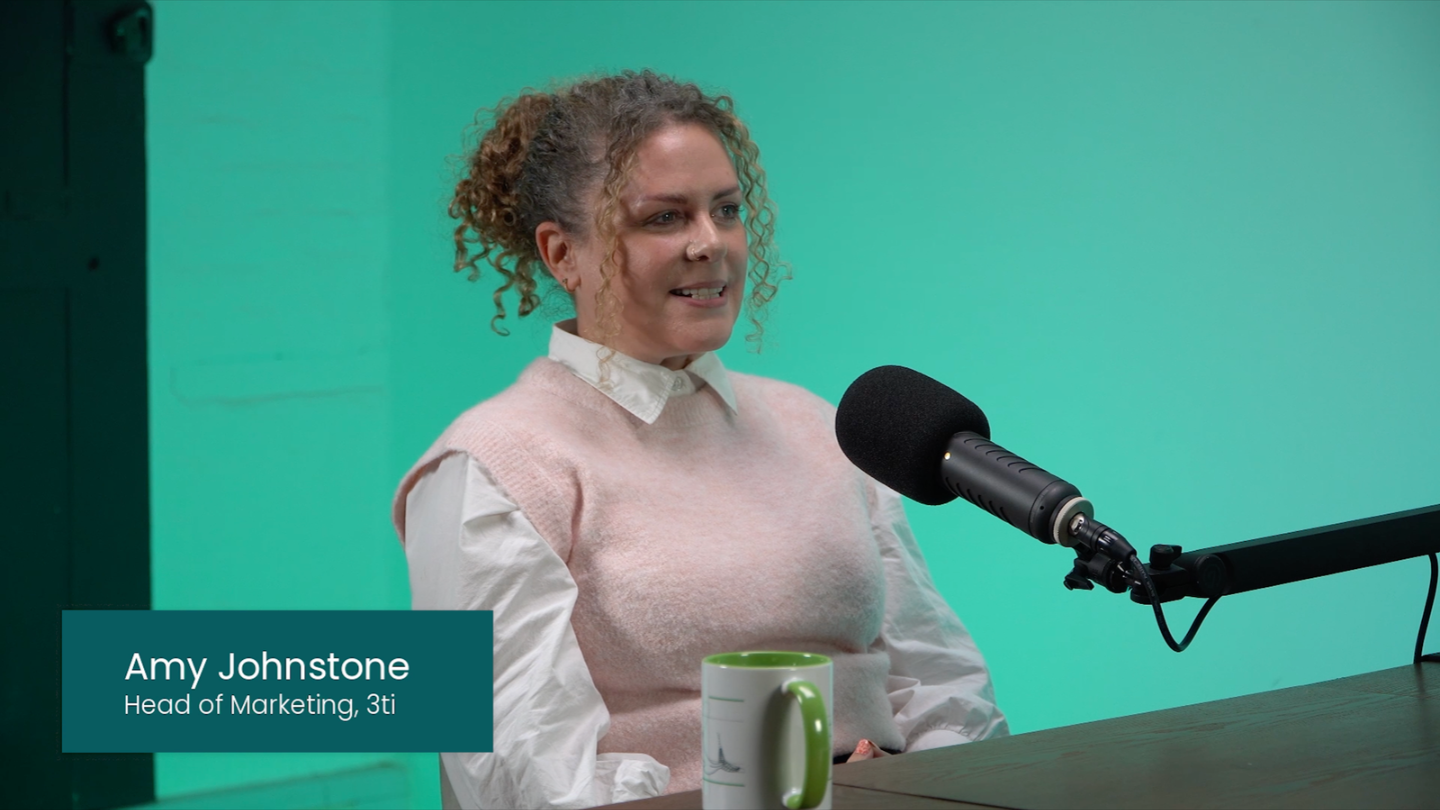
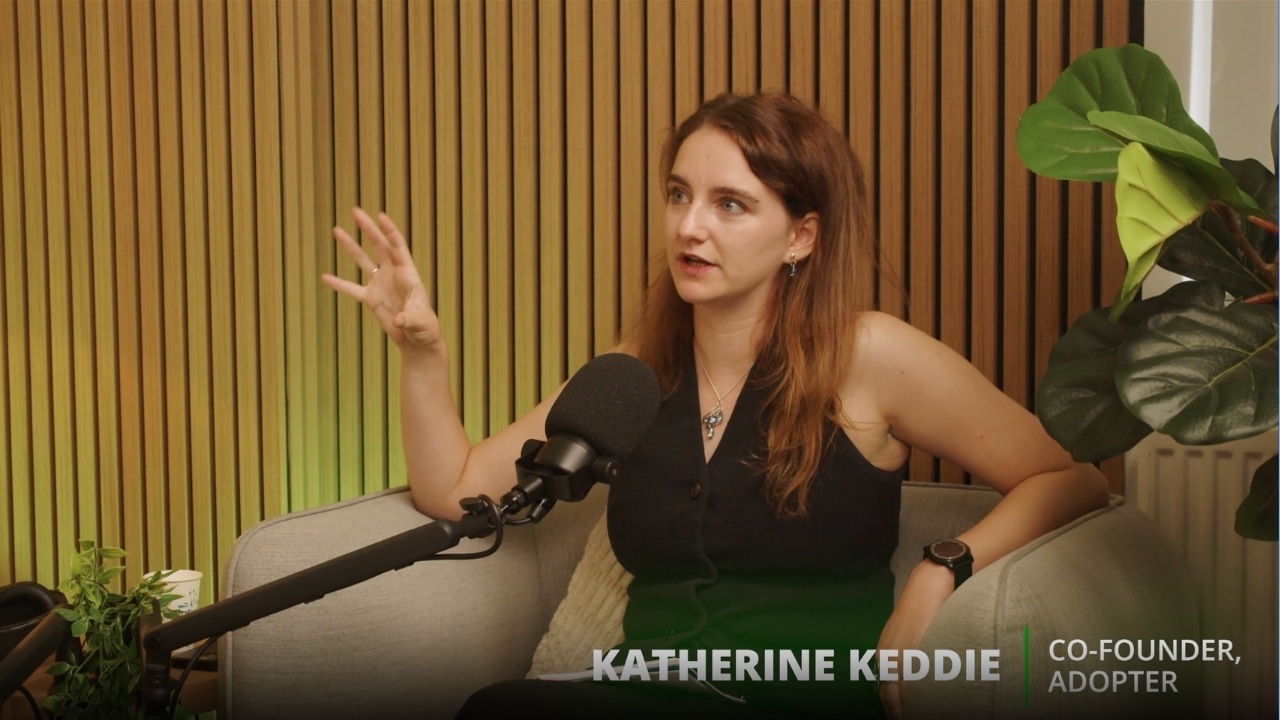
Katherine Keddie: Hello, and welcome back to Scaling Green-Tech with me, Katherine Keddie. I'm here with a special guest, Amy Johnstone, who is the Head of Marketing at 3ti. Thank you so much for joining me.
Amy Johnstone: Pleasure. Thank you for having me.
Katherine Keddie: So, first question, as always, to keep it really simple - which I think you'll probably approve of, as a marketing person in tech. How would you describe 3ti to a five-year-old?
Amy Johnstone: I think the best way for me to describe it is that we install giant sun catchers in car parks that catch the sun, and then people can park underneath, and we magically turn it into power to power those cars and allow them to drive. That's probably the simplest, most magical way.
Katherine Keddie: I love that. I'm intrigued. Please now give me the elevator pitch.
Amy Johnstone: So 3ti turn car parks into solar EV charging hubs. They're installed on top of the car park. They have 12 x 22kW charge points, and they have a solar canopy up above as well. So not only does it give EV charging, but it also makes the car park better, because it provides shelter, CCTV, lighting, et cetera. It can turn a normal work car park into a real EV charging hub for your employees, workers, visitors, whoever it might be.
Katherine Keddie: Amazing. And what kind of stage are you at as a business?
Amy Johnstone: We started off as a business in 2019, working in solar car parks. That's where we were. And then in late 2025, we decided to sell off that part of the business to purely concentrate on our product, which is the HALO FastHub that we're just talking about. The HALO FastHub was around a bit during the car parks, and we then felt that this is a product that stands in its own right, something different and innovative in the space. So we decided to sell off that part and invest our time, effort and money into purely the HALO FastHub. That was at the end of 2025, so we're very new into that journey. As a business itself, we're very much in that growth phase, getting the word and the name of the product out there as much as possible.
Katherine Keddie: We're definitely going to get into that in detail today. But before we talk more about how you've managed that transition and how you've established that brand, give us a bit of context around your personal background. How did you end up doing this role?
Amy Johnstone: Sure. My background has been mainly agency. I've done agencies for about 25 years, which exposes you to a lot of different sectors, and clients, and people, and all sorts. I've worked for companies from Hitachi, Samsung, Ministry of Defence, on big multi-channel campaigns across all different countries and continents with huge budgets, down to working in normal SMEs on their general marketing and strategy, through to festival activations for haircare brands. That was pretty good fun, and pretty crazy times.
Being in agency land brings you into so many different sectors and ideas and people that you work with. I worked mainly in the tech space for the last quarter of my career, and then I decided I'd done my agency time, and I wanted to put all that energy into one brand, because in agency you're spinning plates all the time. One minute you're presenting to a board about deep tech strategy for a big IT company, and then you put the phone down and you're chatting to someone about packaging for haircare. So it's really varied and really changing, but you're constantly having to switch.
I wanted to be able to use my skills for one brand and really put all my heart and soul into it. That's where I started to look around, and the climate tech and green tech space is something I'd only dipped my toes into, but it really interested me, because I think it's the future. I decided I wanted to have a bite of that, and that's why I started looking for those opportunities. Then 3ti came up, and it was the perfect opportunity to do that, and it still allowed me to have that agency craziness and manicness, because it's a startup. So it's still very energetic and still very agile. I don't think I'm the kind of person who could sit in a very corporate world. I like the agile way of working. So 3ti was the perfect place for me.
Katherine Keddie: As someone who owns a - I don't like the word agency, because I wouldn't consider us an agency, but a kind of agency-style company - and also works with a lot of scaling companies, I can definitely agree that the two meld very well, because there are loads of challenges. You have to move really quickly. You can't spend a year considering a rebrand. You have to just keep moving.
In terms of the growth journey of 3ti, you've talked about the pivot. What was the catalyst for that, and why is this a new focus for the company?
Amy Johnstone: It was really because with the solar car parks, they are big projects. They take a lot of time, and they're very bespoke. It's something that a lot of people are doing, which is fine. There's room for everybody. But our team, and especially our engineering team and our CTO, are very much looking at what we can do to make things better.
One of our straplines is "Leave Something Better Behind", because that's what we want to do as a business. We're a B Corp business as well. We're not just producing something because we think it will sell. We do have morals and ethics behind it. That's why the HALO FastHub was born. There are so many challenges in the market stopping people from being able to move forward with their EV transitions in businesses, such as grid constraints. We wanted to solve that problem. We felt like solar car parks are great for what they do, but they don't solve that bigger problem. So let's marry the two together and create something that is changing the industry.
Marketing a product versus marketing a service
Katherine Keddie: And as Head of Marketing, how did you manage that transition? In some ways you're going from a service-type model to something that's more product-focused, which requires a totally different way of selling. You're also changing your approach as a business, which is tricky in terms of changing people's perceptions and building a reputation in a new space. How did you approach that?
Amy Johnstone: When I joined, that transition had already started to happen, so I wasn't there for the major part of it. But just from my experience of working in service-led industries before and going into a product-led business: a service-led business is very much about selling an idea and a concept and a thought, and trying to prove to somebody that you can make something better. Whereas a product is something that you can physically show them the benefits of. That's why for us now, although the sales process is still long, it's a lot easier, because it's "This is the product. We know it works. We've got the data behind it. We can show you." Whereas when you're doing more service-led things, you're selling an idea or a thought or a process, and it's not necessarily got that proof point to it.
Katherine Keddie: So you think this is something that's more tangible in a way?
Amy Johnstone: Yeah, definitely. Exactly that.
Also, when it comes to selling a product versus a service: when all the stars align, which isn't always, we were able to deliver this within six weeks from initial contract being signed. Because it's an off-the-shelf product, so to speak, that allows you to move quickly. Going back to being agile, you're able to move a lot quicker. Whereas with more of a service-led thing, you just don't have that ability to go, "Here it is. Do you want it? Let's do it. Let's go."
Katherine Keddie: And the good part about starting with service then transitioning into product is that you can test that market traction and that interest, because you build really strong relationships with your customers. So it's not just launching into the market with a new product and going by the normal marketing and sales techniques to try and grow. You've had years of partnerships and experience, you've felt the pain of the sector, and it gives you that validation and product-market fit.
Amy Johnstone: I think that's what it was. We'd worked in solar car parks for a long time, so we knew the solar world really well, and we're known for that. Being able to bring that over into a new product, having that trust and credibility for the solar, really helped when bringing a new product to market, for sure. One of our very early hubs went into a client we'd done the solar car park for. They had the trust in us. We brought this new product out, and they said, "Let's try this. Let's go." They've now got two there, and they've been there for the last year and a bit.
Katherine Keddie: In some ways it sounds really similar to a SaaS playbook, where you think there's potentially demand, you run the service yourself, and then you develop your product or your platform in the background, and then people use it and you can prove that market traction. Then you can raise some money, and then you can build the platform.
Amy Johnstone: That's exactly what it's like. And we've got a hub at our head office as well. That's our test hub, so we're constantly innovating on that, and it's used by the people in the technology park that we're in. So that was a great test bed for us too.
Katherine Keddie: One of my questions was going to be about the difference between marketing a tech product and how you might approach marketing a SaaS platform, or a B2C type of relationship. What do you see the differences and similarities as?
Simplifying technical messaging for non-technical buyers
Amy Johnstone: For us a lot of it is about evidence and proving. With tech, you have to prove that you understand and that you are pushing forward.
The difference for us is that because our tech product is a bit different and a bit new, and we build it all ourselves in-house - we're not buying anything off the shelf, it's all done internally - it's about making people understand the tech itself, but in that simplified way. Which is the marketing challenge you always have when you're working with anything that's quite techy, and especially in the engineering world, where there are lots of things involved: simplifying that message.
And it's an unknown product, and that's always a challenge as well. Trying to get people to understand the benefits of it compared to other people, and to look at the education behind the tech. That's really key for us: that education piece, and informing people in a simplified way.
Market education through video, white papers and speaking panels
Katherine Keddie: And what has been your approach to educating the market?
Amy Johnstone: It's something I'm working on at the moment, actually. For me, it's going back to that human element. We have a lot of experts in the room. Our CTO is well-known in the industry. He has a good reputation in EV charging, and he does a lot of speaking panels. He has his own little fan base - whenever we do shows they always come to see him, which is great, because he's got the knowledge. So it's using people like that to get that message out there. And I'm a big believer in things like video and events.
The challenge you always have is that they have all the technical knowledge, and it's how you simplify that for the people who are looking at it. They want to talk about all of that all the time, which is great, but I can't put that on a one-line poster. I can't put that in a summary.
So for me, it's about getting that out there. We're doing that through lots of white papers, shows and speaking panels, and I'm about to introduce a video series where it's simplifying the message. They don't know that yet, so they'll be shocked when they see this, because they won't like the fact that I'm going to be putting a camera in front of them. We're looking to do a whole deep-dive tech series. It's a top level of what it is, but then it has the bones underneath it if they want to know more.
We just did a new website as well, where we totally changed our messaging. It was very technical, and sometimes that can put people off if you go in too heavy on tech. Because the people who are buying aren't necessarily the people who want to know the tech. They just want to know it works, how much it costs, and what it's going to do. So we've redone our whole website and messaging to simplify that and get across simpler information.
Who buys workplace EV charging and how that shapes the sales cycle
Katherine Keddie: I was going to ask you anyway about your messaging and about your customers. Who is that initial customer that is potentially reaching out to your website?
Amy Johnstone: We have three areas that we say we work in: workplace, fleet and destinations. Workplace is your typical office blocks, your retail parks, your business parks. Fleet is your fleet depots. And destinations is places like Silverstone, where we have a couple of hubs, or a retail park.
Who reaches out to us varies all the time, and who reaches out to us dictates that sales cycle as well. For example, if we have a Head of Sustainability reach out because they've seen our B Corp status - we're a B Corp business - they've seen the solar, they're excited about the product. If they come to us, that sales cycle will generally take longer, because they then need to sell that idea into their own business. If we get a Head of Estates or a facilities manager, that's normally quite good, because they already know they need EV charging. They've been tasked with that challenge. They're just trying to find the right solution. If we get somebody at director level, then it goes a lot quicker, because everyone's like, "We've got to do it." So our sales cycle is dictated almost by the kind of person who comes in to talk to us.
But generally speaking, the majority of our first point of contact would be estate managers or facilities managers who've been tasked with that challenge: "We need to solve this problem. We've got 150 salary sacrifice cars coming next month that are all EV, and we've got two charge points, one of which doesn't work." They're the ones who get challenged with that.
Katherine Keddie: And like you said, they're not necessarily a very technical buyer.
Amy Johnstone: No, not necessarily. They're not interested in how the kilowatts are coming in, how the solar works. They just want to know that it works. And then you get people who do want to know all that, but that's generally later on in the sales cycle.
Katherine Keddie: It's something we discuss all the time with our clients. We have clients where the buyers are extremely technical, and in that case having really detailed application notes, for example, is really valuable for them, because they want to get into the nitty-gritty. If we try and summarise it too much, sometimes the innovation and the technology expertise doesn't come across. And then we have other clients where it's maybe the less technical buyer coming in, and then down the line you're going to speak to a technical person, and that's when you use that method.
Amy Johnstone: Exactly. Because for us, our sales cycle is very consultative. It's not a case of "Do you want it? Here it is, plug it in." It's not that simple, unfortunately. That'd be my dream if it was. But it's very consultative, so it starts off with that initial conversation about the product. Then we go to what we call a feasibility study, looking at the space they've got and what power they have available. It's slightly technical at that point. And then when it comes to the deployment part, that's when the real technical elements come into it. So it goes along the journey. It gets more and more technical the deeper in you go.
Keeping marketing and sales as one team
Katherine Keddie: And in terms of the work that you're doing, there's the messaging side and we've talked about the website. How are you using marketing to align with the sales work?
Amy Johnstone: We're a small team. There's always been this thing about marketing and sales butting heads, but I try not to let that happen, because we're all there for the same goal. At the end of the day, we're all trying to get sales in. They want to get sales in so they can get commissions, and I want to get sales in so that they can do all of that. We're all working for the same goal.
When I joined 3ti, I was very lucky with the team I've got. We're very much one team. We work together all the time. Everything we do is together. When we're looking at campaigns, for example, we sit down together as a group. I'll speak to them about what they want to achieve, which you always have to change a little bit, because it's their sales - mould it a little bit more into how I think that could be a tangible campaign to go out. It's all done together as a group, and that's followed all the way through, and then we constantly meet up. We're constantly talking about what clients are saying, what feedback they've had. Because if one client says to them in passing, "We love the fact that it's all made in Britain," for example, I'm like, "Okay, that was a real thing for them. We need to make more of that."
And this whole following the sales leads through the journey as well - it's not like I just hand over an MQL and go, "Off you pop. See you later. On to the next one." I'm following that all the way through, and I'm helping them where they need it. If they need more information or they need something else, it's all done together.
Katherine Keddie: I think that's absolutely the right approach. I also agree it's a stereotype, that marketing and sales hate each other. I actually love working with salespeople, because they have a very clear concept of what they need, and they're also really tuned into what the customer wants. And I love what you said: when someone says, "It's made in Britain," you're like, "Perfect. That feeds into my campaign." A really classic mistake is when marketing's in its own box and you don't have any customer-facing conversations or relationships, and you're not tuned into that live feedback coming through from the sales team.
Amy Johnstone: 100%. Especially when you're new to a product, you need that information, you need that feedback. Because what we think in our bubble in our office - "This is the best thing about the HALO FastHub" - might be something they really don't care about, and we talk too much about A and not enough about B. That's where conversation is so important. And that's something we're quite passionate about with our clients as well. Our sales guys are brilliant. They're always asking the questions, because they want the same thing. They always have the enthusiasm for the product, and that's what's great.
Katherine Keddie: And the curiosity. That's what's really valuable. Because you're right, it's really classic that you can sit there and everyone thinks, "Brilliant, we're all aligned." But fundamentally, the best information you're going to get is having those market insights. You know how an early-stage startup will do loads of customer interviews? A classic mistake is to stop doing customer interviews, or not to consider sales to be customer interviews. We go through all the transcripts trying to work out what the patterns are, and that fuels the content work that we're doing. Otherwise we're basing it on something, but it's not the bread and butter of what the client brings.
Amy Johnstone: And I always think you shouldn't be scared to change your messaging. Sometimes people will, at the beginning of a year, go, "This is our thing for this year. Here's our messaging." Everyone's approved these exact things, and they just stick with it no matter what, because that's the plan for that quarter or that year. That's where you can make mistakes. You've got to adapt your messaging to what the market is saying to you, and that can change sometimes. It shouldn't change dramatically, because if it is, then you're doing something wrong, because you don't understand your own product. But there should be things that move up and down on the scale of importance.
Katherine Keddie: And as the market changes as well. How do you find the current market conditions for your work?
Grid constraints, DNO waits and end user charging fatigue
Amy Johnstone: For us, we have two markets almost, in that we have our customers, who are the people buying the solution for their team, but there's also the end users, who are the ones actually using it. So we have a two-tier market, really.
As far as the people using the EV charging are concerned, the hype of EV charging has died a little bit, the novelty of it, and now people are getting fed up of it not working. They want reliability. They want to know that they can drive to Cornwall and back and not have to do a massive detour and sit in a service station for half an hour. They want to be able to top up when they need to. And we've all been there, where you're in the back of a dark car park, and it's raining, and you get your cable out and you plug it in and it doesn't work. And you put your cable back in and it's all wet. Nobody wants that, because that makes you go, "I'll fill up at the petrol station. It's a lot easier." So the end users are getting a little bit fatigued, and they want that consistency and trust that things are going to work. We have to bear that in mind. That's one of the reasons why we did what we did with the HALO FastHub.
And then you've got our direct customers. For them, they all want to do it. They're all keen to do it. They're just getting blocked by this whole grid constraint thing. That is the biggest blocker for people and the biggest frustration. I know the government announced some improvements recently, but it's still going to take time, and it still takes a hell of a lot of money to get that connection in. So we look at our own customers and then the end users, and that's why the HALO FastHub was created: because we wanted something that solves both those problems.
Katherine Keddie: And for your buyers, do you think it's fair to say that their main pain point is that grid connection?
Amy Johnstone: Yeah, I think so. Because the thing about the HALO FastHub is that it can work on any grid connection, which is a huge USP for us. It means people can save tens or hundreds of thousands of pounds on grid upgrades, because we can just come in, drop it in, plug it in, so to speak, and you're there. So that's what's delaying people moving stuff out: a lot of our clients want to get the EV charging in, but they've got an 18-month DNO waiting list. They just can't do it, but they've got all these EVs in the car park. So that is the biggest challenge for our buyers: the grid constraint.
Katherine Keddie: And the speed that you can offer.
Amy Johnstone: Yeah. Speed is a big thing for us, and that's what makes us stand out a bit more, because the HALO FastHub can be installed in a day. So in a day you can have 12 charge points, and that in itself is pretty spectacular. There's a video on our website, it's quite amazing. When I first saw it, I was like, "That's super cool." It's like a little transformer. It comes in on the back of a lorry. It's lifted off with a crane, placed on the car park, wings up, plugged in, and there you go. There's no digging up the car park. There's none of that. So it also means there's no disruption.
We've got a couple of hubs in hospitals. We've got two hubs up at Salford, and that was installed in three days, putting the two hubs in. No disruption to the car park at all. Some places haven't got the space or the time to do that, because it's a busy hospital with visitors coming in. We can't just close a car park off. To be honest, I think it's just a pain for people to put EV charging in. It's expensive, it's difficult, and it's time-consuming. That is a big barrier for people, especially when they've got mandates where they have to get it done. They're probably banging their head against a wall a bit, I imagine. So hopefully that's where we step in and go, "We can help you out."
And the other reason some of our clients use us: because it can be picked up and lifted - it's self-weighted, so it's not drilled into the ground - we've had people who've got plans for a big solar car park with EV charging and it's happening in three years' time. So they'll have the hub for those three years in the meantime, so that they're still providing that service to their clients. Then it can just be picked up and moved elsewhere. We've got one in a couple of weeks being moved from one location to another. Same company, but they've now got what they need in that car park, so we're picking it up and moving it down the road for them. So it allows them that flexibility.
Getting back to the original question, I do think the grid is the biggest problem for people.
Katherine Keddie: I'm catching a few points of your messaging there: the flexibility, the speed, the grid connection, and generally the ability to make it more convenient for the end user.
Amy Johnstone: Exactly. Because we want the utilisation to be up on our hubs. We want people to use them and not have a problem using them, because that allows our hubs to be successful. It allows revenue for our customer. And we want people to have a better experience. Sometimes it's silly little things like being able to pay by contactless. That's such an easy thing that we have on our hubs now, but so many places don't do it. Sometimes it's just those little things that make the user experience so much better.
Katherine Keddie: It's like the Andy Burnham approach. You deal with the actual small things that annoy people, and people are like, "Thank you, that's actually helping my life."
Amy Johnstone: Yeah. Because they're the things they see every day. I've got a shelter. We've got lighting and cover, so in the winter it covers you from the rain. In the summer it keeps your car nice and cool. You've got CCTV, so it's safe if you're in the back end of some dark car park. They're the little things that the end user worries about. So like you say, the Andy Burnham effect: fix the small things, because they're the things that people notice.
Katherine Keddie: It sounds like you have a really good understanding of the offering and what's valuable to your customer, which I'm sure comes through lots of useful conversations with the sales team. Can you paint us a picture, before we go into more detail, of what your broad commercial and marketing goals are over the next 12 months?
Amy Johnstone: It's pretty simple. It's to grow more sites. That's literally our goal for the next 12 months. Because we've come to a point now where we've crept like this, and now we're at the point where we can just go like this. We know where we stand. We've got the brand and everything sorted. We know what our messaging is. We know what we need to be saying. We know what's resonating with people. So for us, the next 12 months is purely about growth. 100%, that's our total focus. And the trajectory is looking like that's going to be really good. So our plan is to get as many sites out there as possible, and to shout about it as loud as possible.
Katherine Keddie: How does that translate into the specific activities you're doing? I'm thinking particularly about specific channels or formats or methods that you're using at the moment that are working well for you.
Events, outbound email and paid LinkedIn as channels
Amy Johnstone: Channel-wise, we did our first big event this year. We did EVCharge Live and Solar & Storage Live up at the NEC. That was our first big event as a company, as HALO. It was really successful, and that's a big part of our plan for 2027: to do more big events in person. With a product like ours, we don't take the actual full-size hub, because that would be a bit of a challenge, but we have a lovely scale model. People are just so intrigued by it. It brings people in all the time. And then those conversations start, and that's when it goes into that consultative sell, which is what we do so well, because we know their problems.
It's like with any marketing: you always start with their problem, right? That's what it's all about. What's their problem, and solve it. Because they're not looking for a 12-bay solar charging hub. So it's finding what their problem is and talking them through that. That's where events are good, because they just walk past and go, "Oh, what's that? I didn't know this existed." And then the conversation starts. So events is a big channel for us next year.
We do a lot of email outbound as well, which works quite well for us just to get that initial foot in the door. That's always the biggest challenge of marketing: just opening that door a little bit to get your foot into it. So email outbound always works quite well for us. That's probably our most successful lead source at the moment.
Referrals, again, classic marketing: word of mouth is always what works. The doors are really wide open when you can get referrals. That's a challenging one, because you can nurture them to a point, but I always think you've got to be careful with nurturing referrals, because it can come across as insincere. So you've got to be a little bit careful with that one. Hopefully they just happen organically, because they should be an organic lead source really.
So for 2027, events is a big part for us. We carry on with our email outbound, and then we're doing a lot more of what I just call general marketing, which is your LinkedIn paid campaigns, that kind of stuff. Just getting the word out there as much as possible. Quite targeted campaigns that we've been doing through LinkedIn.
Because we have quite a niche target market, we've spent a lot of time this year going back over the whole business: who are the people that are buying from us? Who are the people that we can get into, to get that sales cycle to reduce a little bit? Because at the moment it can take a year or so. We've really narrowed it down now to quite a niche market. And because we have that data and we've done that hard work and all those analytics, our paid campaigns are going to be a lot more effective, because it's such a small group. We're very lucky that we're not marketing to a huge group of people where you might just land with a couple. So that's going to be a big part for us.
And then, because a lot of it's about getting our name and our brand out there, there'll be a lot of PR and white papers and speaking panels. Our main thing for next year is growth, like I say, and brand recognition and brand trust. That's a big thing for us, because we're an unknown quantity really. And it's a high-value product. It's a big investment. It's got a lot of people to answer to when you put that investment in. It's got to work for a lot of people, from procurement to sustainability to facilities to the end user. So it's a risk for people. Brand trust is a big part for us this year as well.
Building brand trust as an unknown quantity in a high-value sale
Katherine Keddie: One thing that I always find challenging is that when you're doing this kind of broader brand awareness work or brand trust work, sometimes it's difficult to measure or understand the relationship between, let's take maybe one of the more extreme examples, PR, and growth. How do you see the relationship between the two?
Amy Johnstone: It's always hard. Everyone in marketing wants to know the ROI and the attribution: "So you did this article, how many leads have we got?" I don't know, because I don't know how many people's eyes actually saw it. And you have to rely on sales to get that information out of people.
So for us, the brand awareness piece is really going to help us with our growth in general over the next 12 months, because it's about credibility. I keep talking about this a lot. The more people know about us, the more people see us around - they see our name here, they see our name there, they go on LinkedIn and we're on there - all of that creates this thing of "These guys know what they're talking about. These are a credible business." And that will help us get that growth over the line. We've had conversations early doors with people where they're like, "We love the product. We love what you're doing, but who are you guys? Where's your credibility?" So that will help us with our growth for sure, because it allows those people to have trust in us. And trust is a huge thing when it comes to the sale of a high-value product.
Katherine Keddie: I'm also working in marketing, so I can understand that. But sometimes it's hard to sell internally, or to non-marketing folk. How do you approach doing that?
Amy Johnstone: That's always the biggest challenge of marketing. I think it's about being the hero in their story, almost, where we're coming in to solve, to help them, to solve their problem. They might not care about the fact that it's got 12 charge points at 22 kilowatts. They might not care that it's got CCTV. It's about solving their challenge, making their life easier. That's how we do it, and that's how we approach our marketing. My CEO talks a lot about StoryBrand 2.0, which I think every marketer's read a million times. So it's very much about that, and coming in and solving their problem, and being their champion.
Katherine Keddie: Being the guide, right?
Amy Johnstone: Being the guide. And then the product becomes the hero.
Katherine Keddie: And you mentioned events are a large part of your approach. How do you go about choosing which events to go to, and measuring return on investment there?
Amy Johnstone: For us it's about who's in the room, like everybody. But it's not just about who's in the room, it's where you want to be seen as well. It's where your competitors are going. We have no direct competitors, so to speak, because no one does what we do. But obviously we have the million charge point operators out there, who are still a competitor. Because paper on paper, they might look cheaper, but then there's all the DNO work, and all the groundworks and everything else. So that's the challenge we have when we go in and talk about the cost involved in the purchase of a HALO FastHub, which is a CapEx investment. They go, "Oh, you're this, but I can get this with these people." And you're right, but they haven't factored in the project cost. When you actually add up the whole project cost, we're a good value proposition.
So getting back to that, it's about who's in the room, and seeing who's there. For us it's about wanting to be somewhere where people are looking for innovative solutions. We're not there to just sell you 12 charge points to put in the ground. That's not what we're there to do. We're there to sell to somebody who is looking for innovation, forward thinking, and that ESG side. I hate to say "tick in the box", but it's not just about that. There are those challenges as well, and that's who we're looking for.
That's why we did EVCharge Live, because it was solar and storage as well. We positioned our stand literally between the two, which was great, because you had people coming from the solar side and people coming from the EV charging side, and we married the two together. So that for us was the perfect event.
Going forward, it's going back to those three places we look into: workplaces, fleets, destinations. We want to start looking at fleet shows, for example, because they'll be our perfect target audience. So it's looking at those three areas that we work in and where the best places are for those. It's quite hard, because there aren't that many that tick all the boxes. You've got the Commercial Vehicle Show, which is the one we're looking into.
It's hard to work out how much you invest. Something like EVCharge Live we'll invest good money into, because it ticks a lot of the boxes. Other shows you might do a smaller stand, or you might do it slightly differently, because you're just not going to get that ROI back as much. But because it's been our first year of doing this, we don't have any stats yet on the ROI from EVCharge Live, because our sales cycle takes so long.
Katherine Keddie: How long is your sales cycle?
Amy Johnstone: About a year. It can be six weeks, like we had before, but it's normally because there are just so many people involved. I'd say our average is probably around six months, to be honest. But some just take longer. The bigger the company you get into, the bigger it is. We're finding now that we're working with a lot of clients that have multi-sites, which is really interesting for us, but that takes a long time. And when I say multi-site, that might be they want two or three hubs on one site, or they've got three separate sites they want them on. That initial sales piece might take longer, but then once it's done, you just rinse and repeat and roll it out.
So that's where we've seen a shift. We've definitely seen a shift in more multi-site people coming to us, because the HALO FastHub is so flexible. It's that redeployable side of it. People like that. So that's where it's extended our sales cycle a bit in the last six months. But once that's done, then you can have eight to 10 units just rolled out for one client, and that'll be really quick: six weeks, six weeks, six weeks.
From an ROI point of view, we're lucky in that because our product is a high-value product, it's a harder sell, but all it would take is one or two sales and your ROI is through the roof. You haven't got to sell 1,000 products just to make the money back.
Katherine Keddie: Most of our clients have similar sales cycles or similar return on investment calculations going on. In some ways it's easier, because you go, "Okay, this event cost me, I don't know, £10,000, let's say, and one of these products costs..." I don't know how much a product is, this is just a random number. Let's say it's £50,000. Then obviously if you make one sale, huge return on investment. Happy days for all.
But the problem is that events are much more trackable, and there are other parts of marketing where it's difficult. Because if you're doing a year-long sales cycle, there are so many touchpoints that you can track there. So how do you approach understanding how people move through that sales cycle, beyond just "the first touchpoint was this and the last one was this"? What's in between?
Attribution across a sales cycle that averages six months
Amy Johnstone: That is a big piece that we're working through now, trying to understand that. Because it's such a long cycle, and there are so many touchpoints out there. And there will be so many more with me coming on board and pushing the marketing further. There are going to be so many elements, and you think, "How do you know where they've been and what they've done and what they've seen, and what was the thing they read that made them go, 'Yeah, let's speak to those people'?" You've got tools that help you with that in your martech stack. You've got your insights and everything that you can see in there.
But a lot of it comes down to that conversation again. That's something that I personally want to bring in: once that sale has gone through and we do that post-sale communication with them, part of that would be to have a conversation with them and find out about their journey. Because the sales cycle takes so long, you get a real relationship with those people. So it's not like you're just going, "Here you go. Thank you very much," and walking out with a carrier bag. You know these people. You know about their family, where they've been on holiday. You know everything. So it's easy to have those conversations, and we've done that a couple of times and it's been really fruitful.
Sometimes they'll be like, "Oh, I just got the email. I spoke to you guys," and that was it. And another time they'll be like, "Oh, I wanted a new website, and then I watched the video on YouTube that you did about this, and then I read the article in here." So we try to track it all, but it is hard to attribute when it's such a long cycle. And that's why sometimes I think you've just got to ask the question.
Katherine Keddie: I definitely agree. I literally had a conversation about this this morning, so it's funny you say that. Asking people is really important. However, I've recently been doing a specific project with one of our clients where I'm trying to understand the difference between how people identify their touchpoints and what their touchpoints actually are. From the individual, you get what they think was important, what's notable for them. But when you look at their touchpoints, typically they've actually moved in quite a different way to the way they've described. It's the same with everything. If you ask people how many units of alcohol they drink per week, they'll probably tell you a different number.
It's always difficult, but trying to combine those two - the data that you can track as much as possible during a year-long sales cycle, and then the qualitative feedback - you have to have both to have some richness in understanding.
Amy Johnstone: And hopefully there's the whole Venn diagram thing, a little bit in the middle that's the perfect sweet spot.
Katherine Keddie: Absolutely. And asking them is good, because if they say to you, "The video was fantastic and it really helped make my decision," brilliant. That's way more rich than getting, for example, website heat-mapping information, where you're like, "Okay, they went on the website, and then they went on the product page, and then they went on the contact us form. They watched a video for 25 seconds." You might go, "Okay, that was a part of it." But if they go, "That was the thing that made me change my mind," it's fantastic.
Amy Johnstone: Video is a big thing for us as well, because it demonstrates the product. We've had a couple of people say to us that it really helped them sell it into the business themselves. That's a big part of why it takes longer: there's so much internal selling going on in the company. When we've had feedback like that, we're like, "We need to do a dedicated product video, showing someone actually using it, all the individual features," which is what we're planning on doing next. And that's come purely from feedback.
It was on the forever-long marketing list that we all have of things we need to do, but when it starts being said over and over again, you're like, "That has to be prioritised now." Because we know that's helped them sell this in internally, so that's a key piece for us. And that's why you've got to listen. I do worry that people are a little bit insular these days, and they don't always want to ask people.
Katherine Keddie: We don't go out enough. That's the problem.
Amy Johnstone: People have lost their social skills.
Katherine Keddie: Exactly. And really going out and having conversations with people is really... I say this all the time. I do a lot of work in digital marketing, but I always say to people it does not replace that in-person relationship and connection that you have with someone. Fundamentally, that's how people do business.
Amy Johnstone: People buy people. That's what they do. And we've all been there. I've been there when I've picked a supplier over someone else because I just thought, "I can work with this person, even if they're a bit more expensive. I like this person. They get me, they get the product." It's about the person.
Katherine Keddie: And that's even when you're making the conscious choice. I'm sure subconsciously it's a massive factor in how you're doing something.
So events are going well. You're doing the email outreach, which is performing well. What's going well for you there specifically? Are there any tips that you can share with listeners?
Amy Johnstone: On the email outbound? We use a third party for it, and they use AI to do it, which is fantastic. One good thing for AI. That works really well, because you can tailor the messaging each time. Originally we worked with them and it was very blanket, just email anybody and everybody. And then since I've come on board, we've narrowed that down and changed the messaging for the individual targets.
What's good about that is, because we're a small team, it takes away that chasing. It does it automatically: it will send an email, then it will follow it up, and then it will see they've opened it and send this email, or see they haven't opened it and send that email. That's working really well, being able to have that done automatically, because it takes away the pressure from the small team that we are to do it manually. It allows for that quite direct sales approach. A bit more old school, a bit more direct into your inbox: "Do you want it? Yes, you do." A bit more ballsy sales. Less fluffy marketing. It's a bit more direct.
By using AI, it allows you to have that continual pushing on the door, reaching out to them consistently. Whereas when you're doing it manually, or even when you're using things like HubSpot and you've got your scheduled things, it's not quite the same.
That's what allows it to work really well, and the fact that we can change it really quickly. They have all the data, and all the stats that come out of it are amazing. You can see where they've been, whether they've gone into LinkedIn or not. So it allows a small company to have that automated email sales approach work really well. If you've got a 20-strong or even a five-strong marketing team, you can do all that through your HubSpot and set that all up. But when it's a small team, one marketing person, you need help from the outside. So reaching out to those people is needed at the beginning of your journey, until you're able to build that martech stack up yourself and bring it in-house.
The messaging works, the consistency of the messaging works really well. And when people say they're not interested, they're not interested, that's fine. You take them off the list and you carry on. But those people who don't say that, it's a constant reminder, and sometimes we've had people come back six months later and go, "I keep getting your emails. I've been meaning to reach out to you. Now's the time." Whereas sometimes when you're doing it yourself, you go, "They haven't reached out for six months. We'll just put them on another list."
So outbound email is still one of the best ways to do it. It's our most successful lead gen, like I said, because it's getting right into people's inboxes, right in front of their eyes. The only challenge is that, because of all the regulations around it, we like a visual sale because of our unit, and you can't do that. So that's the only challenge we have. You have to be a bit more clever in your marketing and your wording and the messaging. Those subject lines are key. I'm the first one to delete an email just on the subject line. All the time.
Katherine Keddie: Messaging's often seen as this fluffy extra activity, and I understand where that comes from, because people will spend months and months picking at it. There's never perfect messaging. But not being precious about it, similar to what you said before, and ensuring that it's really aligned with the sales conversations you're having and constantly informed and updated, is the foundation for every single part of your marketing stack to work effectively.
I get so many cold emails, and messages on LinkedIn, and I ignore 99% of them. So it has to be really engaging and specifically speak to my pain point immediately for me to actually engage with it properly.
Amy Johnstone: That's why we chose the people we use. Sometimes you get a lot of messages from people trying to do your sales shit, and it's really bad. And you're like, "What makes you think I'm going to pick you?" What it was with them was they came to us with that one line that was just like, yes. We need this.
Katherine Keddie: Exactly. It's very meta, because for example, we're doing a lot of work at the moment on building out GEO for clients, improving the likelihood that they'll come up for specific searches for people using AI and LLMs. And we've had several clients who've come to us through using ChatGPT, for example, to search for solutions. They're top of the list. They come to us and they go, "If you're doing it and it's working for you, then clearly you're a safe pair of hands."
Amy Johnstone: That's something that we really need to tackle now. That's something for me to be looking at: AI-driven lead generation.
AI as a support tool
Katherine Keddie: It's exciting. It's a whole beast. So tell me a little bit more about how you're using AI and your marketing tech stack.
Amy Johnstone: AI-wise, we use Claude. I think most people are using Claude these days. It's something that we use within the business. From a marketing point of view, I love it because it gives consistency. The presentations I've seen are crazy. It's so nice that everyone can now put it through something and it will automatically generate a set template with all the right guidelines. That's every marketer's nightmare, that everyone goes and does their own slides. So we use it a lot for that.
It's the best thing ever when it comes to analytics and data and spreadsheets. We have to be careful what we can put in and what we can't put in, but it's a dream for marketers in that respect. What would take me a day before is now done in 10 minutes with the help of something like that.
But our CTO is very hot on what we can use it for and what we can't use it for, and I'm quite passionate about that too. We've got to be really careful, especially in marketing, because marketing is a creative industry. It's a creative job, and AI can, if you're not careful, take that creativity away. For me, I've always said it should be an extra pair of hands, not a replacement for your brain. It's there to help you out. It's like having that marketing assistant that you haven't got. That's what it's there for. And you have to be careful how you use it from a day-to-day point of view.
I remember once I went onto LinkedIn - I think it was Earth Day or something - and I was like, "I'll just see what other people are doing." The first three posts had the same first line, because they'd all just gone into ChatGPT or whatever and gone, "Write me a post for Earth Day." I can't remember what it was now. It was all like, "Today is the..." something. Exactly the same. I just thought, "That's when it's going to kill marketing, if that's what people are doing." Use it to help you. Don't use it to do it for you.
So we use it a bit, and I use it a lot for my own organisation as well, like spreadsheets. And then we obviously have our AI outreach, which I just spoke about. But we don't use it much more than that at the moment. The whole AI search is a big thing, like I said, that we want to get into. I might pick your brains about that later, because we're not involved in that yet, but that's something we definitely want to get into. I think that's the future of search. No one goes to Google any more and looks something up. It's straight onto ChatGPT or Claude or whatever.
Katherine Keddie: It's making a big difference for our clients in terms of found leads, for sure. And an unsung benefit of doing that too is when someone's trying to use it to learn about your work during the sales process. It might not be that they find you immediately through putting their requirements in and you come up when they're searching for a supplier or a solution. But it might be that once you're having the conversation, particularly if you have a long sales cycle and there are lots of people involved, people will use it to learn and to research. And if you don't give it the right information, then either that information is wrong, or it's missing, or it doesn't hit the mark for the customer. And there's this whole touchpoint happening that is out of your hands.
Amy Johnstone: And that's the scary thing, isn't it?
From a marketing tech stack point of view, we have the likes of HubSpot, the usual kind of things. And we've got a couple of companies that we use to help us with research, because we're quite specific. There aren't many research companies that deal with car park layouts, for example. So we've got a couple of companies that help us with that, just to reduce that research phase, or when we're targeting people. We know they've got the space. We know that they're actively looking for EV charging.
And then AI as well from our tech team point of view, because our tech team is in-house. We haven't really spoken about this, but we call it the HALO FastHub, and HALO is the engine of it. Our CTO says HALO is to the FastHub what iOS is to Apple, or Intel inside, or whatever you want to call it. That is created by our in-house tech team, all based at our head office in Guildford. So they use AI within what they're doing all of the time, and they're constantly innovating, always making updates, iterating and iterating to make the product better and better. That's their big focus for next year: continual development of HALO itself. Because that then allows HALO to be used in other ways in the future, not just with the FastHub.
Katherine Keddie: It sounds like you're proactive on AI, both in using it in your business, but also considering where the limitations might be. You alluded to them earlier, but what do you think the limitations should be?
Amy Johnstone: From a marketing point of view, it should always be a support tool. You have to have a human element, especially in marketing. We've talked about the human element a lot. It's just come up a lot today, because it's super key.
As soon as you start putting that into an engine that's also pulling in information from all your competitors and what they're saying and doing potentially, you're putting something in there and going, "Help me out. Write me a white paper on X." And of course you can read it and go, "Yeah, that's fine," but you don't know what it's pulling in, where the source has come from. If you're going to do that, that's fine, but you need to research those sources. You need to check what's being said. You need to fact check everything. You can't just take it and go. And that's where people are going wrong a little bit. When it first started out, we were checking everything, and then everyone's got so used to it that we just believe everything it tells you. We've become lazy.
So it always should be a support tool. I think it's a fantastic enabler. It's great. I love it. I use it every day. At some point every day I use it. But there are limitations on what you can do, and limitations on the data you can put into it, which restricts you on certain things, because you can't just upload a massive spreadsheet of contact details. You've still got that manual thing. I'm just a bit old school maybe with the marketing, and I worry that people starting their career will rely on it too much. And then you lose the creativity. I think it's really important in marketing to have that creative mind, that spark still.
Katherine Keddie: I agree. I also think having an approach where you really understand what it is you want to achieve is really important. If you go in with a very vague brief... we're working with several clients to train their teams around using Claude for effective marketing and improving the efficiency of their processes. What I always say during those sessions is that Claude, or whatever tool you're using, is like a really brilliant intern. That's what we say internally. It's like a really brilliant intern that's exceptionally fast, draws all sorts of things together, makes things look really good. But don't use it as an opportunity to completely rely on it, like you would an intern. You still check, you still give them guidance. You still give them very specific directions. So having that limitation is important.
Amy Johnstone: Yeah. And I'd probably say how you prompt it is really important. If you haven't been educated on the best way to do that, you're not going to get the best result back. So people need to educate themselves about it. Like you said, it's that intern. It's a pair of hands, it's not a replacement brain. And understanding where the limitations are.
Katherine Keddie: I'm going to do an absolutely shameless plug here, because we've just done two resources that are going to be on our website when this comes out. One of them is about content writing and using different AI tools, and we've got an AI tells checklist. Some of it everyone will know, like em dashes, for example.
Amy Johnstone: Yeah, that's a classic.
Katherine Keddie: And then some of it's much more nuanced, and it's something that you can't even really put your finger on, but when you're reading it, something in you goes...
Amy Johnstone: It's like a rhythm to it.
Katherine Keddie: It's repetitive. It has a specific rhythm or a specific style or specific tone. So we've got that one coming soon. And we've also got on our website an article that looks at design tells, which is something that people are becoming a lot more aware of, because you were talking earlier about using it for deck design, which is really standard now. I recently went to a conference, for example, where every single one of the slides was exactly the same format, and there were vastly different speakers, and it had the same structure and tells. So if you're not someone who's familiar with using Claude Design, for example, you might just think, "Oh, it's weird, everything looks exactly the same." But if you're familiar with using any of these tools, you can immediately tell. For example, having a small title inline, that's a classic Claude Design tell. So both of those are coming on our website for those listening who might be interested.
So, sadly, we are coming to the end of our time, which is a shame, because I feel there's a lot more I could ask. Final questions for you. What is one marketing trend that you would like to see more or less of?
Amy Johnstone: For me, in this digital world that we're in, where, like we just talked about, everything is very samey, for me it's about reality, real things. I want to see more real sites, real results, real people. I feel like we've ridden this wave of a digital world, everyone living behind a computer and on Zoom and everything else. And I feel like now there's a real turn in that, and people want that eye-to-eye contact again. So I want to see more people doing what I call just real marketing, real voices out there and talking, seeing the people behind the products. I think that's really key.
People have got very much into this world of shout about the product, buy the product, and not talk about the people behind it, the passion that's behind it, the reason, the cause, the fight behind it. And I guess that's because that's what we're about: trying to make a difference. That's what we want to do. So it's about being real.
Katherine Keddie: I love that, and I like the people-centric angle. We've found across the accounts that we manage that founder or personal accounts on LinkedIn perform so much better than a company account. And if you do it right, if you don't try and do the bogus thought leadership stuff, if you do it with genuine heart and detail and substance and traction, then it comes across so well, because it's a relationship that someone has with you online, rather than just more marketing fluff or AI material.
Amy Johnstone: And it's that fine line. It's not that influencer type marketing, which can come across quite insincere. People have ridden that wave as well. People are over that. It's not about having someone go on and go, "Yay, buy this product. It's great, and I'm the founder," whatever. It's just real. It's just realness. I think that's what people are craving. Cutting through the noise and seeing the real... One of the agencies I used to work for, our strapline was "Powered by people". And I've always loved that, because that's what it is. Every business is powered by the people behind it.
Katherine Keddie: I definitely agree with that. I recently did customer interviews with our clients, and there was loads of amazing stuff that came through about our specialism and our approach to work and our model. But one thing that was really consistent throughout was just, "You're really nice people and I like working with you. I just like having calls with you, and you try really hard, and you work with us."
Amy Johnstone: And that just works better, because then you're both fighting for the same thing. You're both passionate about it, and then you're going to get better results at the end of it, which is what every marketer wants: results.
Katherine Keddie: Totally. And for people who are listening, what should they look out for? Where can they find you?
Amy Johnstone: You can find us at www.3ti.co.uk, which is our new website. Take a look. We haven't got any more shows this year. We will be at EVCharge Live next year, so look out for us there. We will be at some other shows, but we haven't got them in the pipeline yet. And then also just follow us on LinkedIn. That's where we post most of our updates. That's where we showcase a lot of our work. So give us a follow and see what we're up to.
Katherine Keddie: Perfect. All of those links will be in the show notes. Thank you so much, Amy. This was really interesting.
Amy Johnstone: It's a pleasure.
Katherine Keddie: And for everyone else, I will catch you on the next episode of Scaling Green-Tech.