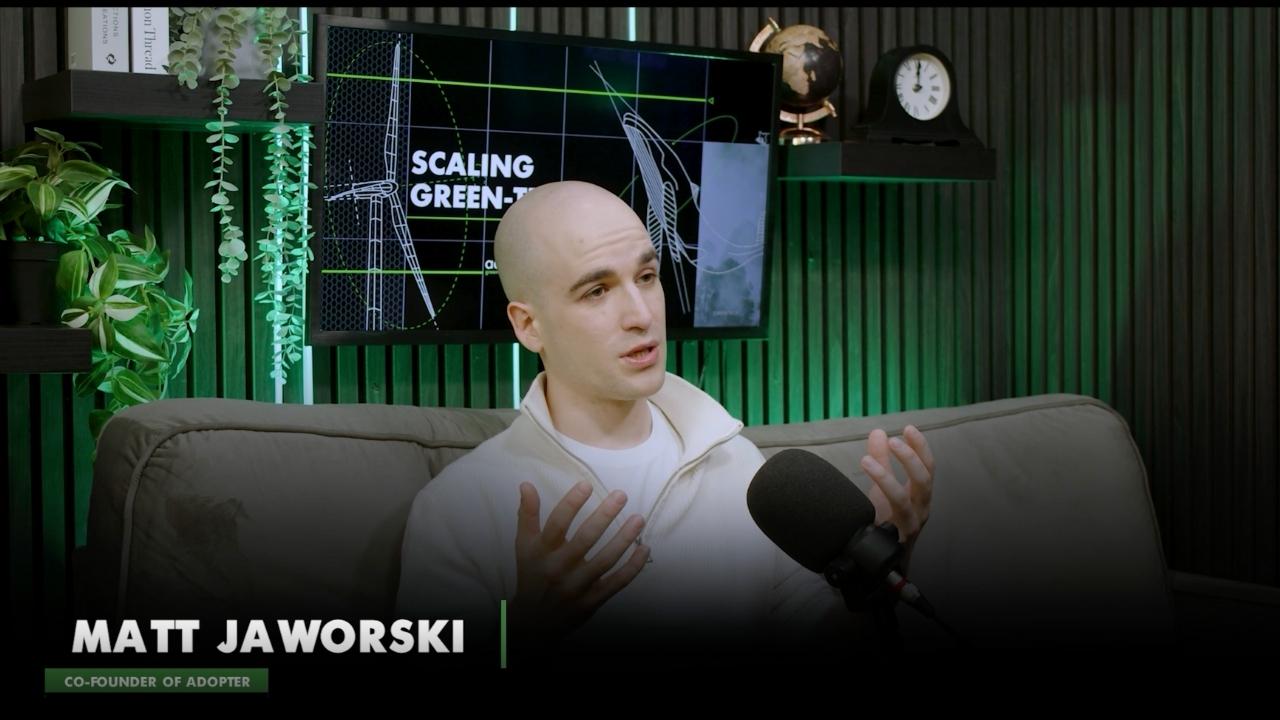
Matt Jaworksi: Welcome to the next episode of the Scaling Green-Tech podcast. Today I'm joined by Adopter's very own Katherine Keddie, and we'll be talking about LinkedIn and LinkedIn in 2025. What changed? What remained the same? And most importantly, how you can use it to support growth and scaling of your climate change solution.
LinkedIn algorithm changes in 2025
Katherine Keddie: Yeah, so today we'll be talking mostly about organic. And there's obviously a whole other area of LinkedIn, which is paid content, paid social, which is extremely valuable. So we will get into that in another episode. But for now, we're going to touch on some of the key trends. And I mean, generally, I don't think this is going to be particularly surprising to anyone who works with LinkedIn, who is a marketer. I think a lot of the same trends have been the case for the last few years. So, for example, we all know that there's been a shift in LinkedIn over the last year to focus on video. There's a vertical scrolling format now, just like TikTok, so you can scroll through videos. So anything that's like within the platform, so you're not linking to YouTube or somewhere else, you're kind of sharing the video natively in the platform and is made for that like vertical phone screen, it tends to be performing better. And there's a new feature, but also a lot of the commentary on what does well on LinkedIn has also reflected the fact that people watching videos, reel style videos that they watch for the whole time is becoming extremely valuable. That's one. Another, and again, not surprising, we've seen this year on year, but LinkedIn is more and more emphasizing discussion and value. So I think particularly in the context where AI allows us to be able to generate loads and loads and loads of content really fast and kind of put it everywhere on the internet, LinkedIn is really focusing on high quality expertise and knowledge sharing. So the way that that comes across in terms of ranking is there seems to be a big emphasis on whether you save a post and come back to it later and on whether the post causes discussion. So we'd be looking especially at comments that are coming in within the first 60 minutes of posting. The other thing which we have seen more of, and this really mirrors actually the trajectory of social media platforms other than LinkedIn, is a big emphasis on creators. So there's lots of new creator and knowledge leader features, and also we see a lot of success from fewer accounts. it's more likely that if you have, for example, an individual personal account from a founder that is performing particularly well, their content will be shown to more people if they kind of reach a certain critical mass when it comes to engagement. So that's something to pay attention to. The final one is that we are shifting more and more towards mobile. There's a great report from a guy that comes out called Richard van der Blom, and he puts out a yearly report on LinkedIn. He looks at thousands and thousands of posts. And he tries to aggregate all of the data together to create inferences about what works on LinkedIn. So he found that 72% of people using LinkedIn are using a mobile device, which again, leans towards doing this like vertical format for video. And when you're creating content, for example, graphics for LinkedIn, bear in mind that anything small won't be able to be seen by someone on a phone. So just to summarize then, the LinkedIn trends that we're seeing are a move towards video, a move towards more individual, personal, and creator accounts, a move towards video, and a focus on the value provided by knowledge. So that's looking at saves and on comments.
Creator accounts and brand page reach
Matt Jaworksi: If you think about it, what's the goal of LinkedIn and any other social media platform? It's to keep people on the platform for as long as they can, because that's how they get more attention. They can do more profiling, so they can show you more ads and make those ads more relevant. So then what's going to keep people on that platform and keep coming back to that platform? Videos, because you need to spend a minute, 30 seconds watching it. And if you watch another one, and if you watch another one, that's multiplying the duration of your session. And then if you get engaged in comments and discussion, that means you will be coming back to that specific post, that specific thread. over the next day, maybe two days, you'll be engaged, you'll be thinking about the replies, so you'll be more active as a LinkedIn user. That's what they want and that's what your content has to provide to LinkedIn, not just your customers and visitors, followers.
Katherine Keddie: Yeah, I mean fundamentally the goal of any social media platform is to keep you on the platform for as long as possible so that you look at advertising content, because that's how they make money. So I think, you know, Fundamentally, if you're creating content that keeps people engaged on the platform for longer, then that is very valuable.
Matt Jaworksi: And also makes them come back to the platform. That's where the saves come in, right? It's someone saves the post, then a week later it's like, oh, I need this information. I've seen it like a week ago on LinkedIn. They come back, press save, they open the post and also see an ad from LinkedIn.
Katherine Keddie: Yeah, absolutely. So I guess the next question would be, how do people jump on these trends? How do you actually factor them into your content?
Matt Jaworksi: How do you actually leverage them, right? It's all good to know that that's what's happening, but what can you do about it? What's your perspective?
Authenticity versus AI-generated content
Katherine Keddie: Well obviously we talked about focusing on vertical video. I think there's also a big shift towards authenticity being a really key feature. So anything that is extremely manicured that looks like it's been written by AI is becoming firstly really difficult to connect with. And secondly it's much of a muchness. It all kind of looks similar. And I mean, there's loads of resources that you can find online about how to identify AI posts. But one key thing that I think relates more to the content being valuable is that it tries to create these false dichotomies. So if you're using Chat GPT or Perplexity to create content, a lot of the time it will try and go. compare two things and create some kind of controversy. So it could be like, it's not this, but it's this. Um, which I mean, can, if you sparingly be a useful way to create some intrigue, but, um, that kind of content where you have this like shallow, um, AI driven controversy type caption, for example, that sort of content is not as useful. I would focus more on How do you get your personality across as a brand? How do you create something different?
Matt Jaworksi: How do you also get your personality across as a person?
Founder and CTO personal branding
Katherine Keddie: Absolutely. And I mean, that's why, you know, focusing more on individuals accounts. So if you're a scaling startup, that would be a founder. Everyone loves founder stories, especially on LinkedIn. So that obviously is a slam dunk. And then any other people that could be really external facing, so it may be a commercial lead of some kind, it could even be your CTO. So often a key part of a CTO's role is to communicate the technology in a way that's easy for people to understand. And with the shift focusing more on the value of high quality knowledge that someone can bring on a topic and being a thought leader, the CTO could be the next person to be at the focus of the personal brand. So I mean, that's what I would do and that's my prediction. But yeah, generally creating stuff in your own voice that sounds like a person and reflects genuine knowledge and focuses on value add, that's really the priority.
Matt Jaworksi: So, okay, cut. That's all nice, but I can imagine what someone might be thinking. Now, focus on video. Everyone is browsing on mobile. Some people have been hearing that for the last couple of years if they've been following LinkedIn and changes in social media. So let's make it a bit more practical. Can you give me some more examples? And then maybe we can talk also about how to actually implement things, what are some easy wins, how to get started with things like video. Sure. So let's start with the examples.
Real-world examples: Jay Lipman and Brittany Harris
Katherine Keddie: Yeah, sure. Yeah, I know. I think, you know, it's not breaking news that people are scrolling on mobile. I think we're all aware. So two examples of people that I think are doing really, really good content. I would encourage you to go have a look at their content. So the first is Jay Lipman. He is the founder of Ethic. He does a lot of content around nature and finance. What you should go to his account to look for is informal videos that he takes of him doing some commentary. He talks about some issue areas. He talks about, so he'll be walking around New York Climate Week, for example, doing some commentary about what's happening. It's very rough and ready. It's very authentic. It's based on his expertise and there's a lot of value added provided by the videos. You know, it's not just talking for the sake of talking. He's actually adding something tangible.
Matt Jaworksi: And it's not just talking that his company and himself are amazing and you should give them your money. It's actually valuable, meaningful commentary to current events that's insightful that you can learn from.
Katherine Keddie: Yeah, exactly. I would say if you look at his account, less than 10% of the time he's talking about his business. He's more doing commentary about the issue areas. So there's clearly some key kind of content areas that he is an expert on that he comments on. He talks a lot about the alignment between nature and financials. And then whenever there's an event of some kind, policy update in that area. He's there doing a post about it, doing a video. And the engagement is really, really strong. And I think it's his natural style of talking to the camera and that kind of scrappiness that comes with it that really engages with people. The other part is that because he's doing these videos off the cuff, it allows him to comment on things really fast. So he's not waiting two weeks to put out his New York Climate Week video. He's filming it. He's putting it out. The week is still going on. People are interested. And then on LinkedIn, it's picking up straight away. And then it's being shown to people for two, three weeks ongoing because he does this great creator content. So he's a very good example. Another one is Brittany Harris, who is the CEO of Qualis Flow. She does the content herself, doing extra commentary. So if she speaks at an event, she'll share some of the insights that she talked about. She'll comment on key updates that are happening in her industry, which is a built environment. And she is very good at commenting. So say someone's talking about something to do with waste or sustainability, or efficiency and data quality within the built environment, all of which is addressed by Qflow Solution. She'll be there commenting, giving her thoughts as an expert. And again, it's not selling, it's literally just contributing knowledge and value add. So that is something I would look out for if you're having a look at her personal account.
Imposter syndrome and technical founders
Matt Jaworksi: Okay, so a common theme I'm hearing is that the content doesn't have to be perfect. When you make videos, it doesn't have to be a studio, a Hollywood production. What matters is that they are meaningful, they are on a topic that the speaker actually knows more than an average person about, and they are released in a timely manner, providing real-world commentary and adding valuable perspective to the discussion. You know, thinking about it and this concept of speaking up on topics where you have an above average level of knowledge, of understanding, it reminds me of this paradox or maybe a trap that many founders with scientific backgrounds and PhDs in the field, sometimes several PhDs, fall into, which is that despite all this expertise, They feel like they're still missing something. They feel like if they have one PhD that there might be someone with two PhDs who will know more on the topic. And if they say something that's not 150% precise, someone will come and attack them. Maybe like it would happen in some academic setting where someone would be pointing out any small slip-ups and mistakes. here for also for anyone like this who might be listening to us who has the scientific background but is at the same time unsure if it's worth for them to speak up and for example record a video. Look, if you have a PhD in the field, if you spent years researching it, if you're capable of starting a company in this space and running it, you definitely have an above average level of understanding and you can share a valuable perspective. And even if you miss something out, it's unlikely that people will try to link you to Shreds or anything like this. They might point it out, and even if they do, you'll say, oh yeah, that's actually a great point, that's a nuance that I didn't have space to get into in a short 30-second social media video. But, you know, it's definitely true. So you can only gain, and I think it's worth for everyone to give it a go and to try it. Because, you know, the upside can be great on LinkedIn. Generally in marketing.
Katherine Keddie: Yeah I think people also in my experience get concerned around sharing information too early. So obviously if you're in a scaling startup or you're doing sensitive work and there's a lot of technical innovation happening You don't want to give away anything that's sensitive to your business or is going to impact the business commercially. So identifying those topics that you can talk about, discussing them with the team. So I guess if you're a technical lead, discussing with the marketing team. If you're a marketing team, giving guidance to the rest of the team about how they can talk about the problems that you're solving, how they can engage with people online. I think this is a really healthy foundation to make people feel comfortable and empower them to do the publishing because as we've discussed it is so valuable and it is worth investing the time.
Matt Jaworksi: Okay, so we talked about the topic, we talked about its relevance, especially in 2025, giving all the LinkedIn algorithm changes. We talked about some great examples of how to make content that still has a chance to perform well. Now what does it mean in the context of climate tech and especially climate tech in 2025 when our sector is going through all those changes related to shifts in global policy and generally approaches and attitudes towards sustainability?
The shift from sustainability to resilience
Katherine Keddie: Sure, yeah I mean I think there's two key things that are impacting climate tech as a whole and then impacting the way that people create content and then their messaging of their solution and where they fit into their market. So the first is, as you mentioned, the policy change that is happening. So there is no longer this like really kind of optimistic sense of policy alignment when it comes to net zero when it comes to sustainability, or even when it comes to corporate strategy. That's something that we can't ignore. The second is that climate tech as a category is reaching a stage of maturity, which means that there are certain expectations in the market from customers, from investors, that things can't just be more sustainable. They also have to be better. That context is really impactful in terms of the way that you would communicate a solution. And I think a good way to summarize that is climate tech no longer means sustainability, it means resilience.
Matt Jaworksi: Okay Kat, so what does it actually mean in practice?
Katherine Keddie: So in practice, I'm thinking about the messaging and how I would shift from climate tech being just a sustainability add-on to being a resilience imperative. I would think about what are the repercussions for my customers if they don't invest in my solution. So, for example, Qualis Flow that I mentioned previously is one of our long-term clients. Their solution focuses on, they have a SaaS platform that supports data management, data quality within construction. So, what that means is that they can help really improve the quality of your sustainability reporting. They're giving unprecedented transparency to the construction sector when it comes to the materials that are on their sites and their sustainability reporting more generally. But it's also a solution that, you know, improves people's understanding of what is on a construction site, which is fundamentally a huge value add for the industry and helps save in terms of a lot of risks for their customers. It helps them do their regulatory reporting more generally. It helps them know how to build a building really efficiently, and that is sustainable as well, and it's cool.
Matt Jaworksi: Essentially, if I remember correctly, right, a part of it is confirming that the materials that the building is supposed to be built with are actually used to build this building. So you avoid situations where the building gets built, it gets audited, and then it turns out that the steel on the beams that are structural elements had the wrong kind of coating and the building is no longer compliant and has to be actually demolished.
Katherine Keddie: Also, a large amount of a budget for a construction project actually goes into rework caused by the wrong thing going into buildings. So if anyone's curious about that, there is a great report on their website around data quality, which gives access and transparency into how data quality works in construction and some really useful tips for construction companies to be able to improve that and the various benefits that can cause. So definitely have a look at that if you're interested in reading more. Going back to the main point around resilience, there's another part to it which is as national governments are thinking about the future and the way that they are adapting to climate change which is happening. I mean there was a report put out by the Met Office recently that shows that heat waves that are reaching temperatures we've never seen before are now the norm in the UK. So governments are thinking about how can they adapt to this context, and they're thinking about things like how do we have national security over our energy infrastructure? How do we have national security over our food supply chains? All of these things are obviously impacted by climate change, And all of these things can be supported through innovations in climate tech.
Energy sovereignty and national resilience
Matt Jaworksi: Absolutely. And to add to this, not very far from the bucket of national resilience and energy, actually, well, within that bucket, is such theme as independence and sovereignty of the country in terms of energy and critical resources. As we've seen over the last three years since Russia launched the invasion and attacked Ukraine, there has been a massive shift across Europe to developing energy systems that are independent of other countries, especially of Russia. Because when the war started, there was a real threat across Europe that if countries oppose Russia too strongly, but still rely on it, for example, in terms of their gas supply, they won't have energy to heat up homes of the people in winter. So something like energy tech that allows country to produce its own energy means that there is no such risk, there are no such pressures. And additionally, when a topic comes up like US Congress considering I don't know the proper word in English, I was learning about it in Polish recently, but when a Congress of the US considers a new batch of sanctions with sort of extended tariffs that would affect countries that import, for example, oil and gas from Russia and would impose strong tariffs on them, not just on Russia, who's supplying those natural resources. That's again a situation where you need to have your own energy systems. Same as in the future you will need to have your own, for example, food systems to make sure that you're not affected by, again, a situation like happened when Russia attacked Ukraine and a huge part of global grain supply got disrupted by this.
Katherine Keddie: I think what we're trying to say is that fundamentally, there are so many value drivers that relate to different types of climate technology that build on and are supported by the fact that they are more sustainable. That includes risk, as we've just explored, for customers, resilience at a national level, resilience at a global level. It also relates to the fact that a lot of climate tech solutions are better solutions. They solve customer problems. They're doing things in more creative, more efficient, more circular ways. Those things should really be emphasized when it comes to your marketing and when it comes to your LinkedIn content. That is a key shift that we've seen with climate tech in the last six months, in the last three months, more and more. So when you're thinking about what type of content to do and then more broadly, how do I frame my solution, considering the type of value add that you have alongside the fact that you're sustainable is important and it means that you're not missing key benefits that could really help your customers and help your company grow.
Matt Jaworksi: So now before we wrap up, do you have any tips for actually getting started and implementing those new types of content and activity on LinkedIn that are aligned with changes both to LinkedIn algorithms and to the needs and shifting requirements in the climate tech space?
LinkedIn audit and practical steps
Katherine Keddie: Sure, yeah. So my first one would be, I think it's a good time to audit your social media, and we actually have a full episode on all this thing, so have a look at that. Audit your social media and think about how is my messaging fitting within the way that people are describing solutions like mine in the market now. How does it fit with investor expectations? How does it fit with obviously customer needs and value drivers? So that's part one. Part two is I'd have a look through my analytics. I would see what content is performing well. And then I'd do a full scan of the potential opportunities that I could be reaching. So In particular, that involves personal channels. Who in your team could be a great spokesperson for the business through their personal channels? Am I looking now more at the technical team to be able to provide value? How do I support them in being able to feel comfortable to start posting online? And then from there, focusing on obviously video content, more authentic personal voices, and content that works for mobile, which obviously relates to the board trends that we see across LinkedIn.
Matt Jaworksi: Perfect. I guess something that might seem a bit contradictory, but it actually I think ties in very nicely to what you're suggesting is to also focus on easy wins, rather than try to do a huge LinkedIn overhaul from the get go. It's better to take one step in the right direction than to try to take five steps at once and then not take any more steps because you're exhausted or you stumble and fall down. So for example, before you start trying to engage a couple of people to create content on their personal channels, see if you're using effectively the personal profiles of the CEO and then other co-founders. Because it will often turn out that those profiles might not be as active as they could be. And that's where your opportunity is, because it might be easier to engage the CEO and help them get the tools or maybe confidence or maybe the ideas that they need to make this content. And then engage their very wide network, because as we know, typically the CEO will be the person with the biggest network due to the events they speak, the interviews they make. So if you're not using the CEO but use the entire, say, technical team, it might be the case that you're still getting less engagement than if you effectively engage this one key person who's the face of your company anyway in the real world. So they should also be the face of the company online.
Katherine Keddie: Yeah, completely. And I think finding those easy wins is key. And people love founder stories. They love them. So that's always an easy win and definitely something that's underutilized in a lot of startups.
Matt Jaworksi: Perfect. So do you have any final takeaway that you would like to leave our listeners with before we wrap up?
Katherine Keddie: My final takeaway is just start posting and then look at the data and then iterate.
Matt Jaworksi: Solid takeaway. Thank you very much, Kat. If any of you, our listeners, would like to chat about anything that we discussed today, or bounce some thoughts, or maybe talk about how you could start implementing those things in your company, just drop Kat or myself a message on LinkedIn. We're always happy to have a chat, and we'll be also delighted to meet our listeners. Otherwise, you'll hear from us next week when we release the upcoming episode. Thank you very much, Kat, for joining me today.
Katherine Keddie: Thank you and goodbye. Bye-bye.











.jpeg)





.jpeg)