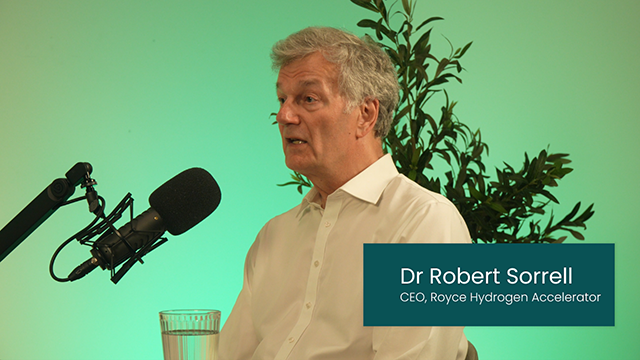
Matt Jaworski: Hello, and welcome to the next episode of the Scaling Green-Tech podcast. Today I'm joined by Dr. Robert Sorrell, the CEO of the Royce Hydrogen Accelerator and challenge lead for materials for end-to-end hydrogen at the Henry Royce Institute, the UK's National Centre for Advanced Materials Research and Innovation.
In today's conversation, we explore how materials innovation is the key to unlocking the hydrogen supply chain, what it takes to move deep tech research from university labs to commercial scale, and how the UK can position itself as a global leader in the hydrogen economy.
Thank you very much for joining me Robert.
Robert Sorrell: Thank you. Looking forward to the conversation, Matt.
Matt Jaworski: So to kick us off, the usual question, how would you explain your work by this? You can also go into the hydrogen accelerator itself and Royce Institute more broadly to a 5-year-old.
Robert Sorrell: Yeah. I guess we're, we are interested in identifying ways in which we can sustainably reduce energy, support, all the things that you would do in your daily life.
And to do that through the Royce Hydrogen Accelerator, we are looking to identify those technologies by working closely with universities and startups.
Matt Jaworski: Amazing. And how would you expand it, for the full elevator pitch rated to both Hydrogen Accelerator and Royce Institute?
The Royce Hydrogen Accelerator and the role of the Henry Royce Institute
Robert Sorrell: I guess for the Royce Institute, as you said in your introduction it's the UK IT Institute for Advanced Materials Research and Innovation.
And that, and innovation part is really critical because we're interested to take technology outta the lab and into the commercial arena. And that's why Royce set up the Royce Hydrogen Accelerator because we identified the key technologies that were needed to effectively enable wide scale deployment of hydrogen.
And then we realised that we needed to attract some investment into that area beyond just public investment so that we could get, so we could get funding for those types of technologies. So what we do is we work with companies to get them to a point where effectively they can pitch to investors.
So they're so called investor ready and there's various means by which we do that.
Matt Jaworski: Amazing. So before I ask you more about the accelerator itself and the Royce Institute's work let's maybe get a bit more in depth into the hydrogen. What would you say is the state of the hydrogen technology at one third of the way through 2026, especially in the context of the Strait of Hormuz and knowing that, no hydrogen went through different stages of the hype cycle so far.
The state of hydrogen technology and the UK hydrogen strategy in 2026
Robert Sorrell: I think we're awaiting the hydrogen strategy from the government.
So that's clearly quite critical. What they, what the government is saying is that this is still a key pillar and they're still committed to this activity. It's just a case of, when that strategy is going to be produced. I think when I look at the energy transition, I think we're going to need a wide range of solutions to address this as we head towards net zero and hydrogen is a part of that solution, but not all of it.
It needs to be integrated with the rest of the energy system.
Matt Jaworski: And where do you see its role?
Where hydrogen fits in the energy transition
Robert Sorrell: I think the initial role for hydrogen is in areas like ammonia. Yeah. Which it typically shows up in fertilisers and in chemicals. And moving beyond that, I can, there's a role for hydrogen in long duration energy storage.
So effectively in the UK context, when you've got large wind turbines offshore, often the wind blows strongest at night when there's no market for the electricity. So what do you do with it? And so one option is to utilise that electricity to, to produce hydrogen, which you can then store and then you can utilise it when you need it.
And then I think to finish the story, the other two areas where I would see use of hydrogen is in transport, but quite specifically in areas where hydrogen meets the needs. So marine for moving large vessels and also aviation, where you have this real challenge about getting sufficient energy density onto the aircraft versus the weight penalty to actually move these planes across the skies.
Matt Jaworski: Okay. So it's not quite a division that came up in some media coverage a few years ago of what normal cars everyone can use, being powered by hydrogen. It's more dose specific, more niche applications.
Robert Sorrell: Yeah. I'm glad you raised that, Matt, because I think there's a couple of areas where I would say hydrogen won't develop outside of a kind of niche application. One is in cars. It's good to see the innovation that the OEMs are doing in this space. Toyota. Yes, exactly. They're developing vehicles and it's great to see that innovation because I'm sure they'll be valuable in some niche areas of transport.
But I don't see us building out a big passenger car network to support that market. I think the other one that I would say that I don't see either is in home heating, because if you look at the inefficiencies of making hydrogen, why would you then put it into a network and then burn it in an efficient boiler in a home setting to provide space and water heating.
So I would say those two are two that we should knock on the head, so to speak. Yeah.
Matt Jaworski: Yeah. I remember seeing a couple of years ago, I think, on the London Underground and ad for some home boiler powered by hydrogen, that there is an infrastructure for this. But yeah, I remember discussing this idea with someone else, and I not a realistic one.
Robert Sorrell: I'm sorry, Matt. I'd say never. There may be some niche applications where you have the hydrogen available and you want to do it, but I wouldn't be the first option. I would consider you could use it for vehicles that return to base. That's how, so basically they do the same route and they come back to refuel.
So you don't need a complicated setup, but at the end of the day, it's not the most efficient use of something that's difficult enough to make in the first place.
Matt Jaworski: Yeah, a hundred percent. Okay. Never say Never right. We could imagine some, tell me, stop me if I'm getting too far into a science fiction island, let's say a community that has access to water.
Let's say we figure out a way to make hydrogen efficiently out of seawater, which I know is one of the challenges. We can talk about that later. And then they could use hydrogen as a heat source. Although if they were going to do that and had this kind of advanced technology, there is a question why they would do that instead of using electric powered heat pumps.
Robert Sorrell: Exactly. And the question about yeah, why they wouldn't use batteries as well in that Exactly. In the cars. And I think that's another part of the story about the huge advances in battery technologies. So you can see that's been very valuable in taking a lot of that space.
Matt Jaworski: Yeah. So maybe on the side of setting the context more broadly, what would you say the value chain for hydrogen technology is?
Like I had a look at reports on Royce's websites. Yes. About the second edition, about hydrogen accelerators work. And I saw that, it's the technologies needed span from novel catalysts for electrodes, reviewing how different materials interact with hydrogen in the context of engines or for example aviation.
You will surely know this topic so much better. So what would you say is the value chain? And then once we cover that, it would be great to hear more about where the challenges are in this value chain.
The hydrogen value chain: production, storage, distribution, and end use
Robert Sorrell: Yeah, so I think the value chain starts with producing it and there's a whole issue about cost, and we can come back to that one.
Then effectively you need to store and distribute it. So we should talk about that. And then there's a piece around end use because it's not a case of simply slotting it in. You need to understand the implications of changing to, to hydrogen for example. And then of course there's the whole issue of monitoring so that you are able to monitor the hydrogen in, in, in whatever environment it's operating in.
So you can determine if there's any safety issues that you need to deal with.
So where should we start? We could start with cost, I think might be a, might be quite a good one. So I think, critical to hydrogen being used going forward, we need to bring the cost down and the target numbers are, one, $1 to $2 a kilogramme.
We are quite a way above that today. But I think there are ways in which you can bring these costs down. I think the other thing to remember in all of this is that the principle cost of running an electrolyzer is the electricity cost, right? Yeah. So first of all, it's like how much are you paying for your electricity?
Then the second thing is the cost of your electrolyzer itself. So what can you do to make that electrolyzer more efficient? So you know, it's got electrodes go, can you improve those? Can you make the surface area bigger so that the catalyst that you are using to break down the water can operate more efficiently?
What can you do about using ever cheaper catalysts so you can bring the cost down that way? And then the other point to bear in mind is the efficiency argument. Because it, as you build larger and larger electrolyte systems, you stack together modules and basically every time you have an efficiency loss, that efficiency loss is multiplied through the number of modules that you have.
And so efficiency is a really important game in, in this, and that's why when people talk about certain technologies rushing off and we're falling behind we might be behind initially, but if you end up with the least efficient operating operation, it's going to cost you more electricity.
And bear in mind what I said at the beginning about electricity being the major cost, that's going to be a significant disadvantage. So there's all to play for in this area.
Matt Jaworski: Amazing. And then across the different stages of the value chain, anything else that you would cover, for example, on the later parts, because we talked about cost, right?
Yes. As the overall part of hydrogen and maybe consideration surrounding it, we touched on the beginning of the hydrogen's value chain, right? Creating it and the electrolyzer and how it connects to the cost of electricity. But now we're getting more either more in depth on, on specific challenges within this area or continuing across the value chain.
Robert Sorrell: Yeah. Which way would you take us? Let's go across, across the value chain. And I can come back to some of the electrolyzer challenges. So the next thing is about storing and distributing the hydrogen. So how do you contain it? So hydrogen is the lightest element. So it has a natural tendency to attempt to escape from what you contain it in.
This situation we understand to some extent the way that hydrogen flows through pipes, but there's a lot more data that we need to build up if we're going to be moving pure hydrogen through these.
Matt Jaworski: I was literally reading about this in the report of how hydrogen can pass through different materials, right? Yes. I think it includes polymers. Yes. But not through metals. Correct. If the metal is one clean, continuous surface without any cracks, even small ones. Yes. So then there was like a company that has support from Royce Accelerator on developing a technology to coat I think plastic surface Yes.
With metal that would be uniform Yes. In a way that would prevent hydrogen leakage. Yes. And it allowed them to develop new type of vacuum insulated pipes for transporting hydrogen.
Robert Sorrell: Yeah. We should switch roles. That's a really good, that's a really good description. Exactly right. So yeah. You can't store in a polymer because it will just, it will get escaped through it. Yeah. So the idea is you put some kind of liner within the polymer through, which is impermeable to the hydrogen. So it can't escape. And your point about continuous is really important because the minute you run up to a joint, then you have a kind of weakness in the system.
So the question is how do you address these complex geometries to make those also resistant to hydrogen. And then there's a lot of people working in this space and different types of solutions with coatings and being able to produce materials where they have coatings inside, which are hydrogen resistant.
So there's a tremendous amount of innovation. And of course, we are only talking here about gas. Yeah. When you move to liquid, which you would most likely do in an aviation setting, then you're down at minus 253 degrees centigrade. And it's the understanding of extreme cryogenic temperatures on the properties and the materials in which you're containing the hydrogen.
And then of course, you've got this issue of what's described as thermal cycling, because, as the hydrogen is moved out of the tank and you burn it in a jet engine for example, then basically the tank is going to begin. There's going to be differences in temperature, a temperature gradient across the tank.
So how do you maintain that and what's the impact of that on the lifetime of the tank? So this is a fantastic area for innovation, and there's lots of people working in this space, but we need the data. There's some quite big gaps in the data in this area. Most of the stuff, not surprisingly, seeing the Artemis piece comes from NASA and their use of their use of hydrogen.
But there's a need for much more data here.
Matt Jaworski: Okay, so we talked a bit about electrolyzer. We might come back to Electrolyzers and a bit more detail.
We talked about storage. Where should we go next in the value chain? Let's talk a bit about end use as well.
Hydrogen for aviation
Robert Sorrell: Let's talk a bit about end use as well, let's stick maybe with the aviation, or you could in a similar,
Matt Jaworski: A very timely topic given the aviation fuel concerns right now in Europe at the time we're recording this episode.
Robert Sorrell: Yes. And quite rightly a very conservative industry. So you need to be very careful about how you introduce new things into this sector.
Matt Jaworski: So aviation fuel being a very timely example right now with the aviation fuel availability concerns in Europe, at the time we're recording this episode, and then obviously with aviation as a sector, having a history with hydrogen where it was used in airships, but then also safety issues that led to the Hindenburg disaster.
Robert Sorrell: So yeah, these are quite separate pieces, so maybe we should just tackle them accordingly. I don't think anyone's proposing that we'd move around with, hydrogen air ships anymore for various reasons. Hydrogen in an aircraft. I think the challenge for hydrogen in an aircraft is that it's energy density terms.
It's very low. So what do you do about that? If it's a gas, you compress it, but hydrogen has this other funny property that it's a non-ideal gas, so you don't get this sort of linear compression to energy density that you might expect. And so the other option is to liquefy it.
You liquefy it in a plane, and then you've got the issues of how you manage that. That's got some really big challenges because that's, you're going to have something incredibly cold minus 2, 5 3 moving around as the aircraft taxes down the runway. These technical areas are all addressable.
But they need to be considered, you need the data point about having the data that I mentioned earlier. You've got the small matter of getting the hydrogen in liquid form to a jet engine so it can burn it. Yeah. So that's a whole issue. You've got. Some potential issues with hot hydrogen if the burn isn't managed correctly, coming back through the burners.
And so you've gotta think about what could happen in this scenario then, and the effect of hot hydrogen on some of those components. And of course you're burning water, which while that, sorry your product of combustion, I'm sorry, is water. And so one of the issues with that is that you have to think about the corrosion issues associated with all that water going out there at the back of the aircraft as well.
I, these things are, them are manageable, but you do need to, consider them as you think about what you're going to do in the aviation sector, for example, there's also talk about using it in ships as well. And the recent kind of that makes sense in ships is because if you want to move hydrogen in bulk, you could move in liquid form and you could also use the same material moving to also power the ship as well.
And so there's certain areas where hydrogen has the as advantages to use. And I think that's why we need, that's why I keep coming back to the point, it's part of the solution and we need to be selective in how we use it as opposed to just, saying it's the solution for everything.
And then that sets up the wrong argument, right? We're not trying to compete with other technologies. What we're trying to do is figure out what's the best blend of system for us to use. And that's also going to depend on where you are. Yeah. What country you live in, what kind of resources you have available.
And it comes back to that point that the UK just has this amazing offshore wind resource that we can tap into.
Matt Jaworski: So what you're essentially saying and which sounds like a good response to a lot of this scepticism about hydrogen and the other technology is that no single technology is the one size fits all solution and the kind of the silver bullet, right?
It's about the mix of technology and the mix of technologies will differ between different geographies. Some are very sunny photovoltaics and electric vehicles make a lot of sense. Yes. Somewhere like the UK where you have a lot of wind and a lot of offshore renewable energy infrastructure then it makes sense to also use it for hydrogen and then find good uses for this hydrogen.
Robert Sorrell: Yes, and there's always competing uses. And one of the things that's interesting is the rise up of data centres, and these data centres are large consumers of energy. So how do they rank against, making hydrogen versus powering data centres? So I think that's why you need to think about the whole system and how you optimise the entire system and think about all the components and as you say, avoid having a competition.
It's this one or that one. And and you are absolutely right Matt. There is no silver. But there is a very smart way in which you could manage this. And actually that brings me, if I may into another topic you raised about artificial intelligence, because the complexity of some of these systems to optimise them is going to be extraordinarily complicated.
And I think there are ways in which we can use, AI to help to improve the operation of these types of systems. And we can use it in, in, in many ways. If we went back to the electrolysis piece and talked about, catalyst discovery and development, then you can use AI to help you inform a lot of the experimentation that you might be doing.
And it's very interesting in our experience when you interact with AI in that space. And there's some fabulous people in the UK are doing some outstanding work in the area.
Matt Jaworski: So essentially it sounds like with hydrogen, it's a similar case as in many other industries from our clients in biopharma or clients in construction who are using AI to accelerate processes like materials, discovery formulation, experimentation design. How does this use of AI for those applications look across Royce's portfolio in the companies that you supported through the hydrogen accelerator?
AI applications in catalyst discovery and materials design
Robert Sorrell: So we're seeing this from through, through a range of applications. So we're seeing the utilisation of AI for the development of catalysts that you would use electro catalyst for use in electrolyzers. And you'll able to do designed experiments which allow you to pinpoint much more accurately what are the really interesting things that you need to do in that space, because you can dial in a different set of parameters and to optimise what you're looking for.
We are seeing it in the design of materials to contain hydrogen and our companies are looking at ways in which we can do that in our portfolio. And then at the other end of the scale, sort of like the much lower level use maybe of ai we are seeing people who are retro fitting small fleets of boats with hydrogen capability to see how that, how might that might work in practise.
And this is, it's really quite interesting because you can, that begins, it's interesting where that story might take us. Yeah. So you see it operating right the way across the piece.
Matt Jaworski: Okay. So someone kind of asking the question, what if and then willing to go to actually try it and good things might come out of that.
Amazing. So we're touching naturally on the wide range of innovation you've been working with. And how do you assess that a startup or innovation is a suitable candidate for working with you?
How the Accelerator selects and supports portfolio companies
Robert Sorrell: Yeah, and that's a really interesting question. So what we've been doing is reaching out and identifying what companies are out there in the overall hydrogen space.
And then it's a case of how can we help them? Because for some companies, they may already be well on their journey and actually they don't need any of the things that we might be able to offer them, in which case we make a note and we stay connected. For other companies, it could be a variety of things.
We choose companies or and companies choose to work with us. I don't know. We are, and be really careful about this one, that we are, we're agnostic. We're just seeking the best technologies. We are not picking winners or anything like that. And so we work with companies to identify what their needs are.
So we have this quite well thought through process where we start with a kind of an oversight, a technical oversight of the company. We get a sense of the technology, what their initial markets are, and get some sense, okay, what does that how does that stack up? And then we can move through that if necessary for a smaller nu, much smaller number of companies to do really detailed technical assessments, SWOT analysis and everything.
And we have a technology advisory group led by a leading academic who can then ask all those kinds of really difficult questions, but in a friendly environment so that when the company's getting ready to pitch to an investor, they've ticked off the questions that the investor would expect them to answer.
And they also understand the strengths and weaknesses of what they're offering. Yeah.
Matt Jaworski: Amazing. So it's, it seems, it feels like a very tailored offering. Obviously it is a process that you follow, but it's not an accelerator. Like some programmes that offer a couple of workshops, a networking event, a demo day, and that's it.
Yes. Feels like something that is much more shaped around the participating companies. Yes. And assessing them, finding what they need and equipping them for this next stage in the investment journey. Yes.
Robert Sorrell: It is. I hesitate to overage it too much. because my team, we are a very small team of people.
But there are specific things that we can help with, like pitching and we're moving into mentoring people through different stages along their commercial journey. But we also run some of these larger networking events where we'll get together industry partners, people who have challenges with a whole group of academics.
And it's interesting to watch that group network and what flows as a result of that. And we also had an investor forum around one last year, hopefully we're on another one this year where we get them more to pitch to investors. And that's very and we have a hydrogen conference, which we run every year as well for the projects that we've funded.
Matt Jaworski: Amazing. And what has been the impact and the success of the companies you supported so far? I know that when we started discussing this episode back in November, you had some investment announcements just around the corner. Yes. So I'm sure there've been a couple more since then, because what, it's now the second half of April.
Robert Sorrell: Yeah so I think that the one measure of looking at what we're doing is to look at the investment successes. And I think we've demonstrated that the model works. We've got three or four companies now that are moving through this process. The frustrating thing is that you have to wait for the announcement.
So we can't drive it, but we know that this effect is multiplying. So there, there's, and they are citing the support that we are giving in some of those cases directly as being as resulting in them getting investment. And it's more explicit in some than others. But we can see, we understand how that process works.
I think the other thing that's critical for us is to prime the front end. That's really critical. And that's what we're focusing on these next 10 months, how do we get as many new innovative ideas into that pipeline? And then ideally those will form the startup companies for the next generation.
Matt Jaworski: It sounds absolutely amazing.
So with investors, and investors in your community and beyond, what feedback have you received from them so far on how we supported the companies? And maybe also something that would be interesting is what's the investor's perspective on hydrogen innovation more broadly?
Robert Sorrell: We have got some, it's one feature that we're really pleased with.
We've got some very positive feedback from the investors we're working with. You really need to work hard with the investors to build the relationship. And we have begun to build those relationships with a small set of investors and go out from there. I think in terms of investor sentiment about hydrogen, which is maybe where you are, you're going, yeah.
That's what, that varies depending on what part of the world they're coming from. So it's quite useful to have a sort of international set of investors because I think the hydrogen peaks in interest go up and down. You just need to stay the course on this one, frankly.
Because at the end of the day, as I said right at the beginning, you cannot make any of this fertiliser, any of these chemicals sustainable without a source of green hydrogen. So at some stage, someone has to deal with this, deal with this issue. So it's just a case of sticking with it and keeping on developing through.
And back to the point really having this more international set of investors that enables you then to tap in when it goes quieter in one region, then you can pick, you can find that there'll be support in other areas. The key thing for us is we are funded out of the public purse. We're funded by the engineering physical research science council.
And so the value needs to accrue to the uk. So the idea is that, people will invest in those companies and take them through the initial stages of development deployment in the uk. And obviously I can't, man, I can't mandate that but that's one of the things we're very clear that we want to happen.
And actually in many cases, we're seeing that is occurring
Matt Jaworski: Amazing. And what does being investment ready mean for an early stage hydrogen company?
Robert Sorrell: Yeah so I think being investment ready at the most basic level is that if you are any kind of investor coming in to talk to a company, then you've got a whole list of criteria.
Yeah. And actually, interestingly, technology's not at the top of the list, right? So there's a whole range of other things about, the competition, the market landscape and most, and when am I going to get my money back, in that, the classic towards that variety, but it's always there.
Matt Jaworski: It's funny you touch on this, right? This technology not typically being the thing that might hold back the investor readiness of a company or that investors are most interested in. What would you say is the place where the most promising innovations get stuck between the lab and the market?
The funding gap at proof-of-concept and prototyping stages
Robert Sorrell: I would say it's at that very early stage where someone has an idea and they're trying to commercialise it, and it typically goes through a pattern of two phases. The first is getting a kind of proof of concept. Yeah. So is this feasible? Yeah. And part of that is talking to someone who holds the problem, like an industry partner, and then doing some very simple testing to say that looks feasible, and there's a lack of funding for this kind of work.
And then there's also a lack of funding for the next stage that follows on from that, which you refer to as prototyping, which is then a mini version of your the most basic level that can demonstrate how your technology might work. Obviously, to scale it up, but what are the basics and these kinds of areas they require, 10, sorry, 20 to 50,000 pounds, probably the feasibility study, somewhat less than the feasibility study to do the proof of concept.
The prototyping is more expensive, and the money is avail. The money to do that can be made available, but what tends to happen is that it's available in larger tranches and at fixed times across the year. And one of the tricks is to make this funding more, more agile and actually bizarrely smaller, because often it's larger chunks of funding over long periods, whereas they need short, they need shorter periods and smaller funding.
So that's one of the areas where there's a real gap.
Matt Jaworski: It's interesting you mentioned this because it's something we talked about in at least one of the previous episodes with Aled Roberts founder and CEO of biomaterial startup who mentioned that, there is this temptation of, for example, chasing grants as a company.
Yes. But actually landing some grants could steer you off course rather than keep you on course. Yes. And a small amount of money right at the right stage might be better for a company than more later on, like you described. And of course if you get locked into grant grants are really helpful.
Robert Sorrell: I've got nothing against that. But there's also an issue of grant dependency and timing. And so you've gotta, if you are running one of these companies, you're always balancing that in your mind about what's the most efficient way for me to get to the next stage of this journey?
Matt Jaworski: Yeah. And then there is the part about the commercial mindset and finding the problems of customers and solving them and not just focusing on the technology and being in the stage of sort of technology looking for a problem. Yes. And being able to, not just able to, being willing to pivot, which is something that we've seen quite a lot in technical founders, science-based founders whom we work with as adopter, where their messaging might be extremely technological heavy science focused, completely missing the actual reasons that the customer is interested in what they offer.
So it might be not about the specific material, but about the cost saving cost reduction that it drives. I know what you experienced in terms of your side of helping researchers, who spent years in lab, in academia start thinking like entrepreneurs.
Robert Sorrell: Yeah. This is such an important point because I think it's about ensuring that the technology in whatever form it is, whether it's a, it is a service or it's a component or whatever, or a new material, whatever it is, that there is actually someone who's interested in using that.
Yeah. And you understand the context in which this thing could be used, because you, that part is absolutely critical to understand. because one barrier could be that if you have to completely re-engineer everything that you are doing to utilise this particular piece of technology, that's a huge barrier.
Yeah. It could be that the industry needs it. Yeah. And in some cases they do. In other cases it's a big barrier. So you've really gotta offer some huge potential benefits if you're going to make those kind of change. So it's, this is why we get these communities together. And we ran an academic forum last year, and we're going to run a couple more this year where we bring together industrialists and academics and spend a half day, this time we do probably a day together just talking about what the challenges are.
Yeah. And the critical thing is having a dialogue because you need both parts of the argument to come to the most innovative solutions. But I'm really glad you mentioned it because it's absolutely critical.
Matt Jaworski: Something that you touched on is the UK's policy, hydrogen roadmap. Yes. And what would you say about how the policy helps or hinders innovation in this space? Yeah, so not necessarily in the uk it can be a broader question if you want to keep it UK agnostic.
Robert Sorrell: I think that if you are interested in investing in the space or operating in the space, what you need is consistency of messaging. I think that's the most important thing. Yeah. So it's very frustrating that there are some delays in some documents appearing, but what you want to know is that the commitment remains.
Because without that commitment, then people will look elsewhere to see where they can where they might invest. So I think having that commitment to, in this case, to hydrogen which we are hearing from Michael Shanks, which is a case of kind of grinding through the process of delivering the strategy is what's important because that's what affects people wanting to invest in, in technologies.
Because they see that the government is invested. And I think they're really important partners in this. And they've been incredibly supportive with us and the accelerator and Patrick Vallance, wrote the forward for the brochure that we have on the Royce Hydrogen Accelerator, which is a fantastic sign of support from them.
Matt Jaworski: And speaking about the UK, right? Yeah. Where would you say the UK sits in the hydrogen landscape? Where does it, where does the UK have world leading capacities? Yes. And where does it have its gaps?
The UK's hydrogen innovation landscape
Robert Sorrell: Yeah. The UK has this tremendous base of innovation. By any measure, the output from the universities in the UK is, is, it's almost second to none. We're up there with people in the space. I think specifically what, where we're not so good is in that kind of scale up space.
Yeah. And I think there's a, there's an issue about gearing up to make mid-size companies and some of the issues around that. I went to a finance breakfast on this re recently. It's quite, and it was quite interesting that the most telling comment was people don't plan far enough in advance for these situations when they really want to start to scale their production.
So there's gaps in the, in, in the support, in the finance support. And there's also some mechanisms in some areas where we don't enable companies to grow as quickly as they might. And I think some of the changes they're trying to make is trying to, is going to enable more funding potentially to flow in those areas and hopefully alleviate this issue.
But it's been recognised for a long time.
Matt Jaworski: Cool, I guess as we now we need to start wrapping up the episode. Final questions for you, and one that's been on my mind, especially with how hydrogen, has this hype cycle and there is a lot of misunderstanding around hydrogen. How important are storytelling and communication for hydrogen solutions?
Storytelling, investment readiness, and the founder communication challenge
Robert Sorrell: Yeah, absolutely critical because I go back to the innovation forum we had in November of last year. Now you've got 20 companies pitching. They got four minutes. So you've got to get your message across in that time, and I'd argue if you haven't got it across in the first minute or so, then you're going to, you're going to lose the attention.
So it's absolutely critical to be able to lay that out really clearly.
Matt Jaworski: Amazing. Continuing on this sort of quick fire for deep tech founders working in hydrogen and adjacent technologies, especially at an early stage, what's the single biggest thing they should get right early?
Robert Sorrell: They should understand where their product or service is going to be used and talk to the people who are doing it so they can make sure that what they're doing actually matches up to where they think it's going to end up.
And be prepared to change as well. Because sometimes the initial market selection is not the best one.
Matt Jaworski: Amazing. That ties in very nicely with what we talked about earlier, and then probably the most difficult question of today's session which is which technologies companies and or developments in the hydrogen space you are currently most excited about.
Robert Sorrell: Oh dear. So that's a hard one because it goes back to picking your favourite children. So I will resist calling out individual companies, but I think some of the developments in the electrolysis area where people are moving to technologies where they're really pushing the boundaries of what's possible.
And there's some really exciting stuff where they're splitting the ox oxidation reduction reactions where they're using membrane free electrolyzers, where they're doing various innovations in that space. It is really exciting. And I just think this whole ability to develop materials that can cope with hydrogen at minus 2 5 3 is just amazing.
And actually understanding what's actually going on with the materials under those kinds of, really low temperature cryogenic conditions.
Matt Jaworski: On the second one, I can't in any way command, but on the first one, I think it reminds me of a startup pitching at the conception X demo day that we met on where the scientists developed a way to use seawater in hydrogen, green hydrogen, yes. Production through electrolysis without the electrodes actually resting through and deteriorating.
Robert Sorrell: Yes. And that's a good one. That's a good one to pick up on because if you can utilise different forms of water then and make your electrolyzer resilient, that's absolutely fantastic.
And then in some companies, you can go further that they're sufficient in your wastewater. You could actually utilise that as a source to make some hydrogen as well. So there's a whole spectrum of things that you can do in that space, which are really interesting. There is quite a debate about sea, about seawater, electrolysis versus reverse osmosis.
That's, yeah. If you wanna have an interesting debate on that one we can get some people with views on that. But yeah, it's very interesting technology.
Matt Jaworski: Oh, I just wish we had more time to get into this now. And then also the topic of hydrogen storage at offshore wind farms. Yes. That requires seawater proof electrodes and all that.
But that's a topic for next time. But now what's next for the Royce hydrogen accelerator?
Robert Sorrell: So I think the next 10 months for us are really critical in terms of demonstrating that we can create, pull through this next generation of innovative technologies so that we can pull through this next stage of innovative hydrogen technologies.
I think looking beyond that, what more can we do with this type of model? It's really exciting. I started by saying that the Royce is about research and innovation in materials. Imagine taking some of the learnings from this model and applying it in other areas. And I think there's the potential to do that.
I think you have to be careful. One size does not fit all that is quite clear. But, I'm very excited about what we've done and I'm very excited to share it with other people and for them to replicate and modify and take this kind of work forward. because I just think it's so critical to advancing innovation and helping these, the startups realise that commercial journey.
Matt Jaworski: Amazing. And as you head into those 10 months and many more months ahead, do you have any shoutouts notices or call to actions for our audience before we finish?
Robert Sorrell: Yeah, I think it, the first shout-out's gotta be to the Royce for a huge amount of support that they've given us.
And to have a CEO in the form of Dave Knowles, who's supported us and the board right the way through this process. So that's been amazing. I think the other thing to say is that the Engineering and Physical Sciences Research Council (EPSRC) who fund the Royce, have also been extraordinary in, in, in supporting and helping us through this journey.
And then you've mentioned, obviously, Conception X working with them has been a joy. There's also Converge in Scotland, we're working with them as well. And there's a whole load of other people. And then of course, there's all these fantastic companies that we get the privilege to work with and this wider community of academics.
So yeah, I'd just like to thank them for giving their time to many industrialists as well to help us to get to where we are today. So I think I'll stop there.
Matt Jaworski: Oh, no, that sounds absolutely amazing. But it leads me to one final question for you. Oh, yes. For any hydrogen startup founder who's listening to this episode and would be interested in getting involved and getting support from the Royce Hydrogen Accelerator, what's the next step they should take?
Robert Sorrell: Just contact us on the website. And then basically we'll have a conversation with you and we'll see where it goes. See where it goes from there.
Matt Jaworski: Amazing. And we'll add the link to the website in the episode description. So thank you very much, Robert.
And for all of you listening or watching us scaling Green-Tech will be back in two weeks time with the next episode. And a link to Royce's Hydrogen Accelerator and to any other resources that we touched on today will be also attached in the show description For now, thank you very much for listening, and until next time.


















.jpeg)
.avif)