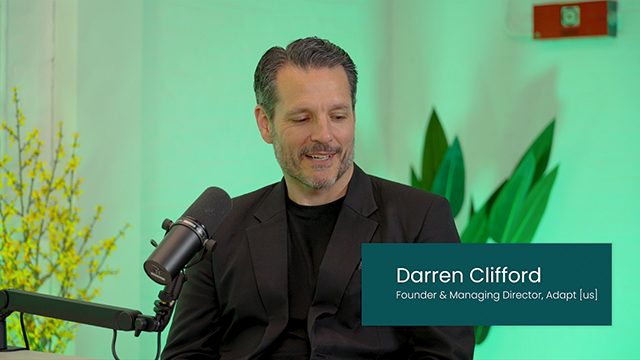
Katherine Keddie: Hello and welcome back to Scaling Green-Tech with Katherine Keddie. I'm here with an amazing guest, Darren Clifford, who is the co-founder of Adapt [us]. Darren, thank you so much for joining me.
Darren Clifford: Thank you for having me here.
Katherine Keddie: So the first question we always ask is, how would you explain Adapt [us] capital to a five-year-old
Darren Clifford: To a five-year-old?
I think it's actually not that complex. I would just ask the five-year-old, if in the summertime do they like going for ice cream? I think most five-year-olds will be like, yeah, of course I do. And what we're looking for is how can we go find better brands of ice cream that are just yummier and also healthier?
And that's about it. We're looking for things where the demand increases as the weather gets hotter and more volatile. And it's what people want to spend their money on. Like a five-year-old would want to spend their money on ice cream.
Katherine Keddie: Perfect. That sounds very exciting. I'm sure all the five year olds listening are like, perfect.
Darren Clifford: Yes. This is better ice cream.
Katherine Keddie: Okay. So then for the adult listeners give us your elevator pitch. Tell us what you do.
Explaining Adapt [us] Capital's thesis
Darren Clifford: Yeah. Ultimately we back companies that increase in demand as the weather gets hotter and more volatile and improve the quality of life for humanity. This has us looking at things like air conditioning, coastal erosion, backup battery systems, new ways of transporting biomolecules.
So you don't need cold supply chain paint on insulation. There's a number of places out there where you can really see what people are going to be asking for and where people are going to be willing to spend their money shifts as the weather changes. We all like talking about the weather. We all think the weather's changing, and that's, we're just very pragmatically approaching that from the weather into people, into demand and from demand.
What types of companies should we build that are going to disruptively meet that we don't just want incrementally better air conditioning. We want step changes. We want something that will actually disrupt the space because it will be so much better for the individual buyer and for society. That's what we go and look at and invest in.
And we're building a wonderful portfolio of companies to go and do that.
Katherine Keddie: Give us some examples of the companies that you have invested in so far.
Temperate and passive radiative cooling
Darren Clifford: So I think the one example I'll give because it is just always so relevant. The single biggest problem we're going to face as the weather gets or the weather changes is heat's the biggest consequence that we face.
It's actually going to be the biggest health risk. And so finding ways to be able to deal with that as the weather changes is essential. And so we're investing in a new form of air conditioning, passive radiative cooling brought into the house. It's a company here in the UK called Temperate. Very early stage.
We're some of the first institutional capital into it. But we really believe in the founding team and their ability to both work the technology and bring the technology to the market. We think that it is going to be just so much more efficient than traditional air conditioning, up to 20 times as efficient as traditional air conditioning.
That it's the type of technology that when we're successful with it, we'll be ubiquitous across the world and really change what's happening. And just by doing nothing more than building a profitable business in the air conditioning space, we will bring a technology that will be better, faster, and cheaper for emerging markets for people in India, Africa, South America, just as much as we will for people here in the uk for people in the United States, Singapore, the Middle East.
If we can just make access to air conditioning cheaper and better for the environment, everyone wins.
Katherine Keddie: Yeah, I think Temperate are one of those companies that you hear about the solution, it sounds like science fiction. So maybe that's a good illustration of your investment thesis.
You're going through these really, big bets that would have substantial ramifications for humans all over the world. You go a bit more into that thesis, what it looks like, what your criteria is for investing in a company like Temperate.
The three investment criteria
Darren Clifford: So it's a bit unique in that you have to still think about this as an investor.
And so the first thing that matters is the team: who are the people behind this company? It's going to pivot five times, especially because we're pre-seed. First check in kind of investors. Who are the people that are really going to carry this forward? And then, yes, you have to go into the other ideas of how big is the market, how much is it growing?
What's happening? What's their ability to capture margin? What's the defensible moat? These things that all investors have to think about. But in addition to that because of the commitment that we've made to our investors and where I want to allocate my money is into a portfolio of companies with this demand shift.
This demand for the product is driven by the weather changing. So it's everything that you have from VC plus this idea of demand that shifts as the weather changes. And the last point is that it actually improves the quality of life for humanity. So those three things are all needed before we can make an investment.
Katherine Keddie: So in some ways you're very similar to any kind of traditional early stage vc, right? That fundamentally you have this additional thematic layer.
Darren Clifford: Yeah. But it is very similar in a lot of ways. We have a thesis, right? Our thesis just happens to be very unique from what we've seen in the space.
There's other people who have been doing adaptation for years. It's always been an underfunded area. My understanding is it's about 0.25% of capital in the world is going to adaptation. That has to cover that big old seawall that you build and these big mega projects. It may take a couple billions of dollars.
It has to cover growth capital for companies and this tiny little slice for innovation capital early stage that we play in. So it's a dramatically underfunded space, but we need to approach it as any other investor would and really focus on where we can find the companies at scale and show that they can be successful.
And part of our theory of change is that if we can do that, if we can find some winners in the space, it's actually going to raise all boats. Because what it'll do is it'll show other investors that you can invest here and get returns. It'll attract and bring more capital into the space. And that'll be someone, something that benefits everyone.
I think a lot about the Jerry Mcguire quote, help me help you. I just see Tom Cruise yelling that into the phone, and I feel so much of adaptation is that way, is that it is about helping people. But people are struggling and are still, haven't recognised that they need the help, that the climate is changing faster than they expect it is.
It's going to have a bigger impact on their life than they expect. And so trying to build these companies to be ready for it, I think will help the people. They just dunno yet.
Katherine Keddie: So you are in a really interesting, somewhat nascent space. A very small proportion of global funding goes into adaptation.
And I think particularly the statistic you quoted is also focused on climate investment too. So a very small proportion of climate investment is focused on adaptation. And of that the vast majority is publicly funded. So it's like governments, for example. Which means that you're quite a rare actor, as you say.
On the other hand, the thesis seems to me like common sense, fundamentally the weather is changing. We can all see that every day in our lives. And we need solutions that allow us to deal with the changing weather. And as the weather changes, those solutions will become more popular, more valuable, more helpful, more crucial for our everyday lives.
So why is no one else involved in this space? What are the objections there? Do you think they are stopping people from taking what seems to be a very logical misbalance in the market?
Why adaptation is underfunded
Darren Clifford: First on, on the data, if you notice I purposely said it was 0.25% of all capital going into adaptation.
I didn't want to say it's only 5% of climate capital, going into adaptation, because our view is that both climate and adaptation are underfunded. It's just a matter, it turns out adaptation, I think, is relatively even more underfunded than mitigation. Which comes to your question as to why that is.
And we're very pragmatic people, and I think people just respond to incentives. So one part of it is timing, where I think if you look at the data the difference from going from zero to one and a half degree pathway, there's change to the weather, but it hasn't been so severe. It hasn't been things that really are pushing people, prompting them to change, where the difference from one and a half degrees to two and a half degrees like this is going to really impact your life.
And so people's self-interest will start driving the change. The other one is we just haven't seen returns in the space. You can do the counter, which is, what is the hot topic today? AI defence, right? Maybe some like energy of course, and like energy infrastructure. These are things where you're seeing a lot of money flow into them and they're shiny and new.
And the returns in adaptation to this point are nowhere close to what we're seeing in ai. But part of what we think people are missing is. People are so focused on where the returns are right now and the immediacy right now. Society really struggles with the marshmallow test. You put one marshmallow in front of them and you say, don't eat this for 10 minutes and I'll give you two.
And they go no. Gobble up the marshmallow, right? They're, I love all the infographics that show that in the short term, the biggest risks are geopolitical and AI and some things like this. In the long term, it's always the same thing as climate. Single biggest risk, but it's long term. You have to go and think about the marshmallow test.
But then as an investor, the companies I'm investing in today, I don't think we're going to have an exit next year. I don't even think we're going to have an exit the year after that. Somewhere around year five maybe, if I'm lucky. Oh, distribution. That'd be so good. But it's more like the data says in Carta it's 11 and a half years to build a business right now.
So I have to think not about where the exits are today. I have to think about where the exits will be in 11 and a half years. And so where it hasn't been on the top of people's minds because it hasn't affected their daily lives so much. It hasn't been the hot topic of today. Our view is it will be the topic of tomorrow.
It will be a situation where people are experiencing it a lot more. It will be a situation where the multiples that you see in companies that produce cash, because they're more tangible and defensible. So what in the adaptation space will actually have a multiple expansion. So you'll actually get significant returns from investing in companies now and then exiting them 10 years from now.
Part of this comes also back to the fact that while we think AI is revolutionary and going to change the world, we don't think it's invest. And that's pretty controversial for most people. It's the hot topic of today, and I think it's a bubble. I don't understand how the valuations are going to warrant being so high compared to their ability to turn a profit, not just revenue.
If you think that AI is going to eat software as a service, which we're seeing out there in the space already, software as a service has been the lifeblood of VC for years. So AI is revolutionary. Don't make money at it. because no defensible moats, AI destroys software as a service.
That type of traditional VC structure, unfortunately, doesn't deliver returns. And there's a bunch of poorly performing funds there in the future, which will deliver returns, tangible assets, and actually have I'm just cheaper than everyone else and can make a margin at being, being cheaper than everyone else.
I'm better than everyone else. Like these companies where there's real demand and there's defensibility to them, that's where the returns will come from in 10 years time. And so we're very comfortable with the investments we make today planning for them.
Katherine Keddie: There's really a return to basic principles. Is the company going to be profitable over time?
Are we making something that has an existing market? So for example, you're talking about cooling. Air conditioning, very established existing markets. So Temperate are finding a way to disrupt something that is very much established and in demand already. Yes. And you have very good reason to believe that demand will only increase with time.
And as you say in 11 years, what does the exit look like?
Darren Clifford: We'll do just fine.
Katherine Keddie: Yeah.
Darren Clifford: It's interesting to me because, in the oversimplification of the world, you can put investors or potential LPs in our fund into two categories.
There's the people who say, I'm investing in your fund because I want returns. And there's the people who say, I'm investing in your fund. because I want the impact. And for the people who are very return focused, this is where we're not the hype investment. And so I just try to do my pre foot qualification upfront.
Look, if what you like is hype, I'm not the person for you. You want to go and find the latest, greatest and like someone who's doing all these cool things and some five time exited founder who claims I know everyone and I can get into all the hottest deals. That's your person. We're not that on the flip side, which means that, by the way, a lot of investors just go, ah, I'm not interested in investing.
You're like, ‘I like you Darren, you seem interesting, but your thesis isn't wild and crazy enough for me. No thanks’. On the flip side, the people who are focusing this on impact first, that's what they really care about. Then the problem is I'm not holding hands and singing kumbaya enough because I'm not solving the problem that they were. They're like no. We need to go and save the rainforest and do mitigation. Which we absolutely need to do. But I, our lens is that we need to actually do more than that, we really try to think about it, we need to improve the quality of life for humanity under a two and a half degree pathway.
A big part of that is mitigation, but a big part of that is also making sure we can live a good quality life regardless of the outcome. So we need both. But that community I get actually more attacks online from the left telling me I'm just moving deck chairs around Titanic. Then I get from the for-profit right side of people who are just like fine, you have a thesis, you seem to be making money, but it's nothing special.
Katherine Keddie: Interesting. So you are in between maybe a traditional investor and then also having a potential, impact side to your business. So what has been your strategy for raising from LPs considering also that you are working in a space that there are not many private sector actors?
The adaptation portfolio as a hedge
Darren Clifford: Yeah, I think the beginning of this is recognising that I'm trying to allocate capital the way that I'm allocating my personal capital. Like I'm putting my money into the fund. This is where I want to go and invest my money. And the question is, do you want to come and join me on this journey or not? And as a person, I tend to be more like, where's the pragmatic middle?
Where's this idea that yes, impact matters, but I have to recognise that if I just chase impact, I'm not going to have the results that I actually want because I won't have companies at scale. On the flip side, if all I do is go and make a bunch more money, there's another place that I could go to make more money.
I should go back to the financial markets and work there, right? It is about finding this middle ground of being able to say, look, the companies we invest in, they will make returns absolutely. Because that's their right to scale and actually go and change the world. And just by the companies doing no more than delivering on their promise of serving their customers and their customers, paying them for it and growing and getting more customers will make the world better off.
And my approach to fundraising is finding the family offices and high net worth individuals that can come with me on, on, like to allocate the capital the way I want to allocate it based on this sort of pragmatic middle. And that what I'm doing with my capital and the people who do take the time to think and actually have a conversation with me, it tends to resonate quite well.
Because once they start thinking about their own investment portfolio, the strategy, they really like the idea that there's predictability in the shift of demand. We have a team that can go and, whether it's our use of being AI enabled as a fund or our use post-investment to be able to help these companies grow and scale, we can go and capture that and actually help scale the businesses.
But then the portfolio that we create actually is a hedge to a traditional investor. because every company in our portfolio, the demand increases as the weather gets hotter and more volatile. Where if you, depending on what data it's, I've seen that, we're going to lose 5% of GDP in by the year 2050 to 25% of GDP based on the fact of the changing climate.
That means that all of your traditional investments and probably most of your climate investments will not succeed. Whereas our portfolio is a hedge, we have a favourable risk profile that helps hedge traditional investments. So you think about the predictable changes in demand, the favourable risk profile and the fact that we're also improving the quality of life for humanity pretty much does become a no-brainer if people are willing to actually dig in and think it through.
Katherine Keddie: Do you ever get the criticism that by, in your own words, hedging, you are creating a perverse incentive for people to further accelerate climate change or assume that it's okay to continue with climate change because technology will save us and everything will be fine?
Darren Clifford: I do have to spend a few days in San Francisco where I hear comments about the world of plenty and that I'm solving a problem that doesn't need to be solved anymore because AI is just going to solve it for us.
I do cringe a little bit when I hear that, I've also heard someone say that adaptation is inevitable, so why bother investing in it? It doesn't help. And I'm like, yes, we will eventually adapt because that's what humans do. But we're great at it and I'm a huge believer in human innovation, but the question is, which pathway do we take to get there?
Do we do it in this challenging pathway where it is misery that actually pushes us to go and change? Or do we do it in a way where if we allocate some capital into the space and drive innovation that it's not so painful along the way to get us there? There's no doubt. I think people can go back and forth on this about whether it changes the incentives and things like that.
But I come back to I listened to Warren Buffett speak once when I was back in university and it, I'd love to tell you it was just me and Warren just hanging out as bros, but it was much more that I was there with 400 other MBA students and Warren Buffett gets on stage with the audience of all these MBA students and says, I don't employ a single financial analyst.
And you can just see the room like, oh, that was my dream to go be a financial analyst as a, with my MBA with Warren Buffett. And he said, look, it's pretty simple. If I need a financial analyst to tell me the returns of a deal are eight, nine or 10%, I don't do it. On the flip side, if I'm not sure if the returns on a deal are going to be 15, 20, or 25%, I really don't care.
I don't need a financial analyst to tell me to go do the deal. And that's our approach because especially because we're so early in the adaptation space today, we have this advantage that I don't have to sit here and go. I wonder if the second order effects of what this is going to incentivize people to do and where this is going to be.
That's like the eight, nine, 10% world. Better, faster, cheaper air conditioning, it is going to be better for the world. The other company, or another company that we've invested in is a company called Bactery. They're making like resilient batteries out of soil. It is a new form of renewable energy that we've never seen before.
It will work in areas where it can be flooded. You can run a monsoon over the top of this thing, but because it's buried, it'll just keep ticking. The reliability for it to be able to continuously provide base load power into processes is just going to be amazing. And you look at this and I go, energy's something.
We desperately need backup energy, especially in situations where we've had environmental damages or tornadoes and monsoons coming through and things like that. Amazing that we need this. It's not a question of the eight, nine, 10% and I'm not too sure, like we're going and investing in things that people are demanding for.
People are spending their money on backup battery systems and energy systems and things like that. That's going to happen whether we do it or not. Can we do it in a way that actually makes it, as I said before, drives the innovation to make it happen quicker? Benefit society? because we bring these disruptive technologies to the market quicker and therefore we have an easier path of humanity going forward.
So I really don't lose any sleep at night thinking about, are people going to start polluting more because we just make living easier in a two and a half degree pathway.
Katherine Keddie: There's something we haven't discussed so far in terms of factors in an adaptation future, which is policy. And we actually have another episode with Dr. Simon Zadek from Morphosis that explores this topic in quite a lot of detail. We've talked about how a lot of adaptation at the moment is publicly funded or that's where the focus is surely for you still as a private investor policy and the policy environment of the countries in which your solutions are active is very impactful on their success.
On the attitude of investors, on the results of the technology over time. What are your thoughts on policy? Is that something that you consider as a substantial part of your investment thesis as your way of thinking?
Policy risk and why Adapt [us] avoids policy-dependent companies
Darren Clifford: So we really like the team at Morphosis and we like their approach with public policy because they're doing things that I don't think I can do that well.
They're deeper and have so much more experience in that space that they can use public policy and find predictability in it to drive returns and really help the companies that they're investing in. And so interestingly enough, I think we actually have to take an opposite approach, which is we try to look for companies that don't have public policy risk, where it is very clearly some sort of consumer that is looking to buy the product of their own self-interest.
And this is because in today's geopolitical market, we think that the ability for governments to come in and change policy is just too great. And that the short-termism of what this government is and the next government and the next government. That we want to make sure that the company's, what we're going in and putting our capital into are things where we don't rely on that to have them be successful.
It is absolutely a huge driver of demand and can really make a difference. And that's why I think you can absolutely find abnormal returns by investing in that space. But we then, because so much of this about predictability, we actually go and look for those things where no.
Consumers are saying, this is what I want. Because I think oftentimes what people miss about governments is if at least democracy is being successful, that means governments are representative of what the people are asking for. And if the people are not willing to have inflationary policies, if the people are not willing to come together to solve these problems, then even though one government may have voted this in, the next government may vote out.
And it really is something that, that's probably more of what we think about is where's the will of the citizen? What is their desire going forward? What will it be going forward? Are they going to be willing to have inflationary pressures to deal with some of the challenges coming up? Because this is where we, I've said it before, I think unfortunately, democracy and climate are actually at odds with each other because of the inflationary pressures that most people would not vote for in a government that would force 'em to face the externality of climate.
Katherine Keddie: So we like the frog in the boiling pot of water, and eventually we get boiled
Darren Clifford: it. So I've been fortunate in life. I blame my parents for this, but I got the travel bug and I've gone to something like, just over a hundred countries and travelled and seen the world. And I don't blame people for saying wait a second I'm trying to survive.
I'm trying to make my life better. So that's what to me, that's all it is people are going like, wait a second, this government's coming in and talking about raising my taxes and forcing me to pay more for different things. I don't want to do that. That's not in my interest. And we see it all the time in climate where this is where everyone says, yes, we should be green and we should do all this.
And then they go home and they don't care about it when they make their buying decision. And so it's not, these are rational actors doing rationally within their self-interest because survival matters and their lifestyle for themselves matters. I don't blame people for this. I actually just accept it as part of the rules of the game.
Capitalism's a system we have, people will be self-interested and the weather's getting hotter, more volatile based off of that, what can we do to help humanity? Go and find big profitable businesses that can scale that actually help people do things outta their own self-interest, that also makes society better off.
Use this as a tool to drive the change you want.
Katherine Keddie: Yeah. I relate a lot to that thesis. It's very central to like, adopter and our view on how to make change. And something that I constantly discuss with companies, nonprofits, investors that we work with is that fundamentally you have to frame whatever solution you're selling in the context of what the person wants, the outcome for them.
And often that involves the environmental benefit or the climate argument being a kind of a secondary factor. So fundamentally, it's cheaper, it's faster, it's better, it makes you a leader in the industry, for example. And then second, as a second point, as an additional extra to align with your values or to align with regulation or policy, it is also more sustainable in whatever direction.
So I think it's similar to what you're saying. Fundamentally, we have to meet people where they are and where their motivations are. And as much as people will care substantially about being green or biodiversity or, the air around them being clean and cool. But fundamentally, if you give someone a decision, they will use their own self-interest.
Not in a negative way, but naturally to make that decision. And the climate in a, in an abstract term at least may not be part of that decision. But you could also, argue that if I'm really hot every summer in my apartment,
yes.
Katherine Keddie: Fundamentally, having a more efficient cooling system, for example, is what I need.
It's a priority for me. So that's me, experiencing climate impact in my everyday life.
Darren Clifford: It's one of the things that I love about Temperate, most people's complaint on air conditioning is it moves heat from one place to another and then causes pollution. So if you take a net zero approach to the world, you would say you should never do any air conditioning.
Temperate is the only technology I've seen that takes heat from places we don't want it, like our living room and actually puts it through the atmosphere and puts it into space. It's actually getting heat off the planet and it's doing it 20 times more efficiently than a traditional split ac. Yes, please.
More of this is definitely what we are looking for, but I think there's one part of what you're suggesting that I think is very interesting in the adaptation space, which is around, I made the comment, why am I not seeing more people invest in it? And we were not seeing enough profitable companies come over there.
And I think if you dig deeper into that and ask, start asking the question, why aren't we seeing profitable companies in adaptation, even though there's predictable shifts in demand, and at least our view there, there's three reasons that we see very commonly that the companies struggle with. The first is a challenge that we've seen all across climate, which is the founders tend to be really strong technically with weak business building acumen.
I'm a fourth time exited founder. I've done so many companies, those founders don't exist because the space is too new, right? Climate hasn't been that successful financially. So we don't really have that type of bench of expertise to pull on. And instead you end up with founders who just need a lot more coaching on the go-to-market side, like what you're doing.
You really need to help them that way. That's number one. The second thing that we see is that the company that we invest in ends up needing to go international a lot earlier than a traditional startup does. And this is it. It's actually quite self-explanatory when you start thinking that it's the change of the hot and more volatile weather that's driving the shift in demand.
Wait, we think we have it hot here in the UK right now. Like I was in the tube this morning and I'm just like, oh, it's sweating and they need air conditioning in this tube, right? This is nothing, right? Go to India, go to the Middle East, go to Singapore, go to Houston. There's a tonne of markets out there where it's just in desperate need of cheaper cooling.
And so companies are going to need to get out their home market and go to where the, where nature and the weather changing is actually driving the demand. And that's going to have to force 'em to build their company differently from the beginning. They need to think about remote operating DNA in their, like in their systems, distributed systems that they're going to be able to operate in.
What's going to happen when they put offices in other places? How do they keep a culture? They need to think about these types of things and have some support through it. But the single biggest reason that we see, at least why adaptation is struggling to be financially successful is that most adaptation technologies require commercialising a loss avoidance business case.
You're a CEO of a company, and I come up to you and I'm like, look, you need to spend $500 million. We're going to do resiliency in your factories or against all forms of flooding warning and it's going to be great. because over the next 10 years, it's probably going to save you $5 billion, 10 to one return on your money.
That's what the WRI report says. This is an amazing investment for you and the rational CEO looks at this and goes that $10 billion loss isn't in my projected financial statements. The $500 million is going to destroy my quarterly profit, which by the way, then hurts my personal bonus. Oh. And probably gets me fired.
So even though it's a 10 to one return on the money, the answer's still no. And they're being rational actors. Like they're following their self-interest. The answer's still no. And so this is one of the biggest challenges that you see in the space is how do you get a buyer to do what is in their self-interest when they don't even recognise it's in their self-interest.
Katherine Keddie: Could you argue that someone who doesn't have a realistic view of that risk over time is a rational actor?
Perceived versus actual climate risk
Darren Clifford: So it is about perception and remember that, because there's uncertainty there. None of us can say we know exactly what the risks are. But I would agree that when you think about the insurance space for vehicles, most of us sit there and think, oh, driving a car, it's reasonably risky.
Of course I'm going to get insurance for my car. The data shows that it's actually quite safe. But that difference between your perception of the risk being high and the actual risk being low creates a market for auto insurance companies to exist. There's some other benefits for society and things like that, but fundamentally it's one of the big drivers for that if you think driving a car is risky.
In reality it's not. They make a spread in between from helping us like defer the risk and take it on to someone else. Now you switch that over into adaptation and climate. Most people think, Hey, this one in 100 year flood, ah, don't need to worry about it. Oh, it affected the one in 100 year flood that hit the valley next to me.
We're safe. I don't have to worry about it for another hundred years. They don't realise that the one in 100 year flood has now become a one in 10 year flood, and it's just as likely to hit them as it is to hit anywhere else in the world. And so the gap between their perception of the risk, which is quite low, and the actual risk being quite high, unfortunately still insurance doesn't work.
Getting people to change their behaviour doesn't work. They're not, we're not pricing the reality of the risk into the decisions we make. And so I love seeing all this risk analysis software out there that I think is going to be great for humanity. because it does allow us to do a better job of pricing the risk and bringing this closer, which will lead to some behaviour change going forward.
Katherine Keddie: I think it's an interesting point generally because obviously there is risk. The perception of what the risk is and what the risk actually is different. The actual risk is also difficult to quantify. So for example, we've done a lot of work through various clients in the nature data space.
Looking specifically at biodiversity loss and how that affects returns over time, nature, risk, et cetera. And we have a lot of data. There's a lot of very brilliant people that are working on this problem. But fundamentally a lot of that information doesn't end up on the balance sheet that you are then speaking to that person.
And it's an interesting dichotomy in that it seems like common sense if the air quality is really bad or you can no longer farm in a specific area, the soil is really degraded. There's flooding, for example, fundamentally in a vast majority of businesses that will have some kind of impact on the business itself, on the returns, et cetera.
But yeah, there's maybe a translation issue here to see that kind of carry through. How can we solve that? What do you think the solution is so that when you have that conversation on your side, the person making that decision goes? I know that this is a big risk for me because fundamentally it's part of my risk profile and projections for the coming, 10, 20 years.
Darren Clifford: First off, if I had the magic wand to solve that one, I probably wouldn't be sitting here.
Katherine Keddie: It's a hard question.
Darren Clifford: It's a hard question.
Katherine Keddie: Solve that one real quick.
Darren Clifford: Yeah. And, but if you just reframe it that this is the same problem we've had in climate all the time, it is the difference between individual impact and social impact.
And that's whether if we could have solved that problem beforehand, we wouldn't be, in this case, we would've mitigated our way outta the problem and we'd be okay. That this is just continuing from mitigation, adaptation, the difference between individual impact and social impact and where those sit.
So a lot of my thinking on this comes back to my training from McKinsey and the marginal abatement cost curve that McKinsey came out with, which was like, for a tonne of CO2 abated, what is the effective cost of getting that tonne of CO2 abated? And it would show technologies like LED lighting, they last longer.
They're better quality for people. Yes, they may be incrementally more expensive, but overall the total cost of ownership's significantly lower with the energy savings, a lot better for the environment. Everyone wins, right? And there's that group of ideas and innovations that are going to be, they're both the incentives for the individual and the incentives for society are on the same page.
Then you have a group of companies where there's somewhere around the middle and we haven't quite figured out whether it's a business case or something there that we can go to scale the company. There's some things there where economically it's okay, but it does improve the quality of life.
But we haven't quite figured out the economics. And then you have a lot of things where, hey it is not going like it, it costs a lot of money to improve our quality of life. And this is unfortunately where a lot of the nature-based solutions are sitting in, where economically they just don't work.
And then when you think about these three buckets, then as an investor, my job is to take that first bucket and accelerate and bring these companies to the market as fast as possible. That is really what is needed from my end is get the companies like the air conditioning, the backup battery systems, the companies that will allow us to avoid cold supply chains.
That you look at this and go, wait a second, the economics pencil out. Yes. And it improves the quality of life for society. Yes. Great. Let's go and let's go faster. The next group of companies are the companies that I'd say that are on the margin. This is where the role of catalytic capital comes in. And this is where if you are someone who is looking at this from an impact space, I think you can have the biggest impact is taking these things that are on the margin and figuring out ways of taking on first loss, helping the companies get over in scale, helping them with the economics so that way they do become positively economically.
Then they'll get them to come to the marketplace and actually solve that type of issue. And the last bucket of the ones that unfortunately aren't quite there yet, this is where we need government regulation. Truly part of the role of government is about forcing society, internalised externalities.
Now I worry about the will of the people and will citizens vote in governments that will do this? Yes. But absolutely do. I think it's the job of governments to be able to bring, whether it's through a carbon credit structure or a biodiversity credit structure, it is the role of the government to basically go, wait a second, these are things that actually are socially beneficial and we just need to enforce them rather than that the markets deal with them because the markets aren't going to get there.
And so at least my thinking about this is there's different roles, different actors to be able to try to go and solve this. It takes the will of people to get there, whether it's investors like me willing to take on the risk in these companies to accelerate their pathway to the market, whether it is the catalytic kind of impact capital to willing to take on risk, to be able to change the economics or the government being forcing us to actually do what is in our own best behaviour.
Sadly. I think it, it's go, it's actually positive, at least to be able to see an example of this. But I would argue that today China is leading so much of the climate space and what's happening in the future of climate. And I think it's actually quite simple. It's China making decisions for the whole of China rather than the West.
We tend to make you make individual decisions for you. And so because of that, just that change now China's going, wait a second, this river, it's polluted. It's causing air pollution. The answer is no, we're changing this. We're, because they're facing the cost of the country, they're just willing to wholesale make the changes.
Now, there's two sides to the coin. What it means for personal, like rights and freedoms may be different, right. But at least you can see that you can take action that actually does at that scale and do some amazing things when we put our mind to it.
Katherine Keddie: Yeah. China's been obviously a leader in something like solar, for example, which has had global implications because it's also meant that the price has been driven down now is substantially competitive, cheaper in many cases than oil and gas.
Darren Clifford: Yeah.
Katherine Keddie: So that, I think that process also is really important. And like you say, you said a few minutes ago that the idea of the solutions that you're working with going global is really important. Because different geographies appreciate these things in different ways and also have different needs.
So for example we did some work with a company called Arborea who have invented a technology that allows you to create protein on arid land. And it's absolutely fascinating technology in itself. But for them, there's countries in the Middle East for example, where there's no rivers that run through them, for example.
So when you are in a context of severe drought you have a lot of arid land, there's a very clear market demand for them and maybe a different approach when it comes to purchasing from a government perspective than it would be that's saying in the uk.
Darren Clifford: Yeah. One of my views is that I'd love to tell you that wind and solar are examples of renewable energies that have just scaled so beautifully because we're doing the right things for society.
Unfortunately, I just think the world is desperate for cheaper electrons and it is just that they've gotten so far down the cost curve that they've become competitive and that's why they're scaling. And I'd love to say that I think China made this sort of effort for the betterment of humanity. We will over-invest in solar.
I think they saw it as a bet that they could make to just drive so far down the cost curve that they get crowded, other people dominate an industry and make more money and do it out of self-interest. And this is where I come back to. I do, I wish there's a part of me in my heart that we could find better solutions to get to the same outcome of cheap renewable power.
Absolutely. But the thing that I've seen work is just make it better, faster, cheaper, and people's self-interest to drive the change in behaviour that you want. And so that's where it really does shape a lot of our approach of just making it easier for someone to buy your product and that when they buy your product, it also does good.
Katherine Keddie: Yeah. I mean it's very essential to your thesis, right?
Darren Clifford: Fundamentally, it is the core of it. Because it is what we think is the best chance of driving change. And here's a good analogy that I like to tell about this. If you think about it, and you look at the science behind wellbeing and happiness, and if you want to go and chase happiness, you and I we're going to go and we just want to be happy people.
What are we going to do?. We're going to party for like weeks on end, right? There may be a few other things that happen while we're there as far as some substances. And we'll drink a little bit, we'll have a bunch of fun. But shockingly, after a couple of months of doing this, we're going to sit there and go oh gosh, like this isn't there.
Yeah. It's not fulfilling for me to define happiness. If you sit here and you go, you know what I'm going to do? I'm going to work with some people I really admire and have some, like a group of people that we're going to go and try to do something that we feel some purpose and meaning in, we roll up our sleeves and it's going to be a bit hard.
It's not going to be fun all the time. But shockingly, at the end of that, you'll feel fulfilled and happy. And so the quest to happiness is not this linear pathway. You don't chase happiness. You go and you live a life of purpose and meaning, and you'll find that you'll get happiness. I think about the same thing in impact.
If I go and chase impact, yes, I will be investing in the Amazon rainforest in a small village, trying to help them with bringing in technology that they could have to aerate their land more and get more crop yield. And in that village, it's going to feel amazingly impactful and that will be the end of it.
because it only works if I keep putting capital into it. On the flip side, if I use the incentives of capitalism, if I go and actually take companies that can scale and bring products to the market that people buy out of their own self-interest, that is going to have the effect of actually growing and getting across the globe and can have a significant impact in what we do, that is going to actually indirectly get the impact that I'm looking for.
But this is why we openly talk about optimising for returns in our fund with a constraint that the companies need to improve the quality of life for humanity. But we are unapologetically a for-profit fund. because that is the best chance I have to scale solutions and actually get them distributed to the world.
So if Temperate wanted to sit here and think about the biggest, best impact it can have for an individual, it goes to India right away and tries to give away air conditioning for free and may be able to get a few units out into the market, it's really going to struggle. Instead, if we ask them to, how can you do this profitably?
Eventually we'll get to India. Yes, it will get distributed to everyone there, but it'll be getting to distribute to everyone there because the company is self-sufficient. And not only will it be able to go to India, it'll be able to go to South America, it'll be able to go into Africa, it'll be able to go to the Middle East, it'll go to Singapore, go to Houston, it'll be able to go to the world instead of just a little bit in India that they actually have more impact from worrying about the financial side of it and actually being a profitable business.
So our view of impact is that you get there indirectly. You actually go and use capitalism for good. You do make a choice of where you invest your capital and where you invest your time, but you have to always focus on building the business first. The impact will follow.
Katherine Keddie: Something that we haven't touched on so far in detail is how you stand out when showcasing yourself to LPs. What would you say is the USP of Adapt [us] capital?
The Adapt [us] engine and AI-enabled sourcing
Darren Clifford: So we've talked a little bit about this idea that we're not the hype investment, right? We're very much more about first principles and how do you actually approach this market.
And so part of my thinking is I, what's the value chain in venture capital and how do you actually make sure that you do this all well? And one of the things that it starts with is sourcing companies and here we are, what I'd call an AI-enabled fund. Now this is going to be something that I think the use of AI to be able to source more broadly and more efficiently is something that will become ubiquitous across all funds.
But we've already led the way in putting our, and it's really been done by my co-founder Sajeev, who has put together what we call the Adapt [us] engine. It's the ability to identify companies using AI across North America and Europe as where we're focusing on right now, we've analysed over 50,000 startups to try to create a short list of where the ones that we think are actually interesting.
That in and of itself has been a real value add for us, along with the fact that we put in our thesis and really trained in our thesis. The other part that happens there is anytime we go and we look at a company individually and we give a reason why we like it, we don't like it. Our investment memos, they all get fed back into the AI.
So it does a better job of scoring for next time. So in three years time when this will become something, most funds will have, ours will just have been trained that much better and we'll just be that much more efficient. And that probably accounts for half the deal flow that we get. The other half is coming from the inbound deal flow where it really is from the presence on LinkedIn and trying to share thoughts and trying to build a community that we get deals from there.
Whether it is the McKinsey alumni network, we generally meet once a quarter to talk about all the, or have all the founders that have been coming out pitch to VCs. And so it's a great thing to be able to invest in other McKinsey alumni that are there. Business school, other VCs like your network. It matters a lot in this space, but ours deal flow is probably half and half, half inbound from our network, half outbound from our AI tools that we've developed through our Adapt [us] engine, which allows us to source broader and a lot more efficiently than a traditional early stage VC would be able to do.
But interestingly enough I think the biggest differentiator going forward is not necessarily going to be on the sourcing. It will really be about how do you get access into these startups? Because if you believe like I do, that privacy is going away. Unfortunately, if privacy's gone, then there's complete transparency over who has capital and is investing and who's actually raising money.
So all of a sudden now this idea like, oh, I have proprietary deal flow that you don't have, that's gone. Everyone knows everything. The question will be, why do they choose you? Why does an investor choose this founder? Why does a founder choose that investor? It's going to be getting access that makes a difference.
And access in my mind comes from your ability as a fund to build a relationship back to this idea that it's founders first. And so you really have to approach how you even interact with the startups that we're talking with about treating our founders as people trying to build a relationship with them.
The best thing I can do to build a relationship is add value. This is why when I meet with a startup for the first time, I actively tell the startup we're not going to do a pitch call. I don't want you to pitch me. I want to do basically four things on a call. The first is, I will introduce myself first and I will tell you exactly what I'm looking for.
I'm trying to give you the startup the best chance you can have succeeding. I'm just going to lay it all on my table. Average check size. What we look for in time, it takes us how we make a decision. This is all the stuff I think you want to know. If you want to know more, I'll open it up. Ask me the question. I want to give you all the information you can.
The second question is, who are you as a founder? Because that's who I invest in is you as a person. I want to know what motivates you. I want to know why you're doing what you're doing. Like these are the things that are important to me. The third question is, what is your big vision that you didn't even put into your pitch deck?
Because you're just like it's too scary to actually tell that to an investor. Tell me that because if I can't help you accomplish your vision, you shouldn't take my money. On the flip side, if I don't believe in your vision, I shouldn't invest. because now I already know that I'm going to have to change out the CEO or change a founder.
Like I'm going to have to force you to do something you don't want to do. This is not a good fit. The reason I'm asking about this big, bold vision is I want to know the journey that we're going to be on together for the next 10 years and can I actually help you? Because the last question I'm asking is, how can I help?
And by just changing that to actually build relationships, we think we get access to investments that we're not, that other people aren't. A lot of the spaces that we're in, it's actually turned over like both Bactery and Temperate. Their rounds are oversubscribed, which is very rare in this climate space.
Yet you know that there's been a mutual benefit from coming together. And actually we love the founders that we're working with and the founders have chosen us to come in even though they're oversubscribed and it all shows our approach. But getting access really makes a difference.
The venture builder model
And then the other thing we really try to do based on this whole idea of adding value and helping the founders is part of our model is a venture builder model. It is this idea that post-investment I spend probably every week with my founders. I have a half hour phone call with the founder. We're checking in every week.
This is a chance. And what we really try to do is just help them plan their next week together. So we ask them questions around, what are your biggest priorities right now? We're comparing that against your roadmap. What are your biggest challenges right now? Comparing that against your priorities. And again, this lovely question of how can I help?
And so through that venture builder model, which we then may even be willing to work with consultants, roll up our sleeves to come in and try to help them accelerate their business in sprint, like fashions. This gets us access to deals. And so to an LP, what does an LP get? They get a much wider portfolio of companies to go and look at.
They get access to then some great founders that we're actually sitting here and they're choosing us to be inside the deal and they're getting a stronger pipeline that is getting more companies going from pre-seed into Series A, series B. And then the other one that we offer to LPs of course is co-investment rights, right?
Like, how can we actually introduce you to these startups so that way you can make direct investments? Because I recognise part of my job is just to be the person who takes all these startups and filters them down to the good ones and then bring that to our LPs. So we're pretty conscious of the fact here that we have to do things differently.
And the best analogy I've heard from one of our LPs is you're, we're basically doing old school VC back when it isn't, wasn't just a check. And that's what gets us access, and that's what allows us to win and be involved in oversubscribed deals.
Katherine Keddie: Yeah. Bactery and Temperate. I'm familiar with both companies and we've recently worked with Temperate too, and they're both extremely impressive companies, like really in demand startups.
So I think that is a good testament to your approach. And I think that generally the focus on being able to use AI to help with deal flow and then that very personal touch that comes with your approach, that combination is really interesting. Selfishly it's great to hear because we are always telling companies that they need to start thinking about how AI is ranking and understanding their business online.
Building an ecosystem through LinkedIn
So this is another factor in which that is important. But I think it's really fascinating to hear about your approach. And you very lightly touched on how you also get deals and outreach and connections through your LinkedIn in particular, which I know is something you've invested a lot in.
For those listening, we'll have a link to your LinkedIn in the show notes so people can have a look. But you've been very active on adaptation, creating content, talking about your work. Tell us more about why you decided to do that and then what the outcome has been for you.
Darren Clifford: Yeah, so I probably try to publish somewhere around three or four times a week. And it became, so while I was working at McKinsey, I was in the green business building space and one of the things we talked about is you're better off to build an ecosystem than you are to just focus on your own approach.
And a big part of what I'm trying to do with LinkedIn is just build the ecosystem. I'm just trying to share information about what we're seeing in the space because it's so early in adaptation. And if I can do that and that makes it better off for other people and they can start making them think about something different.
Great. Now, on the flip side of course, does it give us an advantage? Yes. Because now I am getting, as I mentioned, that inbound deal flow. So I'm getting more companies reaching out to me. If the AI has missed something, the company's still in stealth mode, right? Someone's thinking about something, all of a sudden I'm getting connected to it and it's allowing me also then, like one of the things I think a lot about is how do I go and build partnerships to help the companies we're investing in?
The LinkedIn profile allows me to have bigger reach and so this is something that the returns are coming, whether it is from super tangible things around how many people are actually reaching out to me or more intangible things if you go back to the AI outreach approach. How many founders are actually taking my phone call because of what they see on LinkedIn?
What they see is that I'm actually adding value to the ecosystem if I publish something that helps them think through something. So it’s all related to each other. Because ultimately what doesn't matter is how many followers I have on LinkedIn. What matters is, back to my job as a vc, am I getting to the best companies because it's getting more brand awareness?
Am I getting access to them? Because they'll pick up my phone call and they'll actually go, oh, he adds value and he's contributing, and therefore it's someone I want to work with and can I support my company's post-investment using this as a platform to do that? Which it accomplishes all these things. And ultimately it shouldn't be that hard for someone.
Like I think about this every day, all day, right? It is something I am personally passionate about. I talk to people about things. I try to get inspired with people about things, and I'm trying to like, wait a second, is this right? Is this right? What about this? Now I understand there'll be times that a year from now I'll look back on a post and be like, Ugh, that didn't age well, and that's okay.
I still think this is part of my optimism going out and taking that first step, sharing more information. It will be better off, on the whole.
Katherine Keddie: I think that approach is so wise and putting your measures of success for this type of work, not in the focus on engagements or followers for example, but on how it relates to your actual work, I think is really important.
And also, going back to today’s AI sourcing point. If a company is trying to learn about investors in the space, LinkedIn is a factor in how the AI is describing you to them.
We're coming to the end of our time. So I have one last question for you. What is next for Adapt [us]?
Darren Clifford: Ooh. What is next for Adapt [us]? A lot of it is we're an emerging manager fund, right? This will continue on both the collection of capital from LPs and the allocation of capital into, to startups that are there.
But in the allocation of the capital, it's not just about the investments that we'll be making in the future. We've probably made about one investment a quarter. So we're not a really high frequency firm. It's also about who we are working with and rolling up our sleeves to help support the startups that we're working with and that we've invested in.
I think about this week, I'll meet with Temperate, I'll meet with Bactery. It'll be a great chance to actually go and try to help them add value. because that the single best thing that leads to everything else is to have successful businesses. And if I can help with providing some of that guidance, the rest will look after itself.
So those are the big things. And then we'll continue to try to think about some things like catalytic capital and where does catalytic capital play in the space. I think that's a really interesting one because we've talked about it here and then I think in a lot of your other podcasts about how underfunded adaptation is.
There's an interesting opportunity for some people who are interested in catalytic capital to join us in our fund, to be a big unlock, to get more capital into adaptation, not like for the betterment of humanity that will come with it. And some of the things we've talked about using capitalism to get there, but then there's so many layers to this, whether it's helping our fund, helping a specific portfolio company, or helping a market actually emerge.
There's so many ways that you can actually come in and start getting involved in the ecosystem to start accomplishing the outcomes that you're looking for. And so I think that's something that we'll also continue to explore is how can we find people who are interested in being catalytic with us to be able to support the change that we're trying to see in society?
Katherine Keddie: Amazing. Okay. So for those listening, you'll be able to find all of Darren's information in the show notes. And yeah, watch this space. I think it's very exciting. And thank you so much for sitting down with me and telling us more about your work. I will be cheering on and seeing how you go for everyone else listening, you can catch us on the next episode of Scaling Green-Tech.
Goodbye.
Darren Clifford: Goodbye.
















.jpeg)

.avif)