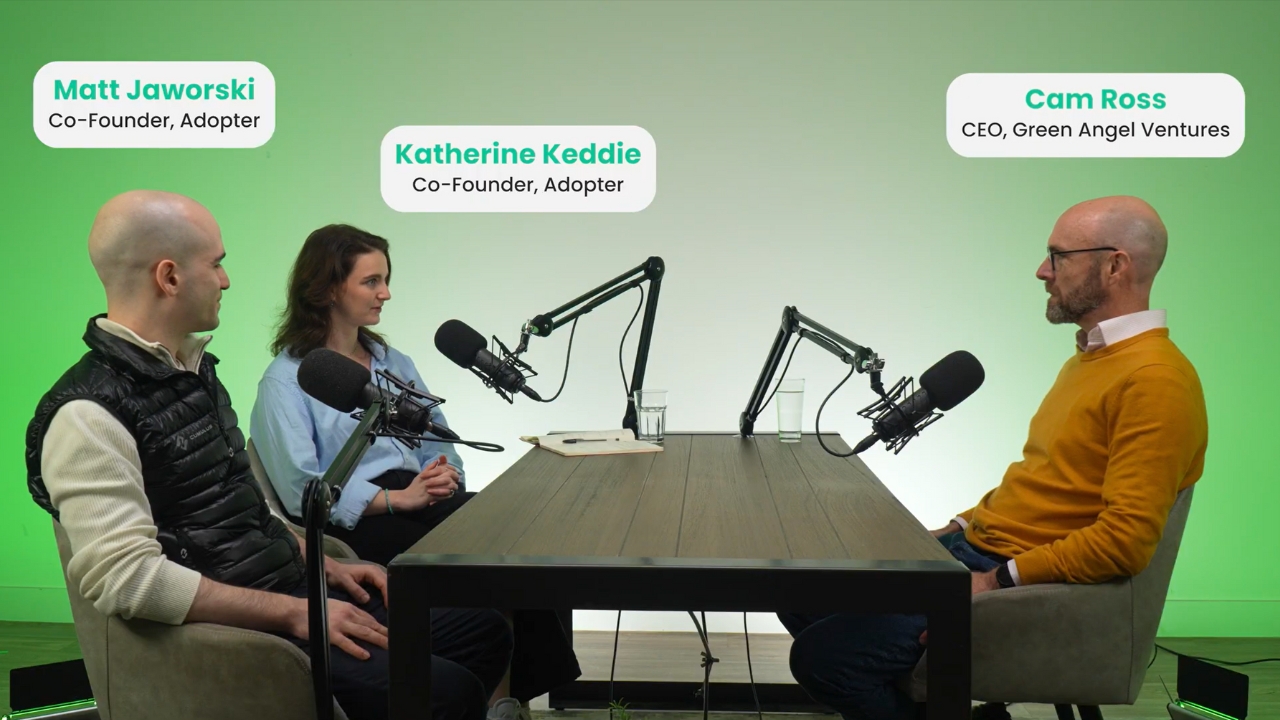
Katherine Keddie: Welcome back to Scaling Green-Tech with Katherine Keddie and Matt Jaworski.
Matt Jaworski: Hello. Hello.
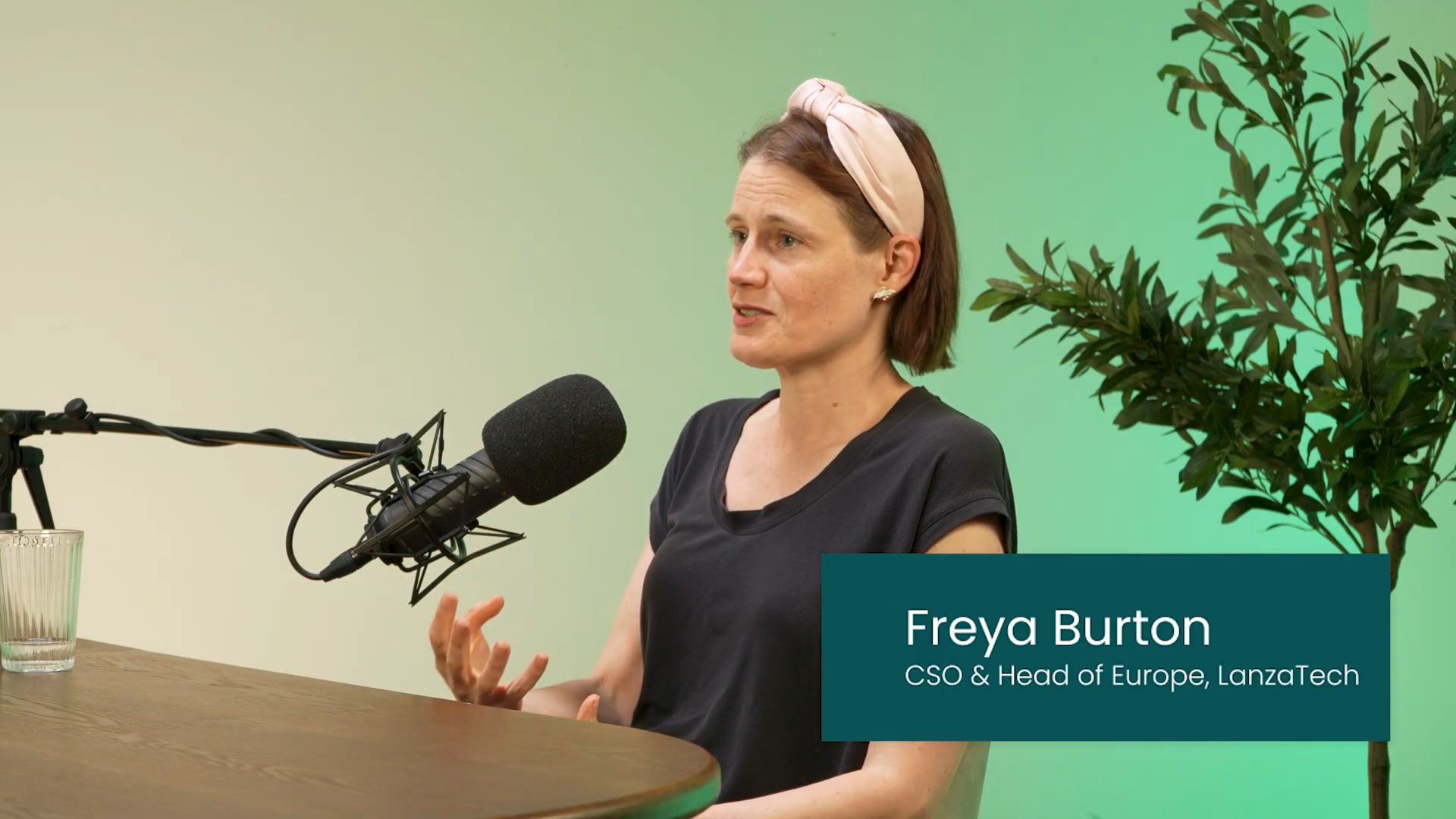
Katherine Keddie: We are here with a very special guest and OG of the industry, Freya Burton, who is the Chief Sustainability Officer at LanzaTech and the Head of Europe. Thank you so much for joining us.
Freya Burton: Thanks so much for having me.
Pleasure to be here.
Katherine Keddie: So our first question as always, and I know you said that you have children, so you are experienced in this department. How would you explain LanzaTech to a five-year-old?
Explaining LanzaTech to a five-year-old
Freya Burton: So interestingly my kids are a bit older now, but I also think about how I'd describe this to my mom, because I use her as the benchmark. I'm still not sure she knows what I do. But when my kids were younger they really liked Dr. Seuss. And one of the things they loved was the Lorax. And the Lorax was really interesting because the Lorax sort of speaks for the trees. So for me, I used to say, look, the Lorax speaks for the trees.
And what mommy does is, mommy helps the Lorax speak for the trees. And, we take pollution, which is bad and hurts the trees and we turn it into something else using these special bugs. And to be honest, what we do is magical. And even when you talk to grownups about it, they're like, wow, let's, like magic recycling or that sort of alchemy for the modern age.
But I tend to relate it to something you know that kids can understand. Like when they draw a picture, are you going to use a blue crayon or a grey crayon? And then I'll say look, we want everyone to use blue crayons for the sky. And what LanzaTech does is we help all the children use blue crayons, because it's not grey anymore. So these are the kind of things that I would explain without getting into the biochemistry of it all.
Katherine Keddie: Very nice. And do you, did you find using that as an explanation came through to your children when you were sharing it?
Freya Burton: I wasn't entirely sure. I thought they maybe got it and it's yeah, that's nice and they'll go off.
But I remember one time actually my son who was really into superheroes and things and we would say, mommy's a superhero, like saving the planet, hoping that would resonate more. And he's just like playing with his Lego going, that's nice. But later on as they got older I realised that they really were listening and there was a really nice time when my daughter when she was in primary school, drew a picture about what she would be when they had to draw a portrait of what they would be when they were older.
And she actually drew herself wearing a lab coat, wearing a sort of CO2 monitor. It's very specific to what we do in a lab. And I had no idea she had been listening or learning or seen that. And she said, I, when I grow up, I want to save the planet. And I was like, oh maybe they do listen to me.
Katherine Keddie: This is amazing.
Freya Burton: Yeah it was all downhill from there. There was no more respect left.
Katherine Keddie: Yeah with teenagers now I feel like it's a whole different thing.
Okay. Interesting. So clearly that cut through which is great. For those listening who are not familiar with your work, give us a brief introduction to what LanzaTech does.
How carbon recycling works: the brewery analogy
Freya Burton: Sure. What LanzaTech does is we, I usually liken it to something like brewing beer. So if you can imagine retrofitting like a micro brewery onto a big industrial site, like a steel mill. Now when we use traditional beer making, you'll use sugars and yeast to make alcohol. And what LanzaTech does is we don't use sugars, we use carbon in gas.
And we don't use yeast, which is a living organism, which sometimes creeps people out. But yes, yeast is a living organism. We use these special microbes. This is normally when people start getting a bit worried if I talk about bacteria and microbes but we'll call them bugs, these magic bugs and what they do is they actually eat carbon and gas and they make alcohol just like yeast would convert the carbon and sugar to alcohol.
So if you can imagine that brewery. But instead of making beer from sugars, we're actually making alcohol or other chemicals that can be used for fuels and other useful things from carbon and gas. And if you think about that big industrial site like a steel mill, if we weren't taking that gas, it would be going up into the atmosphere.
So what LanzaTech does is it stops the gas and that carbon from going into the atmosphere and turns it into cool stuff.
Katherine Keddie: Okay, nice. And tell us more about the scale at which you are using these bugs in this way and what that means.
Reaching commercial scale with a first-of-a-kind technology
Freya Burton: Sure. Bugs are tiny. So they are little microorganisms.
But what we've done is we've harnessed this kind of, it is a naturally occurring microbe but we've thrown it into really difficult conditions over the years. So we've put it in small bioreactors when we started, which are about the size of a litre up to the commercial scale that we have today which are really producing about 64,000 tonnes of ethanol a year.
And I can't convert that, but believe me it's really big. And essentially these sort of multi-story reactors. So if you imagine our first one, our little tiny brewery is now this massive industrial site that is actually operating in six steel mills or industrial sites. We've got a couple of ferro alloy mills, a refinery and some steel mills around the world.
So this is real commercial scale, taking real life emissions and converting that into ethanol, which we use to make fuels and other products.
Matt Jaworski: And what's been the journey to get to this point? How long did it take?
Freya Burton: It took a long time. I started at LanzaTech almost 20 years ago. It was officially founded in 2005 by Dr. Richard Forster and Dr. Sean Simpson in New Zealand. And I joined in 2007, actually weirdly yesterday or this weekend was I was reflecting, it was like the anniversary of when I got my contract from Sean back in 2007. because it was a bank holiday in New Zealand where I was. And he had given me this contract and I signed it that day.
And that was back in 2007. And when I started, there were four of us and we had two of those one litre reactors. We were in borrowed lab space. We had a photocopier that we rented and nothing else. I think that photocopiers were our most expensive asset. And we had an idea and I joined and I was basically like pipetting samples in this borrowed lab space.
And then over the years we grew as a company and, in typical startup fashion, couldn't afford anything so everyone had to do something. I think I was probably one of the few people without a PhD in the team. So I ended up doing all the other things like ordering things, which is quite hard in New Zealand because everything has to come by ship.
If it's like a hazardous good. It takes a long time. And, I had to create a sort of safety system for the lab, then become a sort of de facto HR person. It's awful. As well as running samples and then talking to the external community about what we were doing, you name it we had to do it until we could afford somebody to, who was qualified to do it.
And then we started scaling it at a pilot scale in 2008 at a steel mill in New Zealand and then at a demo plant in China in 2012. We actually did a couple of demos to our first commercial plant in 2018, which was, a massive deal to go from pilot to commercial in pretty much 10 years was for completely new technology.
It's pretty exciting. And here we are today and we've got six plants running. Yeah, that's potted history.
Katherine Keddie: Oh, amazing. I really would love to hear about the commercial side of that, but before we get into it, I think your career in particular has been very interesting. So thinking back to when you got that contract in 2007, did you imagine firstly you would be where you are now and give us an idea of what your personal journey has been in that time?
Freya Burton: No, absolutely not. I was really excited to get a contract where I wasn't paid hourly. Because before that I was teaching and I was paid by the hour, and I just remember going, oh my God, this is amazing. I wasn't thinking long term. I never, let me be clear, I never went into this going, I want to be a sustainability officer when I grow up or whatever.
Certainly didn't want to work with chemistry. I hated chemistry. And, biology and things. I had studied this, but it wasn't really where I was envisaging myself, but I thought what they did was amazing. And so I thought, why not? And I had experience of working in startup setups with companies starting out.
So it appeals to that side of me. And as I said, you ended up doing things. I think my philosophy has never really been about massive career planning. It's about seeing a gap and getting it done, and always trying to find things that you enjoy doing. And I've been lucky that I've managed to chart this seemingly random path throughout the sector, still within LanzaTech.
But when I started this carbon recycling or circular economy, CCU wasn't a thing. It was still Cleantech 1.0. And that bubble had just burst. And so it wasn't really a good sector to be in. And I've helped create a lot of things around this space and then naturally found places to go.
How does that translate to me personally? It's really hard. I'm very tired and I never thought I'd still be here almost 20 years later. And I guess I have this little bit of I don't know what else to do because I've been so focused in this one space for so long, I've not had the bandwidth to think about anything else.
And that does become quite heavy on you as a person. But then you don't have time to dwell because there's another problem that needs solving or this, another barrier that needs breaking. Yeah, it's not been a traditional sort of career path, but I've just found myself doing things that needed to get done and that's how I ended up where I am.
Katherine Keddie: So you've had a very dynamic path that's basically resulted in practically finding problems in the business and solving them as you go.
Freya Burton: Yeah. Yeah.
A non-linear journey: finding problems and solving them
Katherine Keddie: What is the biggest challenge that you remember overcoming personally?
Freya Burton: Personally there's lots of challenges in the sector, which I'm sure we'll get to in terms of policy and cash and, all these things that tough tech takes to scale.
But personally, my biggest challenge was helping grow a company. And helping it evolve as an organisation. So you are not just creating a technology. You are, you're growing a company, which is a career for all the team members, so you can't just pay lip service to it.
You have to think about how you're growing it, what are the values that you as leaders and you as a company want to show and for everyone to get behind. And professionally, it was really hard for me when I was our, in this very American term, chief people officer. I was in the States for a long time.
And that almost destroyed me because I took everyone's burdens on to myself. And that was very hard, and that was a bigger challenge than dealing with a frustrating policy or trying to raise money. And those are big problems. But I found that particularly burdensome as a person. And every time I wanted to get out of that role my boss was like that's why you're really good at it because you care about people.
She kept feeding me that line until I finally said, I really have to step away. And thankfully I am now, but I still spend a lot of time helping the team grow and thinking about what kind of company do we want to be? And how it doesn't just happen because somebody writes a memo or shows a presentation.
How do you get everyone to get behind your values and your behaviours that you want, to get behind as a company? And that's really hard because growing a company takes time. And I think a lot of people want immediate results. And I think generationally different generations think about company culture differently, and we have quite a mixed bag.
And so that's also interesting to navigate expectations and so on. So that's hard.
How commercial strategy shifts from startup to public company
Katherine Keddie: Let's talk about the commercial side and the challenges you face there. As you were scaling versus now as a public company, how has your commercial strategy changed over time?
Freya Burton: I think, becoming a public company that's hard. You are really under scrutiny, rightly from investors, from banks we were on, listed on the NASDAQ. You now have to think of everything in terms of quarterly reporting in a very different way than you might have done previously.
And so that puts a lot of focus on, time, whereas, and I think one of the things I've have a new appreciation for now is, when you are the kind of joker like this, you've got all these new technologies that are around raising a lot of money, which is great, but they're like the cute puppy in the pound, right?
Whereas we are the kind of scraggly mongrel at the back who's been in the pound for years, middle aged startup people expect us to have already succeeded. And, whereas with the young things, there's a lot of hope and there's aspiration, and that's exciting to invest in.
But when you've got that kind of older one waiting, to take it across, that final stage it's really hard. And that's because we don't have time left. Whereas the other companies, they have time to build on what their ideas are. Whereas we've been doing this for so long and that changes how you think about scaling and how you think about selling projects.
As a company we've gone from purely licensing to looking at different structures for getting investment into our projects when they reach a sort of final investment decision. FID. We are looking at ways to build on and operate, which traditionally we wouldn't have done.
And you certainly wouldn't have six plants operating if you did the BOO model. because you just, you don't have the time. But licensing takes time. And we've gone through COVID, other geopolitical shocks, that makes this a slow going process, especially when you're working with industries that are facing increased regulation in some markets.
So that has made it quite challenging and we've had to keep thinking differently about how we finance projects, how we work with our partners to finance projects and what kind of business model we operate. I would say that also makes us more focused. Historically we did everything.
We were everything to everyone. Because what is the thing? Throwing spaghetti against the wall and seeing what sticks. It's like that when you start up. Because even if you have 10 projects in the pipeline or 10 letters of intent or whatever it is maybe you only get to one project because the rest fall down for whatever reason.
And so we've now sharpened that focus to really look at aviation as a sector and supporting low cost SAF, sustainable aviation fuel, rather than trying to cover all sorts of sectors, which we had historically done. And that is a definite response to the scrutiny we're getting from Wall Street.
Narrowing focus to win a single market
Katherine Keddie: And when it comes to, throwing the spaghetti on the wall and seeing what sticks, why did you choose to stick with sustainable aviation fuel?
Freya Burton: Yeah, interestingly, our CEO Jennifer Holmgren, she's known as the godmother of SAF. So her work was part of all the original SAF technology development back in the day.
And when she joined us, she immediately thought, look, she'd worked on HEFA technology, which is the fats and oils technology for which most SAF is made from today. And she said I know it's feedstock limited. I know there are issues there. So what you do could actually feed that sector and be a low cost feed stock because you're taking pollution and you're recycling that carbon and turning it into fuel.
So we don't need to extract more fossil carbon. And so it was always on the cards for us, and it took us quite a long time. We had to work, we actually worked with a department, a US Department of Energy national lab called Pacific Northwest National Lab, PNNL, to establish a pathway to convert ethanol to jet fuel.
So that took a bit of time. Then we had to get ethanol accepted as a safe, this goes through a very, you'd be thankful to know you have to go through very rigorous testing to use new types of fuels in a plane. But that took many years. So in 2018, we finally got it recognised and approved as a safe pathway and so on.
So where we are today, we had been spending that time working on the parts of the SAF sector that needed to be ready. And we'd been working on road fuels and materials and packaging. But we see now that we've got all the things in place for SAF and the market is huge and these are mandated markets.
So in the UK and the EU there's quite high penalties for non-compliance. So if you don't use SAF, you're not providing a sustainable aviation fuel as a fuel provider so it's heavily incentivised, which means there's money to invest in SAF and there are quite punchy and aggressive timelines on meeting these targets.
So for us it's a natural area to focus on because the material space doesn't have that market yet, and roads are increasingly going to electrification. So SAF is one of these hard to abate sectors where there's a lot of financial upside.
Matt Jaworski: It also feels like your focus on SAF could be giving you an advantage now when there is talk of jet fuel shortage in Europe.
Freya Burton: Yes. Yeah. Yeah, absolutely. E energy security and what's happening today is a big focus in boardrooms for decision making. And I think that has been the case. Especially in countries where they want to have more energy security and domestic energy security. And we actually see a lot of focus on SAF in China and India, and also focus on domestic feedstocks.
So wanting to move away from importing feedstock weather for SAF or for fossil kerosene. And so it's definitely made things more acute. I suppose people are definitely interested because of that.
Katherine Keddie: And what does the regulatory environment look like for SAF around the world?
Freya Burton: I wouldn't say it's developed. In some markets it is. It's been worked on for a number of years. In the UK we have the SAF mandate, it's called where you can meet your compliance obligations through making SAF or buying certificates.
And you can trade these certificates. They're based on volumes of SAF and their greenhouse gas reduction. And or you could pay a buyout penalty which is quite high the buyout penalty set for different types of fuels. And in Europe it's much more compliance based. You have a penalty, you either meet it or you don't, and then you get a penalty.
So those are two quite developed. Policy frameworks in India, they're creating a new one in China that's also being developed right now. So these are two that are happening at the moment. Internationally. You have something called CORSIA which is UN policy framework which rewards jet fuel or sustainable fuel, which has a greater GHG reduction on a sliding scale.
But it just has to be, the baseline is 10% better than Fossil. So it's not a huge amount, but it is, you've got to start somewhere, so that's a sort of international framework. And then the other types of things that help move the needle in SAF are voluntary frameworks, which are perhaps less focused on right now in the current climate, no pun intended.
But voluntary sort of scope emission reductions. These sorts of targets that consumer brands have or big companies for their reporting metrics. That also creates a drive to either invest in SAF technologies or by offtake of SAF, which helps SAF producers.
Katherine Keddie: Interesting. So there's the voluntary piece, which shouldn't be overlooked but obviously is more changeable. And then there's broadly to summarise, a carrot and a stick approach. Which do you think is the most effective as an environment for innovation, supporting businesses and helping with this transition?
Freya Burton: It's a good question. What I find interesting is that the stick method in Europe is already getting quite a lot of stick in terms of being way too high a compliance penalty. So as an example, the e-fuels, which are fuels from CO2 and hydrogen if you don't meet your quotas for those the penalty can be two x the difference between fossil kerosene and the e-fuel price, which is like 10 x.
So it could be like 20 times more expensive as a penalty because they want it to be punitive. But there's a lot of discussion now saying, look, nobody's going to meet these targets because the hydrogen infrastructure's not there. SAF technologies for e-fuels haven't developed and you are going to start issuing these punitive measures too soon.
So on the one hand, looks great to have a super high penalty that would help stimulate investment, but actually the reality is it's not probably going to work. It's my cynical approach that penalties are useful and if we look at the way the UK framework is done, having this buyout price that's interesting because as a SAF producer you could do a discount to the buyout price, because that's the ceiling.
So you could actually say, look, I'll give you like whatever, 30% discount. So you still get, the person who wants to avoid their compliance penalties gets a better deal than not doing anything. And, we can stimulate the market. So I think there's merits to both.
What I would say is the most important thing for regulation is to be practical. And I would say that a lot of regulation around new fuels is not very pragmatic. And a good example is in what we see for green hydrogen regulations today. Very complex in both Europe and the UK. Hundreds of pages of compliance documents to, to follow.
And it just takes a lot of time. Meanwhile, who doesn't have all these compliance systems in place, fossil kerosene. The ones who are trying to make a difference have to jump through hoops to do all this. And that's very difficult. And I'm not saying don't have strict sustainability criteria, but be pragmatic.
I think the other big thing is, as a CCU fuels or recycle carbon fuels provider that's very important is that you can't have prescriptive feedstocks or pathways because otherwise you risk falling behind. Innovation is such that you're going to keep moving forward. And if you just have a list of five feedstocks that are allowed to make fuels, then those who are not on the list don't get to play.
And this was the case for LanzaTech for many years. Recycled carbon fuels didn't exist. The list was basically like corn sugar plants. And interestingly, LanzaTech was founded by two people who were originally working in biomass fuels, cellulose fuels. And it didn't work. So they were always like, why are they on the list?
And, we've shown it, it can work. And I worked for over a decade on trying to get new language in the legislation both at the European level and the UK, and even in the US tax code. So that takes a lot of patience. It's very boring and you don't get fancy press releases around that kind of stuff.
This is the kind of hard graph that needs to get done. So it's very important for policy that you don't forget what's out there and how do you protect against bringing new things in, make it outcomes based, make sure you meet sustainability criteria, on, on the outputs. Don't make it prescriptive on the inputs because you then automatically skew bad actors by saying you have to meet this threshold, blah, blah, blah.
So that for me is very important to get policy, right? Otherwise, we are sadly in a position today, we've got these lovely policy frameworks, but there's no fuel. So it's a bit sad.
Katherine Keddie: You're working on it.
Freya Burton: Yes. Watch this space. We are working on it. And I think the beauty of what we do is we can address all the different feedstocks.
We don't have to just use steel mill gas, we can use all the different feedstocks. This isn't just about one company. This is a big problem. You need everyone to succeed. So I think there needs to be some more, as I say, pragmatic approaches to certification and policy frameworks coming soon, I think.
Navigating regulatory uncertainty and advice for scaling
Matt Jaworski: So how would you reconcile this fact that you had to wait 10 years observing the legal landscape, catching up with your work with this sort of common wisdom, that startups need to move quickly and should avoid areas of such kind of like legal uncertainty, regulatory uncertainty, you've been waiting 10 years.
Freya Burton: Yeah.
Matt Jaworski: And you clearly it clearly worked out for you quite well since you made it to the IPO stage, which is the goal for most of the startups, isn't it?
Freya Burton: I think what's interesting is that if you are waiting for the perfect environment you are in, you're not doing something new.
If you know what you're doing may be driving more efficiently or something like that, which is lovely. We need those things. But what we are trying to do is completely disruptive. Nobody had thought about it. They thought we were completely crazy for what we were trying to do.
In fact, from a biological systems perspective, nobody believed it was technically possible. People said gases are too dirty. The organisms you work with will never do it. And we basically have always adopted this philosophy of watching us. We'll do it. Don't take no for an answer.
In fact, Sean, our founder, and Jennifer always used the Muhammad Ali quote of ‘Impossible is nothing’. They just said, no, we can do it. Which cue all the scientists going, oh my God, how are we going to do this? But that's the problem. And I think what's been interesting is working with partners who said, screw it.
Let's do it anyway, because we believe in this. And a great example is working with ArcelorMittal, a middle steel mill, one of the largest steel companies in the world. And, when we started working with them, there was no legislative framework. We worked together on trying to get a new language, people made aware of what was possible, and to get new language in fuels legislation in Europe, but they still managed to raise capital to build a plant.
And we have this plant operating in Belgium, like a stone's throw from the commission in Brussels, which is, everyone likes to visit it. But it didn't exist, the policy framework wasn't finished. When they started building. And so there is an element, yes, there's a risk, but you also have to work with people who believe and they know it makes sense, and that's hard.
You got to convince them. These are not inconsequential figures to invest in. And that's been a big part of what we do. But if we were, and I sometimes do go, why are we making things so hard for ourselves? Like, why can't we just do X, Y, and Z? That's already done. But the reason is that it's too easy.
Everybody would do that. You need to be looking at what is hard and how do we make it better for everybody else? because this makes sense. But just everything else hasn't caught up yet. It's a lot better now. It's not finished, but it's a lot better. I don't know if it's one of those things that are ever finished.
Yeah, I don't want to hear that. Or at that point I can graciously step away and let the next generation take over. Yeah.
Katherine Keddie: Okay. So, what you did was very bold right at the beginning. You've really carved a path yourselves. Taking a first of its kind technology from lab to IPO, which is an incredible feat around you.
The context and the environment has completely changed. The current environment for climate solutions or carbon is in some ways much more hostile than it was, even five years ago. How have you managed to frame your work in the context of this most recent change, but also in the context of change over time?
Leading with value and energy security, not sustainability alone
Freya Burton: I think what's interesting in this space is, there's always been multiple dimensions to it. And depending on who you are talking to, I'll give you an example. When I spent quite a few months in Brussels many years ago working on fuels legislation. And I would have a different way of talking about what we did for each political member I spoke to.
And so it's not a case of one story, versus all the rest. It's just getting the right message to the right people, and you're not lying. You're just highlighting one thing over another. So where I would say, today we probably focus on energy security back to what we were talking about earlier.
This is something that's on people's minds more than GHG reduction targets, it's about supply chain security. So you might have consumer brands today, and especially we see a change of where sustainability professionals sit. They're more embedded less than the ex if there was a kind of whiff of someone going, oh, they're just greenwashing.
It's like people are not writing hundreds of millions of dollars worth of checks to be like good citizens. This is a financially motivated decision. They understand the economics of it, they see where it's going, and the sort of the nice benefits, and what you can put on your website or your impact report, whatever it is additional.
But these are big organisations that are not playing around here that need to make economic sense. And it's more about, I think we often think what's interesting is people often think about sustainability as that kind of crunchy granola-eating, happy-clappy, hug-the-trees. But actually it makes sense. Do you have a supply chain that will keep going when there are disruptions?
Is your business going to keep going? When there are geopolitical events, this is actually what it means. It's the financial element and, are your workers going to be happy or rise up against you, or are you going to lose a lot of your talent?
So it's about thinking about sustainability in a different way. And we see that our customers certainly are all about resilience and energy security, and these are all words that a lot of people talk about a lot of the time. But for them it is existential, I think for those serving markets in Europe.
Climate and sustainability and greenhouse gas reductions are still big. We've got a lot of carbon legislation on products that's impacting players globally. I think marine fuel aviation. Maybe less marine. There's a lot of discussion on that. But aviation, it certainly is still about GHG reductions as well as supply chain resilience.
So I think it's about how we don't hide sustainability benefits, but it's just, oh, and by the way, it does this too. But most people are interested in cost. And, safeguarding against supply shocks and that type of thing. It's very hard to compete on cost today. Even today with fossil, you need fossil to be just a little bit higher to compete.
But supply shocks are something that people can relate to. So if you've got a pathway to make domestic waste based products, fuels or chemicals, that sort of sings to them. So that, those are the kind of, that's the narrative we focus on today. because that's what people are interested in.
Katherine Keddie: Do you find that narrative is a response to maybe changes in the context more recently? Or rather as you started to scale the conversations you're having with customers focus a lot more on price, competition process?
Freya Burton: Oh, they always talk about price, yeah. Prices. So that has always been a big part of what we do, which is why policy and mandated markets and regulatory frameworks are so important. Because if you can't sell what you make, then you have no economic case.
Katherine Keddie: This may be a bit of a selfish question with my background, but we've talked a bit about framing and narrative and how that's changed over time.
What role would you say marketing has played in your company as you've grown and scaled?
Funding tough tech and marketing it to mainstream audiences
Freya Burton: I think for new types of technology, it's really important that people understand what you do. And I still think we haven't got it right. We don't interface with the customers directly. We provide the ingredients for the brands, be it Zara, H&M or running IKEA. When you look at these products, you don't often hear the marketing spiel from whoever provided the ingredients to these.
So we are the kind of boring, backroom provider. But what's been interesting is working with these so that, so I guess on the one hand it's LanzaTech marketing about what we do. I think it's important for investors, so a different type of audience. But the next more fun thing is marketing with customers like our brand owners.
And what we noticed was they want to talk about us and for them they're showcasing that they're progressive, they're using innovation. It's really cool what they do. And. And every single customer has told the story in a different way. And that's been fascinating. And, we've got and actually I have my top here, which is made from recycled steel mill emissions from the US company, Athleta.
And, they started putting it on their website. They did ingredient claims, and so on the labels they put it when we worked with Zara, they did a very high editorial kind of abstract video of emissions turning into yarn. And they had fabulous models wearing party dresses and did this whole thing about innovation.
We worked with Adidas on a collaboration for the Melbourne Cup a few years ago tennis. And they actually put a description of emissions into material on a tag. It takes up a lot of kind of real estate on a tag, but I think my favourite marketing was when, so we provide ethanol as a feedstock for perfume and we work with Coty, who work with all the big fragrance houses.
And they wanted to move away from crop based ethanol with impact on land and biodiversity. And so they wanted our ethanol and they provided ethanol for Gucci House of Gucci perfume. And they actually, so the House of Gucci did a whole marketing campaign. And now if you can think about what a perfume counter looks like, it's quite pretty.
And the exclusive was in Selfridges and it was a Gucci counter covered in flowers. Beautiful. The perfume is called Alchemist's Garden. And it's, I don't know, it's 300 quid a bottle. It's quite fancy. And I went along to Selfridges to see, and I was with my mom. And we went to the perfume counter and the perfume lady came up to me and started talking to me about carbon recycling from a steel mill and using microbes to make perfume.
And it, and the set was all flowers and it was beautiful. And she was fabulous looking. And she's, and my mom is like, tell her. And I was like, shh. And when she finished, I said actually I'm from the company that did that, and she goes, oh my God, how did I do? We were trained in how to talk about this and we've all been learning about biotech and they didn't tell us this.
They just went out and they armed all their people with the story and the technology. And for me that was amazing because, you can talk about what you do in science journals and to investor audiences, but for me, the benchmark is like, wouldn't my mom find it interesting? Wouldn't a normal person get what we are doing?
So for me, that was the most interesting thing: to see a customer train up their team about biotech and have them deploy into the real world and talk to normal people about this. And that for me is the most exciting part of marketing is reaching a wider audience, not just the kind of VC crowd, not just tech people, but regular people who are going to make decisions based on what they learn.
That's how you change the dynamic. You need to scale, it needs to make sense economically, but you need people to know that it exists. And one of the other things we make it, it's very boring, but it's like laundry detergent and household cleaner. And it's actually brought into generic products in supermarkets in Switzerland because that's the one that most people will buy.
And for me that's great because they have a little sticker on it. And actually when they launched it, they had this amazing campaign of Heidi in Switzerland, in the mountains overlooking this pollution covered mountain. And then our process came along and cleaned it all up and Heidi was happy and in the Alps and, turning pollution into, household cleaner.
And it's that kind of stuff that resonates with people. And then they go, oh, that's interesting. I'll buy that. because it's cool. And that creates the demand and hopefully, changes the way people think about carbon. I think most people never think that carbon is, in our lives beyond heating and cars and things, we're all covered in carbon.
Katherine Keddie: Yeah. It's like an abstract environmental thing. Yeah.
Freya Burton: Yeah. So yeah. Marketing is important, exciting and brings a lot of joy when I see how it's interpreted by different customers.
Katherine Keddie: Yeah. It must be interesting to see how that works. And your story resonates with us a lot, because the vision of our company has been to see the solutions that we work with and support part of life.
Freya Burton: Yeah.
Katherine Keddie: So I know for example you were a finalist of the Earthshot Prize. One of our other clients, Low Carbon Materials, was a finalist at the Earthshot Prize. And we started from working with them when they were three founders together. And now their products are used in roads all across the UK.
Freya Burton: Awesome story. I love it.
Katherine Keddie: It's such a good story and it really feels so exciting to be a part of that journey, even just the small part that we played.
Matt Jaworski: And then to walk on this road that's made using their material.
Freya Burton: Yeah. It's real, you can be on it and see it and Yeah.
Katherine Keddie: You must have that same feeling from wearing a jacket that has come from.
Freya Burton: Yeah, no, it is especially if you make fuels, it's like, really boring. To be fair, I have been on, when we did our first proving flight, it was a commercial flight with Virgin Atlantic a couple of years ago, and I was on the flight and that was exciting.
But it's just fuel. It could have been any fuel. Whereas when you have stuff,
Matt Jaworski: And it's written on it that it uses this specific source of materials.
Freya Burton: Yes. Yeah. And in fact there's some when H&M Move, that's their athleisure wear, did a series of yoga clothes and LanzaTech printed inside the garment. So it's not a removable label, it is on the label. And the other one I love is Craghoppers, the sort of UK outdoor brand. They do a series called CO2Renu. And all my family get these for every present, like birthdays and Christmas, but amazing like fleeces and trousers.
And they have this cool label stitched on, which is made from recycled carbon emissions. It's really cool. And for me, the benchmark there is my dad always wears his fleece because I don't think he really knows what I do, but he wears the fleece and he's yeah, no, look, my daughter works at a company that, so that's when you'd break through,
Matt Jaworski: Yeah. Very much.
Katherine Keddie: Yeah. It's a good criteria. Can you explain it in a way that someone who's not at all associated with the world can understand? Like when I'm for example, trying to really understand in depth what a client does, I think a really good measure is, can I explain it to my mom and dad?
Because my, my dad was a teacher for 35 years and my mom was a librarian, so they're both very well-read people I guess, but they don't have any connection to this specific world. Yeah. And being able to share with them, or often they'll read something, the newspaper, so Low Carbon Materials, for example, featured in something that my dad read and he went, oh my gosh.
I understand, I've seen this, it relates to this road. And I walked on that road and there was a road near where they lived. So I think that bringing it down from the science to being able to share it with people in your life, it feels practical and substantial.
Which is super exciting.
Freya Burton: In fact, a really fun moment was when, because of the Earthshot Prize and that level of exposure, we were in People magazine, which is very exciting because when else would people run anything about tough technology and cool tech? And I think we were on some other kind of gossip mags and things.
And then my sister was excited about it because she was like, oh my God. And it was just, how do they start talking about these things which are hard to explain and they're not very glamorous and exciting but are important and part of our lives.
So for me it is just how do you get to more audiences in different ways.
Matt Jaworski: Yeah. Okay. We've touched on the Earthshot Prize, what it's been like for you to be a part of this Earthshot journey?
Freya Burton: Oh, it was amazing to be part of it. And interestingly, LanzaTech we were told, look, you're a bit old to be part of the Earthshot Prize, but we love what you do and we really value you being part of it.
And interestingly as we went through that sort of finalist journey, and they, and I mean they're evolving as an organisation, but when we did it, we had this kind of retreat in Windsor working with amazing partners with the Earthshot prize. And it was amazing. And I remember the rest of my kind of cohorts who were there said they really enjoyed having the kind of wise old LanzaTech there because we could provide input on really basic things.
Some of them would say we are raising our series B and we've, how do we approach X, Y, Z? Or someone said at what point do I hire an internal, legal person? Or, how did you do your patent portfolio because we had done all this, and, and they actually said to the Earthshot prize afterwards, they said, you should think about how you can bring in more mature, distinguished companies because they can provide that sort of input. It was and the exposure that you get when you're part of something like the Earthshot Prize was really exciting.
And because when we were a finalist, we were actually the only US company. And so we were on all the US morning shows, which was like wild, really cool, Prince William brings a lot of attention. And so his association made sure that people were talking about it. And I suppose the funnest thing for me was, I suppose back to our sort of earlier question about how you talk to kids.
My son was at primary school and he'd, his teacher said he came home and said, my teacher thinks I'm lying. Because I said that my mom works for a company that's part of the Earthshot prize. He's, can you email her to tell her that it's true? And I emailed her and she was like, oh my God, that's really cool.
Can you come and talk to the kids? And so then I went to the school and it was a whole, like the whole school was there in the assembly and I'd got some pictures up and I brought some party dresses made by Zara and trainers made from other partners. And I was talking about it.
And then I asked them to, all beforehand, I got them to do their own little Earthshot prize and they all had a poster thing about what technologies they would invent. And then I had to judge it, which is really hard because you don't want to break little hearts. And I had to tell my son, I can't vote for you.
So it was, that's the kind of stuff that I love because it's reaching the next generation of innovators and getting them to think about, what can you do to make the world a better place? And I think that's what Earthshot does in general, raises awareness and gets people, so for anyone who's thinking about applying, go for it.
It's very exciting. Definitely do. Yeah.
Katherine Keddie: So your relationship with Earthshot has been really exciting and I think it has got you amazing press attention and then relationship with other people and it's just a very kind of exciting community to be a part of, I think.
But like you mentioned earlier, you've also had some really high profile partnerships and relationships. For those listening who are more in the scaling process, how did you as a company build those partnerships from scratch?
Building partnerships on data and proof points
Freya Burton: Yeah, it doesn't happen overnight. I think as a, so when we started out in New Zealand, it was quite easy to work with the steel mill there because there was one steel mill.
But we actually very quickly focused on the steel industry globally. So as we left New Zealand and we started out going to China and we started working with what we considered like the best in class. So we worked with the Chinese Academy of Sciences, we worked with Baosteel and then Shougang, so two of the largest steel companies in China.
And then from that point on, as what we did is we just kept developing data of our technology because that is what gets people interested. And so the fact that we've worked with some of the largest steel companies in the world, in different geographies is a testament to, that, that proof point, the data that we've generated.
I think we were quite unusual in that, we were all about data. So we had a pilot, we had four demos which seems like overkill, but we did it with different different customers, different steel mills in different regions. We generated thousands of hours worth of operating data.
And that is what got partners involved with LanzaTech. because it wasn't just a one, a one-off, it wasn't a lab curiosity. We were all about getting that data to the right people. And then, I think the challenge is when you've got new technology, everyone wants to be first to be second.
So we've managed to find partners who, you know, partners who believe, so working with Shougang and ArcelorMittal, they are looking forward, they see this as the future. And for us that was a really big part of creating those partnerships.
Katherine Keddie: So a foundation you needed to be able to have those data points to come back and then build.
And then once you had one, it was more, I guess like a domino experience.
Freya Burton: People came to us once they saw what was possible.
Katherine Keddie: And when you were before you'd knocked over that first domino how did you know what was needed to build those partnerships?
So for example, did you know what kind of partnerships they would be impressed by? Did you know what kind of data they'd need, the kind of proof that would be needed to make those types of partnerships? Or was it apparent once you had it and then you were doing the selling?
Freya Burton: Yeah. When we started we didn't know a thing.
And Sean took on the lion's share of this. He, he's, he was the founder that, he was in the lab and then all of a sudden had to go out into the world. And this is before we hired Jennifer as our CEO, which happened in 2010. And so we were learning on the go what do people want to see?
But, as a very sort of tech driven organisation with all data doesn't lie. You can, if you've got the data to back it up you can convince people. And back to the sort of earlier point, like it has to make economic sense. So you have to show a path to where this makes sense, and that is still what resonates the most with people, and I think it sounds really obvious, but something that you have to remember to do when you are working to get partners is what do they want out of this relationship? Not what do you think you are bringing them, what you think you're solving for a particular problem, but you need to make sure you know what their motivation is.
And, I say it sounds obvious because sometimes they have completely different motivations. It could be purely financial. They don't care about the environmental element. Or it could be completely different. And so if you're going out as a, a new technology company looking for partnerships, make sure you understand that before you get into the room, because otherwise you're just selling them something they don't need.
Katherine Keddie: Yeah. So having the customer research layer to really understand what someone's looking for.
Freya Burton: Yeah. And then have the conversation to really understand what they are trying to get to. Because even companies in the same sector have wildly different motivations, so you can't expect them to all have the same.
Katherine Keddie: Yeah, I’m very glad that you said that. because we constantly tell companies that all the time. And, we will work with them and create amazing, ideal customer profiles and that's the foundation of the marketing strategy. But fundamentally, if it's not really vigorously validated then you know, you are guessing and people don't act in these categories.
Maybe as broadly as we think they will. Like you say, multiple companies in the same category, having totally different motivations. Maybe one is your first customer and then the rest are different stages of adoption. Yeah. Yeah. So understanding where that sits through actual experience is the foundation.
Freya Burton: Yeah.
Katherine Keddie: So as well as the partnerships which have obviously been invaluable to your growth and development funding has also played a very key role. So you recently won a very substantial EU innovation grant. You've done a whole host of different funding rounds, venture capital, like I would imagine if there's a type of funding.
By this point, you probably had an experience with it. What did your journey look like? And for those listening who are again in the midst of that scaling journey, what lessons have you taken from funding?
Freya Burton: It's hard. It takes time. You need to go global. You need a lot of friends, and they have to be patient.
Those are my headline messages. I would say funding takes a lot of time. We will always underestimate how long it takes to close a deal, close around, and when you are in specifically tough tech, this is not a quick turnaround. So you need the right partners, the right investors who know what the payback is going to be.
We were very lucky in how we approached funding. We were never about one geography or one type of investor. We've had a huge mix of different types of financing as an organisation from traditional venture capital groups to strategics. So I would encourage people to spread the net widely if you can.
And I'm not saying that people are going to be picky, but I'd say have an open mind. When we started, we were based out of New Zealand. We closed around in the US, we closed around, led by Japan, Malaysia, China, we've had, yeah, we've had a lot of rounds. And so it was an important part of it.
Two different types of funding. We've worked very closely with government grant programmes for years in the US and in Europe and in New Zealand. And for us it's, it's always been a really important part of developing some of that technology. So the US Department of Energy has played a really big part in scaling some of our tech.
And in the EU, the innovation fund's been really an exciting programme to be part of. And actually another lesson would be, we didn't, we've applied before and didn't get it, but you go through the kind of grading system and if you're encouraged to apply again, do I would encourage people not to, give up.
It's, you've got to keep going. And, this project's very exciting. It's integrating carbon utilisation and sequestration in Norway. And it will be a world first, when it comes online. It's not for the faint heart applying for EU grant funding. It is, there is a lot that goes into it and it is an expensive process both time and money to put into it.
But I think if you are on this journey and you're looking at ways to get financing, there are a lot of really interesting programmes at sort of government levels for grants that you should definitely look at applying for.
What investors prioritise at different stages of growth
Matt Jaworski: One thing that we heard in the past from Dr. Simon Thomas, Co-Founder of a graphene startup Paragraf, is how investors in the UK and Europe and in US sometimes value different things that in the US they're about the big vision, the ideas, the sometimes the energy in Europe they might be more focused on things like the business plan and so on.
What has been your experience with all those different investors across the geographies?
Freya Burton: I, I think I would probably say it less in a geographical sense, but more in a timeline sense. We were closing rounds back in 2007 is when we closed Series A.
So it's been a long time. And, for a lot of things that people were interested in from us, it was the data. They needed to see that this could work because everyone else told them it couldn't. Then as we grew and we had the kind of the chops to back it up from a technology perspective, it was about the vision, and it was more about that.
And today it's all about economics, because we are further along. Whereas I wouldn't say economics played a backseat, but it was more forward thinking. Whereas now it's really focused on that. So the business plan, the execution, the finances, that is, is really important today and the market, what is it doing?
Does it have a future?
Matt Jaworski: Amazing. Thank you.
Katherine Keddie: We're very sadly coming up to the end of our time. So I have two questions for you. The first is for a, let's say a series B startup founder or commercial lead that's listening to this podcast has scaled to a certain extent, is ready for the next step. What would be your number one piece of advice for them?
Freya Burton: Oh my goodness. One,
Katherine Keddie: You can do a few if a few come to mind.
Freya Burton: Alright, so seriously, first of all, I would say don't be disheartened if you're going, oh my God, she's still doing the same thing after 20 years, and she's not done.
What am I doing in this space? I'm still here because I love it. So I'd say make sure you love what you're doing, because this is not for the faint hearted. This is hard work, especially if you're doing disruptive tech. Don't give up. Don't give up on the financing. We've been told so many times, you are wrong.
That makes no sense. You are crazy. That's never going to work. And, we're still here. So you have to like, believe in yourself and make sure you enjoy what you're doing. And I guess that comes back to: are you creating the company you want to be in? Because you are going to spend most of your waking hours and probably while you are not really sleeping, thinking about your company.
And so it needs to be where you want to be. You need to think about that as well as fundraising and all of these things.
Katherine Keddie: That's good advice.
Freya Burton: Don't forget about where you are and what you're doing.
Katherine Keddie: Yeah. Yeah. And create for yourself a situation that you will love going back to, even when it's not rewarding you, even when it's difficult.
Even though it's exhausting.
Freya Burton: Yeah. When it's hard, you need to make sure you still want to be there.
Katherine Keddie: Yeah.
Matt Jaworski: It's quite refreshing, to have this perspective for okay, five years and try to cash out and exit. Yeah.
Freya Burton: Hey, if I could have done that. Yeah.
Katherine Keddie: But you wouldn't. because you love it.
Freya Burton: Because I love it so much.
Katherine Keddie: Yeah.
Freya Burton: I think I'm just stubborn. It's like I just need to, still not where I need to be. I need to see it.
Katherine Keddie: Yeah. But you are not even where you imagined you would be. So what an exciting journey.
Freya Burton: No, this wasn't, there was no plan. I'm still here.
Matt Jaworski: And the question is, I guess leading very nicely to our final question.
Where next might this journey go?
Freya Burton: So the journey for LanzaTech very exciting because, we've been scaling up our sort of platform technology and now we're looking at sort of new feedstocks and, the key is CO2. And so that's really exciting because we are ready for that once the infrastructure catches up.
Mine personally, where next, I'm still at LanzaTech, I'm part of the furniture. For me it's really important that we help the ecosystem and innovators of startups, people trying to do work. And actually our founder and some of our original team in New Zealand have created this amazing ecosystem for startups.
And, we want to have that same support system wherever we are. So I think for me, it is, reach out to us, to, to me, I'm on LinkedIn, LanzaTech on LinkedIn we are here to help people create that ecosystem of support for people going through this, because you want to take away the good stuff of the exhaustion and, the pain points by sharing, the wins with others and how they can win too.
Katherine Keddie: That's the benefit of being a pioneer in the space, is you have these
Freya Burton: I'm glad you said pioneer and not old.
Katherine Keddie: Yeah. But it's true, like a seasoned experience. Yes. You can share with other people.
Freya Burton: I'll take seasoned experience.
Katherine Keddie: Okay. Everyone will be able to find the website LinkedIn for details, et cetera, on the description of the episode. Unfortunately we're out of time. So thank you so much. This has been amazing. Thank you very much for joining us.
Freya Burton: Thank you so much.
Katherine Keddie: And for anyone else who wants to hear more from Scaling Green-Tech, the episode with Simon from Paragraf will also be up if you want to give that listen.
And we will see you next time. Goodbye.
Matt Jaworski: Bye-Bye.



















.avif)