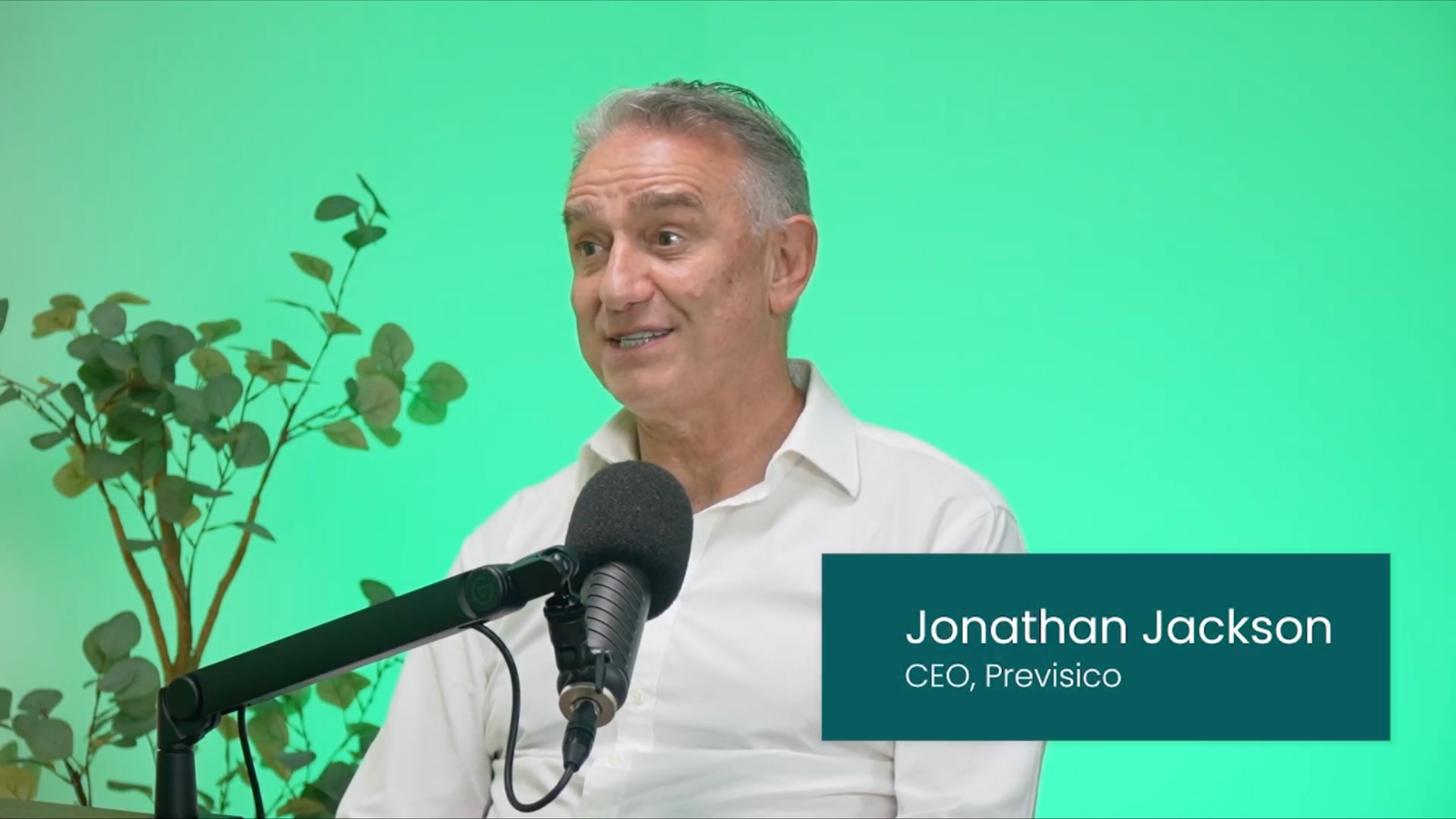
Matt Jaworski: Hello and welcome to the latest episode of Scaling Green Tech. Today I'm joined by Jonathan Jackson, the CEO of Previsico, a company that specialises in flood forecasting with property level flood warnings up to 48 hours in advance. This kind of data fills a critical gap in how governments forecast flood risk and provides data to insurers, large corporates councils and housing associations that allows them to take action before any losses due to flooding occur.
Welcome with me today, Jonathan.
Jonathan Jackson: Thank you very much. Nice to be here.
Matt Jaworski: Let's start with a classic question. How would you describe what your company does to a 5-year-old?
Explaining flood forecasting
Jonathan Jackson: Sure. For a 5-year-old, we are providing a flood warning to keep you safe in the event of a flood. As simple as that.
Matt Jaworski: Okay. Yeah, that works.
And what else would you add if you were explaining it to an adult?
Jonathan Jackson: Is that we are providing that advanced warning. So we are looking every hour at the risk of flood and if your property's at risk of flood, we will give you that advanced warning, and that could be up to 48 hours ahead of the actual flood being predicted.
And consequently we are able to do that at a property level, which enables that homeowner or a business person to have confidence that actually they do have flood risk for their own property and therefore need to take some action to hopefully mitigate any loss.
Matt Jaworski: And how is that different from other similar solutions available on the market?
Jonathan Jackson: Sure. So the Environment Agency does a fantastic job in providing flood warnings for Main River and Coastal Flood, but they have a gap in their system when it comes to surface water flooding. So if you look to find about surface water flooding, you have to use a, basically a weather forecast is the best that there is out there.
And the challenge about our weather forecast is it's very general. So it'll say southeast of England is at risk of flood which it doesn't say
Matt Jaworski: Much.
Jonathan Jackson: Which it doesn't. Exactly. And surface water flooding, which is just very simply the volume of rain falling is greater than the ground's ability to absorb it, is actually the biggest flood risk of all.
So it's getting close to 60% of all flood risk in the UK is from surface water flooding. So it's bigger than both Main River and coastal combined nowadays. And because of a changing climate and urbanisation, that's what's causing the real growth in it too.
Matt Jaworski: I think one of those counterintuitive bits is that when you have dry periods and droughts, it dries the ground, which makes it also more likely to result in flooding.
Jonathan Jackson: Absolutely. Absolutely right. And as you say, as we've just witnessed recently, had some very hot weather and what happens, you get thunderstorms come in and drop lots of rain and because the ground is really hard, that just exacerbates the flood problem. Yeah.
Matt Jaworski: Yeah. And tell us about your background and how you came to lead Previsico.
Jonathan Jackson: I wish I was a very clever flood modeller. Sadly, I'm not. I'm just an entrepreneur by background. Previsico is my first startup business. I started off in the telecoms world. I did a startup in that and then did a couple of businesses moving the offline world online including one called Farming Online, which is the UK's longest running internet B2B business.
Matt Jaworski: No way.
Jonathan Jackson: Yeah. And then I found myself at Loughborough University where they very kindly were looking for me to become the entrepreneur in residence for the Royal Society. And as part of that process, I was very fortunate to meet Dapeng and Avi. So Dapeng is the, the, the chief academic. And Avi was his PhD student.
And they said to me, listen, would you like to come on board and help us spin the business out? I grasped it with both hands and thought what an amazing opportunity. And yeah. The rest is history, as they say.
Matt Jaworski: And how was joining this kind of business different than your previous business experiences?
Launching with the product built
Jonathan Jackson: Yes. It, the spin out side makes it really interesting for me. Other businesses, you start with an idea and then you put everything together and, you try and mock things up and get things going. And then finally maybe after a year or two, you actually have something that actually works.
Yeah. Whereas with, in this instance Dapeng had been working with the UK government because they'd, it'd actually been the government who'd come to the university and met with Dapeng, who's a world leader in flood science. And said to him, can you help us build a product to, to do this?
And so effectively we launched the business with the product built, which I've never, ever done in a startup before.
Matt Jaworski: Yeah. You would think that it's meant to go the other way. You do customer sort of discovery, problem, discovery, validation, and then you build product around those needs rather than build a product
Jonathan Jackson: Absolutely.
Matt Jaworski: To market.
Jonathan Jackson: Absolutely. We had just started with a product, which our first customer was the UK government. So it's amazing.
Matt Jaworski: But isn't it also one of the best case scenarios in a way where you start a business to serve a need from a customer who is already lined up to use it as ready.
Jonathan Jackson: Absolutely. Absolutely right. Yeah it has been great. And then the other thing I guess is that I've never been involved in a science-based business. So we actually are a business which is based around good science. So Dapeng has got close to 6,000 citations on Google Scholar for his work.
He's been developing his model since 2001, and it has a whole range of different publications that published his work and Avi peer reviewed, et cetera. So that also has been really fascinating to work with these incredibly smart people who understand all this science.
And for my part, I can take enough knowledge from that and turn it into hopefully a reasonable commercial conversation and yeah, help, help get the product out to the market.
Working with academic founders
Matt Jaworski: And how are those interactions different from your interactions with your previous teams that were not as academic and central?
Jonathan Jackson: Yeah, with previously because again, been both telecoms and in the and moving the offline world online, those are very much developer teams. So working with developers, and we do have a great team of developers here, but we also have this, this team of scientists flying flood modellers who just makes it very different.
Matt Jaworski: Maybe let's delve deeper into the product and the flood warning gap. What are the different areas of it that your company fills? We touched on it at the beginning, but maybe we can get more in depth on the topic.
Jonathan Jackson: Sure. Yes. So we are as I say, trying to fill that gap in the current government warnings that we have here in the UK.
And typically that's the case globally as well. Governments around the world tend to be providing flood warnings, but only do it for Main River and Coastal. Yes. So for us, we start off with our forecasting model. Which is great. But we also realise that, a forecast is just that it doesn't you, we can't give people a hundred percent guarantee it's going to flood.
We're simply saying there is a risk of flood. Yeah. And we're doing it to your individual property. And the more we work with organisations who have either very high flood risk or have very high value services, for instance, National Grid and Network Rail. Yep. These guys, we recognised that we needed to have something which having helped them prepare for the risk of flood with the forecast, we could then give them a, effectively a, a warning to say, flood water is actually rising the source of flood for this location.
Ah, so you now need to take an action. That action could be evacuate the site, it could be close a production line whatever, but it gives them that very high level of confidence to know that they have to now act
Matt Jaworski: Yeah. So that the disruption in the business is warranted rather than happening more frequently and losing the money.
Correct.
Jonathan Jackson: Yeah, exactly that because it's a very difficult thing if you've, one of the things about a flood warning, as I say is it's not a hundred percent accurate when it comes out of a forecast. And yes, if you're going to take those big decisions, they could cost you a lot of money.
You realise actually the forecast wasn't right. It's quite painful. You
Matt Jaworski: cannot have a forecast that is Yeah. Risk of flooding in the Southwest. Right?
Jonathan Jackson: Correct. Correct. Exactly.
Matt Jaworski: Goes back to your point earlier, but I realised that we've been talking quite a bit about the watch, but we haven't touched much on the how, so how do you actually achieve this result?
Jonathan Jackson: So the, how our service works is the, the forecast itself is based around the flood model, which Dapeng has developed since 2001. Yeah. And a flood model, effectively what it does is it takes in a whole range of different data sources. So it'll look at topography. I how land changes in in, in elevation.
It looks at land cover. Are there buildings there or is there tarmac? Similarly, it'll look at drainage data. because drainage is one of the single biggest problems, particularly with ageing infrastructure. So it takes in a whole range of these. Just a second. Yes. A whole range of different data sources.
And then what's been really clever about what Dapeng’'s done is he's then takes in real time weather data and he processes it through the model. And so we use the weather data to then predict. What the flood pathways that'll be caused by a particular storm as it comes through. So to that example of, the Southwest is at risk of flooding, what Dapeng is doing is he's taking that weather data and then saying, okay, based upon this weather data I'm predicting that these are the flood pathways and these are the properties, therefore, that will be at risk.
And one of the really key insights that Dapeng managed to crack during his research was that every storm is different. So a storm that comes in north to south floods differently than one coming in east to west which is very different to a river flood. So when a river over tops, it effectively goes into a flood plain.
Matt Jaworski: Yeah.
Jonathan Jackson: So that's that, that's why river flooding tends to be an easier prediction than a than when it comes to surface water flooding.
Matt Jaworski: I can imagine. Yeah. Wow. Yeah, that sounds like a quite a bit of unpredictability that you can handle.
Jonathan Jackson: Exactly. And it's a really tough problem, which is why, that there hadn't been any, anything really before until Dapeng came up with his model to enable us to do that.
Matt Jaworski: Amazing. And how is the ageing infrastructure compounding the problem?
Jonathan Jackson: That is a really significant issue. The fact is that the more we build, the more we're putting pressure on existing infrastructure. I live in a rural Lincolnshire. Our local town is Grantham and they have just been building more and more housing estates.
So when the housing estate is built, they put in new pipe work to cater for the fact of that. But at some point it has to interconnect with the old pipe system. And that's where you get pinch points then in the network that come out of that, but in the city like London you've got a situation where, you are building high rise apartments and offices.
And again, you've just got this, this really ageing infrastructure which was designed for a very different population size. And the other key thing is it was also designed on the basis that there was more green space. And the other thing that was designed for was what at the time was considered to be different levels of extreme rainfall.
Extreme rainfall now has changed radically. And as a consequence, that's why systems which were fit for purpose 50 a hundred years ago, just no longer can cope.
Matt Jaworski: So what's the difference with this extreme rainfall definition now and previously?
Jonathan Jackson: It's just the way that we are seeing rainfall is moving from, we are not seeing as many wet days during a year, but when the rain does come, it comes in a much greater intensity.
It's that intensity of rain over a short period of time, which causes the flooding that
Matt Jaworski: yeah. That overwhelms the system.
Jonathan Jackson: Exactly.
Matt Jaworski: And again, less wet days. Yes. It means more dry ground days.
Jonathan Jackson: Yes. Yeah. And again, in a city environment, you've got drainage, which if it was running completely clean, would be able to handle a certain amount of that that rain water.
But unfortunately, lots of rubbish gets thrown down. Drains we all hear about fat bugs and everything else, so there's a lot of things that are restricting the performance of drainage as well, which just exacerbates the problem again.
Matt Jaworski: So with those changes in the rain patterns and broader climate, how did your product have to evolve and with it, how did your messaging marketing, the whole commercial presence have to adjust?
Jonathan Jackson: That's a very big question. You could take a few hours to answer that one. I
Matt Jaworski: guess we have, what, 40 minutes?
Jonathan Jackson: Yes. The I guess the abbreviated answer to that is we've had to do a whole range of things. A big thing about when you are predicting flood is actually looking at the state of what's called antecedent conditions.
In other words, what's been happening in the recent past. So if there's been a continuous amount of rain over a long period of time, that will mean that the ground is therefore already saturated. Yeah. So therefore it's less able to take more water, so therefore it's more liable to flood. But similarly, if the ground has been very dry for a long period of time, then again, there's no way for that water to go and if it was normally draining off through grass, et cetera.
So therefore you then again, exacerbating the flood. So looking at the recent conditions and then producing the forecast as a key thing. Another thing for us, we've developed the ability to look. Back as well as forward. So we run a a forecast, as I say, but actually we also look at the preceding 12 hours and we use what's called radar rainfall, which is actually the amount of rainfall that's fallen.
And then say, based upon the amount of rainfall, we are predicting that this amount of flooding has already happened. So giving people more insight in terms of the state of play on the ground. A key area as well that we've recognised is local knowledge. So the way the model is set up is that we can work with an organisation or a municipality, they can tell us certain things about their particular situation, which will then enable us to modify the model, effectively, customise it to take into account that, that local knowledge.
So an example of that, this is a construction site. So large construction sites are changing topography because they're digging up ground, they're moving things around and everything else. And what they often will do is they'll fly a drone over the construction site to measure the change in topography because it's actually important for them to manage water across the site.
By looking at that, they can send us that drone data, we can put it into our model and therefore update the model to enable us to take into account those local conditions. So that's a, a really key area. And then as I mentioned earlier, the fact that we develop the sensor product as well, so our sensor products.
Works both above and below ground. So it'll go into drains we've put it into basements. We have a a number of cases where we see groundwater is actually the, the actual problem that for a particular location, it's the fact that there's been flood, but then the flood goes into groundwater flooding which makes it hard for anybody.
because you're not actually seeing the water now on top. Yeah. It's actually coming from below.
Matt Jaworski: Yes.
Jonathan Jackson: So therefore, planning, planning about how you manage that. So in those sort of situations, we have clients where they've put in pumps so that they think, okay, when it starts to flood, I'll turn the pump on, it'll pump the water out of the basement.
The challenge is that flooding doesn't tend to work between nine to five. It'll occur at two o'clock on a Sunday morning. So therefore having a sensor in place where we can warn a store manager or a property manager that flooded waters start to happen, you need to come on site and turn on the pump, therefore, starts to address that issue as well.
Yeah, lots of different things that we're doing. And how did you approach the development of your product to have those features? Did you try to launch with all of them from day one, or did you add in modules and layer it on top?
No definitely the, the latter. It is a big area.
And to say Dapeng did an amazing job in coming up with the original model preparing it for the government. And then it's been about constant innovation because flood is a, is an ever evolving piece. And we're learning all the time. The fact that we've got now seven years of live experience gives us a huge advantage because.
We just know so much more about the nature of flood, how it occurs where the model can be improved to help it do an even better job. So yeah it's a constant constant moving feast that we're always looking to innovate and improve.
Matt Jaworski: Yeah. Yeah. And what's been the market response to your solution over those seven years, and how has it evolved?
Jonathan Jackson: Yeah, we've just been delighted about the, the reception that we've received we chose to go to take the service into the insurance market to start off with. And the reason for that is insurers here in the UK, provide insurance for flood to pretty much everybody out there.
And so everybody in the UK pretty much starts off with flood insurance, and that's not the case in other countries. So in the US if I think homeowners, there's less than 5% of homeowners have flood insurance. So if you think about that that's pretty scary. Yeah, absolutely. So there's a, a huge level of under insurance in markets like the US.
Germany also had a very similar sort of situation, but I think they got a little bit better since they had those major floods of some years ago. And so for us, the insurance market has been fantastic. They've been really receptive to what they do. Insurers are really focused around risk prevention.
They're trying to help people avoid a loss. because they know that, if you've had a flood and you get paid out on insurance, that's partial recompense in terms of the actual cost. But the, the impact on your life is huge. If you have to go and live in a hotel now for, for three months whilst they're having to clean up your property because you've had environmental damage from the result that sewage has come up through your toilets and everything else, and the impacted the home, these are all things that, that whilst, money helps, it doesn't fix all problems.
It doesn't fix
Matt Jaworski: time, doesn't make things as nice.
Jonathan Jackson: Exactly. Exactly. And it's, and the insurance industry is really trying to help people out there by by, as I say, really encouraging risk prevention and risk mitigation. And so we fit into that really well. And, we've been delighted to have, the likes of Zurich Liberty and Generali, these, these massive insurers who've, who are out there actively engaging with their clients, encouraging them to use the Previsico service.
And and what we've also seen is that we've been really, delighted about how many clients have been happy to share case studies and give testimonials. Because flood is something which I think a lot of people, unless you've had flood, you just don't think you're going to suffer from flood.
And the fact that these are organisations are saying, this is what can happen. These are the challenges that you have when it comes to flood, and this is how we handle it, and this is how Previsico can really be a part of that solution for you has been wonderful for us.
So we're very blessed with having, as I say, so many great customers who are willing to stand up and say, you need to do this.
Matt Jaworski: I can imagine that it's, yeah, it's one of the key marketing assets you can have. It is as a business at any stage, isn't it?
Jonathan Jackson: Indeed,
Matt Jaworski: we've been actually doing research into the AI search visibility and AI search readiness of website in this space of clima nature data.
We've analysed over a hundred websites in the space, and I think you'll be very pleased to hear that your company is coming right in the top 25%.
Jonathan Jackson: Fantastic.
Matt Jaworski: And a big part of it be is because you have such an amount of substantial content, proof of the solution working in a form of those testimonials and case studies.
And those are exactly the things that, your chat GPTs, Claude and Geminis look for when they're trying to assess whether a company is worth recommending whoever it's relevant to anyone looking for a solution in this space.
Jonathan Jackson: That's great to hear. Thank
Matt Jaworski: you for sharing that. Yeah. That's something you can pass to your marketing team when you meet them as a good compliment.
But going back to what you were also describing about this proof of traction with customers with insurers, you then moved to over 40 UK councils and corporates. So how were those conversations different and how did your messaging, and again, also marketing, have to evolve to match this?
Jonathan Jackson: Yes, municipalities are, a very unique set of customers that, you know, that because they're not just looking at properties that they own, they're responsible for their whole district and all of the the people and and properties within the council area or municipality area.
So for us, they are a really, important part of our sort of work because it again, gives us a really good insight in terms of how these organisations will benefit from our sort of service. So we've really developed the service thinking about that market, thinking about how we can support them better.
So for instance, where with a typical organisation, we'll forecast to their individual property, what we're doing with councils is we break up the council area into different wards or regions so that we can help councils understand which, which part where they need to be thinking about a total area as opposed to an individual property.
We also have a thing called the, the flood adoption score, which will help, it's really helps organisations, particularly councils and housing associations, think about how they're currently managing flood and how they can make the most of the service, so to ensure that they're getting the best possible risk mitigation coming out of it as well.
So yeah, a really interesting sector that we've really benefited from working hugely with. And it's one of these ones where as well, I, I think that we are seeing ongoing benefits from the fact that you now, we work with a utility company, people like National Grid. So when the utility and the the municipality work together, that again, we can start to see real synergies that can come from our work in those areas too.
Matt Jaworski: Yeah. So essentially a council can focus on protecting the areas that are most vulnerable rather than trying to protect the council as a whole, and then they can pull the resources together with a utility or another company to strengthen it further.
Jonathan Jackson: Correct. So f if you're a council and you'll have say, flood defences if a flood's coming, you have to make a decision about where are you going to deploy those defences because you've only got a limited supply of defence.
And so choosing where you put those resources is really key. So a big part of where we can help is in triaging a situation so that a council can then be better prepared to ensure that it's is as effective as it possibly can be.
Matt Jaworski: Okay. Okay. Now maybe let's shift the focus tiny bit away from the tool itself in specifics and back onto your journey, because something that I've been trying to think about is.
What's been your investment journey like, because that's one of the challenges of, all right, early stage startups and scaling startups. How do you raise money? How do you scale your solution? Sure. But now you mentioned that you had actually a pretty unique situation where you were able to build the business with a specific customer who was ready to become a customer as soon as the solution is ready, which should be something that positions you very strongly for fundraising.
Raising as a university spin-out: grants, angels and proof points
Jonathan Jackson: Definitely. And I think again, this is a benefit about being a spin out and. The spin out process from universities. There is support out there, false university spin outs and we benefited from being involved with the scheme, which effectively meant that we were able to apply for Innovate UK funding as a spin out.
So our first bit of funding as we span out of the university was a grant funding from Innovate UK and also Loughborough University, also put some money in as well to support the business. And that was fantastic, but it was very much, really early stage stuff. We're not talking millions of pounds.
Realised that we needed to get a, get an investor round away pretty quickly. So we did a, an angel round with fantastic, a group of business angels called Advantage Business Angels. It's based out of the West Midlands. And you talked earlier about experience of flood.
The reason why I think so many of them invested was because they had flooding experience. They really knew. And so they were willing to back us, which has been fantastic. And then the journey continues. You as a startup, you're all about trying to hit proof points. For us, the key proof points were we're getting that first insurer on board.
And so we were delighted when we, when Zurich signed up. And so we got the first insurer, then we got our second insurer, which was Liberty. So you started to then be able to have something to take to venture capitalists and say, look, you can see this is going to work.
This is the start of something which is going to be really big. And you are selling a vision. You don't have the proof at this stage. You have to help people understand that you've got the early seeds that are starting to grow. And therefore that's the rationale for making the investment because you will see a, a great return from backing us.
And our first major investors is Foresight Group who've been brilliant that, they invested us in 2021 and continue to invest in us. So again, last year they were still investing in us. because they, clearly see that what we're doing is making a real difference and and we're growing the business well.
So yeah, we've had a, a, a fascinating investment journey and with our last investment round, what that we did for the first time, we got in some investors from the us you know, the US is a market which we've gone into. We are doing it in a very structured and careful way.
And it was. Brilliant that we managed to get both Burnt Island Ventures, who's a specialist in water-based investments, and then also Connecticut Innovations investors as well. So yeah, having those first us VCs on board as well is just means that we've got a really, I think, great investor base that we can now build the business on.
Matt Jaworski: And what differences did you see between the approach of UK and US investors?
Differences between UK and US investors
Jonathan Jackson: It's very interesting. I would say that for us, US investors have been lighter touch. They've been they've not had as as challenging a due diligence processes as UK investors. That's partly perhaps reflective of the fact that when you're doing an investment round, if you're doing it at an early stage, there's more risk in you.
So the investor feels they probably have to do more due diligence. It's also a reflection of actually how the, the markets are. So we we've been raising, as I said, since 2021 and there's been times in the market where, people have been able to raise or get a term sheet for a fund within two weeks of starting to talk to venture capitalists.
But probably in the last year or 18 months, it's probably taken, probably more like six months to get that first term sheet for people. So very different. Sort of a ba basis upon where you go out and raise funding in terms of what the market sentiment is a time how the market is looking at investing how you fit in that investment window as well. One of the things that we've been, I think, a real beneficiary of is that we are an InsureTech.
So that's been a, a sort of quite a a hot sector at times, but we're also a climate tech. And again, that's been a hot sector at times. So things like that can really make a difference too.
Matt Jaworski: Yeah, that's something that I also would love to hear more about, which is what's been your experience of how your investors and maybe your customers perceive the climate part of your business, especially across last year and a half when there was a lot of change in the narratives that are preferred by the market and a shift from climate towards things like adaptation and resilience?
Selling climate adaptation
Jonathan Jackson: Yes, and I think it's a really good point because, two years ago, ESG was a big thing. You hardly hear anybody talking about ESG. And when it comes to investors nowadays, where we've been playing, we are, I think fortunate from that perspective of the way politics around, around climate has shifted in as much that we are in the adaptation space.
It was interesting. I was at Climate Week in New York last year, and, the message that I took away was very much that if you are somebody who doesn't really believe in climate change too much, what you do know is that the severity of storms is getting much worse.
And therefore you have to do something about that. I always smile and think to myself. Yeah. People may not want to talk about what's causing it, but they are sure are talking about the effect of it. Yes. And some of the most advanced and innovative states in the US when it comes to flood are actually those right wing states who will say that climate change isn't really a thing.
But they do know that they have to do something about the changing weather. Yeah. Yeah.
Matt Jaworski: They cannot have rivers and walk ground water and flash floods, washing. People’s lives away.
Jonathan Jackson: Exactly that, King Canute didn't do too well when he tried to suggest he could push the waters back.
And it's the same, it's the same whatever your views are around the science of climate change, the fact is you are seeing, the impacts,
Matt Jaworski: It goes to the rest of kind of adaptation focused narratives, which is that people have to eat, people have to drink, people have to be able to survive in their houses.
So you need things that provide power, that provide water, that provide food. And the ways that these can be provided are changing if the landscape around us is changing.
Jonathan Jackson: Yes. And I think that the thing that people are starting to learn more and more is the fact that flooding is not just about property damage.
It impacts in so many different ways. So to your point about food you are seeing farms being wiped out because of flood crops are ruined. But also, logistics. I think there was a thing about when you harvest peas in a field, you need to get them to the the factory to be frozen.
I think within about five hours or something like that.
Matt Jaworski: Oh,
Jonathan Jackson: I probably got that number wrong. But it is within very quickly. Quickly. And therefore if you've got a problem because you actually can't drive through roads because they're flooded all of a sudden that's, again, you've just got, so there's all these things that suddenly organisations seem to realise that actually flood is having a serious impact on them.
And so yeah it's something where I think education is a massive area that we are really trying to focus on working with in the insurance industry to help everybody understand, just how significant flood can be to everybody's lives.
Matt Jaworski: Yeah. Makes sense. I would like to bring us back to the topic of your UK US expansion.
And we touched on the investors, but now how did you find expanding to the US markets from the UK in terms of customers?
Jonathan Jackson: Yeah. We've been very customer driven. So we went to the US because we were asked by a customer to go to the US and we always knew that the US was a huge market for us.
It's the biggest flood market in the world. But similarly, I'm old enough to know and remember lots of companies who tried to set up a US business and failed. And so just because we share a common language does not necessarily mean that you can
Matt Jaworski: Oh, we keep hearing that a lot on this podcast.
Jonathan Jackson: Yes. So we have been cautious. Maybe I've been a bit too cautious but hopefully not. And so we've taken it very gently. We haven't got any employees yet in the US but we're just doing it via our, via customers. We had our first customer, a large insurer who was our first client in the US.
And then since then we've been successful in a thing called the Transit Tech Lab Accelerator, which meant that we ran a, a proof of concept for the MTA who runs the New York subway system and also the Port Authority of New York and New Jersey who run all the airports ports, et cetera and other assets in in those two states.
And delighted that successful POCs with both of them has led to us now doing a year long pilot with the Port Authority. And so that's been really helpful because that's a public again, endorsement about what we're doing. And it's we've been very fortunate about getting all the case studies we have in the UK.
We're now getting these US case studies that gives people confidence that, what we're doing is powerful and delivers results that people are looking for. And I'm delighted to say as well, we've just won Governors Island as well as another project where we're helping them as an island just off Manhattan in New York as well.
So yeah, we're just keeping building that up and our insurers and insurance brokers, people like Marsh McLennan, who's the world's largest broker. They're now pushing us as a partner to their clients. And so we're just looking to build through that, that client relationship.
Matt Jaworski: So it's happy clients bringing you along for the journey.
Jonathan Jackson: Correct. Absolutely. And a big thing that we did last year in taking this same client-focused strategy was we'd launched in the UK, we then did Ireland, and then we went to the US but we only did the northeast of the US to start off with.
And we were thinking, we would grow by country. But then we realised that actually doesn't make sense to our clients if we've got a client. Burger King is one of our clients in here in the UK. If Burger King says to us, Previsico, I need you across all of my sites globally, we couldn't do that.
And so we said we need to change, we need to be able to respond to our clients' needs. And so we've now set the platform up. So with the forecasting service, if Burger King does come to us and say that we can literally set them up globally, all of their locations so that, let's suppose they have sites in, in, in someone like Germany, we would just set up those sites.
We wouldn't set up the whole of Germany. So we can do it very efficiently. Yes. Very low cost. Yes. But deliver what the client wants.
Matt Jaworski: Oh, that is a great lesson. You're not, you're building actually the product that your customers need rather than a product that you think is needed for the market.
Jonathan Jackson: Correct.
Matt Jaworski: And to concur with the market because the path is different.
Jonathan Jackson: Yes, absolutely.
Matt Jaworski: What, did you have any other similar set of learning observations where an assumption that you had about what customers need or what the market needs turned out to be not fully aligned with reality?
Jonathan Jackson: So I think that we thought that very large organisations so FTSE 100 companies, yeah.
International companies would really understand flood risk. They don't there's a real gap with these really large companies and we've actually just published a, a report called the State state of Flood report with two organisations, one called Airmic, the one called InsTech.
And Airmic is effectively a a trade body for risk managers of large organisations. And that report is saying that about 10% of people actually have a flood plan. And these are, as I say, really large organisations. So we've been staggered. That's
Matt Jaworski: unexpected.
Jonathan Jackson: Yeah. Really staggered that about that.
And so that's made us have to redouble our efforts around providing that support to clients, again, holding their hand and saying, look, to get the full advantage of our services, you need to be doing these things. And helping them to go through the adaptation piece. Which a lot of them have been really either unaware of or slow to do.
And often the reason why they've been slow to do it is because they've been reactive. So they'll say, okay, I, this property's just flooded, so I need your service here, please, Previsico, they were saying to them, but you've got another 200 locations, you're going to have flood risk around these. And they go really
Matt Jaworski: Like a survivorship bias.
Trying to reinforce the aeroplanes when there were bullet holes, forgetting that the aeroplanes that got hit most badly during Second World War, they didn't come back to show you their bullet holes. The way that we want them to think about flood is the way that they think about fire. They don't put in fire extinguishers and sprinkler systems.
Jonathan Jackson: After fire has happened, they put it in all of their locations and that's what they need to do with flood because flood is just the same risk flood right now. It costs about twice as much than fire to us. So there's about double the cost when it comes to flood losses as there is to fire.
Matt Jaworski: I see how lack of preparation compounding this
Jonathan Jackson: Yeah. People just, people aren't just not aware about the need to prepare for it, are they, and that they're suffering those losses, whereas there's the, again, insurers in a fantastic job in helping people understand that you need to put in these things to prevent fire, to help you reduce that risk.
Matt Jaworski: and to have a cheaper insurance policy.
Jonathan Jackson: Exactly.
Matt Jaworski: Yeah. Or one in the first place.
Jonathan Jackson: Absolutely. They are the first to motivate through making it adv advantageous to their clients. And they're done it in the same way with, with young drivers in cars. If a young driver puts a black box in, they'll find that they're, they'll be able to insure their car.
If they don't put a black box in, probably they won't be able to get insurance as well. Yeah. So it's this is why we think the insurance industry is important to helping. The country get on top of the flood situation.
Matt Jaworski: So I would like to circle to things to two things that I wrote down, which seem like very interesting commercial challenges that your businesses face.
Marketing a preventative product
So you now mentioned that it turned out that many companies are not aware of the flood risks. So it sounds like you have a big education piece to do with your market. How do you, how have you approached this? How have you built your marketing to assist with this call?
Jonathan Jackson: Yeah yeah multiple ways.
A, a couple that always come to mind is we've gone through this thing about a flood adoption score. So we will, when we onboard a client, we will actually say to them, do you have a flood plan? And if they don't, we'll say here's some flood plans. You need you need to have these flood.
Yeah, exactly. And then, we're talking about do you have flood mitigation measures? And again, talk to them about that, making sure they're aware of it. So the flood adoption school to us is a really key thing. And for us, if you've got a three out three, that's fantastic.
And I think when we started the flood adoption school, it is about out one and a half and I think we're now at about 2.4. So you can really see actually how things are improving on that front, which is great. The other thing we do the as I say, the case studies are really powerful.
I think when organisations see the impact that a flood has had and then also see the impact that putting in adaptation measures such as Previsico can make, that's really compelling. That's really compelling.
Matt Jaworski: Yeah. Especially if you have a story like, oh, we were able to protect this very expensive site from very expensive damage.
Jonathan Jackson: Exactly. Yeah. And to that point, we have this fantastic case study with Balfour Beatty VINCI, huge construction company, who's again, been fantastic at sharing their story about, they were building a bridge over the river Blythe for HS two out there in the West Midlands.
And they had a major flood event. And unfortunately they had a huge multimillion pound loss primarily because they had lots of specialist equipment and materials and the flood waters hit and that was, it washed away. They washed it all away. And replacing that takes a long time. So that means they've had now this whole issue about having to delay the, getting the site built that costs them a significant amount of money.
It's called business interruption loss. So they came to us and, asked us to put the service in which we did. And then literally, about a year later, another major storm came in 36 hours out. We gave our first warnings that there was a risk of flood. So they got their action plan out.
They said, okay, need to get ourselves ready seven hours out. We were still warning of the risks, so they started to move vehicles and materials to higher ground. And then with four hours to go, our sensors went off. Which is that whole thing you've got Yeah. It's And they evacuated the whole site.
Yeah. And they went from a multimillion pound loss to a zero loss.
Matt Jaworski: Incredible
Jonathan Jackson: It, yeah. And exactly. And the more of those stories that we can help people understand of what's possible, just I think is going to be vital to just getting everybody to be more aware of flood and think about how they're going to adapt to flood.
Matt Jaworski: One thing I saw on your website also along those themes is the very detailed pages focused on different sectors. Yes. So one of them was, flood sort of data for car dealerships. Yes. Again, explaining how specifically your solution can help car dealerships making it very relevant to very specific use case.
And you covered, I know, 20 different industries, which also contributed to this really good score on your websites and marketing's GEO AI search readiness. So I'm sure that you also have many other things that you approach, again, in this way to make them hyper-specific to the customers so they can find them relatable and relevant and thus also build their awareness of flood risk and mitigation potential in their space.
Jonathan Jackson: Absolutely. I think the, and we continue to do that, in fact, so our latest case studies, Whitbread with one of their Premiere Inns where we they published the fact that yes, they feel that we've probably saved them over 150,000 pounds on, on that particular location.
So the more we get this out, the more it's everyday brands, like Whitbread Premier Inn that's great. because it that really I think talks to people
Matt Jaworski: so it becomes something that is not just for a massive and avoid a loss. And again, when you thinking about those more vulnerable construction company, something that is for a massive insurer, something that can be accessible for more of a local business.
Jonathan Jackson: Absolutely, yes. And for us, we have housing associations again, who've been fantastic at giving us some really great case studies. Ratcliffe Housing Association, a small housing association, I think less than 500 properties that they have and they were pointing out how a flood caused very significant damage for over 30 properties that they had.
And again, through using the service, they were able to take preventive action people who are living in social housing and the impacts it can have, again, it just helps everybody again, appreciate that flood is something which affects everybody.
It doesn't matter who you are where you live, everybody is, has got a a risk of flood. Everybody
Matt Jaworski: is equal in a way.
Jonathan Jackson: Exactly. It is the floods, yes.
Matt Jaworski: Damage.
Jonathan Jackson: Absolutely. Absolutely.
Matt Jaworski: So very sadly, our time is coming to an end in the studio. So what I would like to know now is what's next for you and Previsico?
Building a commercially driven business with a social mission
Jonathan Jackson: For Previsico it's about us continuing to educate and help people and organisations around the world mitigate flood. We've had a mission since the day we started, which is to help people as well as organisations. So part of our ethos in the business is to be commercially successful which will enable us to help more people around the world. And we started off, so here in the UK one of the things we did at Early Doors on that front was we helped a community up in Lancashire place called Whalley who'd had a massive flood hit 300 properties in, in the community.
They now have our service and have managed to avoid flooding on I think over 10 occasions. And then another community down in Cornwall or called Perranwell. And again, we provide these service-free of charge to both of these communities. We just wanted to do it to just help give a sense to people within the business that we are not just about making money, we're actually about doing some good as well.
We need to make and-ing
Matt Jaworski: actual people from an actual kind of disruption in their life, not a big company from what was it, operational loss that you said?
Jonathan Jackson: Oh, yes. The multimillion pound operational loss. Yeah. Yes, exactly. Exactly. Yeah. And it's, and but the thing is that we are not going to shy away from the fact that we are commercially driven.
Matt Jaworski: Yes,
Jonathan Jackson: We are absolutely about making a profit because we are, we know that the more profitable we can become, the more good that we can do.
Matt Jaworski: And that's the kind of money that drives the profit, drives everyone's salaries, makes investors interested. Exactly, yes. Investing in a universal place.
Jonathan Jackson: Yes. These investors are putting money into us so we can help people.
Matt Jaworski: Yeah, exactly. And do you have any notices, shout downs or announcements for our audience before we finish? It can even be something related to how to reduce the risk of flooding in your personal house.
Jonathan Jackson: Yeah. A really simple thing as a recommendation that if you think about flood, as I say, as something that you think is never going to affect me, you probably think about fire in the same way.
But if you put a smoke alarm in your home, put a thing called a non-return valve in your toilet downstairs, because if you put that in, that's probably going to, potentially in the event of a flood happening in your property, mean that you can get back into your property a heck of a lot faster than if you didn't have it in.
Because the biggest problem with a residential property being flooded is sewage. And you're not able to go back into your home often for months because of the fact that it's an environmental hazard. And so that non-return valve will stop that sewage coming out through your toilet and hopefully give you the peace of mind that if a flood did happen, at least you better get back into your home that much faster.
Matt Jaworski: Yeah. Very practical advice. Thank you very much. And to all of you who listen to this episode, thank you for joining us today. And if you'd like to learn more about the topic of climate adaptation and also opportunities for building climate solutions in this space, definitely take a look at our previous episodes with Simon Zadek, the managing partner at the Fund, Morphosis, and an episode with Darren Clifford from Adapt [us] Capital Fund where we also talk about those themes and what investors are looking for in adaptation solutions.
Until next time, thank you very much.
















.jpeg)

.avif)